
![Aston Villa Vs Nottingham Forest [4–0] – UEFA Europa League Semi-Final Second Leg 2025/2026 – Tactical Analysis](https://cdn.mymidnight.blog/77f959f119f4fb2321e9ce801e2f5163/size/w1000/2026/05/Aston-Villa-Vs-Nottingham-Forest-20252026.png)
Aston Villa Vs Nottingham Forest [4–0] – UEFA Europa League Semi-Final Second Leg 2025/2026 – Tactical Analysis

Aston Villa met Nottingham Forest for the second leg of the UEFA Europa League semi-finals after the first encounter finished with a slight 1-0 advantage for the Garibaldis.
This decisive second leg, however, saw the Villans make a powerful comeback, scoring four goals to nil thanks to Unai Emery tactics and experience in the final phases of the UEFA Europa League, as well as the excellent performance of his players.
On the other side, Vítor Pereira’s men failed to protect their lead.
They were unable to resist Aston Villa’s recurring dangerous attacks, while also missing a few dangerous opportunities that could have helped them defend with more ease if scored.
Aston Villa’s qualification means that they will play the long-awaited final against SC Freiburg, the winner of the other semi-final, at the Beşiktaş Stadium in Turkey.
In this tactical analysis article, we explore Aston Villa’s attacking solutions, their reliance on the wing and half-space, as well as their efficient exploitation of Nottingham Forest’s defensive errors and the impacts of formation switches.
Aston Villa Vs Nottingham Forest Lineups & Formations
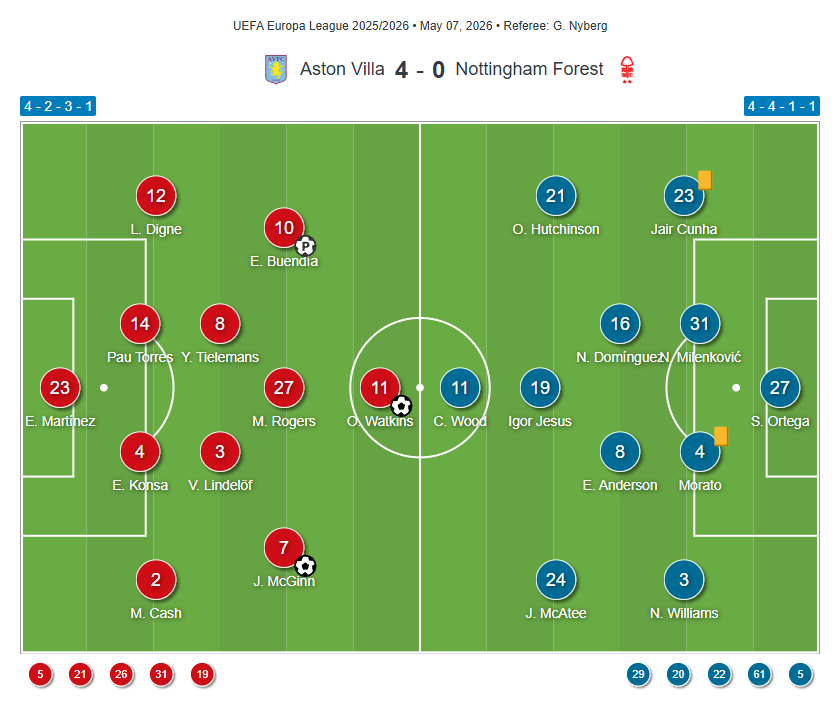
Aston Villa Lineup Vs Nottingham Forest
Emery started the match in a 4-2-3-1 formation, with Emiliano Martínez in goal, and a defensive line of Ezri Konsa and Pau Torres as centre-backs, Matty Cash at right-back, and Lucas Digne at left-back.
The midfield duo consisted of Victor Lindelöf and Youri Tielemans as central midfielders, while John McGinn and Emiliano Buendía were the two wingers, and Morgan Rogers played as an advanced playmaker/second striker behind the striker, Ollie Watkins.
Nottingham Forest Lineup Vs Aston Villa
On the other hand, Pereira relied on a 4-4-1-1 formation with Stefan Ortega in goal and a back four of Nikola Milenković and Morato as centre-backs, Jair Cunha as a right-back, and Neco Williams as a left-back.
Their midfield line was composed of Nicolás Domínguez and Elliot Anderson as central midfielders, and both Omari Hutchinson plus James McAtee as wingers.
Up front, Igor Jesus supported the striker Chris Wood by playing just behind him and sometimes alongside him as a second striker.
Aston Villa Attacking Solutions Vs Nottingham Forest Defensive Weaknesses
Aston Villa started the match with great intensity and willingness to press high on Nottingham Forest’s defence, win their duels and force their opponents to defend.
Nottingham Forest’s approach was very cautious too, as they knew that they had to protect their first-leg lead.
However, Nottingham Forest’s very defensive approach cost them dearly in the end, as it prevented them from threatening Aston Villa and allowed their opponent to disrupt the team’s defensive line repeatedly.
The continuous conceded attacks and opportunities eventually tired Nottingham Forest's defensive lines, making it difficult for them to withstand numerous attempts and resist all of the attacks.
This leads to the argument that Nottingham Forest’s general approach and plan for the match were not as ambitious as needed, and it penalised the team in the long run despite having started the match with a one-goal advantage.
In fact, Nottingham Forest had the tools to attack more and disturb Aston Villa further, while at least resting their defensive players for some moments.
However, they preferred to focus on countering Aston Villa’s attempts with their two lines of defence at the expense of advancing and attacking.
The opening period of the match was a bit encouraging for Nottingham Forest, as they were able to play in a balanced way, preventing Aston Villa from dominating and creating some threat, mainly from the wings.
Nottingham Forest could have built on their few chances to gain more confidence, disturb Aston Villa further, and, why not, score.
However, they preferred to attack only occasionally, with the main objective of wasting time rather than seriously trying to score.
Nottingham Forest Dangerous Yet Suspended Attacking Job
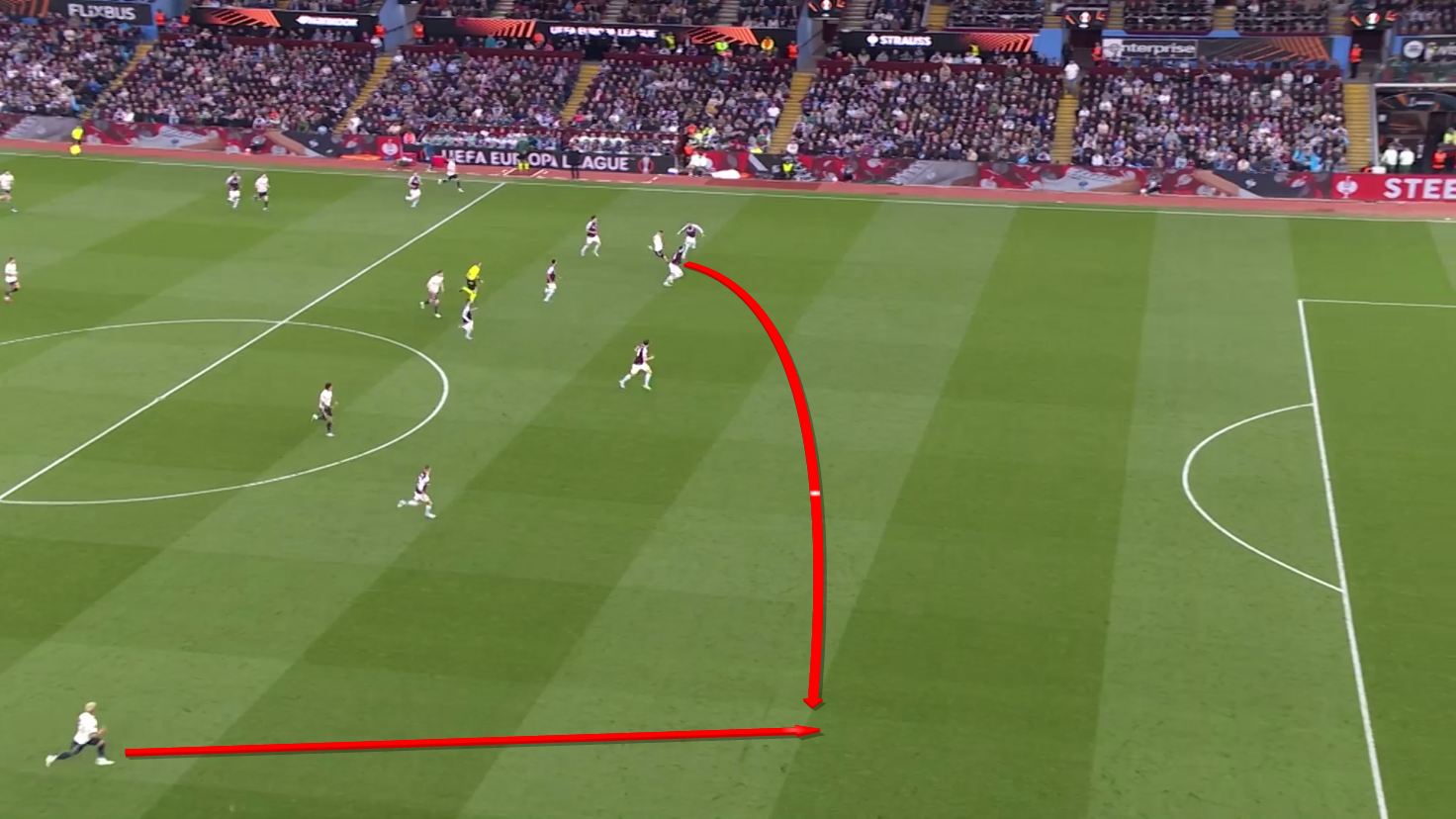
One of the most dangerous Nottingham Forest actions of the match occurred in the eighth minute of the first half and could have been better exploited to put Aston Villa in trouble.
The action saw Nottingham Forest advance thanks to Anderson’s ball protection and resistance of his direct marker’s interception attempts, before serving McAtee with a vertical pass.
McAtee’s ability to quickly spot Hutchinson advancing from the right wing and the possibility of providing a through pass in his running direction was remarkable. That decision made this attack very dangerous.
McAtee’s switch of play to Hutchinson at the right time, while being surrounded by more than two players, allowed Hutchinson to find himself in a 1v1 situation against his direct marker while having a lot of space and time for dribbling and shooting.
However, Hutchinson failed to find the net despite having dribbled past his opponent and opted for a well-executed curved shot.
Missing this dangerous opportunity was a serious issue for Nottingham Forest, as it gave Aston Villa more motivation to attack with greater intensity.
At the same time, Nottingham Forest failed to reproduce other dangerous attacks, as they were unable to find the necessary spaces or repeat line-breaking passes.
Aston Villa Reliance On Wingers & Penetrations From The Half-Spaces
Aston Villa’s attacking solutions were based mainly on both McGinn and Buendía’s wing penetrations, crosses, and ability to advance from half-spaces on many occasions.
McGinn was relied upon for advancing from the right wing and crossing as often as possible, creating confusion within Nottingham Forest’s defensive line inside the box.
On the other side, Buendía’s cutting inside and advancing while occupying the half-spaces were very useful for finding attacking solutions, especially with the help of the two strikers, who usually leaned towards the wings to help with playmaking whenever they noticed their teammates not opting for crosses towards the box.
Furthermore, Aston Villa relied on long passing towards the box a lot, with Watkins and Rogers winning many of the aerial duels and providing passes to the players coming from behind.
Even when the strikers failed to win the aerial duels on some occasions, Aston Villa kept pressing high on Nottingham Forest’s defence, and their pressing was often rewarding.
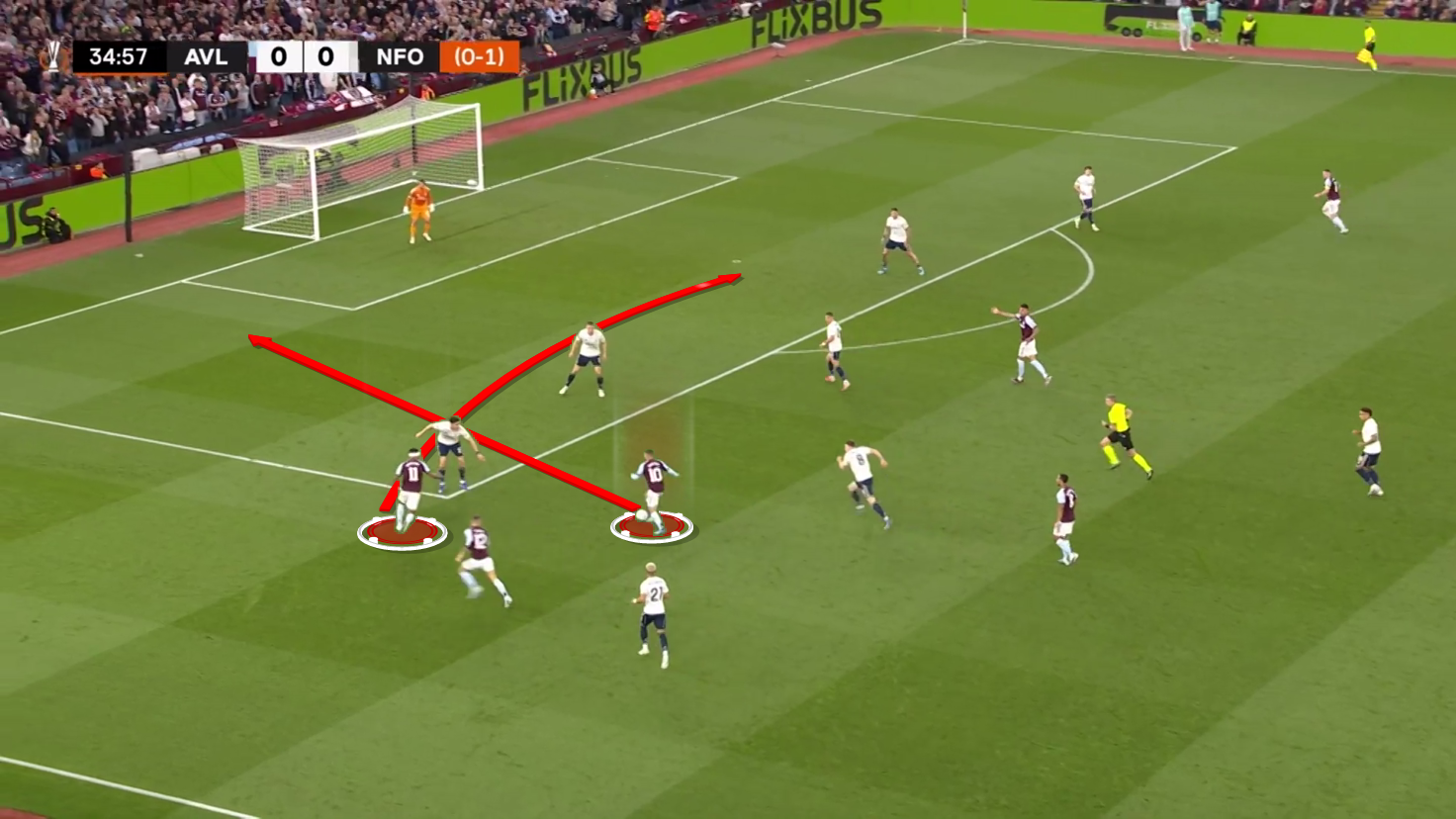
In the first goal action, it all started with a long pass towards Watkins that was intercepted and cleared away.
Still, Tielemans turned that clearance into a vertical pass thanks to his header.
With the help of Rogers and Watkins, who leaned towards the left wing to support the action, Buendía found himself in a suitable position for dribbling and crossing.
He was excellent at dribbling past two opponents in a very creative way, eliminating both players and penetrating the left side of the box before providing an assist to Watkins, who soon repositioned himself inside the box as Buendía dribbled and advanced.
The creative movements without the ball from Watkins first to help in the playmaking process and then to quickly reposition himself inside the box before escaping from his marker when Buendía was about to provide the pass was crucial in making this action successful.

![Scotland Vs Switzerland [0-3] UEFA Nations League 2026/2027: How Aggressive Pressing Backfired & Murat Yakin Took Advantage - Tactical Analysis](https://cdn.mymidnight.blog/77f959f119f4fb2321e9ce801e2f5163/size/w600/2026/10/Scotland-Vs-Switzerland-20262027---Tactical-Analysis.png)
![Olympique De Marseille Vs PSG [1-2] Ligue 1 2026/2027: How Bruno Génésio Transitions Troubled PSG - Tactical Analysis](https://cdn.mymidnight.blog/77f959f119f4fb2321e9ce801e2f5163/size/w600/2026/09/Marseille-Vs-PSG-2026_2027---Tactical-Analysis.png)
![Fulham Vs Manchester United [1-1] Premier League 2026/2027: How Álvaro Arbeloa Tactics Exposed The Red Devils' Problems - Tactical Analysis](https://cdn.mymidnight.blog/77f959f119f4fb2321e9ce801e2f5163/size/w600/2026/09/Fulham-FC-Vs-Man-United-2026_2027---Tactical-Analysis.png)
![AS Roma Vs Inter Milan [2-2] Serie A 2026/2027: When Undefeated Giallorossi Attack Met Nerazzurri Comeback Resilience - Tactical Analysis](https://cdn.mymidnight.blog/77f959f119f4fb2321e9ce801e2f5163/size/w600/2026/09/AS-Roma-Vs-Inter-Milan-2026_2027---Tactical-Analysis.png)
![Real Sociedad Vs Bournemouth [1-2] Europa League 2026/2027: How Do Marco Rose Pressing Tactics Work? - Tactical Analysis](https://cdn.mymidnight.blog/77f959f119f4fb2321e9ce801e2f5163/size/w600/2026/09/Real-Sociedad-Vs-Bournemouth-20262027---Tactical-Analysis-1.png)
![AC Milan Vs Benfica [0-2] Europa League 2026/2027: How Marco Silva Tactics Exposed Rúben Amorim Defensive Problems - Tactical Analysis](https://cdn.mymidnight.blog/77f959f119f4fb2321e9ce801e2f5163/size/w600/2026/09/AC-Milan-Vs-Benfica-20262027---Tactical-Analysis.png)
![Sunderland Vs AZ Alkmaar [1-0] Europa League 2026/2027: Why The Black Cats Make Better Underdogs - Tactical Analysis](https://cdn.mymidnight.blog/77f959f119f4fb2321e9ce801e2f5163/size/w600/2026/09/Sunderland-Vs-AZ-Alkmaar-20262027---Tactical-Analysis.png)