Como’s 2025/2026 Serie A season under Cesc Fàbregas has quietly evolved into one of the most compelling tactical projects in Italy.
After promotion and a transitional first year, this campaign represents a clear step forward in identity, structure, and performance.
Fàbregas has imposed a game model built on controlled possession, aggressive counterpressing, and intelligent occupation of space, allowing Como 1907 to compete consistently against more established Serie A sides.
Statistically, they rank among the league’s strongest teams for ball retention, progressive circulation, and pressing intensity, reflecting a side comfortable dictating tempo rather than merely reacting.
However, their data also reveal natural limitations in chance creation and, in the final third, highlight the gap that still exists between Como and the league’s elite.
This season, therefore, offers a valuable case study, a developing team using modern positional principles and high-intensity behaviours to punch above their weight, while still navigating the challenges of sustainability, depth, and attacking output at the top level.
In this Como FC data analysis, we examine Como’s pressing intensity and defensive structure, analyse possession control and space exploitation, compare their metrics with Serie A peers, assess attacking transitions and final-third efficiency, and evaluate their current performance level, limitations, and potential competitive ceiling this season.
Points On The Board Vs Process On The Pitch: How Como Results Mirror Their Tactical Reality
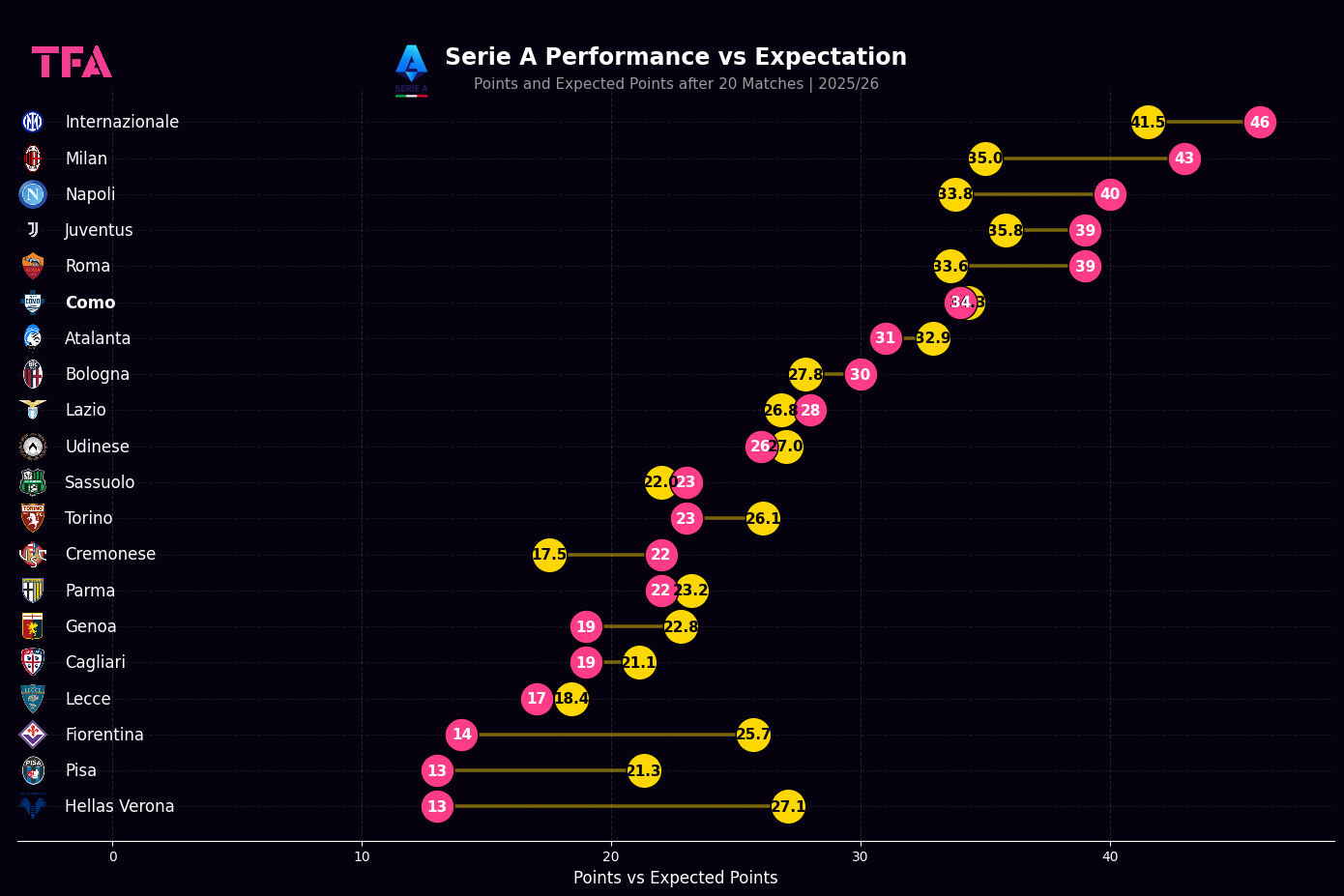
After 20 Serie A matches in 2025/2026, Como sits on 34 points, a return that almost perfectly aligns with their expected points total of 34.3.
Serie A Points Vs Expected Points After 20 Matches 2025/2026
This near-identical relationship between outcomes and underlying performance is tactically significant.
Unlike several sides that either overperform through finishing variance or underperform due to inefficiency, Como’s league position is a faithful reflection of their structural level.
Fàbregas’ side have won nine matches, drawn seven and lost only four, placing them firmly in the European conversation and ahead of more established clubs such as Atalanta, Bologna and Lazio.
This balance between points and expected points suggests a team driven by process rather than randomness.
Como FC’s goal difference (28 scored, 16 conceded) underlines a controlled, low-volatility profile built on territorial dominance, compact rest-defence and measured attacking progression.
Their ability to restrict chances while consistently generating moderate-quality opportunities explains why their results neither spike nor collapse relative to expectation.
Tactically, this speaks to the effectiveness of their positional structure in possession and the reliability of their counter-press out of possession, limiting opponent transitions and shot quality.
In contrast to teams like Fiorentina or Hellas Verona, whose expected points far exceed their actual return, Como shows minimal performance distortion.
This indicates tactical clarity, emotional control, and repeatable behaviours, hallmarks of a well-coached side.
Territorial Control Through Possession & Space: How Como Dominate Games With And Without The Ball
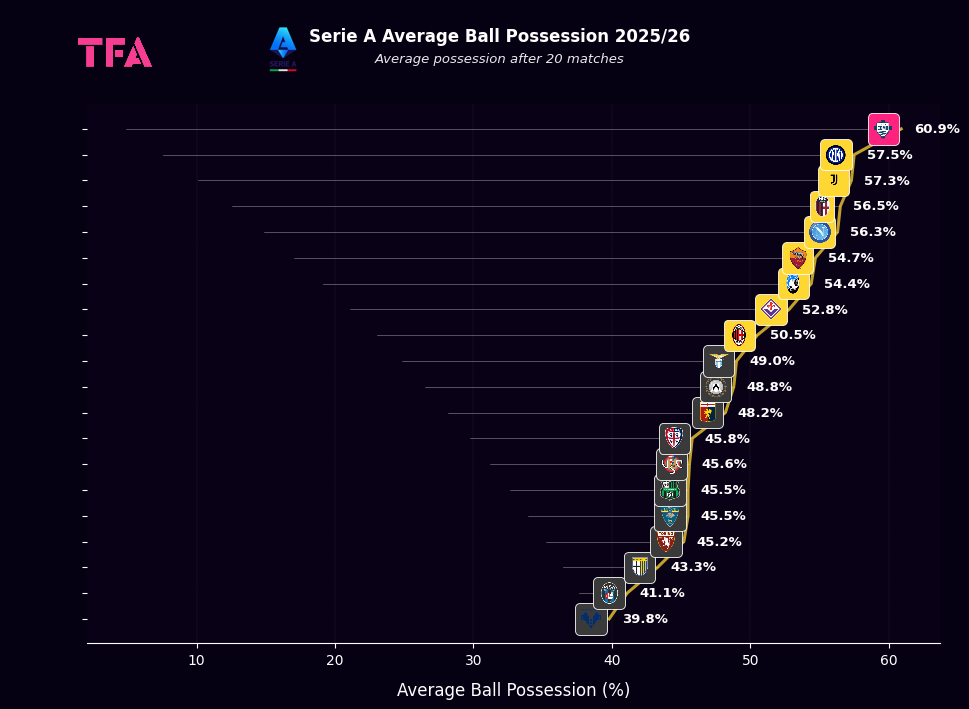
With an average ball possession of 60.9%, Como ranks as the most possession-dominant side in Serie A 2025/2026, outperforming traditional heavyweights such as Inter Milan, Juventus and Napoli.
Serie A Average Ball Possession After 20 Matches 2025/2026
This figure is not a matter of cosmetic dominance but a direct consequence of Cesc Fàbregas positional framework.
Como’s circulation is patient, layered, and deliberately risk-managed, designed to stabilise matches and dictate the rhythm rather than unnecessarily accelerate play.
Their high possession share reflects prolonged phases of structured build-up, repeated recycling across the back line and midfield, and a strong capacity to resist pressure through spacing rather than individual dribbling.
Tactically, this level of control reduces game volatility: opponents are forced to defend for long stretches, limiting transition opportunities and lowering shot volumes against Como.
Unlike teams that dominate possession primarily in advanced zones, Como’s control often begins deep, allowing them to reset shape, lure pressure, and manipulate opposition blocks before progressing.
The data confirms a side that uses possession as a defensive mechanism as much as an attacking one, explaining their strong points return relative to expected metrics and their low concession rate.
Space Occupation & Structural Patience In Build-Up
Como’s spatial dominance during possession is equally revealing.
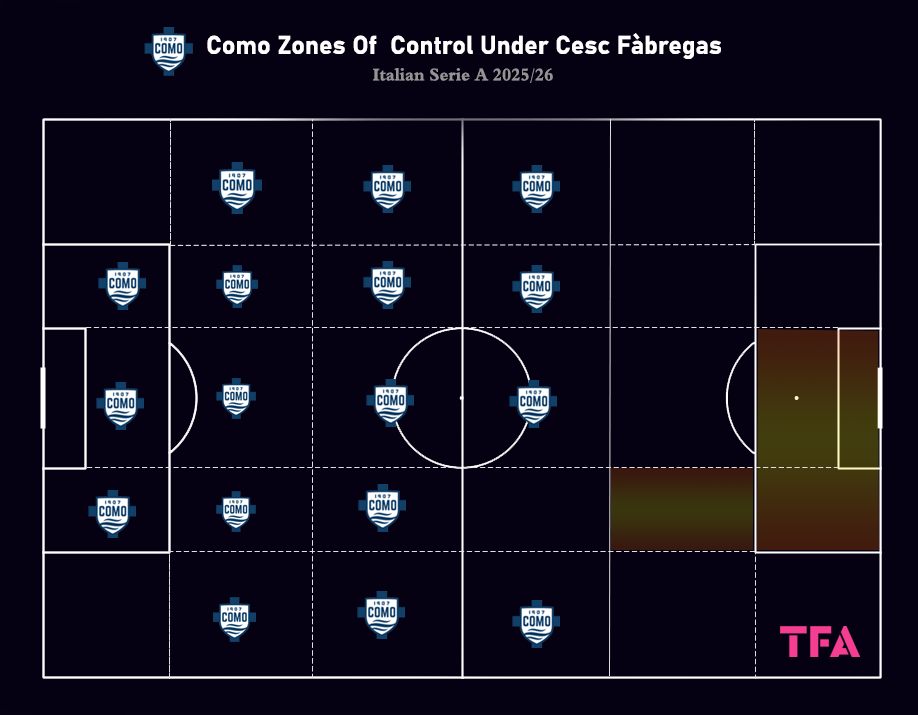
As illustrated by their zones of control map, they prioritise central and lower-middle thirds, favouring conservative occupation over reckless territorial gain.
Como Zones Of Control Under Cesc Fàbregas Tactics
In the first phase, centre-backs Marc Oliver Kempf and Diego Carlos regularly drift into the half-spaces, widening the base and stretching the first pressing line horizontally.
This is reinforced by full-backs Ignace Van der Brempt and Alberto Moreno holding extremely high and wide positions, not to attack immediately, but to pin opposition wide players and prevent central compression.
The most important spatial mechanism, however, lies in midfield behaviour.
Máximo Perrone, Lucas Da Cunha, and Mërgim Vojvoda frequently align on a flat horizontal line ahead of the centre-backs, deliberately attracting pressure from the opposition midfield.
This coordinated drop vacates the space between the lines, which Como then attacks directly with vertical passes once the block is destabilised.
Como don’t chase territory for its own sake; instead, they patiently shape the pitch until progression becomes structurally inevitable.
Pressing Intensity & Collective Discipline: Como PPDA Superiority In 2025/2026
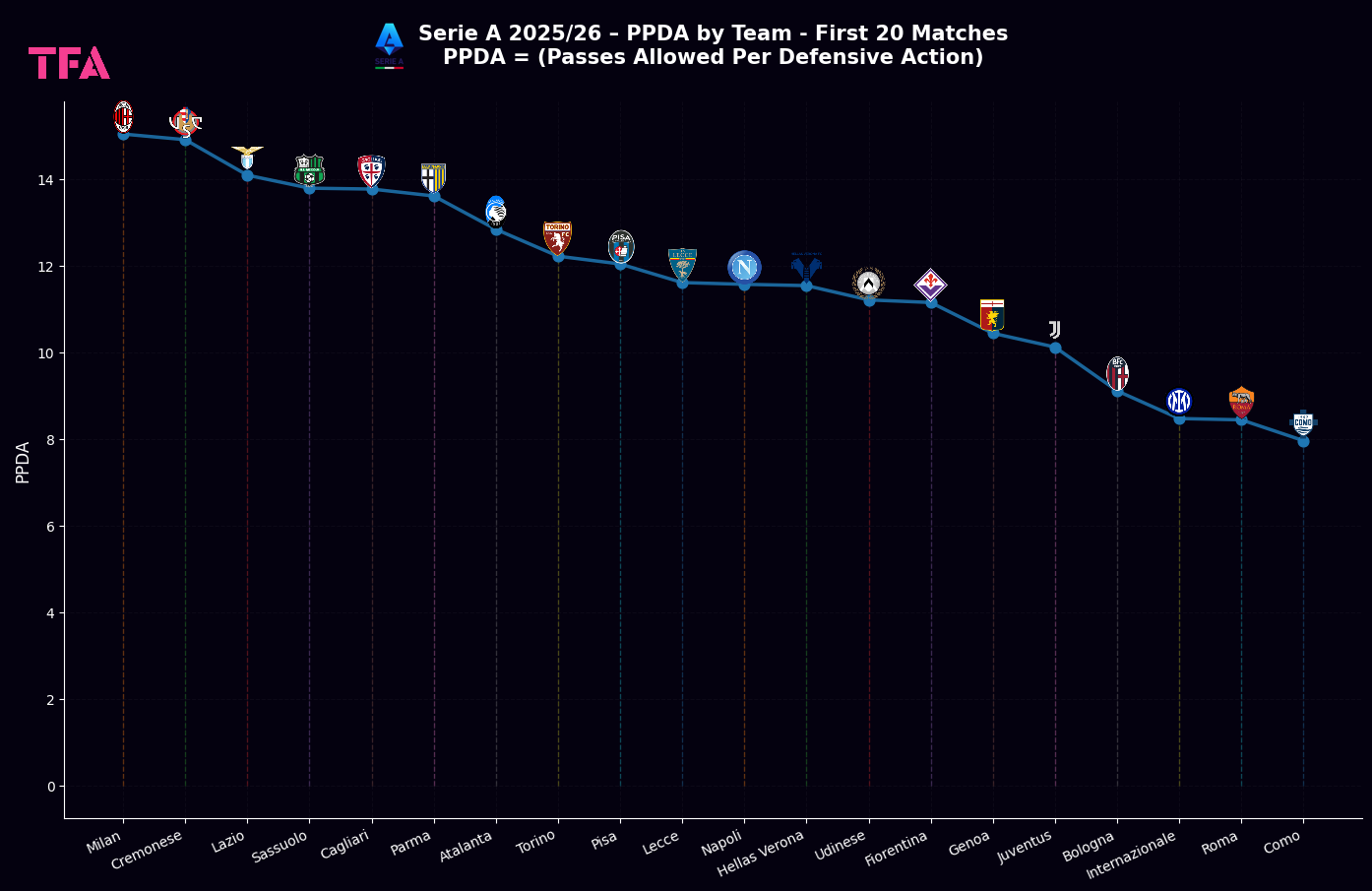
One of the clearest data-backed indicators of Como’s tactical evolution under Cesc Fàbregas is their league-leading PPDA of 7.96 after 20 Serie A matches, the lowest figure in the division.
This places Como ahead of traditional pressing sides such as Inter, AS Roma, and Bologna, and marks them as the most aggressive team in Italy in terms of limiting opposition passes per defensive action.
Serie A 2025/2026 PPDA First 20 Matches
This pressing intensity is not chaotic or purely volume-based.
Instead, it reflects a highly structured and situational approach rooted in spatial control and collective timing.
Como primarily operates from a compact mid-block, choosing moments to accelerate pressure rather than sustaining constant high pressing.
When the ball is forced wide, the ball-near winger steps out aggressively, supported closely by the full-back behind him, creating a controlled 2-v-1 pressing trap on the flank.
Inside, Máximo Perrone and Lucas Da Cunha remain disciplined, protecting central lanes and preventing quick wall passes through midfield.
This restraint is key to Como’s low PPDA: pressure is applied forward and wide, not recklessly inside.
Behind the press, centre-backs Marc Oliver Kempf and Diego Carlos hold a slightly staggered line, ready to step in if a forward drops between the lines, while still maintaining cover depth.
These coordinated behaviours allow Como to recover second balls efficiently and launch short, controlled transitions without losing defensive balance.
Como’s Challenge Intensity Leadership (2025/2026): Duels, Tackles & Interceptions Per Minute Of Opponent Possession
In addition to dominating possession and pressing metrics, Como also leads Serie A in challenge intensity, a combined measure of duels, tackles, interceptions and defensive challenges per minute of opponent possession.
This metric quantifies how actively a team attempts to recover the ball when the opposition has possession.
A higher challenge intensity indicates frequent defensive engagements and proactive disruption, closely linked to pressing effectiveness.




![FC Porto Vs Nottingham Forest [1–1] – UEFA Europa League 2025/2026: Porto Dominate, Forest Stay Alive – Tactical Analysis](https://cdn.mymidnight.blog/77f959f119f4fb2321e9ce801e2f5163/size/w600/2026/04/FC-Porto-VS-Nttm-Forest-20252026.png)
![Barcelona Vs Atlético Madrid [0–2] – Champions League 2025/2026: Atlético’s Defensive Control & Clinical Edge – Tactical Analysis](https://cdn.mymidnight.blog/77f959f119f4fb2321e9ce801e2f5163/size/w600/2026/04/Barcelona-vs-Atletico.png)
![PSG Vs Liverpool [2–0] – Champions League 2025/2026: Luis Enrique Rotations Dismantle Liverpool – Tactical Analysis](https://cdn.mymidnight.blog/77f959f119f4fb2321e9ce801e2f5163/size/w600/2026/04/PSG.-VS-LIVERPOOL.png)


