
![Barcelona Vs Atlético Madrid [0–2] – Champions League 2025/2026: Atlético’s Defensive Control & Clinical Edge – Tactical Analysis](https://cdn.mymidnight.blog/77f959f119f4fb2321e9ce801e2f5163/size/w1000/2026/04/Barcelona-VS-Atl--tico-Madrid-2025_2026.png)
Barcelona Vs Atlético Madrid [0–2] – Champions League 2025/2026: Atlético’s Defensive Control & Clinical Edge – Tactical Analysis

Barcelona hosted Atlético Madrid at the Camp Nou for the fourth time in just two months in the UEFA Champions League quarter-final first leg.
However, the stakes are even higher now, as both teams are competing for a ticket to the UEFA Champions League semi-finals.
The match ended with a 0-2 win for Atlético Madrid, which complicates things for Barcelona and obliges them to try to mount a comeback in the Riyadh Air Metropolitano.
Barcelona created several opportunities but failed to convert them into goals, while committing defensive errors that made things easier for Atlético Madrid.
This cost them a loss at their own stadium and reduced their chances of qualification, at the expense of an Atlético Madrid side showing they have been progressing since the start of the season.
This season, Atlético have shown they are still good in defence and have also developed a powerful attacking system, making the team more balanced and even more difficult to beat.
In this Barcelona vs Atlético tactical analysis, we identify why Barca failed to score and how Atlético Madrid resisted their attacks and exploited Barcelona’s defensive weaknesses.
Barcelona Vs Atlético Madrid Lineups & Formations
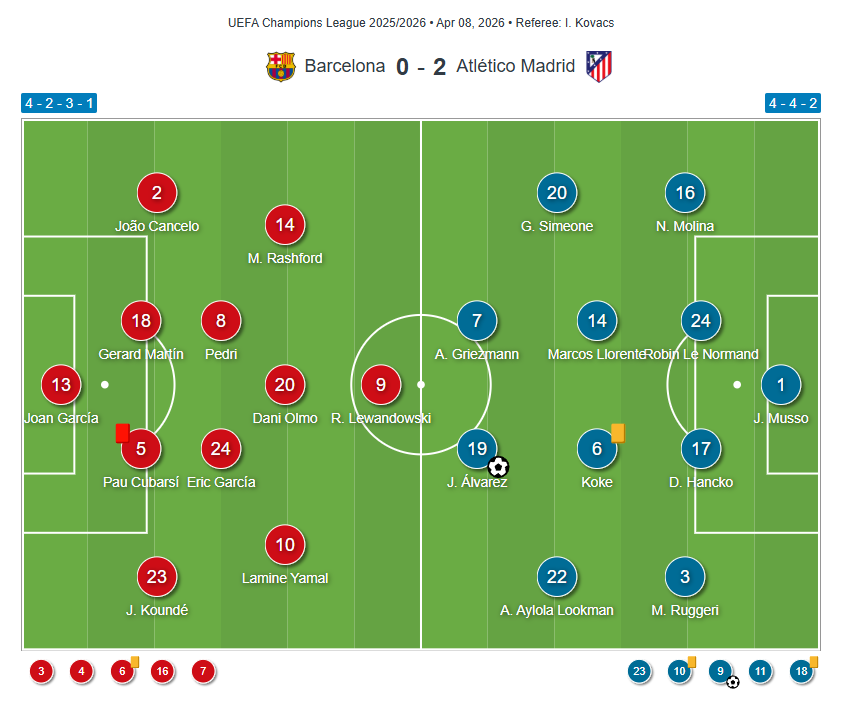
Hansi Flick opted for the 4-2-3-1 formation in this match, with Joan García in goal, a back four of Pau Cubarsí and Gerard Martin as centre-backs, and both Jules Koundé and João Cancelo as full-backs.
The midfield was made up of Pedri and Eric García as central midfielders, with Dani Olmo being the advanced playmaker.
In attack, Barcelona deployed Marcus Rashford and Lamine Yamal as wingers and Robert Lewandowski as the team’s main striker.
Diego Simeone started with a 4-4-2 formation, with Juan Musso starting between the sticks.
Los Rojiblancos’s back four were Robin Le Normand and Dávid Hancko as centre-backs, with Nahuel Molina and Matteo Ruggeri as right and left full-backs.
Both Koke and Marcos Llorente played as central midfielders, while Giuliano Simeone was Atlético Madrid’s right winger, and Ademola Lookman on the left wing.
In the attack, the team relied on Julián Álvarez and Antoine Griezmann as the attacking duo.
Barcelona Finishing Issues Vs Atlético Madrid Patient Resistance & Intelligent Exploitation Of Defensive Weaknesses
Barcelona started the match with their usual attacking approach, relying mainly on high pressing to disrupt Atlético Madrid’s build-up from the back and make high recoveries.
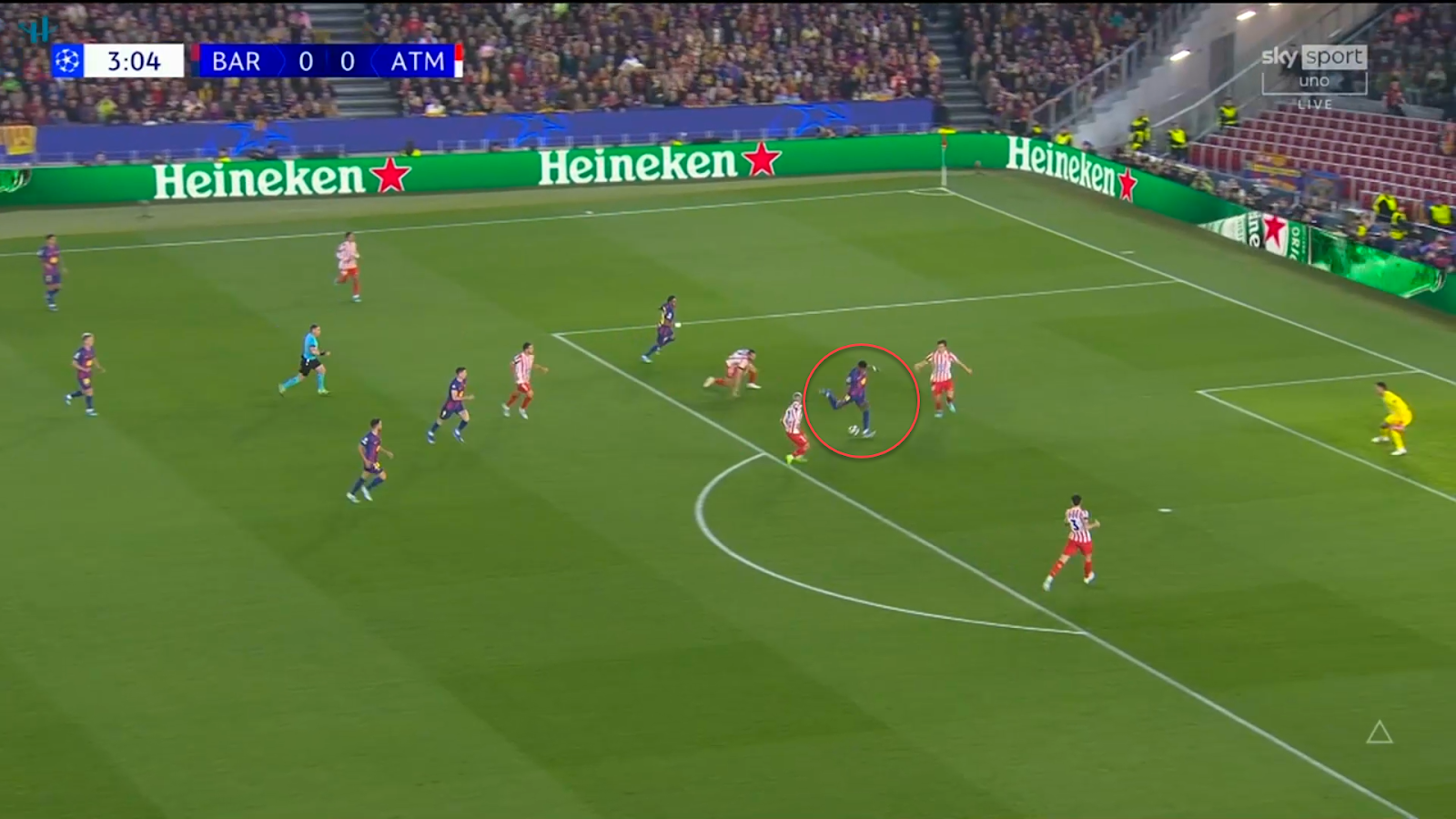
They were quickly successful in doing so thanks to their intense, tight marking, which led Atlético Madrid’s players to make a wrong pass, enabling Yamal to intercept it and pass to Rashford.
Rashford’s finishing was disappointing despite receiving the ball in a perfect goalscoring position, having had time to coordinate his body well enough and shoot at a more acute angle.
Instead, Rashford’s shot was not that powerful, not high, and went towards the middle, allowing Musso to save it without a lot of effort.
Missing this crucial goalscoring opportunity is something Barcelona will most likely regret, especially in the second leg, as it made their mission more complicated and prevented them from getting the early advantage that would have obliged Atlético Madrid to advance more frequently and left space at the back.
That would have been the perfect scenario for Barcelona’s players, who love to play against teams that leave space at the back, since their strategy and players’ characteristics make them extremely dangerous in such situations.
Atlético Madrid Approach & Defensive Plan
Atlético Madrid risked conceding an early goal mainly because they chose to build from the back, remain patient, and focus on short passing and advancing from the wings to reach Barcelona’s third, rather than opting for safer solutions like long passes.
Although this could have cost them an early goal, it soon helped them respond to Barcelona’s attacks by relying on Griezmann’s unorthodox positioning and his retreating to receive the ball in midfield, contributing extensively to playmaking before joining the box when needed.
This allowed Álvarez, Lookman, and Simeone to move more freely and have more chances to receive passes, since Griezmann served as the link between the central midfielders/full-backs and the attacking players.
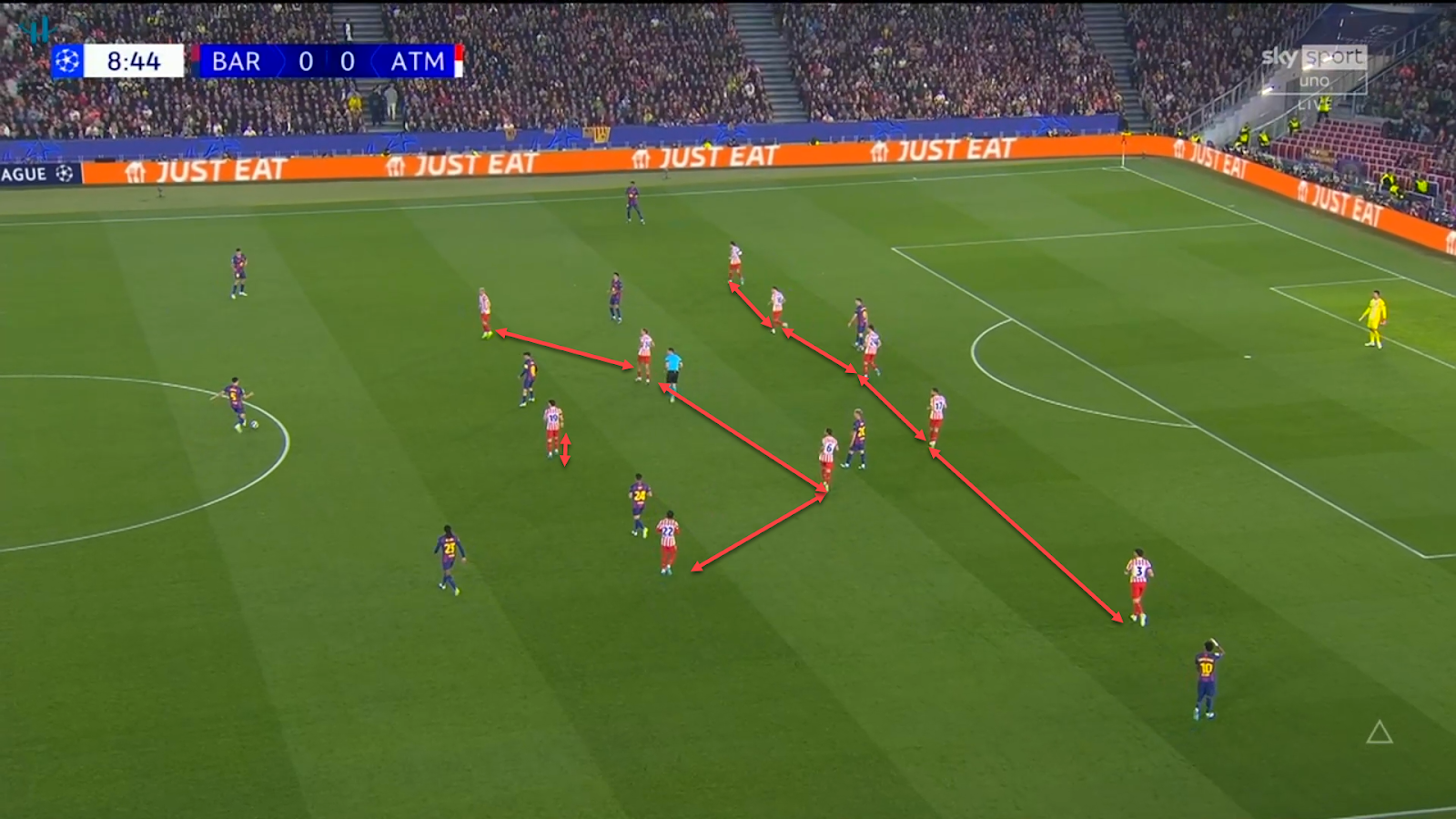
Defensively, Atlético Madrid tried to solidify their back line and complicate matters for Barcelona’s attacking players by switching to a 5-4-1 when out of possession, which guarantees less space at the back and makes it more difficult to break through the second line of defence.
This second line involved both Lookman and Griezmann, who were instructed to be on the same line as Llorente and Koke to limit Barcelona’s vertical passing options, especially through the middle, and to force them to rely only on their wingers.
If they opted to advance through the wings, Simeone had to retreat to form a defensive five with the four initial defenders, as both Ruggeri and Simeone had to mark Rashford and Yamal tightly, even though they were not always successful in limiting their threat.
Furthermore, both centre-backs always had to cover for Simeone and Ruggeri in case one of Barcelona’s wingers penetrated towards the box or received passes in those areas, with both Koke and Llorente ensuring double marking on the wings when needed and keeping an eye on Olmo in the middle.
Barcelona Unsuccessful Decisions Inside The Final Third
Barcelona’s players made several poor decisions in the final third, preventing them from exploiting the chances they created, allowing Atlético Madrid to gain more confidence in defence and grow more dangerous in attack as time went by.
It is true that Atlético Madrid also missed a few chances due to poor finishing following some key penetrations by Lookman and Álvarez; however, Barcelona’s misses were more decisive, as their chances were more dangerous, at least in the first part of the first half.
One of these crucial occasions saw Barcelona advance from the right wing thanks to a one-two combination between García and Koundé, with García making an intelligent penetration into the half-space before crossing towards the far post as soon as he received the pass from Koundé.
García’s cross was perfect for a volley, and as the cross was inviting, Rashford was unmarked inside the box.
Therefore, the most obvious solution would be to try shooting with power and accuracy in that situation.
Instead, Rashford opted for a more complicated solution, providing a first-time pass to Lewandowski, who was surrounded by two players and risked being offside, with the goalkeeper ready to intercept any potential pass in his direction, as he was very close to him.
![Borussia Dortmund Vs Werder Bremen [2-2] Bundesliga 2026/2027: How Daniel Thioune Tactics Earned A Late Comeback With 29% Possession - Tactical Analysis](https://cdn.mymidnight.blog/77f959f119f4fb2321e9ce801e2f5163/size/w600/2026/10/Borussia-Dortmund-vs-Werder-Bremen---Tactical-Analysis.png)
![Croatia Vs Spain [1-2] UEFA Nations League 2026/2027: How Slaven Bilić High Pressing Tactics Troubled Spain - Tactical Analysis](https://cdn.mymidnight.blog/77f959f119f4fb2321e9ce801e2f5163/size/w600/2026/10/Croatia-Vs-Spain--1-2--UEFA-Nations-League-20262027---Tactical-Analysis.png)

![Scotland Vs Switzerland [0-3] UEFA Nations League 2026/2027: How Aggressive Pressing Backfired & Murat Yakin Took Advantage - Tactical Analysis](https://cdn.mymidnight.blog/77f959f119f4fb2321e9ce801e2f5163/size/w600/2026/10/Scotland-Vs-Switzerland-20262027---Tactical-Analysis.png)
![Olympique De Marseille Vs PSG [1-2] Ligue 1 2026/2027: How Bruno Génésio Transitions Troubled PSG - Tactical Analysis](https://cdn.mymidnight.blog/77f959f119f4fb2321e9ce801e2f5163/size/w600/2026/09/Marseille-Vs-PSG-2026_2027---Tactical-Analysis.png)
![Fulham Vs Manchester United [1-1] Premier League 2026/2027: How Álvaro Arbeloa Tactics Exposed The Red Devils' Problems - Tactical Analysis](https://cdn.mymidnight.blog/77f959f119f4fb2321e9ce801e2f5163/size/w600/2026/09/Fulham-FC-Vs-Man-United-2026_2027---Tactical-Analysis.png)
![AS Roma Vs Inter Milan [2-2] Serie A 2026/2027: When Undefeated Giallorossi Attack Met Nerazzurri Comeback Resilience - Tactical Analysis](https://cdn.mymidnight.blog/77f959f119f4fb2321e9ce801e2f5163/size/w600/2026/09/AS-Roma-Vs-Inter-Milan-2026_2027---Tactical-Analysis.png)
![Real Sociedad Vs Bournemouth [1-2] Europa League 2026/2027: How Do Marco Rose Pressing Tactics Work? - Tactical Analysis](https://cdn.mymidnight.blog/77f959f119f4fb2321e9ce801e2f5163/size/w600/2026/09/Real-Sociedad-Vs-Bournemouth-20262027---Tactical-Analysis-1.png)