How To Coach Inverted Full-Back Tactics From Celtic, Bayern Munich, & Liverpool - Tactical Theory
The inverted full-back position is an ever-evolving position, and new ideas and tactics for best utilising these players are constantly being introduced.

What Is An Inverted Full-Back?
The inverted full-back position is an ever-evolving position, and new ideas and tactics for best utilising these players are constantly being introduced.
This tactical analysis will show some of the most common ways inverted full-backs are being used, not just in the build-up but also to finish off attacks.
Inverted full-backs can become a useful attacking option when deployed correctly and within a suitable system.
This tactical theory includes various ways the full-backs can be used in the final third to attack the box.
Either to deliver or aid the delivery of crosses or to make late, half-space runs to get on the end of balls put into the box.
This analysis shows how full-backs are now dynamic attacking players who can unlock various types of defence.
Creating Space In The Wide Area
Inverting full-backs in the build-up phase effectively narrows the opposition to create space in the wide areas.
This space can then be used to isolate a tricky winger one-on-one with their direct opponent or for the full-back to move into the wide area and combine with their wide teammate.
The above image shows Celtic’s right-back, Alistair Johnston, receiving the ball in the half-space whilst the Scottish Premiership champions launch an attack.
Due to Johnston receiving in this position, the opposition's widest midfielder stops shifting across the pitch to press him while still in a central position.
The opposition's left-back must also stop shifting across to protect the passing lane between himself and his centre-back.
This leaves Johnston’s winger with the entire wide area to himself.
Had Johnston received wider, the opposition would have been able to squeeze the wide area by shifting across as the ball was travelling and crowd Celtic out.
The angle of Johnston’s pass into his winger would have been decreased and much more easily blocked off.
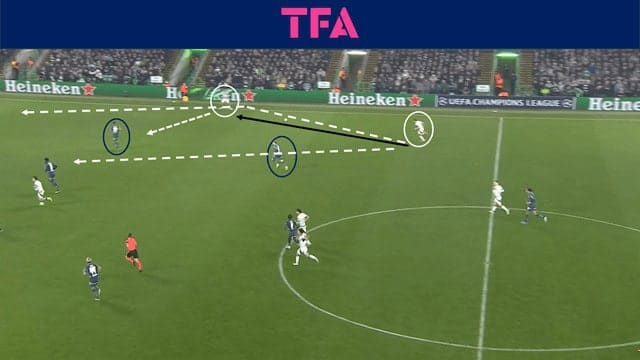
Having played the ball into his winger's feet, Johnston has several options at this point.
The full-back could allow his winger, who has time to receive the ball any way he wants, the space to take on his direct opponent 1v1.
Alternatively, Johnston can support his winger by making an underlapping run between left-back and centre-back or by overlapping his winger.
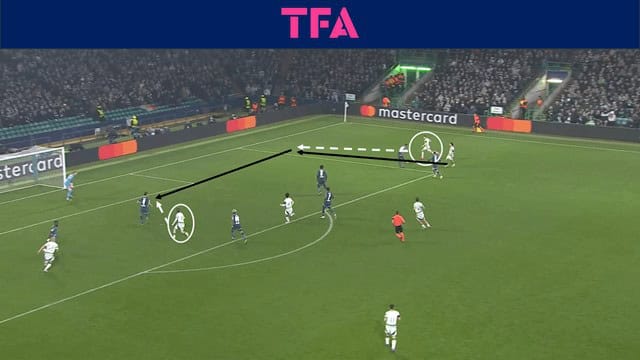
In this example, Johnston elects to overlap his winger.
The wide attacker's first touch was towards the opposition left-back, pinning him in place and allowing Johnston to overlap him.
Running diagonally towards the box, Johnston was fed the ball at the last moment to give the defender the least amount of time possible to react.
The full-back then completes the move by cutting the ball back for his striker, who fires into the net.
The Underlapping Run
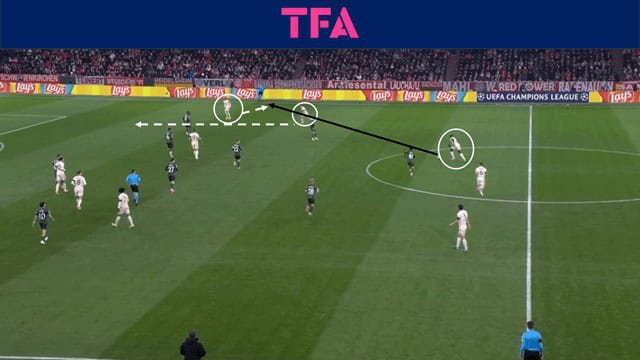
The above image, this time taken from an inverted full-back playing against Celtic, shows Bayern Munich’s right-back, Josip Stanišić, making an underlapping run.
As the ball was switched from Bayern’s left to right, Stanišić's positioning in the half-space again created space in the wide area for his winger.
The wide forward backtracking slightly to receive from his centre-back, Dayot Upamecano, triggered Stanišić's forward run.
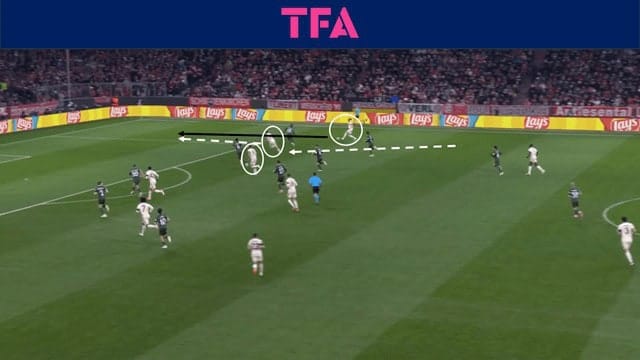
Celtic’s left-back, having to press the winger, opened a big enough gap for Stanišić to run through.
This run, made at full speed when opposition midfielders are following the ball, is very hard to track.
It is also difficult for centre-backs to pick up the run.
Should the ball-near centre-back fully commit to getting tight to Stanišić's run, Harry Kane, circled at the top of the box, would be left wide-open.
Stanišić burst into the box, let the ball roll across him and delivered a dangerous cut-back towards the penalty spot.
Playing Long To The Inverted Full-Back
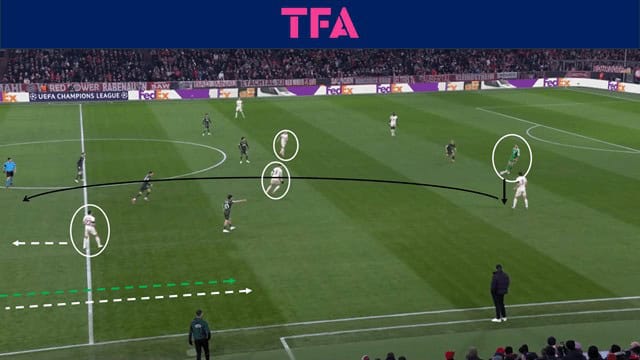
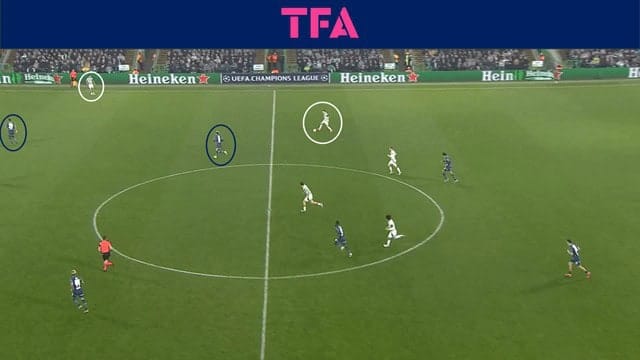
From the same Champions League encounter, the above image shows Bayern building out from their goalkeeper, Manuel Neuer.
By playing high between the centre-backs, Neuer effectively creates a back three.
In these scenarios, Bayern’s double pivot moves closer to the ball into the space their inverted full-back could occupy.
With Celtic’s wingers tucked in, defending the half-spaces, this leaves left back, #22 Raphaël Guerreiro (circled on the half-way line) with two options.
Guerreiro can either pull out wide to create an angle for a pass or make a forward run for a long ball to be played over the top.
As Guerreiro sees his winger dropping towards the ball, bringing Celtic’s right-back with him, Guerreiro elects to run in behind.
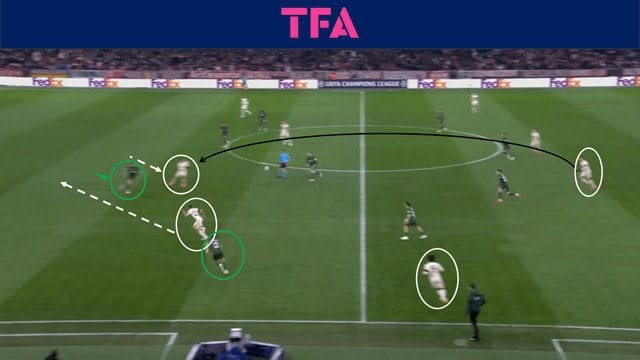
As his centre-back is about to play the ball, Bayern’s striker makes a movement towards the ball to bring his marker with him.
The winger's movement drags forward Celtics' right-back, and their centre-back is preoccupied with competing with the striker for the ball, creating a gap between the defenders.
From an almost unmarkable position, Guerreiro makes a diagonal run through this gap.
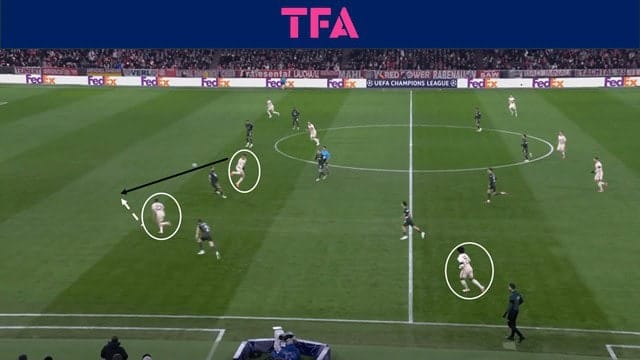
The centre-back long-ball is aimed at the striker, who meets the ball in the air.
Just as Guerreiro is about to break through Celtic’s backline, the ball is flicked on for him to meet and run through on goal.
Late Runs From The Half-Space
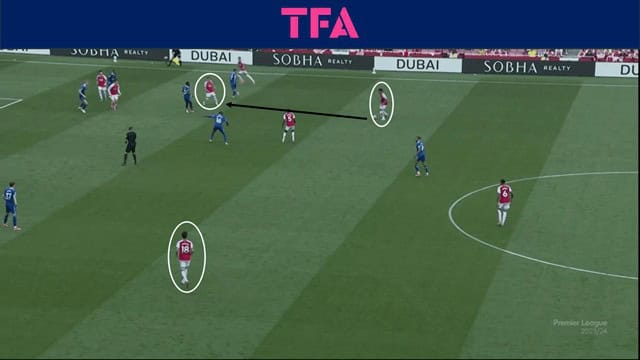
Another benefit of taking up an inverted starting position on the ball-far side of the pitch when attacking the box, in addition to keeping a secure rest defence, is the late, attacking runs it facilitates.
The above image shows the starting position of Arsenal’s left-back, #18 Takehiro Tomiyasu, in the half-space in the middle of the opposition’s half.
This positioning does not alert the opposition to any danger, allowing the left-back to unassumingly attack the box, as the next image will show.
Occupying these spaces in a positional attack provides the benefits of attacking and ball retention, as well as added security should the ball be lost.
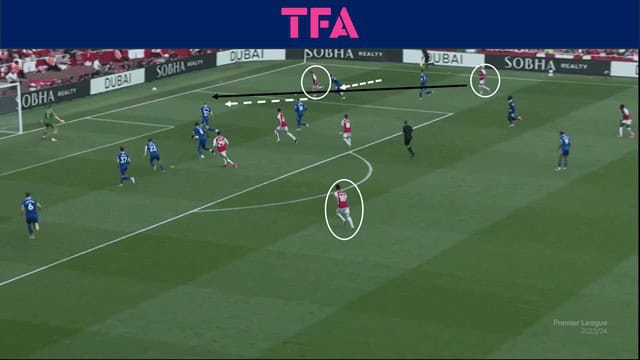
Arsenal combined in the right wide area to create a cut-back opportunity.
The ball being played behind the opposition's backline to Martin Ødegaard is the trigger for Tomiyasu to support the play and attack centrally on the edge of the box.
As the image shows, the opposition backline has been pushed back towards its own goal with runners into the box, leaving a big area for Tomiyasu to target.
With all eyes on the ball, Tomiyasu runs undetected into a dangerous area.
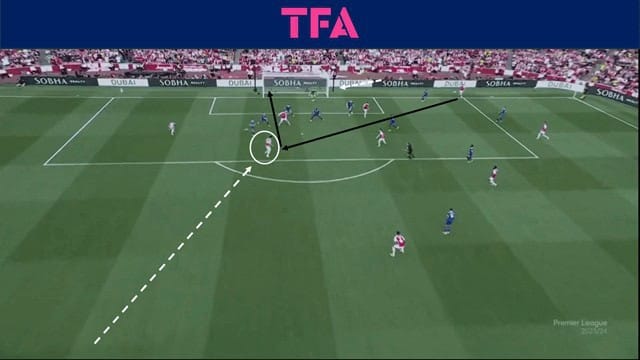
Tomiyasu ran onto the end of Ødegaard’s cut-back at a perfect angle to finish first time with his right foot.
Although he was the target of the cross on this occasion, this positioning would also provide the maximum opportunity to win second balls coming out of the box.
It also allows for counter-pressing high in the opposition's half if they have won and attempted to come out with the ball.
Arriving In The Half-Space
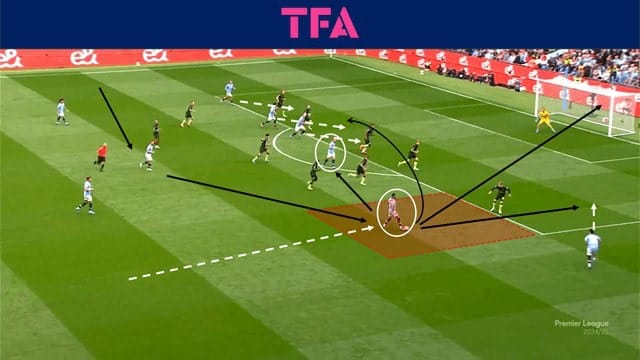
The half-space areas on the edge of the opposition’s 18-yard box are two of the most dangerous spaces to attack on the pitch.
The above image shows Manchester City attacking an opposition that has deployed a low block deep inside their defensive third.
City’s former defender, Kyle Walker, has just received the ball, which had been switched via the midfield, in the dangerous half-space box.
Walker could receive here, alone, by making a similarly late run as Tomiyasu.
To create the space for Walker's late run, City used high and (relatively) wide wingers to pin back the opposition’s wing-backs.
By switching the ball via their ‘6’, who is positioned well inside the opposition's final third, City have narrowed their opponents' central midfielders.
The ‘6’ receiving was Walker's trigger to make a forward run, on the blind side of the opposition's midfield, who were fixated on the ball.
By timing his movement to receive in this area, rather than standing in it, Walker makes it very hard for the opposition to either pick him up or block passing lanes into him.
What makes these areas so dangerous and difficult to defend against is the number of options they provide the player on the ball.
As shown in the image, receiving in this position gave full-back Walker a plethora of options, making him very difficult to defend against.
On this occasion, as the opposition midfield shifted across to close down Walker, it opened up just enough space for Walker to combine with Kevin De Bruyne, who then fed the ball into Erling Haaland for City’s first goal.
Clearing The Space
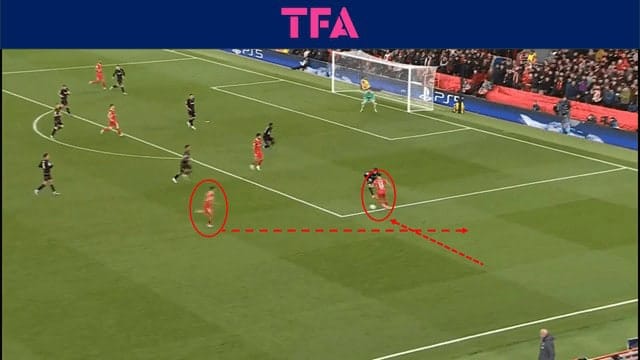
Making late runs into, and then out off, this same half-space area can be an effective way for full-backs to create space for their wingers to cut inside to.
In a similar phase of play to Walker's receiving at the edge of the box, the above image shows the moments Liverpool has just switched the ball via their midfield, but this time misses their former inverted right-back, Trent Alexander-Arnold.
Instead, it is winger Mohamed Salah who receives in the wide area.
Salah’s first touch, towards the left-back, showed he intended to take on the opposition's left-back.
Alexander-Arnold's trigger to vacate the space at the edge of the box and overlapped his forward.
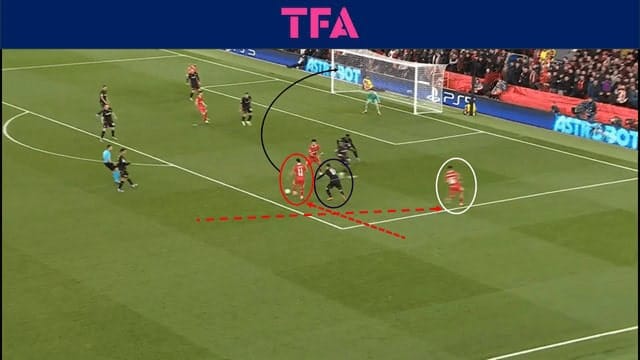
Alexander-Arnold's run cleared the space and distracted the opposition left-back, who overcompensated to prevent the right-back from receiving the ball.