In addition, team captain Morten Hjulmand is one of the most trusted figures, ranking second in total minutes played, just behind Trincão.
From an attacking perspective, Borges' team has been extremely effective.
Sporting currently boast the best attack in the league, with 73 goals scored in 28 games, reflecting clear offensive efficiency.
Individually, Suárez stands out as the league’s top scorer with 24 goals, while Trincão plays a key creative role, topping the assists chart with 11.
Now, we will shift our focus to the tactical ideas implemented by Borges, analysing the key principles behind his model at Sporting.
Rui Borges Attacking Tactics At Sporting CP
Low Build-Up
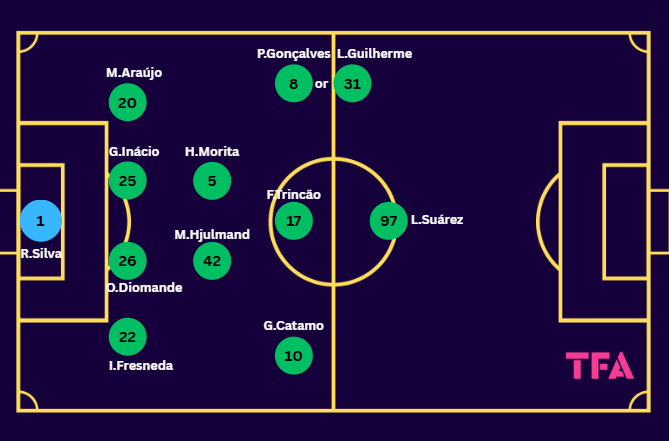
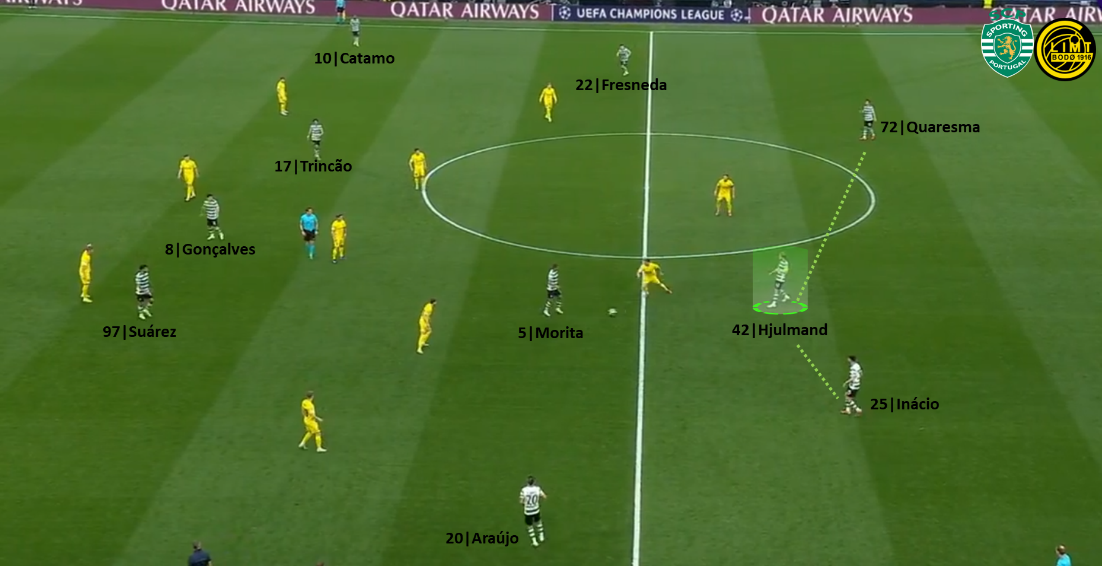
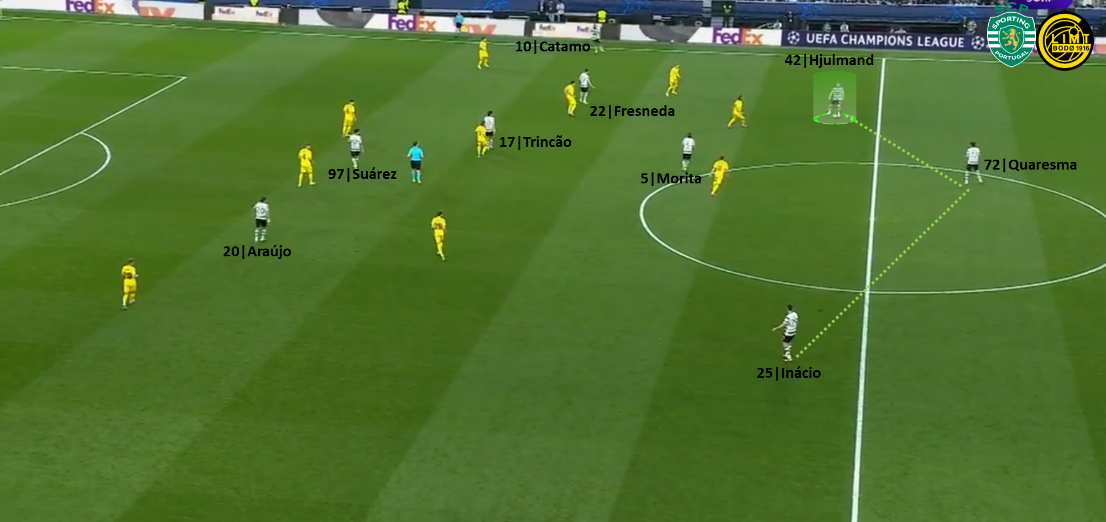
In the low build-up phase, Sporting CP often organise in a 4-2-4 structure.
The two midfielders remain positioned in the central corridor, while the front four push high onto the opposition’s defensive line, typically around the halfway line.
This positioning stretches the opponent vertically and creates significant space between the lines, which can be exploited during progression.
As an alternative solution, Sporting show positional flexibility within the same phase.
Hidemasa Morita can drop wider, moving into the full-back line to support build-up, while Maximiliano Araújo advances higher up the pitch.
This adjustment leaves Hjulmand as the single midfielder in the centre.
With this structure, space opens in the half-space, which is then occupied by the winger Pedro Gonçalves, who drops from a higher position to receive between the lines.
This movement creates a passing option for the centre-backs and helps connect the build-up phase with the attacking unit.
High Build-Up
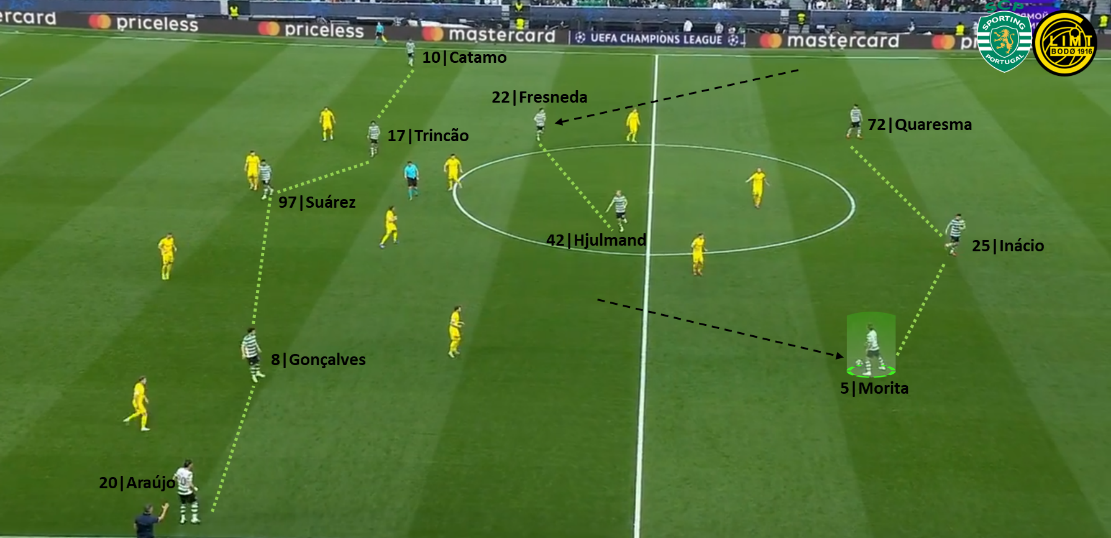
In the high build-up phase, Sporting typically organise with a back three created by one of the midfielders dropping into the defensive line.
This adjustment can occur in different ways.
Most commonly, Hjulmand drops between the centre-backs.
In other situations, he may position himself slightly to one side, or alternatively, Morita drops to the left side of the centre-backs, creating asymmetry in the structure.
When this happens, the right full-back, Ivan Fresneda, often moves inside into a more central position to support the midfield and maintain numerical superiority in the middle.
In advanced areas, Suárez remains the central reference, occupying the opposition’s centre-backs.
Around him, Trincão and Gonçalves operate in the half-spaces, providing connections between the lines and an attacking presence in interior channels.
At times, Araújo can also occupy these interior zones.
Width is generally provided by the winger Geny Catamo on the right side and full-back Araújo on the left.
However, when Araújo moves into the half-space, Gonçalves adjusts his positioning to maintain width on that flank, ensuring the team maintains horizontal balance.
Chance Creation
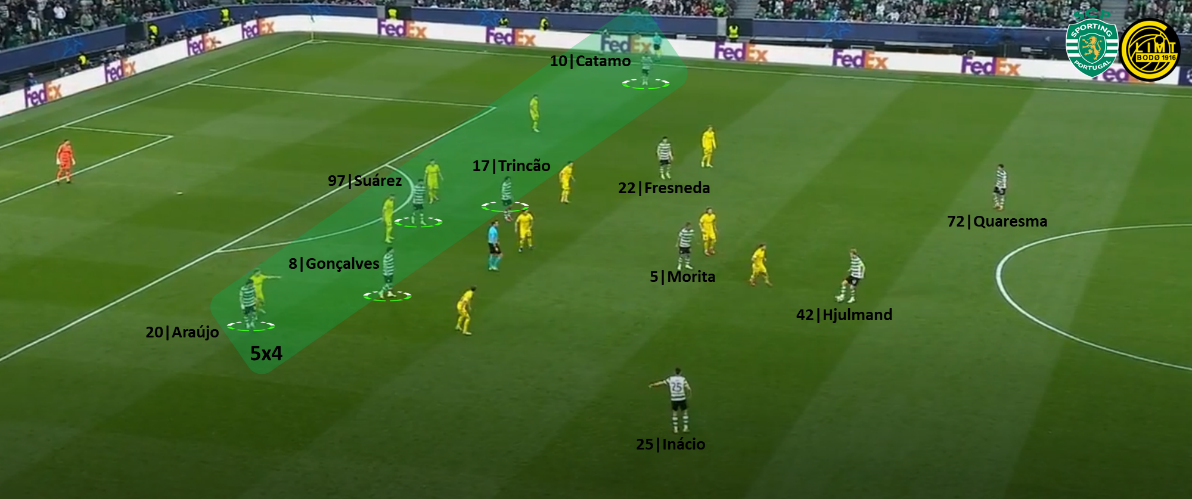
Sporting position five players against the opponent’s back four, creating a 5v4 numerical superiority on the last line.
As previously mentioned, the full-backs play a very active role in the attacking phase under Borges.
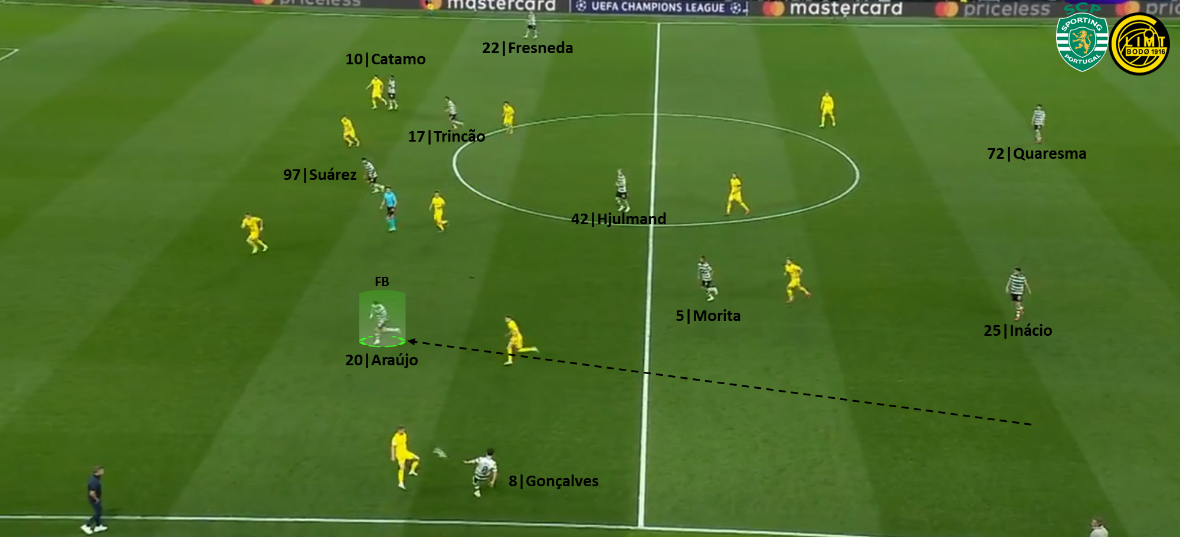
In particular, Araújo frequently makes runs in behind, attacking the depth to threaten the defensive line and looking to receive the ball behind the opposition’s full-back.
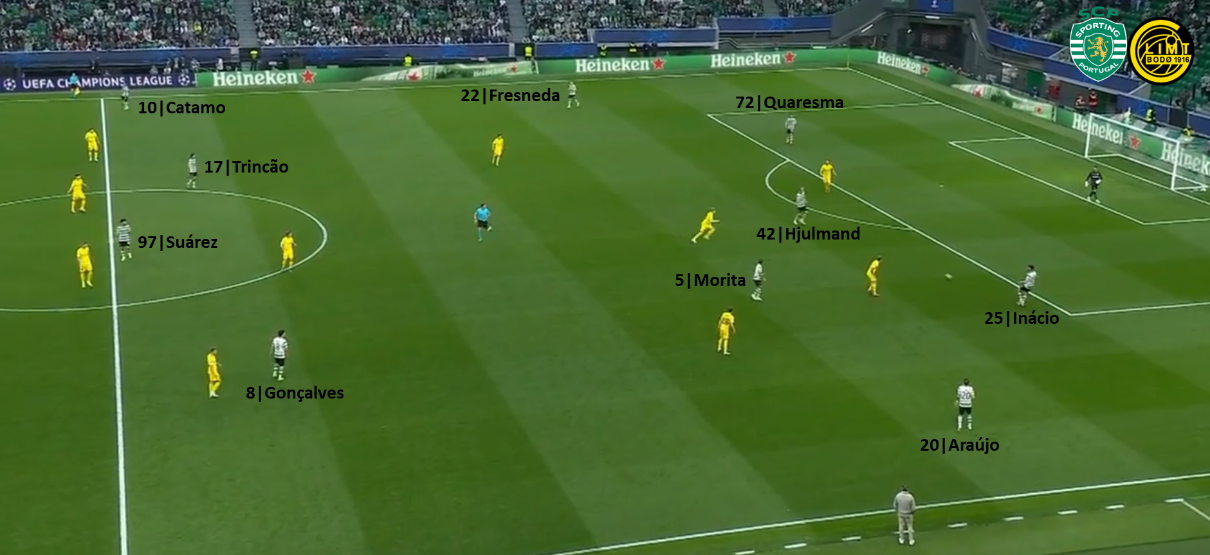
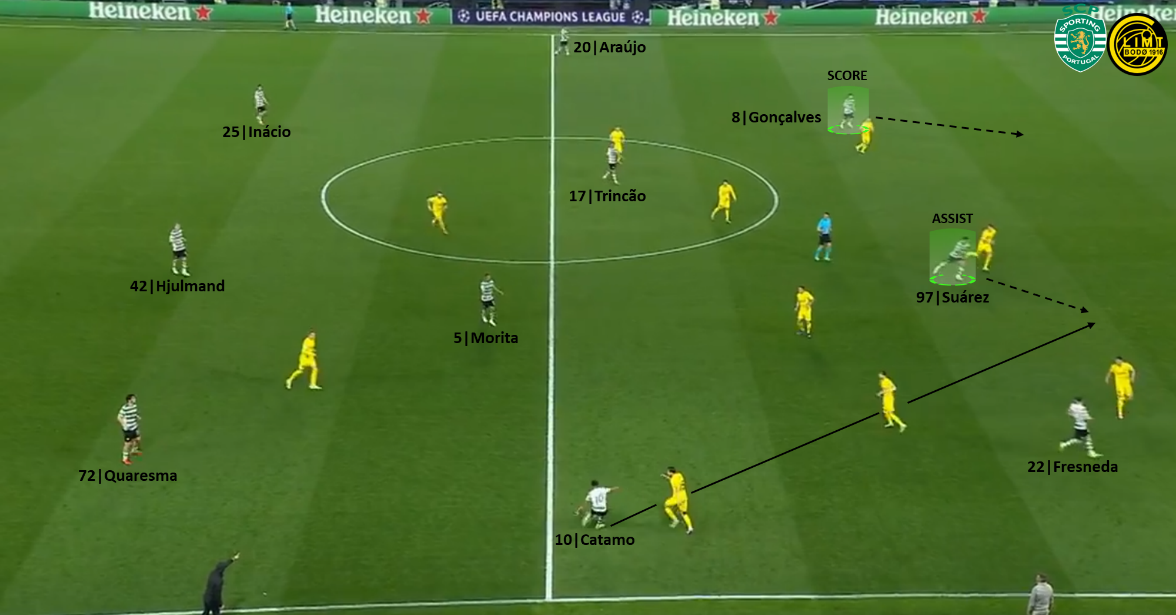
The following image illustrates Sporting's second goal.
In this situation, Fresneda makes an important off-the-ball movement, drifting wide to open space in the defensive line.
This movement creates the perfect condition for Suárez to attack depth, something he is particularly effective at and which makes him a constant threat.
At the same time, Trincão positions himself more centrally with Morita, ensuring defensive balance, being well-positioned to react in case of a defensive transition while Fresneda advances.
The sequence continues with the left winger passing the ball to Suárez, who then assists the opposite winger, Gonçalves.
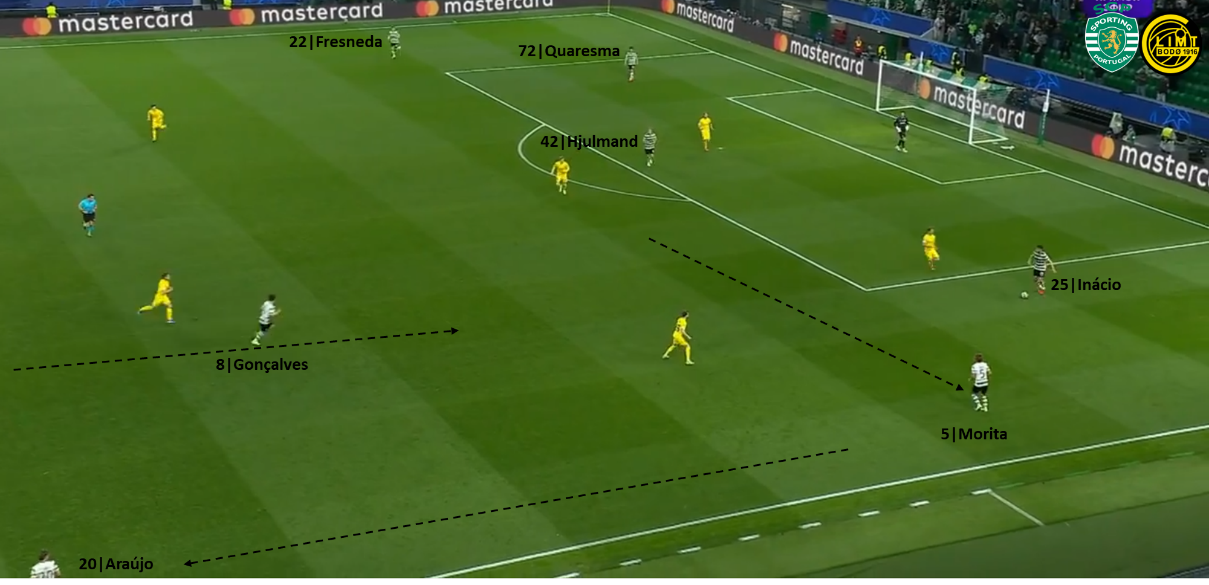
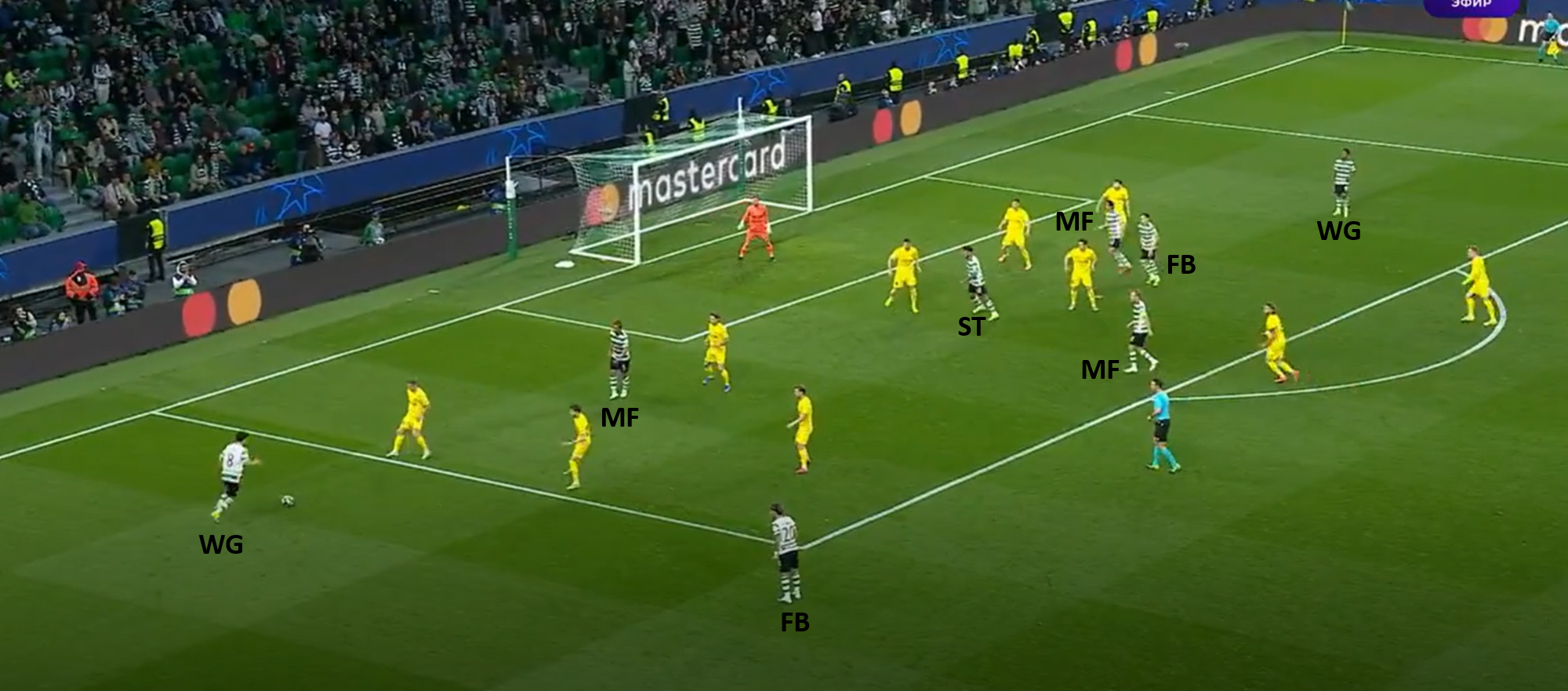
In the next image, we can see that Sporting commit a large number of players to the final third to finish the attack.
This includes the full-backs, with several players occupying the penalty area.
As a consequence, the centre-backs are left alone at the back, providing the only defensive cover.



![FC Porto Vs Nottingham Forest [1–1] – UEFA Europa League 2025/2026: Porto Dominate, Forest Stay Alive – Tactical Analysis](https://cdn.mymidnight.blog/77f959f119f4fb2321e9ce801e2f5163/size/w600/2026/04/FC-Porto-VS-Nttm-Forest-20252026.png)
![Barcelona Vs Atlético Madrid [0–2] – Champions League 2025/2026: Atlético’s Defensive Control & Clinical Edge – Tactical Analysis](https://cdn.mymidnight.blog/77f959f119f4fb2321e9ce801e2f5163/size/w600/2026/04/Barcelona-vs-Atletico.png)
![PSG Vs Liverpool [2–0] – Champions League 2025/2026: Luis Enrique Rotations Dismantle Liverpool – Tactical Analysis](https://cdn.mymidnight.blog/77f959f119f4fb2321e9ce801e2f5163/size/w600/2026/04/PSG.-VS-LIVERPOOL.png)


