
![Atlético Madrid Vs Barcelona [1–2] – Champions League 2025/2026: When Pragmatism Beats Control – Tactical Analysis](https://cdn.mymidnight.blog/77f959f119f4fb2321e9ce801e2f5163/size/w1000/2026/04/Atle--tico-Madrid--Vs-Barcelona-20252026.png)
Atlético Madrid Vs Barcelona [1–2] – Champions League 2025/2026: When Pragmatism Beats Control – Tactical Analysis

Atlético Madrid welcomed FC Barcelona to the Riyadh Air Metropolitano for the second leg of the 2025/2026 UEFA Champions League quarter-final in a ferocious, high-octane encounter.
Following a disciplined 2-0 victory for Atleti in the first leg at the Spotify Camp Nou, the narrative heading to Madrid was whether Hansi Flick's youthful side could orchestrate a historic comeback.
The match ended in a rare home defeat for Diego Simeone's side, their first in a knockout stage of this competition since 1997, as they fell 1-2 on the night.
Despite the loss, Atlético Madrid secured their progression to the Champions League semi-final with a 3-2 aggregate scoreline vs Barca.
The game was a masterclass in tactical tension, illuminated by the brilliance of Lamine Yamal and the clinical resilience of Ademola Lookman.
In this tactical analysis, we aim to highlight the structural nuances of both sides, Hansi Flick Barcelona’s aggressive early recovery, and Diego Simeone Atlético Madrid defensive grit that eventually saw Atlético endure to book their encounter with Arsenal in the next round.
Atlético Madrid Vs Barcelona Lineups & Formations
Let's look at how Diego Simeone tactics and Hansi Flick tactics fielded their squads for this decisive encounter.
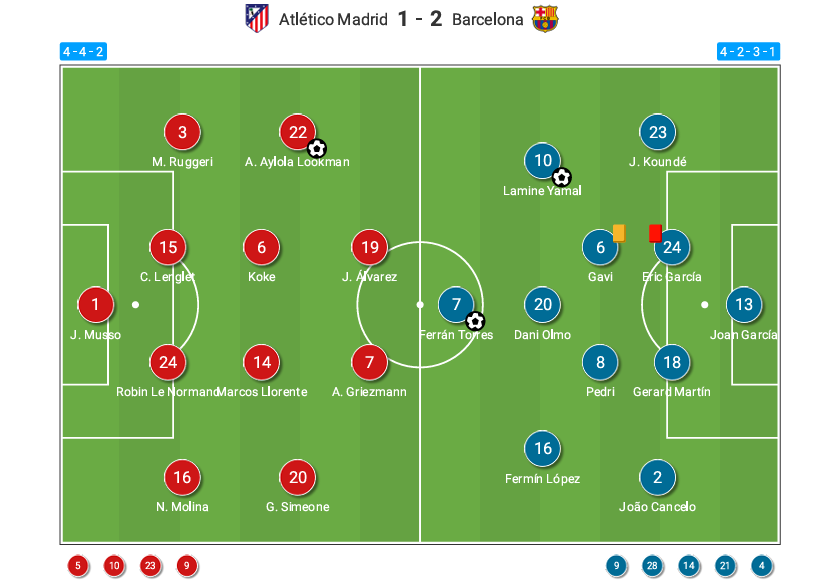
The hosts utilised a 4-4-2 formation that prioritised horizontal compactness and vertical explosive transitions.
Juan Musso started in goal, a selection that proved pivotal given the sheer volume of shots he would eventually face.
The back four was composed of Nahuel Molina at right-back, Robin Le Normand and Clément Lenglet as the central pairing, and Matteo Ruggeri on the left.
Lenglet’s inclusion was a necessity due to injuries to José María Giménez and Dávid Hancko, placing the former Barcelona defender in a high-pressure reunion.
The midfield was anchored by skipper Koke and Marcos Llorente, while the wings were occupied by Giuliano Simeone on the right and the dangerous Ademola Lookman on the left.
Up front, the strike partnership of Antoine Griezmann and Julián Álvarez provided a blend of creative playmaking and relentless pressing.
The visitors lined up in a fluid 4-2-3-1 that functioned with extreme verticality in the final third.
Joan García started between the sticks, highlighting Flick's trust in the young keeper during this European run.
The defensive line featured Jules Koundé on the right, Eric García and Gerard Martín as the centre-backs, and João Cancelo on the left.
In the absence of Marc Casadó, the double pivot was constructed with Pedri and Gavi, providing a mix of technical security and combative energy.
The attacking trio was led by Ferran Torres in a central role, with Fermín López operating as an inverted winger on the left and the 18-year-old sensation Lamine Yamal providing the primary threat from the right.
Dani Olmo operated as the central attacking midfielder, linking the pivot to the forward line.
Barcelona’s Strategic Onslaught: High Risk & Early Dominance
Barcelona’s path to a comeback required an immediate impact, and Hansi Flick’s tactical setup was designed for nothing less than a total offensive siege.
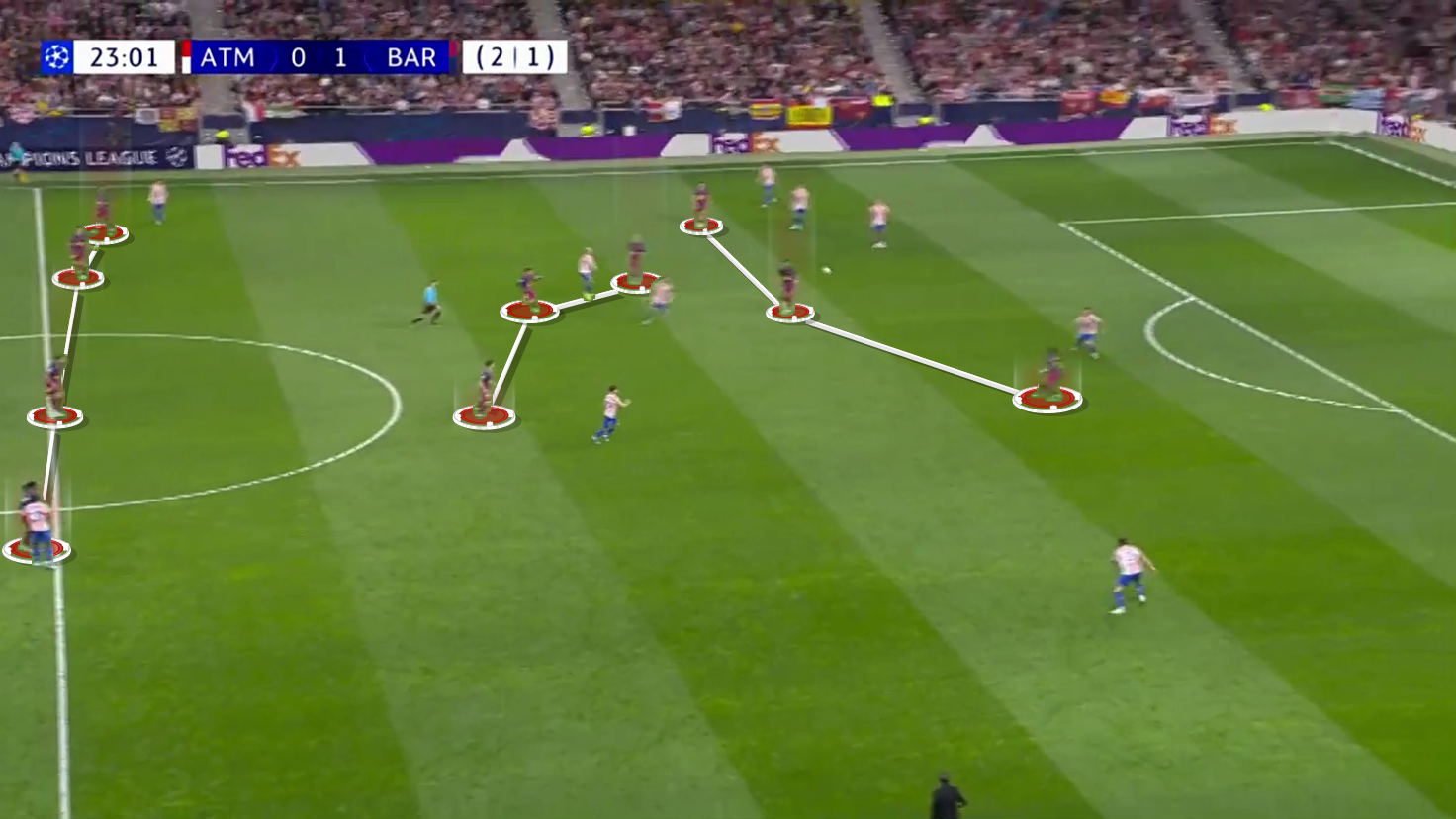
From the opening whistle, the visitors deployed an incredibly high defensive line, often squeezing the play within a 30-meter band.
As illustrated in Figure 1, this structural compactness allowed Barça to sustain constant pressure in the final third, leaving almost no room for the home side to exit their own half.
This approach forced Atlético to retreat into a deep block, but it also placed immense pressure on Simeone’s men to be perfect in their distribution, a level of precision that was notably missing in the early exchanges.
The influence of Lamine Yamal cannot be overstated.
From the first 31 seconds of the match, he looked like a player possessed, driving at Ruggeri and forcing an early fingertip save from Musso.
Barcelona’s intent was to exploit the psychological weight on Clément Lenglet.
The tactical gamble paid off in the fifth minute when Lenglet, under pressure from Barça’s front-line press, committed a costly error, passing straight to Ferran Torres.
Torres immediately released Yamal, who finished with the composure of a veteran to make it 1-0 on the night and 2-1 on aggregate.
Barcelona’s dominance was built on their ability to win second balls and maintain possession in the final third.
They successfully overloaded the "half-spaces" between Atlético’s full-backs and centre-backs.
Dani Olmo was particularly effective in these pockets, acting as a connecting hub between the midfield and the forwards.
The aggregate score was remarkably levelled in the 24th minute, barely sixty seconds after the tactical snapshot captured in Figure 1, when Olmo slipped a pass through to Ferran Torres.
Torres, exhibiting a "thunderous" left-footed finish, drilled the ball into the far top corner.
At this point, Atlético appeared to be crumbling.
Their lines were ragged, and they struggled to maintain any semblance of the "classic defensive grit" for which Simeone’s teams are famous.
Had Musso not produced a spectacular point-blank save against a header from an unmarked Fermín López shortly after, the "remontada" might have been completed before the half-hour mark.
The primary tactical issue for the hosts during this period was the lack of protection for their back four.
With Gavi and Pedri winning the territorial battle in the middle third, Koke and Llorente were forced to spend the majority of their energy tracking runners rather than dictating play.
This created a disconnect between the defence and the attackers, leaving Griezmann and Julián Álvarez isolated and unable to act as outlets for a relief pass.
Barcelona Defensive Consolidation & Structural Failure
Following the goal, the match entered a phase of tactical consolidation.
Simeone refined his defensive block to deal with the introduction of Robert Lewandowski and Marcus Rashford.
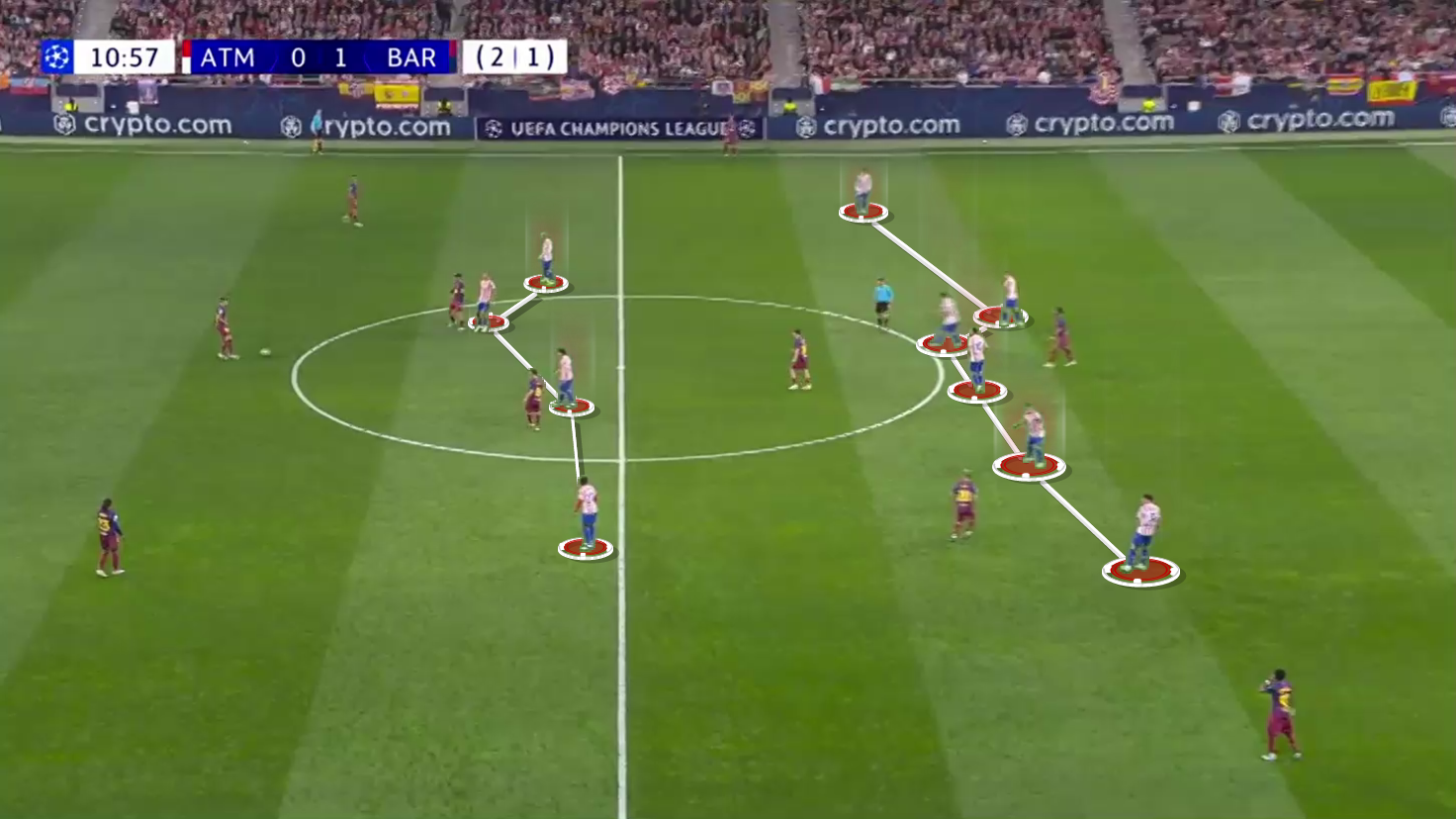
The home side shifted into an ultra-low 6-4-0 "trench" block (Figure 6), stretching six players across the defensive line to eliminate all interior passing lanes.
This forced Barcelona to circulate the ball laterally, neutralising the threat of vertical through-balls to Olmo or Torres.
Barcelona’s lack of discipline in transition finally proved fatal in the 79th minute.
With the team entirely committed to the attack, a turnover left Eric García as the lone defender against substitute Alexander Sørloth.
The resulting foul and García’s dismissal were direct consequences of a structural failure: Barça had abandoned their defensive vigilance in favour of volume.
While FC Barcelona were technically irresistible, controlling 66% of possession and generating an xG of 2.11, their insistence on an ultra-high defensive line proved to be their downfall.
Atlético Madrid progressed because they understood the game state, balancing periods of extreme suffering with a seven-second tactical riposte that decided the fate of the tie.
The Anatomy Of The Transition: Exploiting The High Line
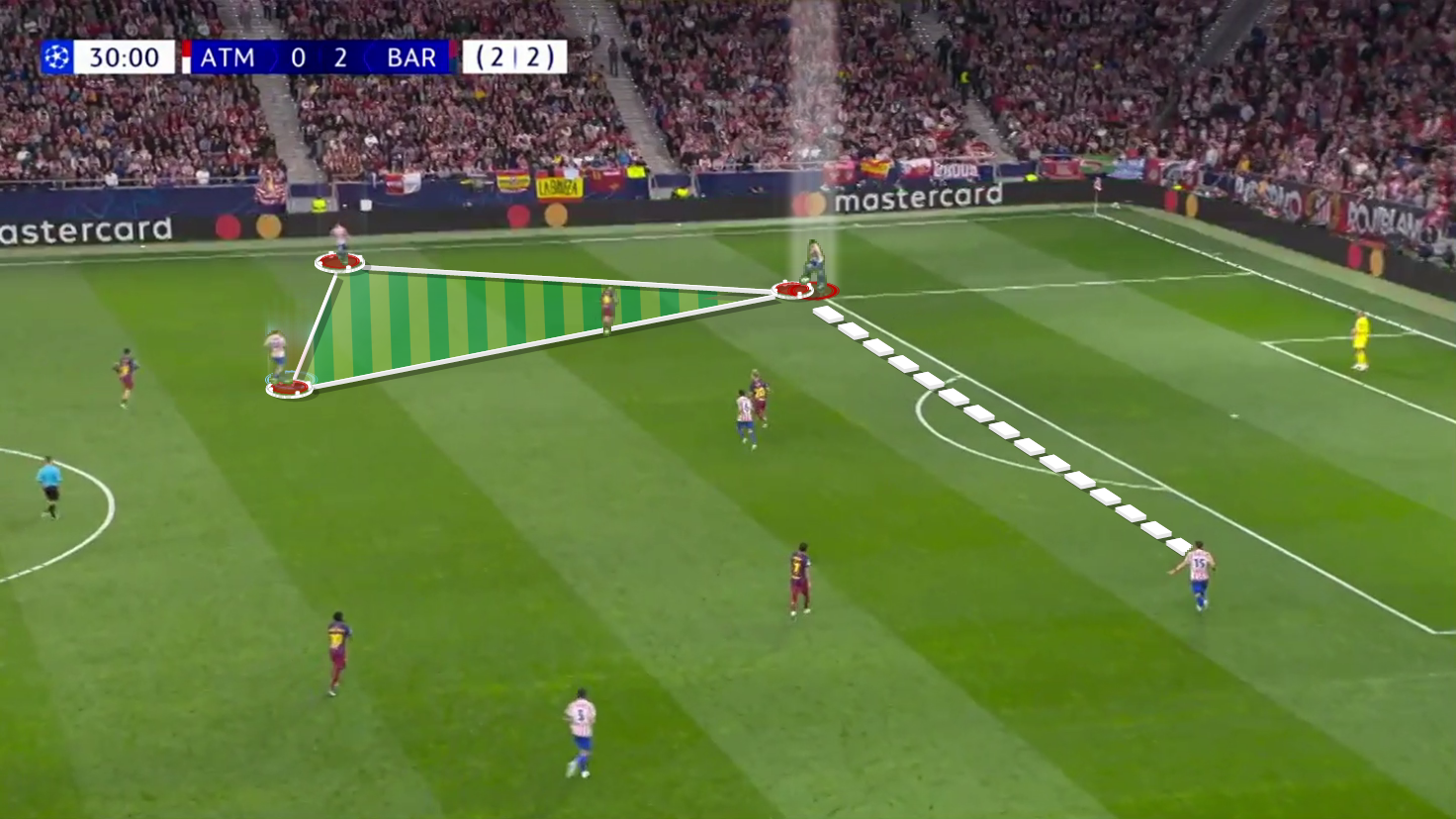
Just as the atmosphere turned to anxiety after Torres’ aggregate equaliser, Atlético manufactured a decisive response.
Their tactical identity has evolved into a system that thrives on exploiting structural risks through high-speed verticality.
The sequence captured in Figures 3 to 6 demonstrates the clinical efficiency of this seven-second transition that ultimately decided the tie.
![Celta Vigo Vs Juventus [1-2] Europa League 2026/2027: How The Old Lady Escaped With A Late Comeback Despite Predictable Attacking Play - Tactical Analysis](https://cdn.mymidnight.blog/77f959f119f4fb2321e9ce801e2f5163/size/w600/2026/10/Celta-Vigo-Vs-Juventus---Tactical-Analysis.png)
![Villarreal Vs Napoli [3-1] Champions League 2026/2027: How Iñigo Pérez Tactics Exploited Massimiliano Allegri Mistakes - Tactical Analysis](https://cdn.mymidnight.blog/77f959f119f4fb2321e9ce801e2f5163/size/w600/2026/10/Villarreal-Vs-Napoli---Tactical-Analysis.png)
![Manchester City Vs PSG [2-4] Champions League 2026/2027: How Luis Enrique Tactics Controlled The Key Moments - Tactical Analysis](https://cdn.mymidnight.blog/77f959f119f4fb2321e9ce801e2f5163/size/w600/2026/10/Manchester-City-Vs-PSG---Tactical-Analysis.png)
![Borussia Dortmund Vs Werder Bremen [2-2] Bundesliga 2026/2027: How Daniel Thioune Tactics Earned A Late Comeback With 29% Possession - Tactical Analysis](https://cdn.mymidnight.blog/77f959f119f4fb2321e9ce801e2f5163/size/w600/2026/10/Borussia-Dortmund-vs-Werder-Bremen---Tactical-Analysis.png)
![Croatia Vs Spain [1-2] UEFA Nations League 2026/2027: How Slaven Bilić High Pressing Tactics Troubled Spain - Tactical Analysis](https://cdn.mymidnight.blog/77f959f119f4fb2321e9ce801e2f5163/size/w600/2026/10/Croatia-Vs-Spain--1-2--UEFA-Nations-League-20262027---Tactical-Analysis.png)

![Scotland Vs Switzerland [0-3] UEFA Nations League 2026/2027: How Aggressive Pressing Backfired & Murat Yakin Took Advantage - Tactical Analysis](https://cdn.mymidnight.blog/77f959f119f4fb2321e9ce801e2f5163/size/w600/2026/10/Scotland-Vs-Switzerland-20262027---Tactical-Analysis.png)
![Olympique De Marseille Vs PSG [1-2] Ligue 1 2026/2027: How Bruno Génésio Transitions Troubled PSG - Tactical Analysis](https://cdn.mymidnight.blog/77f959f119f4fb2321e9ce801e2f5163/size/w600/2026/09/Marseille-Vs-PSG-2026_2027---Tactical-Analysis.png)