
![RC Lens Vs OGC Nice [3–1] – Coupe de France Final 2025/2026: Pierre Sage Tactics Punish Defensive Chaos – Tactical Analysis](https://cdn.mymidnight.blog/77f959f119f4fb2321e9ce801e2f5163/size/w1000/2026/05/Coupe-De-France-Final-20252026.png)
RC Lens Vs OGC Nice [3–1] – Coupe de France Final 2025/2026: Pierre Sage Tactics Punish Defensive Chaos – Tactical Analysis

RC Lens met OGC Nice at the Stade de France for the 2025/2026 Coupe de France Final, and the game ended in a decisive 3-1 Lens win.
Lens had a magnificent season as they battled against PSG for the Ligue 1 title.
It was important for Pierre Sage to make up for the loss of the league title by winning the cup instead, and he has now achieved that.
Winning the Coupe de France for the first time can only be regarded as a huge achievement for Lens, who have been one of the best teams in France in recent seasons.
On the other hand, Nice were disappointing in Ligue 1 this season and are about to play the relegation playoffs to try securing their place in Ligue 1 next season.
This is a very disappointing outcome for one of the most prestigious French teams, who were competing for top spots in recent seasons and were also playing in Europe regularly.
Nice and their head coach, Claude Puel, tried to make a reaction in this Cup final but failed to do so despite their ambitious attacking performance, confirming that they need a lot more work, especially defensively.
In this tactical analysis, we examine Nice’s ambitious match plan, their midfield and attacking performance, and how they sought to disrupt Lens.
The analysis also sheds light on Lens’ attacking solutions and exploitation of Nice’s obvious defensive weaknesses.
RC Lens Vs OGC Nice Lineups & Formations
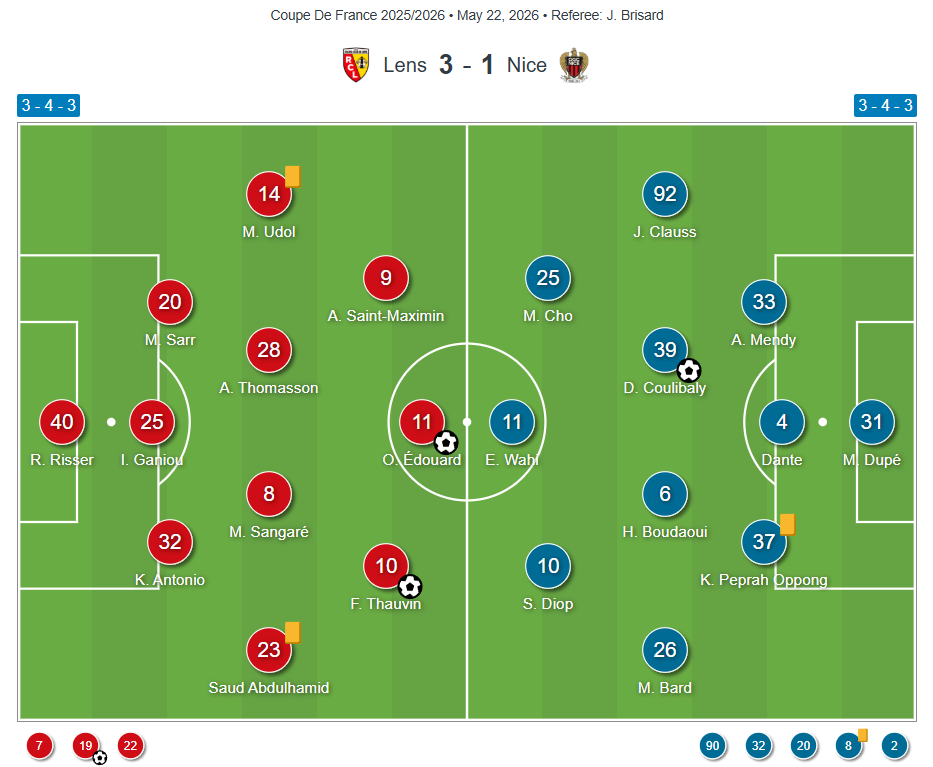
Lens Lineup Vs Nice
Sage opted for a 3-4-3 formation with Robin Risser as a goalkeeper, and a back-three made up of Kyllian Antonio, Ismaelo Ganiou, and Malang Sarr.
The midfield comprised Mamadou Sangaré and Adrien Thomasson as central midfielders, with Matthieu Udol and Saud Abdulhamid as wing-backs.
In attack, Lens’ trio featured Allan Saint-Maximin and Florian Thauvin as wingers, with Odsonne Édouard as the main striker.
Nice Lineup Vs Lens
On the other side, Puel opted for a similar 3-4-3 formation, with Maxime Dupé as the goalkeeper, and a defensive line formed of Antoine Mendy, Dante, and Kojo Peprah Oppong.
The midfield line was made up of Hicham Boudaoui and Djibril Coulibaly, with Jonathan Clauss and Melvin Bard as wing-backs.
Up front, Nice relied on Mohamed Ali Cho and Sofiane Diop as wide playmakers, with Elye Wahi as the main striker.
OGC Nice Tactics Vs RC Lens
Lens started the match with a plan that relied on aggressive high pressing inside Nice’s half, while maintaining a high defensive block and trying to push their opponent into committing mistakes in passing or ball protection.
Whenever they lost the ball, they'd try to counter rather than regroup and retreat.
This plan could have been very rewarding for Lens if Nice had played according to expectations before the match: playing a more cautious game based on ball possession and counterattacking whenever possible, while maintaining a low defensive block to avoid Lens’ attacking threats.
However, Puel had a different idea and preferred to take more risks to surprise Lens with a similar approach to the match, based on a relatively high defensive block, dynamic movements without the ball to win possession, and high recoveries as often as possible.
The aim was also to try to exploit the space behind Lens’ defensive line with through passes.
Nice were initially successful with this plan, as it helped them limit Lens’ threats and counter them with dangerous opportunities.
This happened mainly thanks to Nice’s high recoveries and the quick passing between Nice’s players to surprise Lens’ high line.
The quick and intense disturbance of Nice’s midfield trio on the ball holder was efficient and rewarding, especially in the first half, as that was crucial for the Eagles to launch counters while winning precious time over Lens’ defenders.
In this illustrative example, all of Coulibaly, Diop, and Cho had a role in the creation of this action, with both Cho and Diop surrounding the ball handler and obliging him to turn towards Coulibaly, who intercepts the ball and passes it to Cho.
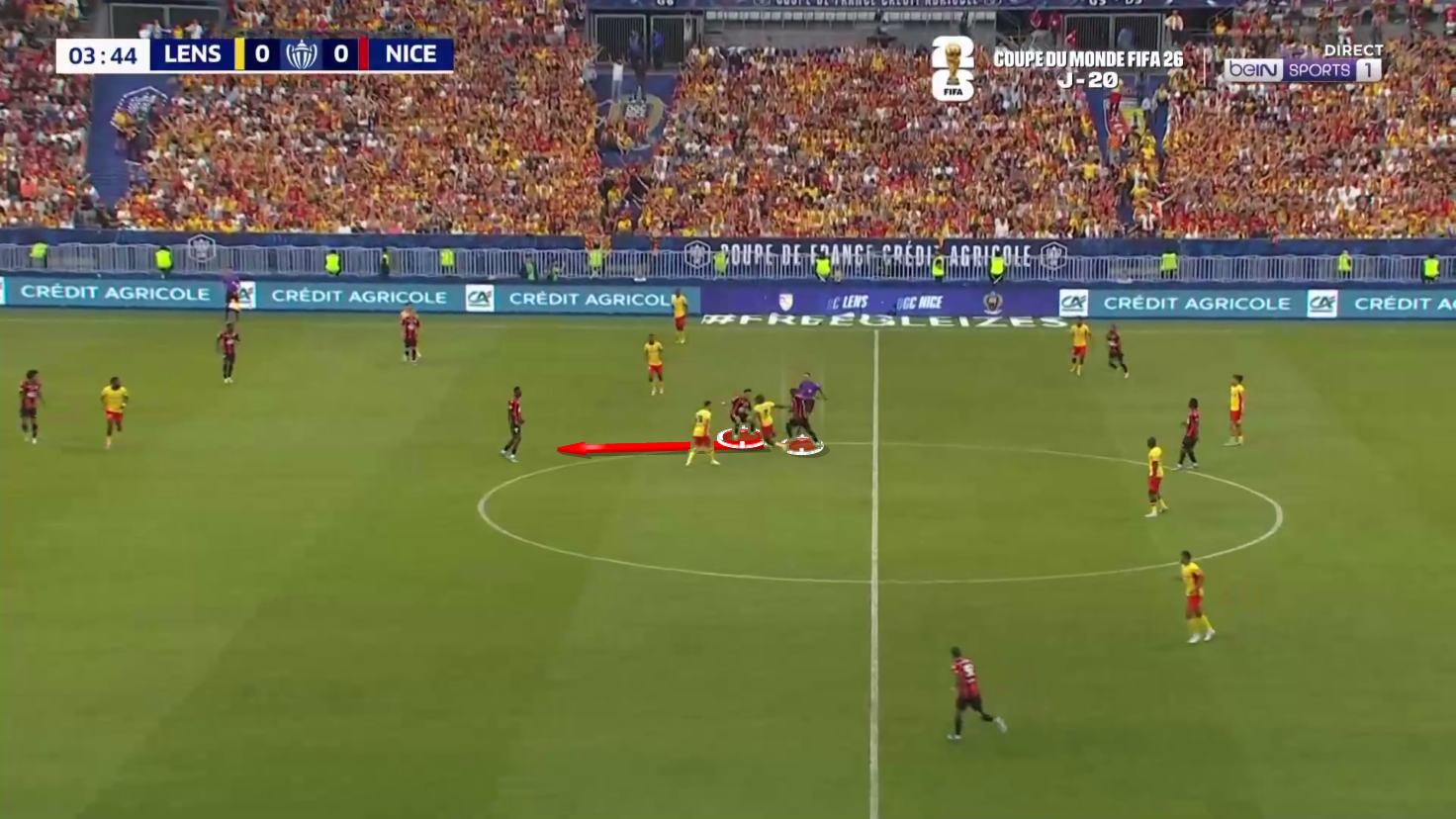
This smooth, quick ball recovery highlights the teamwork in midfield and the complementarity and chemistry among this trio.
Furthermore, the understanding and complementarity between Nice’s midfielders helped make the attacks quicker and more efficient, with Wahi always making intelligent off-the-ball movement to meet potential through passes, as he did in this same action.
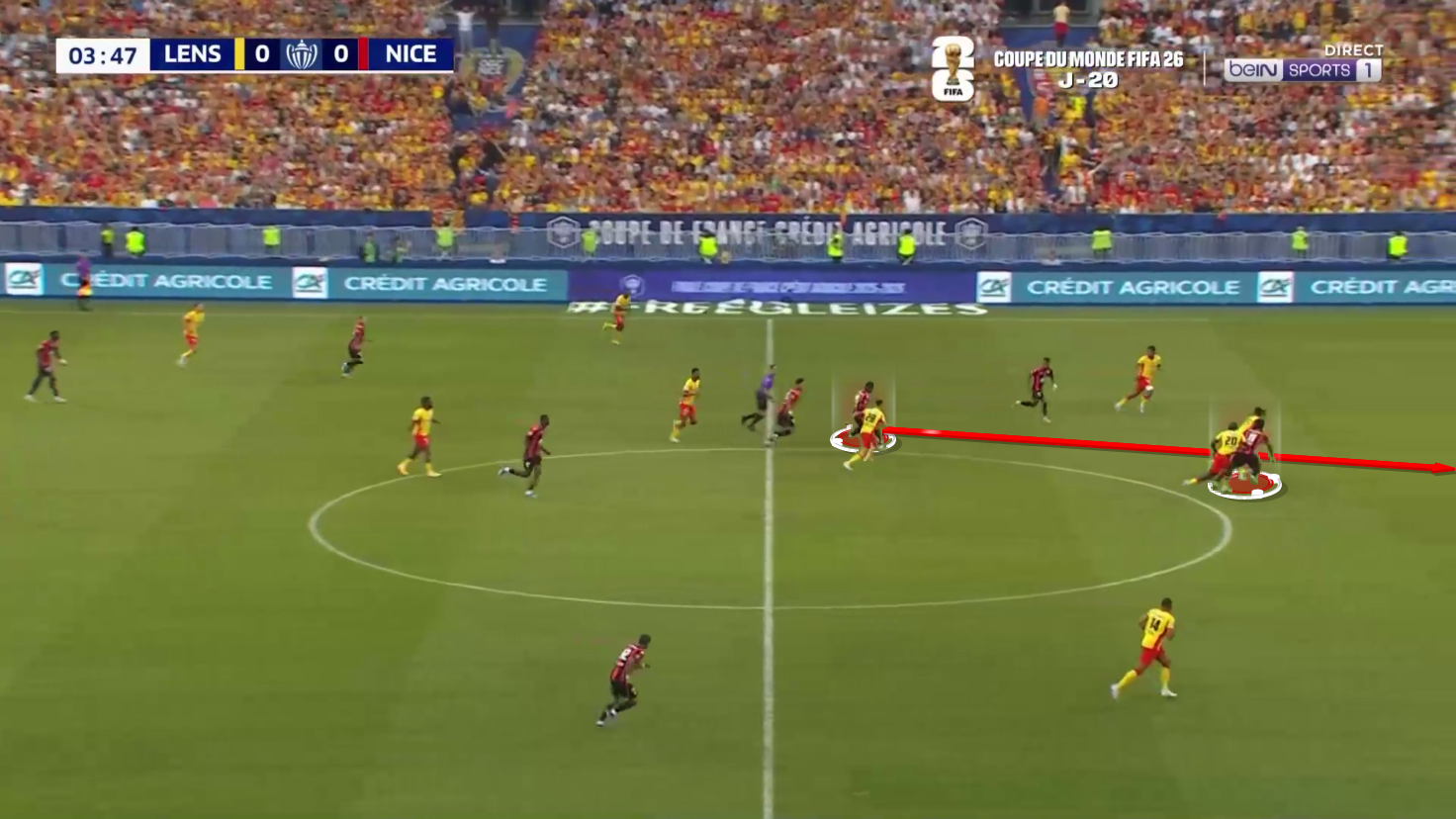
Wahi posed a real issue for Lens’ centre-backs, as he was constantly moving explosively in the non-possession phase to try to intercept the ball in very dangerous areas.
He was successful in doing so on numerous occasions, but failed to convert his interceptions and anticipation of second balls into goals due to poor finishing.
RC Lens Attacking Solutions
It was complicated for Lens to execute their match plan as they had to adapt to Nice’s intense midfield and compact shape, given Nice’s reliance on tight defensive lines most of the time.
The solutions to disturb Nice’s defence were progressively found by resorting to crosses from the wings, set-pieces, and shots from distance.
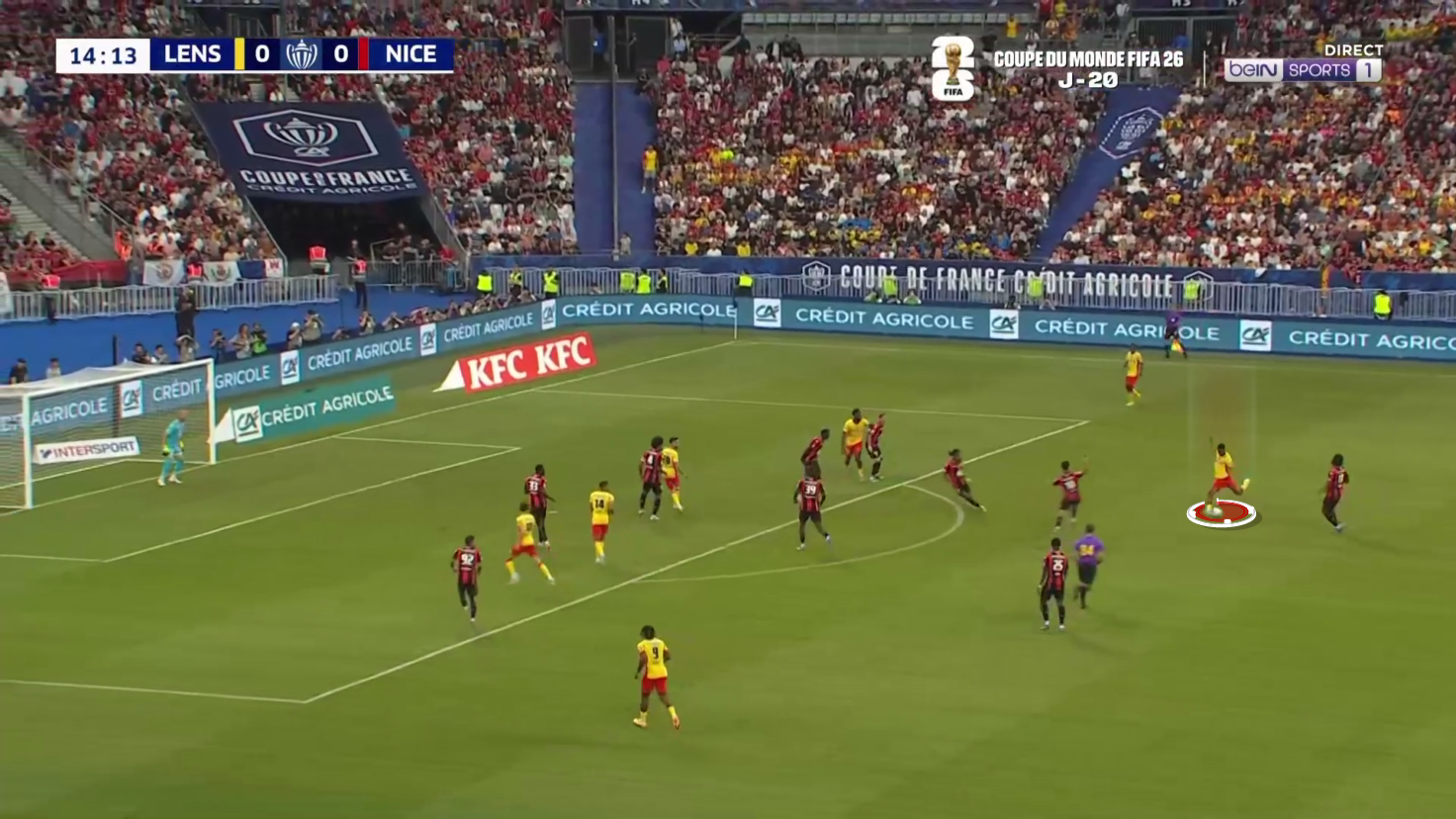
In particular, Lens relied on Sangaré and his shooting from distance on more than one occasion, exploiting the fact that Nice were always busy marking the more dangerous attacking players, Thauvin, Édouard, and Saint-Maximin.
That paved the way for Sangaré to advance from behind and gain an advantage on second balls, as well as when receiving passes inside the final third, as he was not well-marked during Lens’ attacks.
![Croatia Vs Spain [1-2] UEFA Nations League 2026/2027: How Slaven Bilić High Pressing Tactics Troubled Spain - Tactical Analysis](https://cdn.mymidnight.blog/77f959f119f4fb2321e9ce801e2f5163/size/w600/2026/10/Croatia-Vs-Spain--1-2--UEFA-Nations-League-20262027---Tactical-Analysis.png)

![Scotland Vs Switzerland [0-3] UEFA Nations League 2026/2027: How Aggressive Pressing Backfired & Murat Yakin Took Advantage - Tactical Analysis](https://cdn.mymidnight.blog/77f959f119f4fb2321e9ce801e2f5163/size/w600/2026/10/Scotland-Vs-Switzerland-20262027---Tactical-Analysis.png)
![Olympique De Marseille Vs PSG [1-2] Ligue 1 2026/2027: How Bruno Génésio Transitions Troubled PSG - Tactical Analysis](https://cdn.mymidnight.blog/77f959f119f4fb2321e9ce801e2f5163/size/w600/2026/09/Marseille-Vs-PSG-2026_2027---Tactical-Analysis.png)
![Fulham Vs Manchester United [1-1] Premier League 2026/2027: How Álvaro Arbeloa Tactics Exposed The Red Devils' Problems - Tactical Analysis](https://cdn.mymidnight.blog/77f959f119f4fb2321e9ce801e2f5163/size/w600/2026/09/Fulham-FC-Vs-Man-United-2026_2027---Tactical-Analysis.png)
![AS Roma Vs Inter Milan [2-2] Serie A 2026/2027: When Undefeated Giallorossi Attack Met Nerazzurri Comeback Resilience - Tactical Analysis](https://cdn.mymidnight.blog/77f959f119f4fb2321e9ce801e2f5163/size/w600/2026/09/AS-Roma-Vs-Inter-Milan-2026_2027---Tactical-Analysis.png)
![Real Sociedad Vs Bournemouth [1-2] Europa League 2026/2027: How Do Marco Rose Pressing Tactics Work? - Tactical Analysis](https://cdn.mymidnight.blog/77f959f119f4fb2321e9ce801e2f5163/size/w600/2026/09/Real-Sociedad-Vs-Bournemouth-20262027---Tactical-Analysis-1.png)
![AC Milan Vs Benfica [0-2] Europa League 2026/2027: How Marco Silva Tactics Exposed Rúben Amorim Defensive Problems - Tactical Analysis](https://cdn.mymidnight.blog/77f959f119f4fb2321e9ce801e2f5163/size/w600/2026/09/AC-Milan-Vs-Benfica-20262027---Tactical-Analysis.png)