
![Bayern Munich Vs Stuttgart [3–0] – DFB-Pokal Final 2025/2026: Vincent Kompany Positional Play, Half-Space Runs & Harry Kane – Tactical Analysis](https://cdn.mymidnight.blog/77f959f119f4fb2321e9ce801e2f5163/size/w1000/2026/05/DFB-Pokal-Final-20252026.png)
Bayern Munich Vs Stuttgart [3–0] – DFB-Pokal Final 2025/2026: Vincent Kompany Positional Play, Half-Space Runs & Harry Kane – Tactical Analysis

The DFB-Pokal Final at the Olympiastadion in Berlin featured a highly anticipated tactical battle between Vincent Kompany's newly-crowned Bundesliga champions, FC Bayern München, and Sebastian Hoeneß’s tactical chameleons, VfB Stuttgart.
Having traded blows in the league and established themselves as two of the most structurally sophisticated positional sides in European football, this final promised to be an elite chess match.
While the 3-0 scoreline suggests a comfortable, routine victory for the Bavarian giants, the reality on the pitch was an incredibly tight, deeply intellectual tactical struggle defined by micro-adjustments.
For the first 45 minutes, Stuttgart threatened to overrun Bayern through a brilliantly orchestrated defensive shape that completely isolated Kompany's dangerous wide players.
It required a series of structural modifications from Kompany in possession, specifically altering the behaviour of his full-backs and demanding aggressive off-the-ball movement in the half-spaces, to break Stuttgart's defensive resolve.
Ultimately, the match served as a masterclass in modern positional play, decided by minor shifts in territorial control and the terrifyingly efficient penalty-box movement of Harry Kane.
In this tactical analysis, we examine three factors that decided the game in favour of Bayern Munich and also take a look at how Stuttgart managed to make it a tightly contested game, even if the scoreline does not reflect that.
Bayern Munich Vs VfB Stuttgart Lineups & Formations
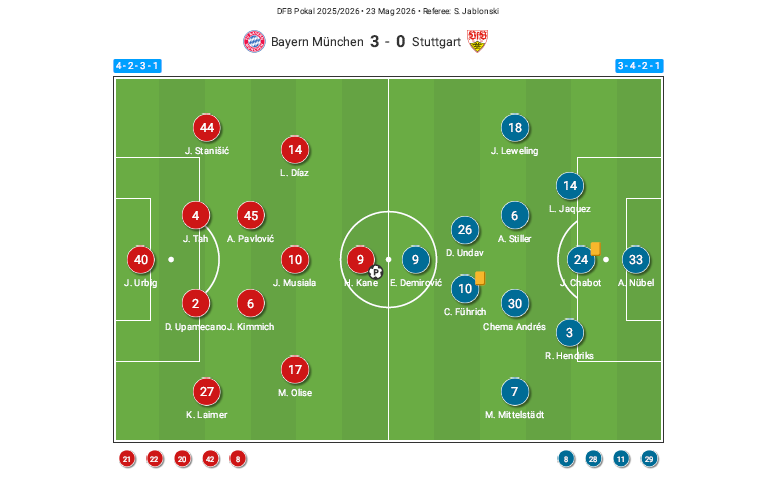
Bayern Munich Lineup Vs Stuttgart
Vincent Kompany tactics fielded a 4-2-3-1 base shape that transformed into a fluid 3-2-4-1 or 2-3-5 in possession.
With Manuel Neuer unavailable, Jonas Urbig started in goal behind centre-backs Dayot Upamecano and Jonathan Tah.
Konrad Laimer at right-back operated with license to overlap or invert, while left-back Josip Stanišić stayed deeper to form a back three during build-up.
Joshua Kimmich and Aleksandar Pavlović formed the press-resistant double pivot, anchoring an attacking line featuring Jamal Musiala in the number 10 role, flanked by Michael Olise on the right and Luis Díaz on the left, with Harry Kane leading the line.
Stuttgart Lineup Vs Bayern Munich
Sebastian Hoeneß tactics countered with a 3-4-2-1 structure that collapsed into a highly compact 5-4-1 mid-block out of possession.
Alexander Nübel lined up in goal, protected by a central defensive trio of Luca Jaquez, Jeff Chabot, and Ramon Hendriks.
Angelo Stiller and Chema Andrés formed the central midfield engine room, flanked by wing-backs Jamie Leweling on the right and Maximilian Mittelstädt on the left.
In the final third, inverted attacking midfielders Deniz Undav and Chris Führich operated in the half-spaces behind the physical, pinning presence of central striker Ermedin Demirović.
Stuttgart’s Defensive Blueprint: Disabling The Wings & Unlocking Mittelstädt
From the opening whistle, Sebastian Hoeneß’s tactical intent was clear: deny Bayern the ability to generate isolation scenarios for Michael Olise and Luis Díaz.
In Kompany’s structural framework, the wide forwards are primary offensive engines, relying on quick switches of play to isolate opposing full-backs in 1v1 situations.
To counteract this, Stuttgart implemented an asymmetric defensive block that shifted seamlessly between a medium press and a deep-lying containment shape.
When Bayern attempted to build out through Upamecano and Tah, Stuttgart’s front line did not engage in a frantic high press.
Instead, Demirović focused on shadowing Pavlović, cutting off the direct vertical passing lane into the young midfielder.
Simultaneously, Undav and Führich tucked inward to narrow the space, forcing Kimmich to drop deeper to receive the ball.
This narrow midfield shape meant that the central corridors were completely congested, effectively forcing Bayern to circulate the ball horizontally towards their full-backs.
![Croatia Vs Spain [1-2] UEFA Nations League 2026/2027: How Slaven Bilić High Pressing Tactics Troubled Spain - Tactical Analysis](https://cdn.mymidnight.blog/77f959f119f4fb2321e9ce801e2f5163/size/w600/2026/10/Croatia-Vs-Spain--1-2--UEFA-Nations-League-20262027---Tactical-Analysis.png)

![Scotland Vs Switzerland [0-3] UEFA Nations League 2026/2027: How Aggressive Pressing Backfired & Murat Yakin Took Advantage - Tactical Analysis](https://cdn.mymidnight.blog/77f959f119f4fb2321e9ce801e2f5163/size/w600/2026/10/Scotland-Vs-Switzerland-20262027---Tactical-Analysis.png)
![Olympique De Marseille Vs PSG [1-2] Ligue 1 2026/2027: How Bruno Génésio Transitions Troubled PSG - Tactical Analysis](https://cdn.mymidnight.blog/77f959f119f4fb2321e9ce801e2f5163/size/w600/2026/09/Marseille-Vs-PSG-2026_2027---Tactical-Analysis.png)
![Fulham Vs Manchester United [1-1] Premier League 2026/2027: How Álvaro Arbeloa Tactics Exposed The Red Devils' Problems - Tactical Analysis](https://cdn.mymidnight.blog/77f959f119f4fb2321e9ce801e2f5163/size/w600/2026/09/Fulham-FC-Vs-Man-United-2026_2027---Tactical-Analysis.png)
![AS Roma Vs Inter Milan [2-2] Serie A 2026/2027: When Undefeated Giallorossi Attack Met Nerazzurri Comeback Resilience - Tactical Analysis](https://cdn.mymidnight.blog/77f959f119f4fb2321e9ce801e2f5163/size/w600/2026/09/AS-Roma-Vs-Inter-Milan-2026_2027---Tactical-Analysis.png)
![Real Sociedad Vs Bournemouth [1-2] Europa League 2026/2027: How Do Marco Rose Pressing Tactics Work? - Tactical Analysis](https://cdn.mymidnight.blog/77f959f119f4fb2321e9ce801e2f5163/size/w600/2026/09/Real-Sociedad-Vs-Bournemouth-20262027---Tactical-Analysis-1.png)
![AC Milan Vs Benfica [0-2] Europa League 2026/2027: How Marco Silva Tactics Exposed Rúben Amorim Defensive Problems - Tactical Analysis](https://cdn.mymidnight.blog/77f959f119f4fb2321e9ce801e2f5163/size/w600/2026/09/AC-Milan-Vs-Benfica-20262027---Tactical-Analysis.png)