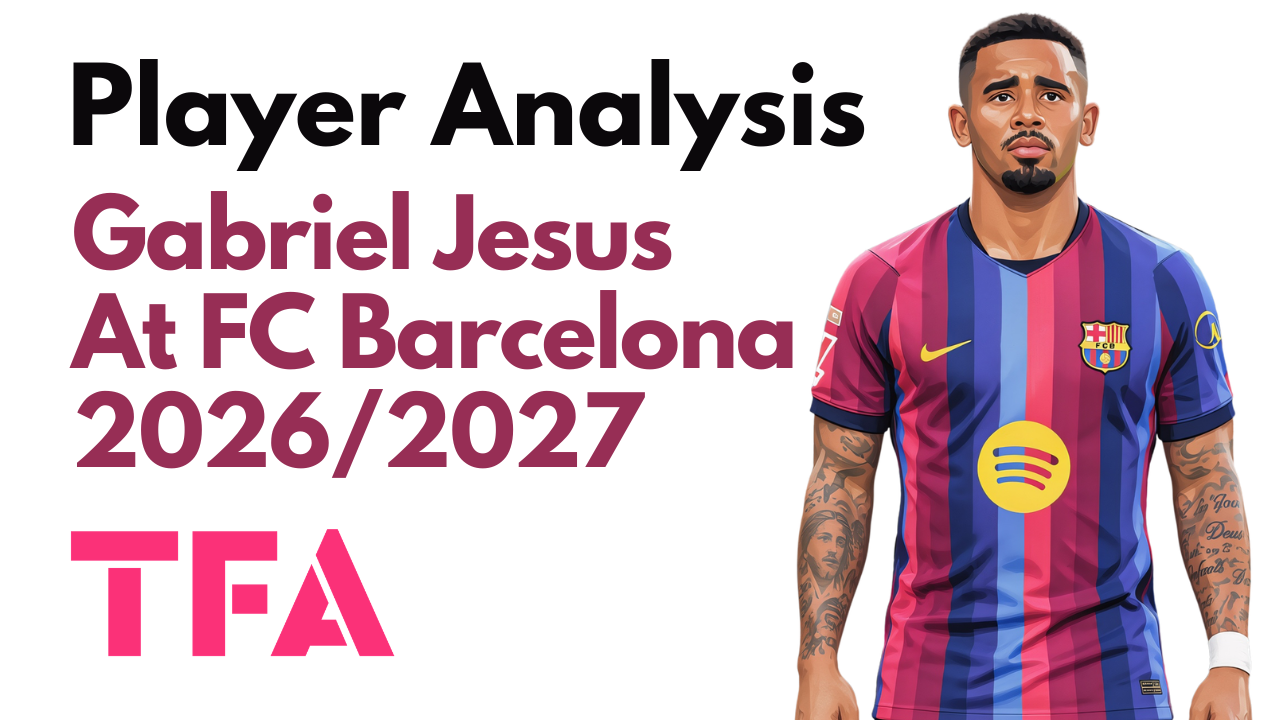
Gabriel Jesus Scout Report At Barcelona 2026/2027: Can Hansi Flick Tactics Unlock The Versatile Signing From Arsenal? - Data Analysis
Barcelona needed more than a goalscorer to replace Robert Lewandowski and Ferran Torres. This data analysis examines Gabriel Jesus’ pressing, counterpressing, penalty-area threat, carrying and progressive play to assess how the Brazilian can fit Hansi Flick’s demanding tactical system.

Barcelona entered the 2026/2027 season with a clear problem in the centre-forward position.
The departures of Robert Lewandowski and Ferran Torres left Hansi Flick without an established No. 9, while 18-year-old Hamza Abdelkarim emerged as the only natural striker in the squad.
Despite an impressive pre-season, relying heavily on a teenager with limited senior experience represented a significant risk over a long campaign.
Barcelona’s preferred solution was Julián Alvarez, but Atlético Madrid refused to negotiate, forcing the club to explore alternative options before the transfer window closed.
Gabriel Jesus ultimately arrived from Arsenal for a reported fee of around €10m plus add-ons, signing until 2029.
But why was Jesus the chosen solution?
This Gabriel Jesus data analysis examines the Brazilian forward’s pressing, movement, work rate, link-up play and attacking qualities to understand exactly how he can fit Flick’s demanding system.
Barcelona Attacking Requirements
Barcelona’s need for a new centre-forward was shaped by the departures of Robert Lewandowski and Ferran Torres, leaving Hansi Flick without two forwards who had become important components of his attacking structure.
Despite his age, Lewandowski continued to provide qualities that suited Barcelona’s requirements, combining penalty-box presence, link-up play and intelligent movement with an ability to consistently threaten the opposition goal.
Torres offered a different profile, with greater mobility and versatility across the front line.
Goals & Box Presence Among Top La Liga Forwards In La Liga 2025/2026
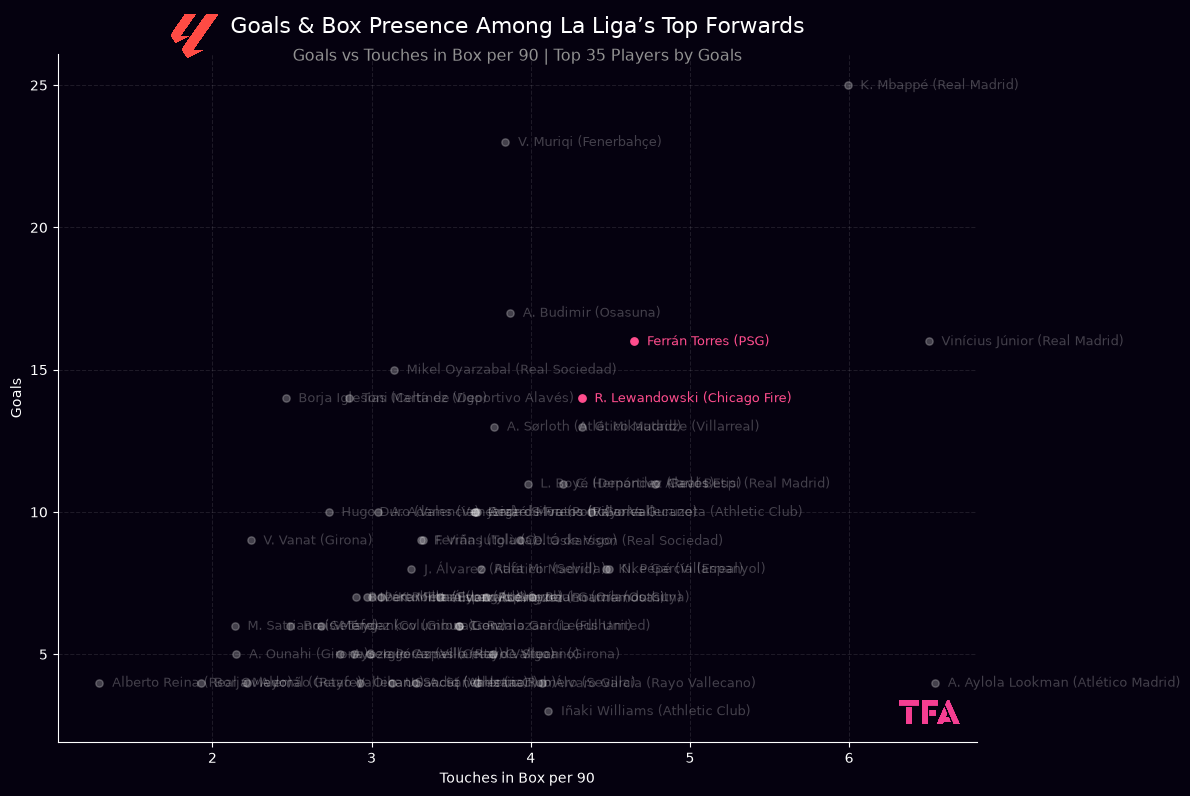
The pair scored 29 La Liga goals last season, while also ranking highly within the squad for attacking metrics such as touches inside the box.
The attacking role at Barcelona extends beyond scoring goals.
Flick requires his forwards to initiate pressure, remain active after possession is lost and help increase the intensity of the press.
Lewandowski and Torres both contributed to this defensive phase through their positioning, pressing actions and ability to restrict passing options from the first line.
Their work helped Barcelona maintain pressure higher up the pitch, reducing the opponent’s time and space in possession and supporting a lower PPDA.
The new striker must therefore combine attacking production with pressing intensity, movement and link-up ability.
A Pressing Profile Built For Hansi Flick Tactics
Gabriel Jesus arrived as a pragmatic solution to the immediate shortage at centre-forward, but his selection was clearly about more than availability.
The Brazilian offers a profile that can reproduce several of the defensive and tactical qualities Barcelona demand from their forwards.
Despite playing fewer than 1,000 minutes for Arsenal in 2025/2026, Jesus ranked as the second-highest pressing striker among centre-forwards in the top-five European leagues, behind Brighton’s Charalampos Kostoulas.
Gabriel Jesus Pressing Map With Arsenal 2025/2026
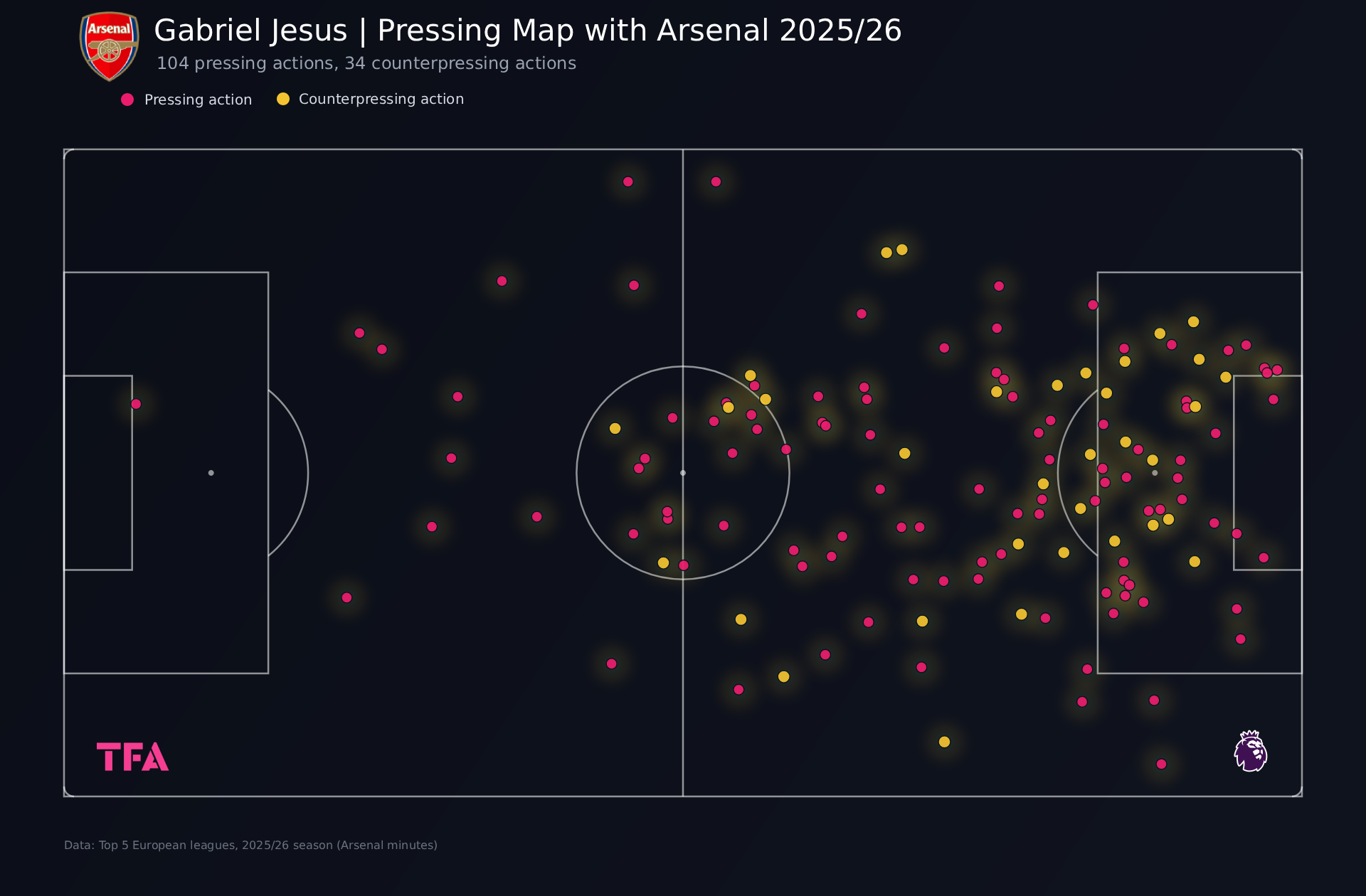
Within that limited sample, he registered 104 pressing actions and 34 counterpressing actions, highlighting the intensity he can bring even without sustained minutes.
Jesus averaged 28.22 pressures per 90 minutes, a figure that placed him in the 95th percentile among top-five league centre-forwards.
His 7.36 pressure regains per 90 also fell within the 95th percentile, showing that his pressure was not simply about applying intensity, but also about helping his team recover possession.
His counterpressing numbers were even more impressive, with 6.95 counterpressures per 90 placing him in the 97th percentile, while his 2.45 counterpressure regains per 90 were also in the 97th percentile.
Overall, Jesus recorded 30.47 defensive actions per 90, alongside 7.98 defensive-action regains per 90, in the 94th percentile.
Gabriel Jesus Out-Of-Possession Percentiles With Arsenal 2025/2026
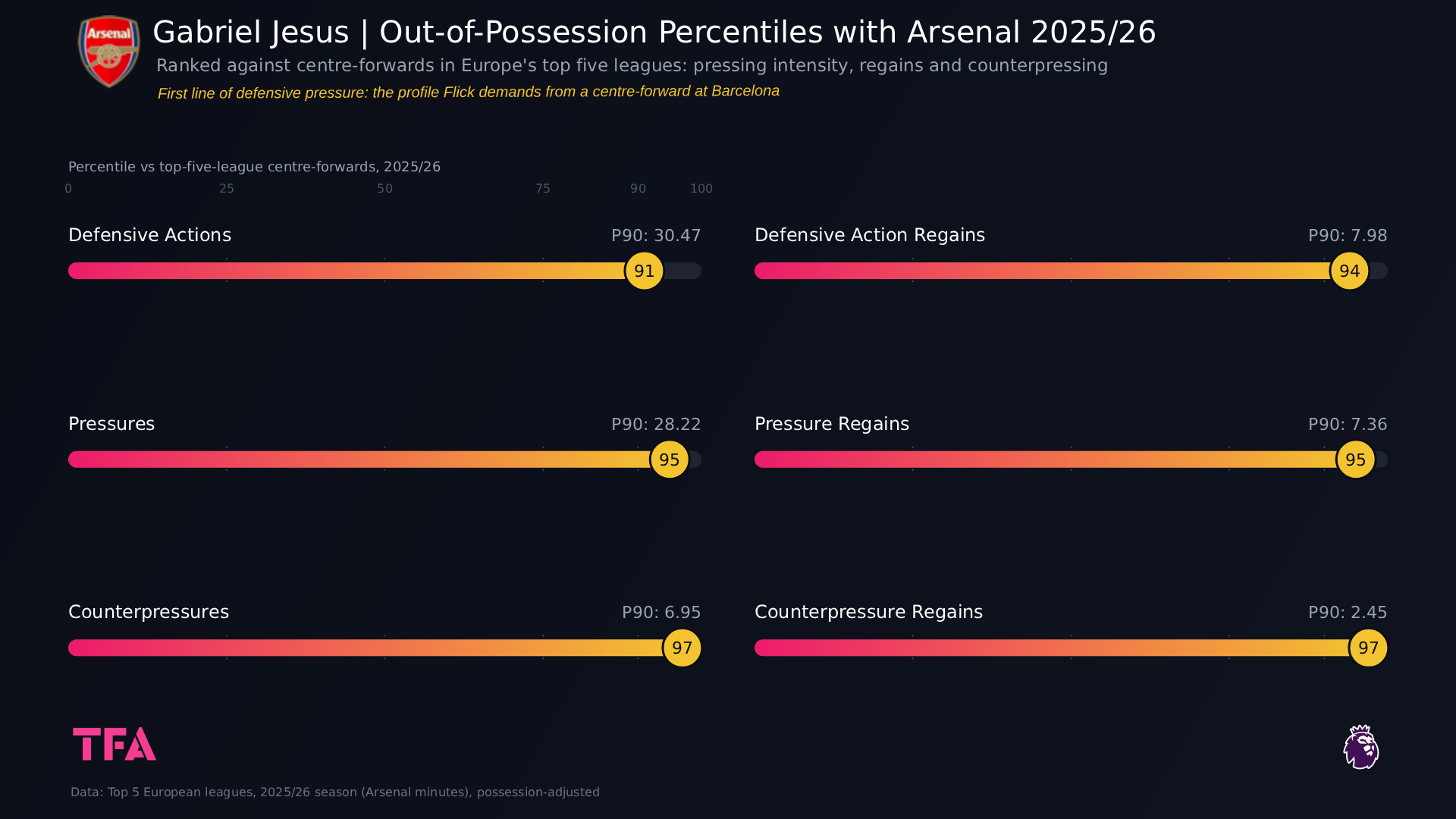
These figures highlight a forward who remains highly active without the ball, capable of pressing opponents, reacting immediately after turnovers and contributing to possession recoveries.
This is particularly relevant to Flick’s requirements, where the centre-forward acts as the first line of defensive pressure and plays an important role in closing passing lanes and maintaining the team’s intensity higher up the pitch.
Jesus, therefore, offers Barcelona more than a short-term solution to their shortage of forwards.
His pressing and counterpressing profile closely aligns with the defensive demands of Flick’s system, giving the manager a forward capable of triggering pressure in advanced areas while helping the team sustain its aggressive approach without the ball.
A Direct Threat Inside The Box
Despite playing fewer than 1,000 minutes for Arsenal in 2025/2026, Gabriel Jesus still demonstrated an attacking profile that could address another important requirement for Barcelona: direct involvement inside the penalty area.
Jesus attempted 41 shots, with 36 coming from inside the box, accounting for almost 88% of his total attempts.
Of those, 20 were on target, while his efforts from inside the area generated 6.20 xG and produced six goals.
By contrast, he attempted only five shots from outside the box, with just one resulting in a goal.