
![Atlético Madrid Vs Arsenal [1-1] – Champions League Semi-Final First Leg 2025/2026: Structure Over Spectacle – Tactical Analysis](https://cdn.mymidnight.blog/77f959f119f4fb2321e9ce801e2f5163/size/w1000/2026/05/Atle--tico-Madrid-Vs-Arsenal-20252026.png)
Atlético Madrid Vs Arsenal [1-1] – Champions League Semi-Final First Leg 2025/2026: Structure Over Spectacle – Tactical Analysis

After the goal-fest, the grind.
After the symphony, the street fight.
While Paris Saint-Germain and Bayern Munich played out a nine-goal thriller, Arsenal's trip to the Metropolitano offered a different kind of Champions League semi-final.
This was a game of three penalties: two converted and one controversially overturned.
It was a contest determined by the narrowest of margins, fitting for a duel between Mikel Arteta and Diego Simeone, two managers renowned for favouring structure over flamboyance.
In this tactical analysis, we look at Mikel Arteta tactics and Diego Simeone tactics during this 1-1 draw.
We will examine how Arsenal attempted to control the central lane, Atlético de Madrid’s use of wide overloads, and the second-half system changes that left the tie finely poised ahead of the second leg in London.
Atlético Madrid Vs Arsenal Lineups & Formations
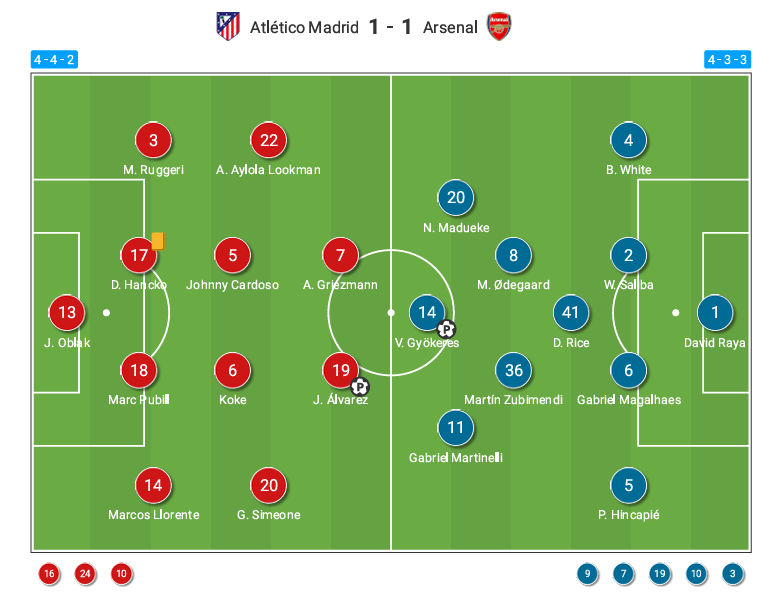
Atlético de Madrid set up in their familiar 4-4-2 defensive shape, which often morphed into a back five or six depending on the phase of play.
Jan Oblak started in goal.
The back four consisted of Marcos Llorente (right-back), Marc Pubill (right centre-back), Dávid Hancko (left centre-back), and Matteo Ruggeri (left-back).
The midfield was comprised of Giuliano Simeone, Koke, Johnny Cardoso, and Ademola Lookman.
In attack, Antoine Griezmann supported Julián Álvarez.
Arsenal utilised a 4-3-3 formation.
David Raya started between the sticks.
The defensive line featured Ben White (right-back), William Saliba (right centre-back), Gabriel Magalhães (left centre-back), and Piero Hincapié (left-back).
The midfield trio saw Declan Rice and Martin Ødegaard acting as a double pivot in the build-up, with Martin Zubimendi positioned slightly further forward to link play.
The front three consisted of Noni Madueke (right-winger), Viktor Gyökeres (centre-forward), and Gabriel Martinelli (left-winger).
Mikel Arteta Tactics: Closing The Central Lane
Arsenal’s approach in the first half was defined by their refusal to let Atlético Madrid play through the centre of the pitch.
Arteta instructed his side to accumulate players in the central channel to man-mark Cardoso and Koke closely.
When Atlético Madrid attempted to build from the back, they relied on their double pivot staying at the same height to connect the defence to the attack.
However, Arsenal’s central density forced Atlético away from their preferred options.
This left Simeone’s side with only one reliable outlet: long balls toward the wingers or full-backs.
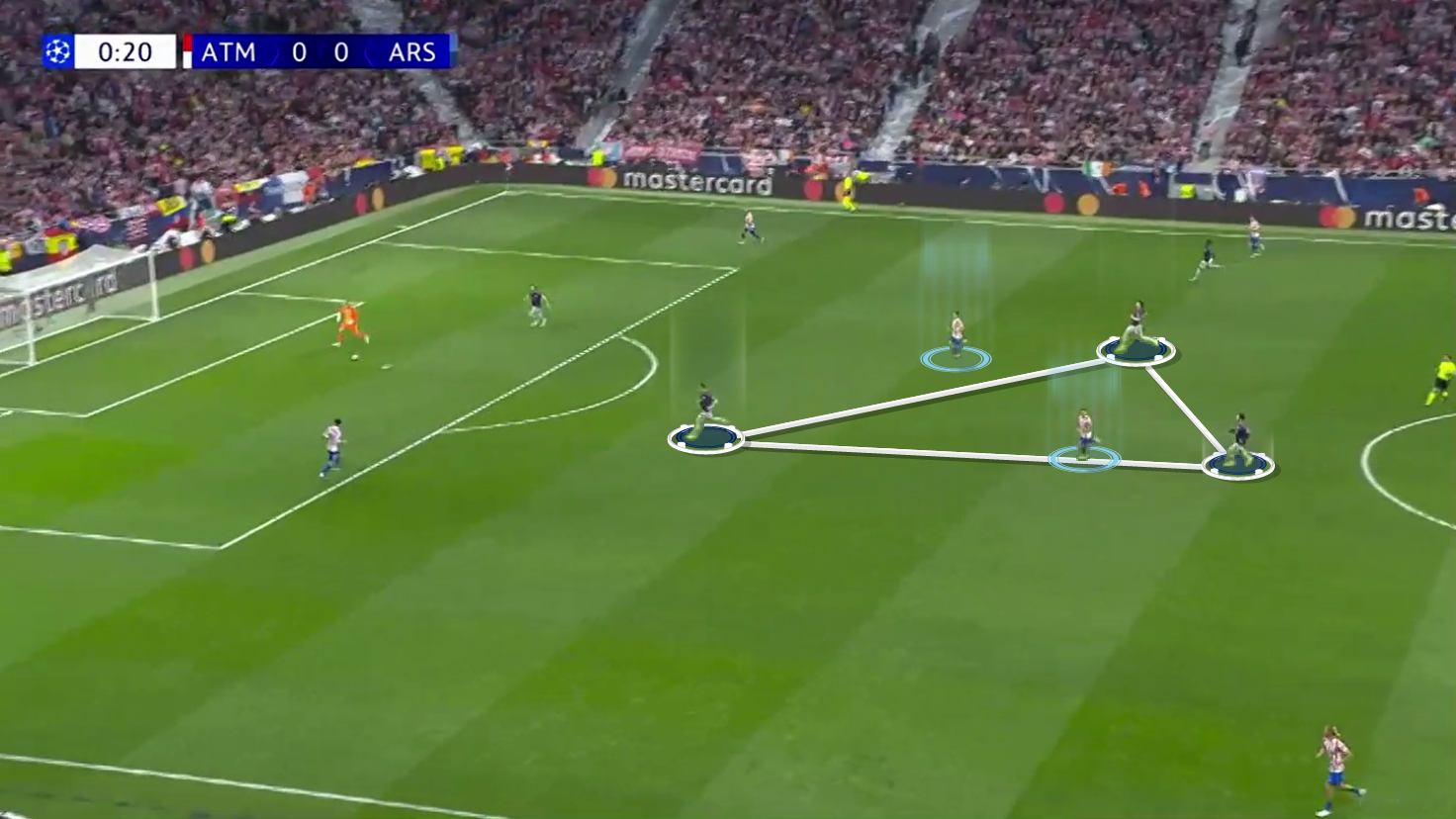
In the opening seconds, Arsenal established their defensive intent.
As seen in the image, three Arsenal players form a tight triangle around Atlético’s central midfielder.
This 'cage' prevents any vertical pass from Jan Oblak or the centre-backs into the double pivot, forcing the play toward the flanks immediately.
By neutralising the double pivot, Arsenal gained significant control in the first half.
Rice was used in a deeper role, charged with both instigating the build-up and snuffing out counterattacks.
This structural discipline allowed Arsenal to weather the early storm from the home crowd and the intimidating atmosphere of the Metropolitano.
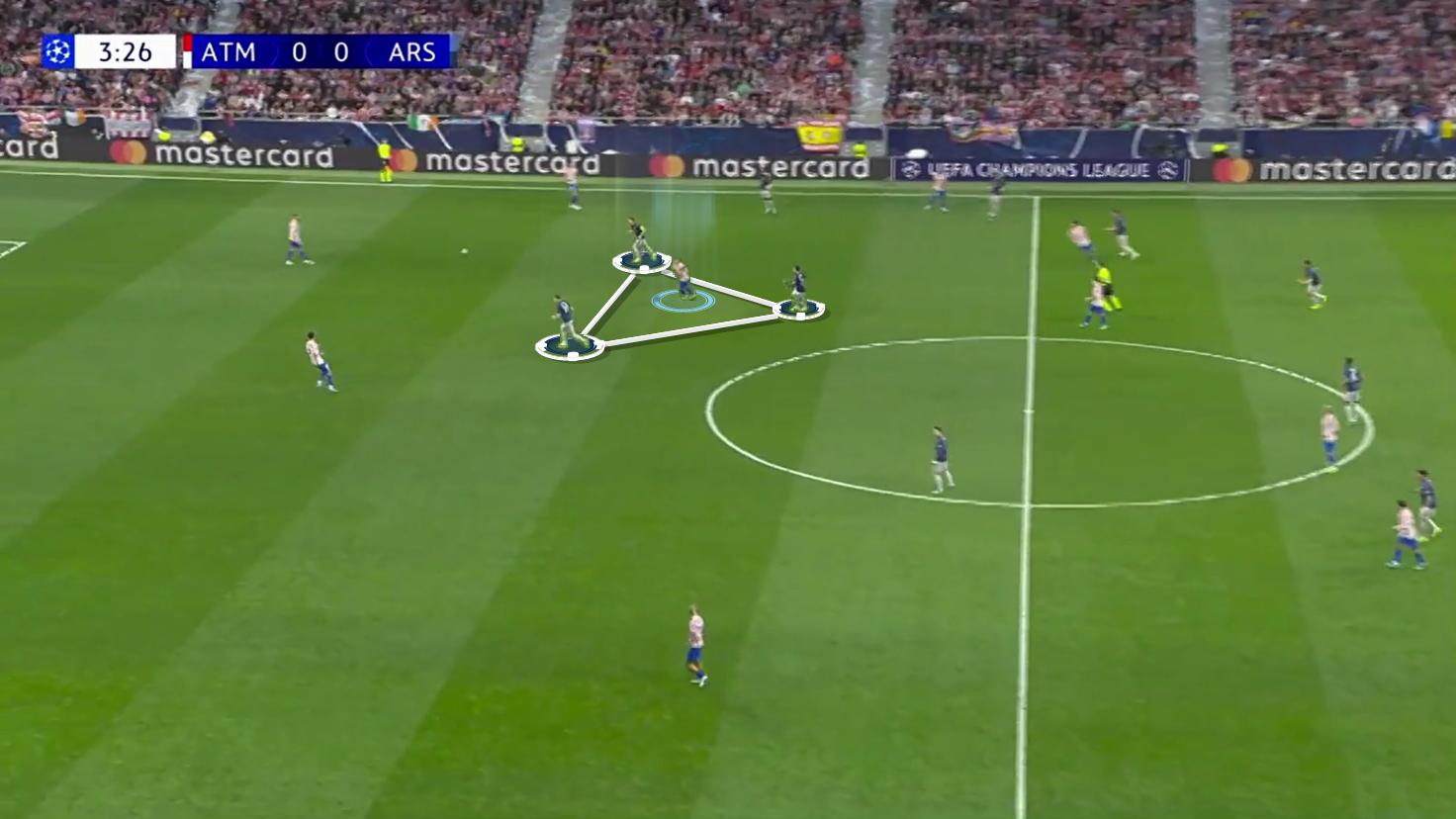
This second play demonstrates the systematic nature of Arteta’s tactics.
By maintaining this triangular structure around the ball-carrier in the central channel, Arsenal successfully suffocated Atlético’s build-up.
This forced Simeone's side to abandon the middle and rely on long balls, as the central passing lanes were effectively disconnected.
Diego Simeone Tactics: Wide Overloads & Triangles
While Arsenal closed the centre, Atlético Madrid looked to exploit the wide channels.
Simeone’s side is known for accumulating players in exterior corridors once they cross the halfway line.
When Atlético moved into the attacking third, they didn't just use a winger; they often committed two or three players to the flank.
Llorente and Ruggeri frequently pushed high to create 2v1 situations against Arsenal’s full-backs.
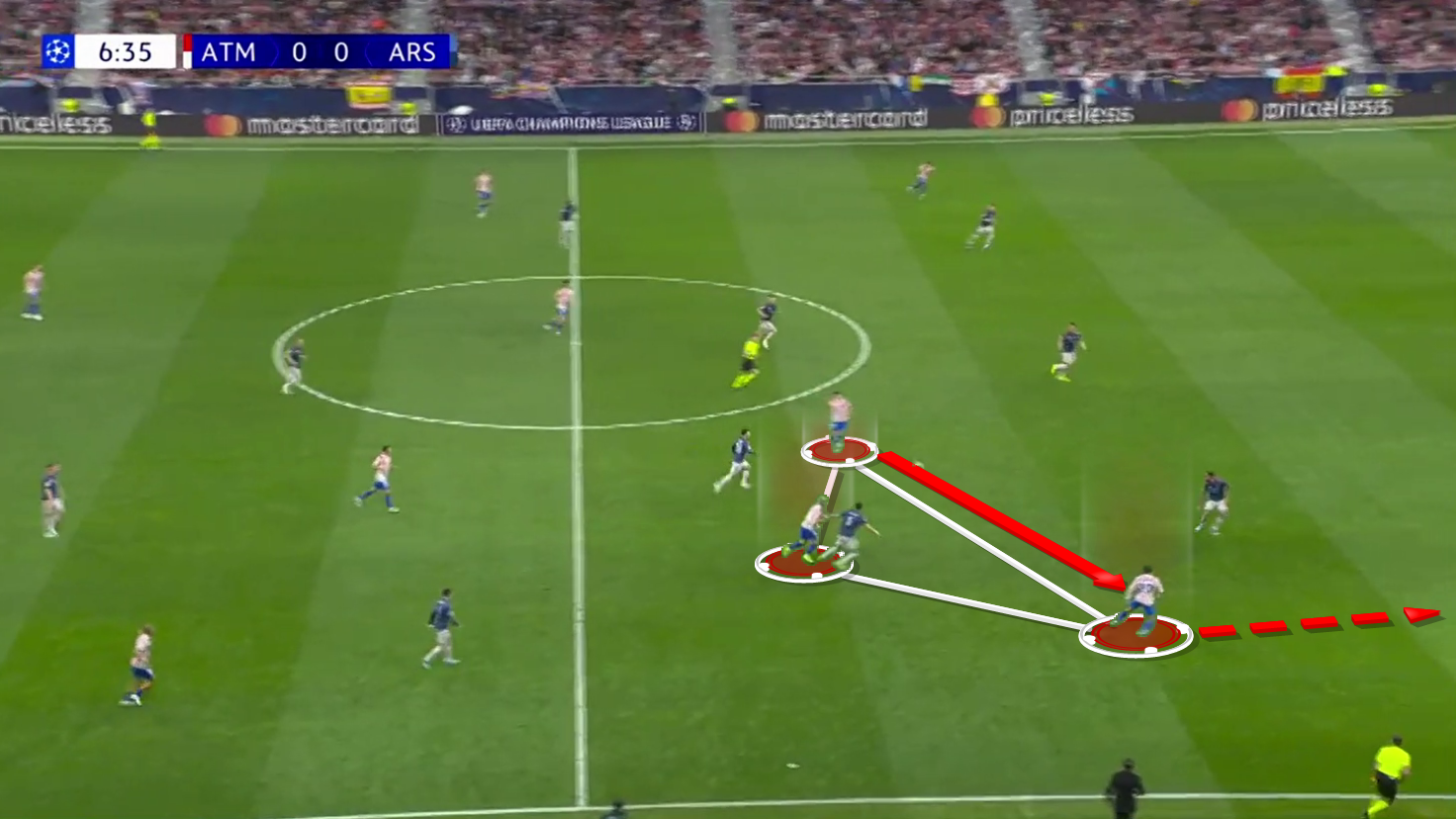
To further complicate the defensive task for Arsenal, Griezmann would drift wide to form a tactical triangle.
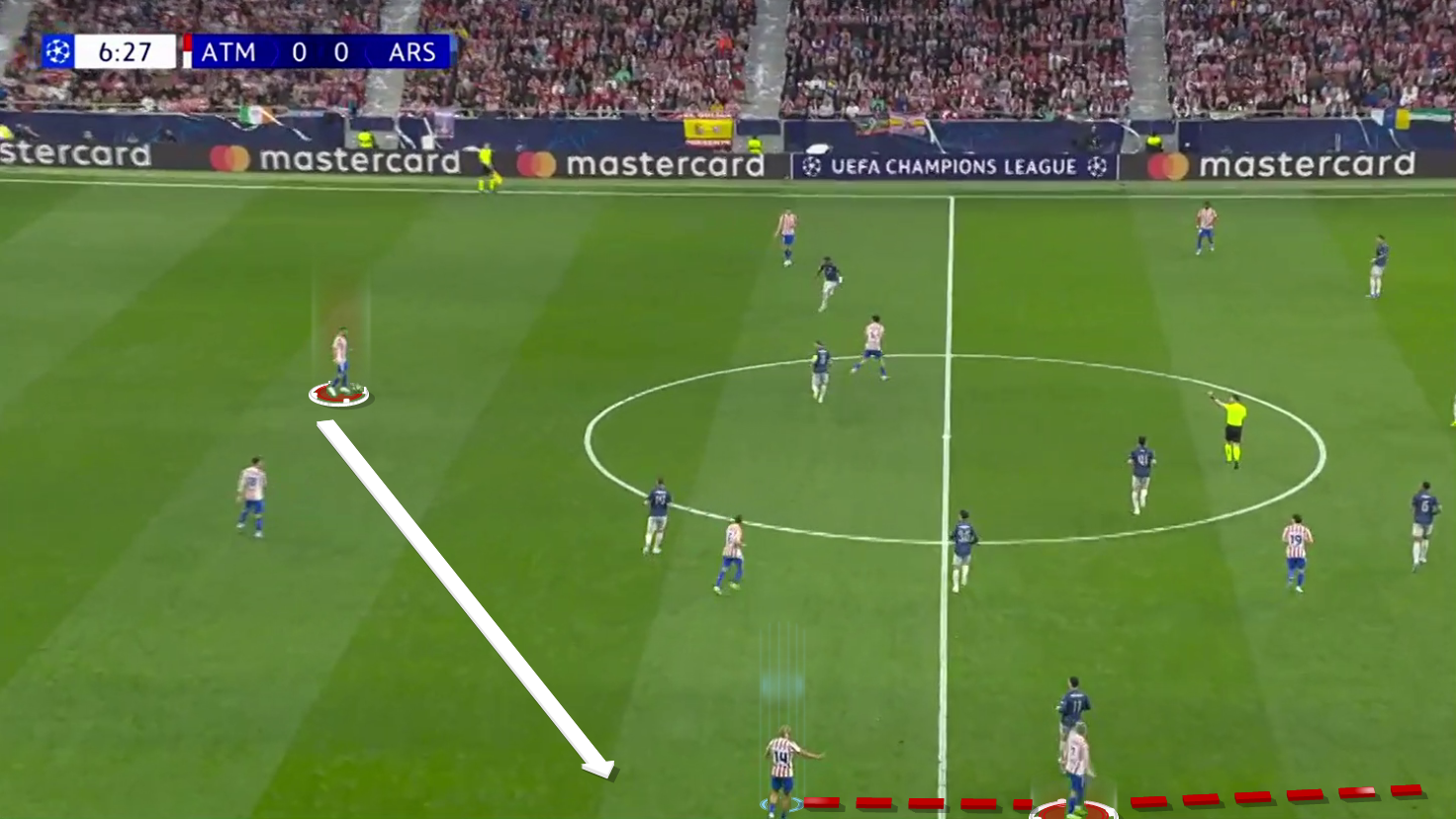
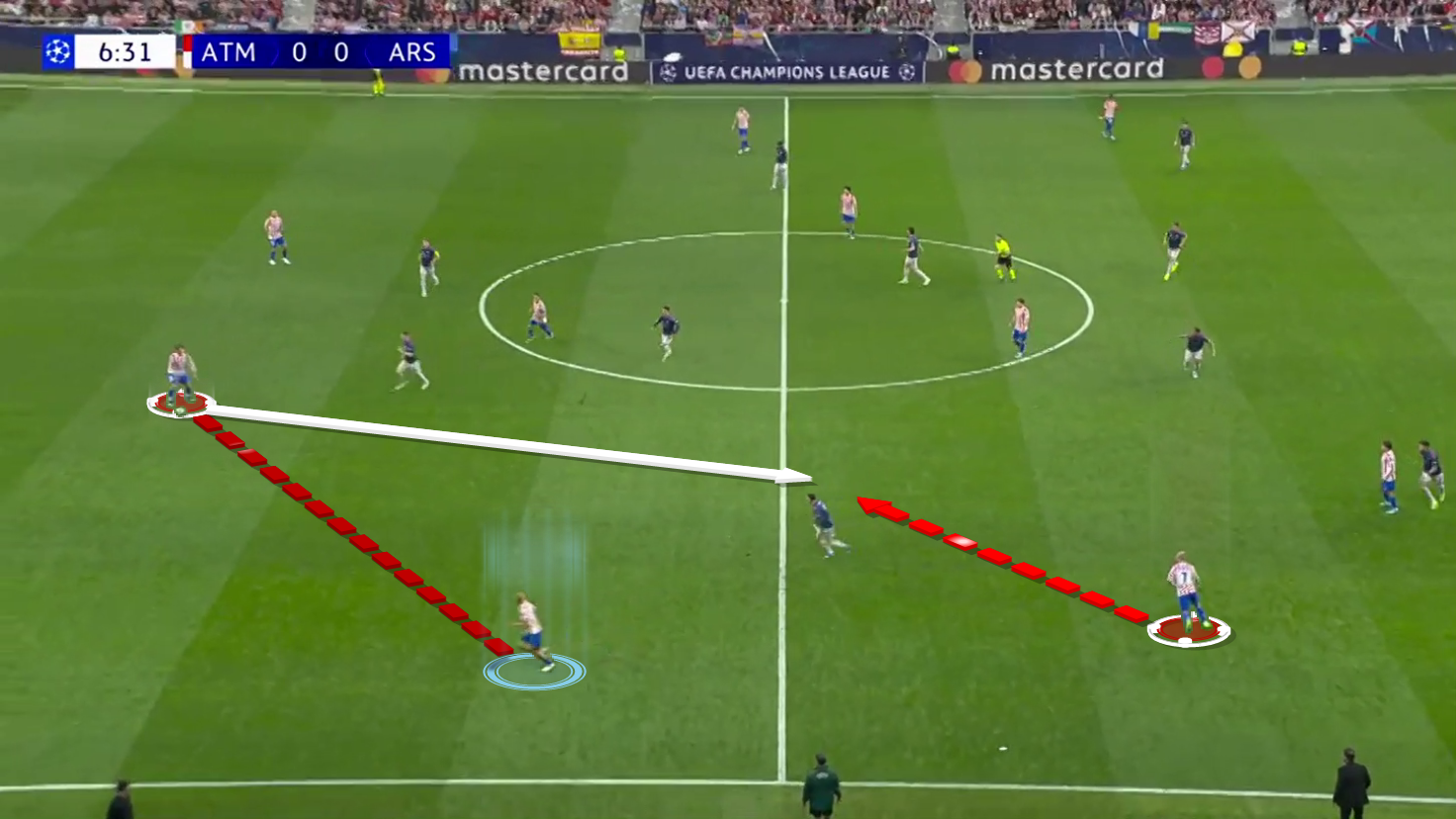
In the first stage of the sequence, Atlético identifies the central congestion and immediately shifts the focus to the flank.
A long diagonal pass is triggered toward the right wing, targeting the space behind Arsenal's high-pressing line.
This move forces the Arsenal block to shift horizontally, opening the first crack in their defensive structure.
As the ball reaches the wide channel, the "Griezmann factor" comes into play.
Instead of staying central, the Frenchman drifts toward the touchline to support Marcos Llorente.
This movement is crucial; it creates an immediate 3v2 overload against the Arsenal full-back, drawing defensive cover away from the box and forcing the Gunners' wingers to track back deeper than they would like.
![Real Sociedad Vs Bournemouth [1-2] Europa League 2026/2027: How Do Marco Rose Pressing Tactics Work? - Tactical Analysis](https://cdn.mymidnight.blog/77f959f119f4fb2321e9ce801e2f5163/size/w600/2026/09/Real-Sociedad-Vs-Bournemouth-20262027---Tactical-Analysis-1.png)
![AC Milan Vs Benfica [0-2] Europa League 2026/2027: How Marco Silva Tactics Exposed Rúben Amorim Defensive Problems - Tactical Analysis](https://cdn.mymidnight.blog/77f959f119f4fb2321e9ce801e2f5163/size/w600/2026/09/AC-Milan-Vs-Benfica-20262027---Tactical-Analysis.png)
![Sunderland Vs AZ Alkmaar [1-0] Europa League 2026/2027: Why The Black Cats Make Better Underdogs - Tactical Analysis](https://cdn.mymidnight.blog/77f959f119f4fb2321e9ce801e2f5163/size/w600/2026/09/Sunderland-Vs-AZ-Alkmaar-20262027---Tactical-Analysis.png)
![Leeds United Vs Newcastle United [4-1] Premier League 2026/2027: Why Did Daniel Farke Tactics Dominate The Magpies? - Tactical Analysis](https://cdn.mymidnight.blog/77f959f119f4fb2321e9ce801e2f5163/size/w600/2026/09/Leeds-United-Vs-Newcastle-2026_2027---Tactical-Analysis.png)
![Real Sociedad Vs Atlético Madrid [0-3] La Liga 2026/2027: How Diego Simeone Tactical Precision Rescued A Late Victory - Tactical Analysis](https://cdn.mymidnight.blog/77f959f119f4fb2321e9ce801e2f5163/size/w600/2026/09/Real-Sociedad-Vs-Atl--tico-Madrid-20262027---Tactical-Analysis-1.png)
![Manchester United Vs Manchester City [0-1] Premier League 2026/2027: How Enzo Maresca Tactics Secured Victory With 10 Men - Tactical Analysis](https://cdn.mymidnight.blog/77f959f119f4fb2321e9ce801e2f5163/size/w600/2026/09/Manchester-United-Vs-Manchester-City--20262027---Tactical-Analysis.png)
![Tottenham Hotspur Vs Everton [0-0] Premier League 2026/2027: Why Can't Spurs Score? - Tactical Analysis](https://cdn.mymidnight.blog/77f959f119f4fb2321e9ce801e2f5163/size/w600/2026/09/Tottenham---Vs-Everton-20262027---Tactical-Analysis.png)
![West Ham United Vs Wrexham [6-0] EFL Championship 2026/2027: The Cost Of Passive Defending Against Smart Movement - Tactical Analysis](https://cdn.mymidnight.blog/77f959f119f4fb2321e9ce801e2f5163/size/w600/2026/09/West-Ham-United-Vs-Wrexham-2026_2027---Tactical-Analysis.png)