
Jesper Sørensen Tactics At Vancouver Whitecaps 2026: Can His Football Deliver An MLS Cup? – Data Analysis
Jesper Sørensen has transformed Vancouver Whitecaps into one of MLS’ strongest teams. This tactical and data analysis examines their build-up, progression, counterpressing and recent attacking dip while comparing his ideas with Brøndby.
During my time working at FC Midtjylland, Jesper Sørensen's Brøndby IF was one of the teams I remember most clearly.
They were always a difficult opponent, and I particularly enjoyed watching their football.
They played an attractive, possession-based game, with players like Yuito Suzuki and Mathias Kvistgaarden making them particularly dangerous in attack.
I always appreciated their ability to combine in tight spaces and control possession.
So when I recently came across Sørensen's name again and saw that he was managing Vancouver Whitecaps, I was curious to see what he had been doing since leaving Denmark.
A quick look at the results suggested things were going rather well.
In his first season, Vancouver reached both the MLS Cup and CONCACAF Champions Cup finals, setting club records for points (63), wins (18) and goals (66).
This season, they sit top of the Western Conference with 58 points after 32 matches.
However, their underlying numbers are even more impressive: Vancouver lead MLS in non-penalty expected goal difference (+0.89 per match), rank first in npxG created (2.01), and rank second in npxG conceded (1.12).
This Jesper Sørensen tactical analysis examines the question: how much of the Brøndby I remembered could I still recognise in his Vancouver side?
From Brøndby To Vancouver
That Brøndby side came remarkably close to winning the Danish Superliga in 2023/2024.
Sørensen's team finished just one point behind FC Midtjylland, with the title slipping away after a 3-2 defeat to AGF on the final day.
What made that season particularly interesting was the contrast between the two title contenders.
While Midtjylland relied on a more direct approach, Brøndby preferred to build patiently, combine through midfield and control possession.
Two very different ways of playing, separated by a single point.
Sørensen left Brøndby in December 2024 and took charge of Vancouver Whitecaps the following month.
He replaced Vanni Sartini, whose team had generally favoured a more direct approach, particularly when building from the back.
It was a different starting point from the one Sørensen had found in Denmark.
A Familiar Approach To Building From The Back
One of the clearest similarities between Sørensen's approach at Brøndby and Vancouver is how his teams build from the back.
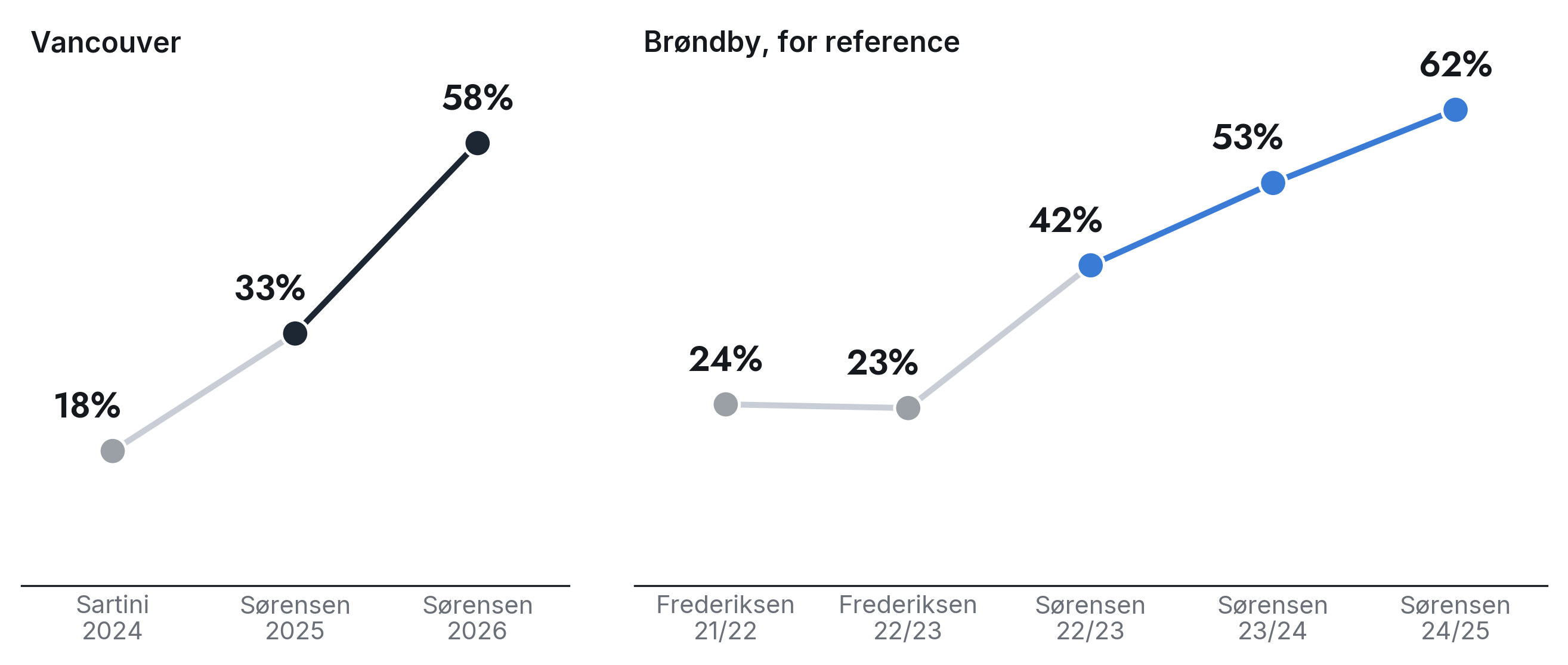
At Brøndby, only 23% of goal kicks ended inside their own penalty area under Niels Frederiksen in 2022/2023.
That figure rose to 42% following Sørensen's arrival, before increasing to 53% in 2023/2024 and 62% during his final months at the club.
Vancouver have followed a similar pattern.
Under Vanni Sartini in 2024, just 18% of goal kicks ended inside their own penalty area.
In Sørensen's first season, that share increased to 33%, reaching 58% in 2026.
Evolution Of Goal Kicks: Brøndby & Vancouver
Vancouver's goal kicks offer a closer look at how Sørensen wants his team to start their attacks.
In 2026, 71% travel less than 30 metres, the highest proportion in MLS, with an average distance of just 21 metres compared with the league average of 33.
The goalkeeper, Yohei Takaoka, plays an important role in this structure.
Rather than simply distributing the ball to his defenders, he is often involved as a receiver himself.
Of goal kicks with an identified recipient, 42% go to Takaoka.
Playing short from goal kicks is one thing, but Vancouver also need to find ways to move the ball forward against opposition pressure.
Across all build-up sequences starting in their defensive third, Vancouver manage to break through the opposition's first line 62% of the time, a figure that has remained remarkably consistent throughout the season.
The responsibility for progressing the ball is shared across the defensive line, although two players stand out.
Opponents Played Past Per 90 Minutes
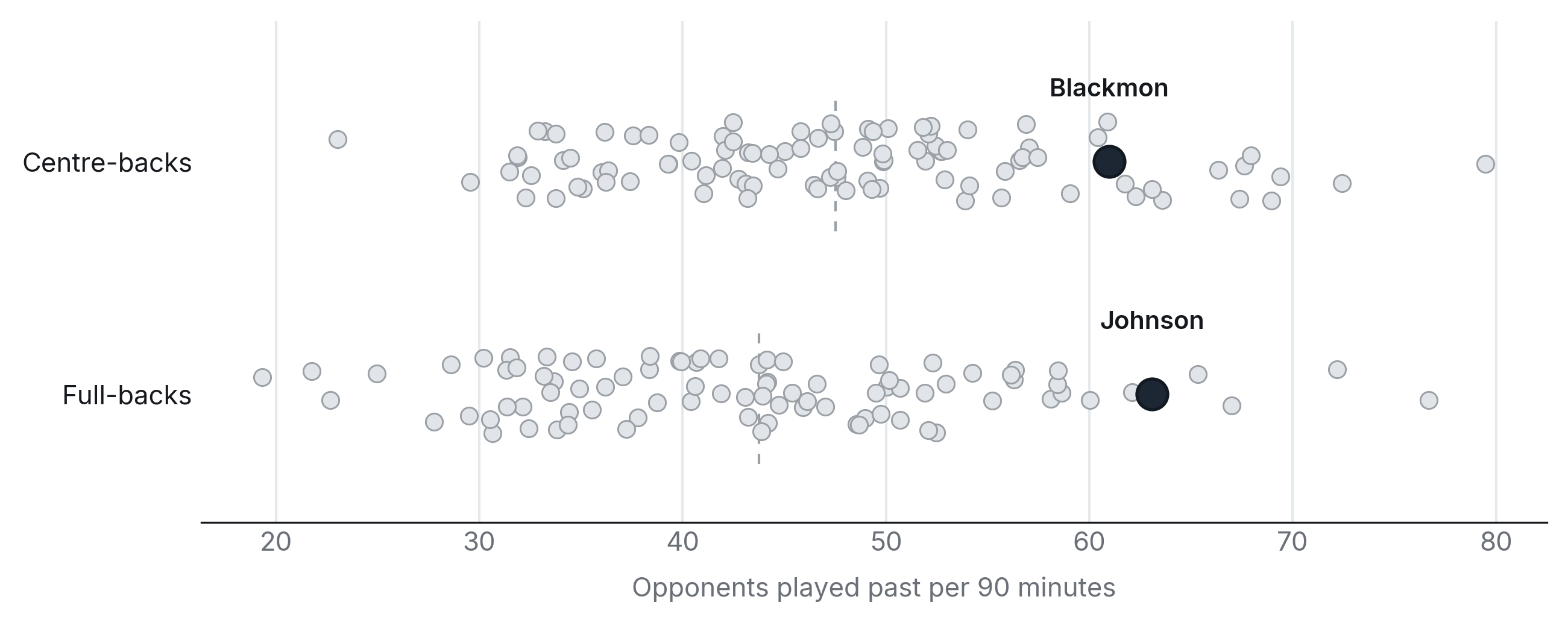
Tristan Blackmon, at centre-back, plays past an average of 61 opponents per 90 minutes (88th percentile among MLS centre-backs), while left-back Tate Johnson averages 63.1 (96th percentile).
Together, they provide important routes for Vancouver to progress possession beyond their own half.
How Do Vancouver Progress The Ball?
We've seen how Vancouver build from the back, but how do they actually move the ball up the pitch?
Vancouver have three main ways of progressing the ball, and each works a little differently.
More than 60% of the opponents they play past are bypassed by actions from their goalkeeper and defenders, with 61% of the team's total coming from ground passes.
The left and right sides contribute in fairly similar proportions (36% and 38%, respectively), but the way Vancouver use each flank is quite different.
On the right, Vancouver rely heavily on the connection between Tristan Blackmon and Édier Ocampo.
Blackmon has found Ocampo with 115 progressive passes this season, more than any other combination in the team.
Ocampo receives out wide in 83% of those passes, usually around the halfway line, and carries the ball down the right flank in 91% of his following actions.
It's a fairly straightforward pattern: Blackmon finds Ocampo near the touchline, giving him the opportunity to carry the ball forward.
On the left, Vancouver play quite differently.
Tate Johnson generally starts near the touchline and looks to combine with Thomas Müller and Ryan Gauld.
He has played 54 progressive passes to Müller and 41 to Gauld, making him their main source of progression from deeper positions.
Both players regularly move towards the left to receive from Johnson.
Müller receives out wide in 69% of these situations and between the lines in 24%, while Gauld receives wide in 39% and between the lines in 37%.
With Bruno Caicedo also involved on that flank, Vancouver have several players combining in relatively small spaces.
Müller frequently plays the ball back to Johnson, who receives a quarter of his passes, helping them maintain possession and find different ways forward.