

Premier League 2026/2027: Is Possession Football Losing Its Power? - Data Analysis
Is possession losing its Premier League advantage? This data analysis examines falling win rates for high-possession teams, rising physical demands, fast breaks, direct attacks and the shift away from patient build-up.

Possession has long been regarded as one of the defining principles of modern Premier League football, reaching its peak during Pep Guardiola’s dominance at Manchester City, Jürgen Klopp’s high-intensity Liverpool era, and the early stages of Mikel Arteta’s project at Arsenal.
Controlling the ball, building patiently from the back and dictating the tempo became central to the pursuit of success.
However, recent seasons have raised questions about whether this philosophy is losing some of its former significance, as teams increasingly embrace direct attacks, rapid transitions and a more pragmatic approach to winning matches.
Does having more of the ball still provide the same competitive advantage, or are Premier League teams learning to succeed without it?
Are counterattacks and vertical football becoming more effective alternatives to sustained possession?
In this Premier League data analysis, we compare statistics from the 2026/2027 campaign with previous seasons to examine changing trends in possession, attacking output and match results, exploring whether the Premier League is entering a new tactical era.
The Changing Role Of Possession In The Premier League
Since Pep Guardiola’s arrival at Manchester City in 2016, possession-based football has become increasingly influential in the Premier League.
Teams have placed greater emphasis on controlled build-up, shorter passing sequences and territorial dominance, with several managers attempting to replicate aspects of Guardiola’s approach.
The relationship between possession and winning has shifted in recent seasons.
In 2024/2025, victories were almost evenly distributed between teams with more and less than 50% possession.
This pattern continued into 2025/2026, when sides winning with less than 50% of the ball recorded 139 victories, compared with 137 for teams exceeding that threshold.
Premier League 2005/2006-2026/2027 Games Won By Possession Share
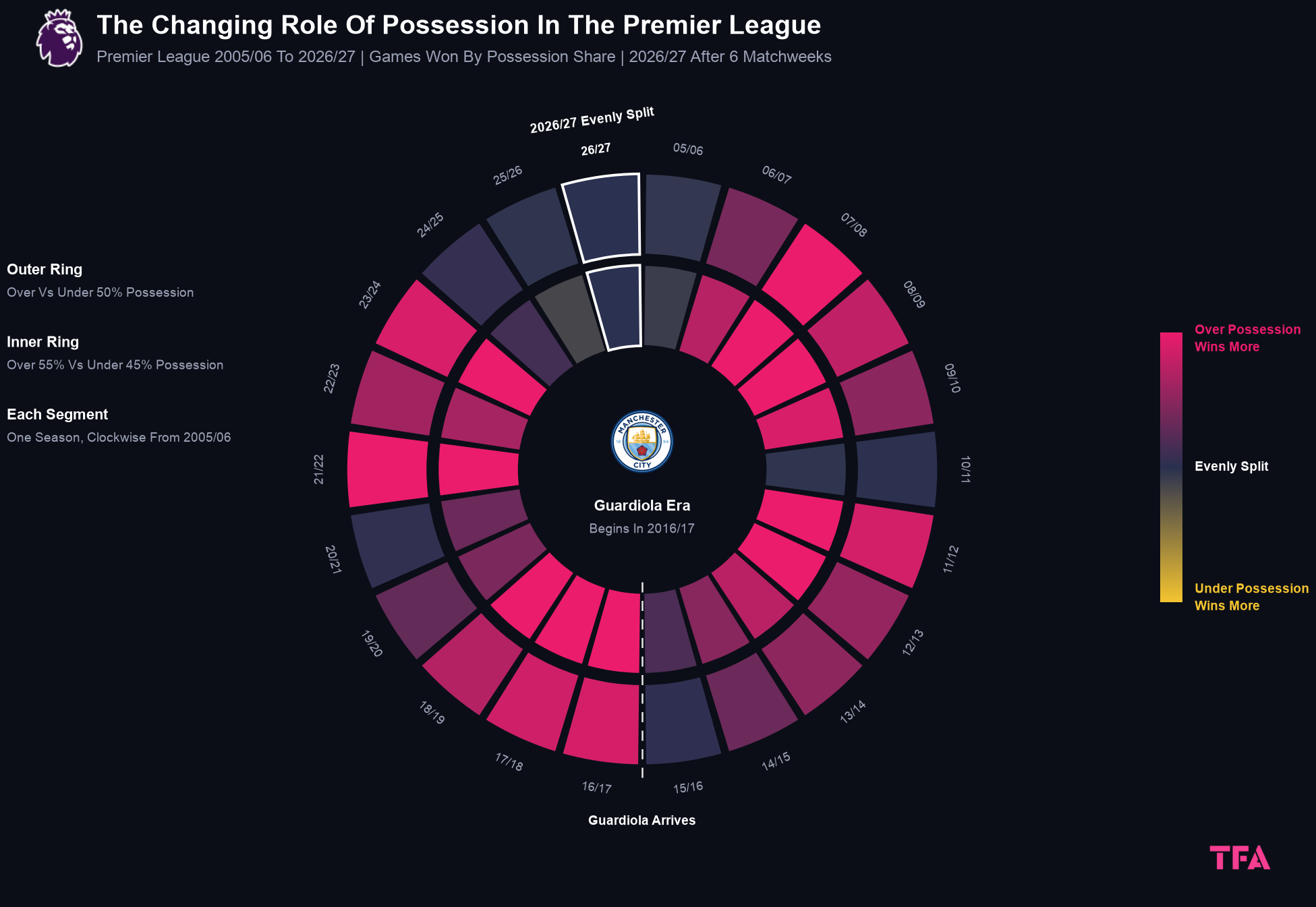
Across the first six matchweeks, victories were evenly split between teams with above and below 50% possession.
Although these figures alone can’t establish a direct link between lower possession and success, they raise an important tactical question: are Premier League teams increasingly prioritising defensive organisation, direct attacks and quick transitions over sustained possession?
Is High Possession Losing Its Competitive Advantage?
To address this question, the relationship between possession and winning provides a useful starting point.
Following Pep Guardiola’s arrival at Manchester City in 2016, averaging at least 60% possession became increasingly common in the Premier League.
The effectiveness of this approach appears to have declined in recent seasons.
In 2025/2026, teams recording at least 60% possession won just 34.1% of their matches, the lowest rate on record.
The early figures for 2026/2027 suggest a similar pattern; across the first matches, teams reaching that threshold won only eight of the 22 games in which they did so, producing a win rate of 36.4%.
Premier League 2005/2006-2026/2027 Win % Of Teams With 60% Possession In A Match
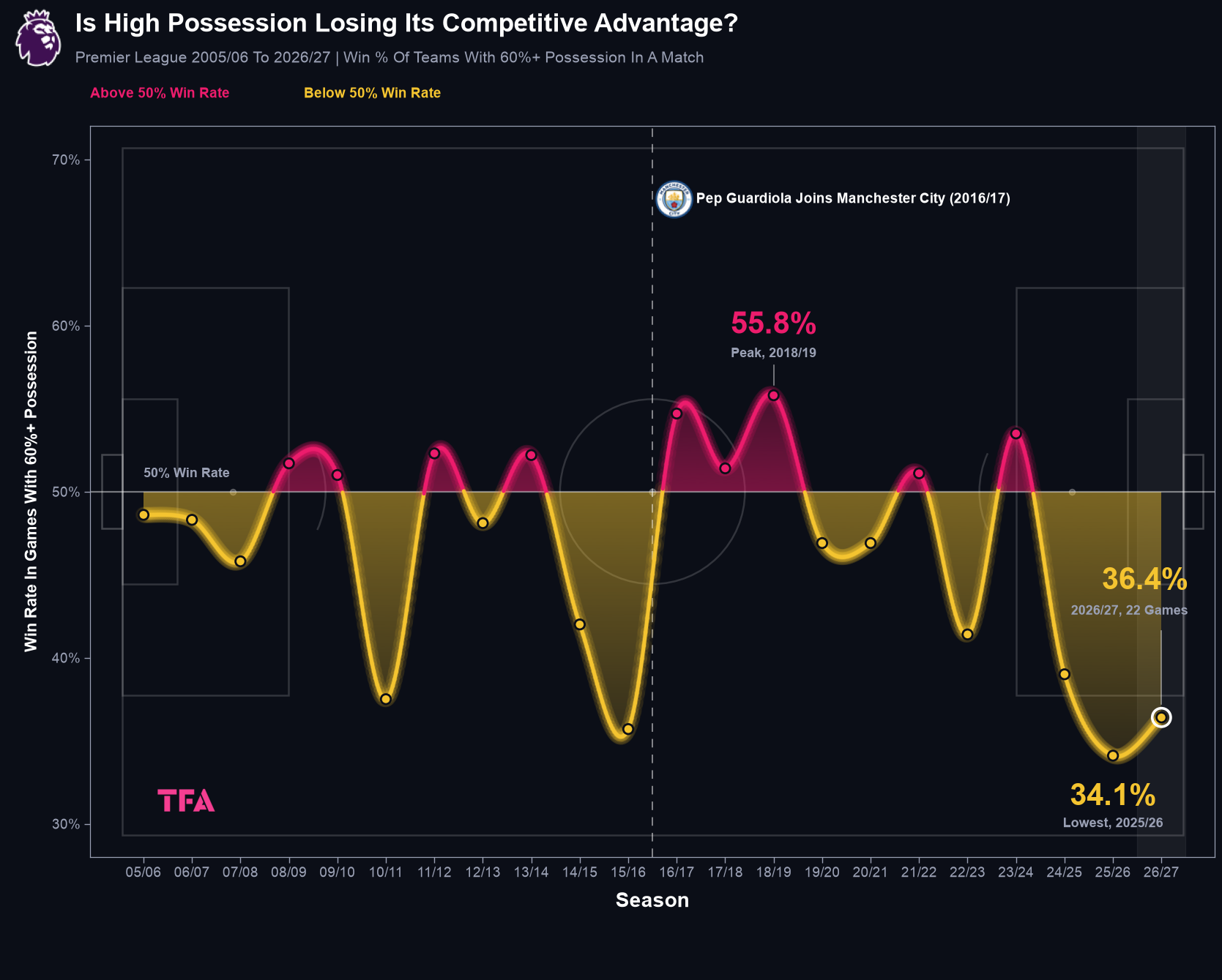
These figures indicate that dominating possession does not necessarily translate into victories.
Tottenham Hotspur’s struggles despite averaging over 60% possession further illustrate this point, as territorial control alone can’t guarantee effective attacking output or defensive security.
Although the current sample remains limited, the declining win rate raises questions about the competitive value of sustained possession.
As opponents increasingly adopt compact defensive structures and exploit spaces through direct attacks and rapid transitions.
The key consideration is whether possession remains an advantage in itself, or whether its value increasingly depends on how effectively teams turn control into chances and goals.
The Increasing Physical Demands Of Premier League Football
The changing tactical landscape of the Premier League may also be increasing the physical demands placed on players.
As teams look to exploit spaces more quickly and respond to changes in possession, they must cover greater distances to support attacks, recover defensively and maintain their structure throughout matches.
The figures for 2026/2027 show that every team is covering more ground per match than in the previous campaign, suggesting that the increase in physical workload is a league-wide trend across different tactical approaches.