

Xabi Alonso Tactics At Chelsea 2026/2027: How Is His Bayer Leverkusen Blueprint Changing In The Premier League? - Data Analysis
Xabi Alonso has brought familiar ideas from Leverkusen to Chelsea, but adapted them to a very different squad. This data analysis examines their box entries, build-up, midfield progression, wide attacks, transitions and pressing.

When Xabi Alonso arrived at Chelsea in the summer of 2026, after three seasons at Bayer Leverkusen and a brief spell at Real Madrid, there was an obvious reference point for what his team might look like: the Leverkusen side that won the Bundesliga in 2023/2024.
Seven Premier League matches into his tenure, that resemblance is easy to find on the tactics board.
Chelsea have started five of those games in the same 5-2-2-1 formation.
However, sharing a formation does not mean sharing a way of playing.
Alonso has brought Leverkusen's idea to London, not Leverkusen's team.
He is adapting his principles to a different group of players.
The changes run through every line of the team, from how Chelsea build their attacks to where they recover the ball.
This Xabi Alonso and Chelsea data analysis examines how one of the defining features of the Spanish tactician's football remains: how his teams find their way into the opposition box.
Chelsea Box Entries
Despite the differences between his teams at Bayer Leverkusen, Real Madrid and Chelsea, one aspect of Xabi Alonso's football has remained consistent: how they enter the opposition box.
Leverkusen averaged 35.1 successful box entries per match during the 2023/2024 Bundesliga season, compared with 28.4 at Real Madrid.
Seven Premier League matches into his Chelsea tenure, that figure stands at 28.3.
The volume is similar to Real Madrid's, but the more interesting resemblance is how those entries are produced.
Leverkusen ranked second in the Bundesliga for box entries through both passes and dribbles.
Alonso's Madrid also ranked second in La Liga for both metrics, while Chelsea currently sit third and fourth, respectively, in the Premier League.
In all three leagues, the preference is the same: into the box through passing and carrying.
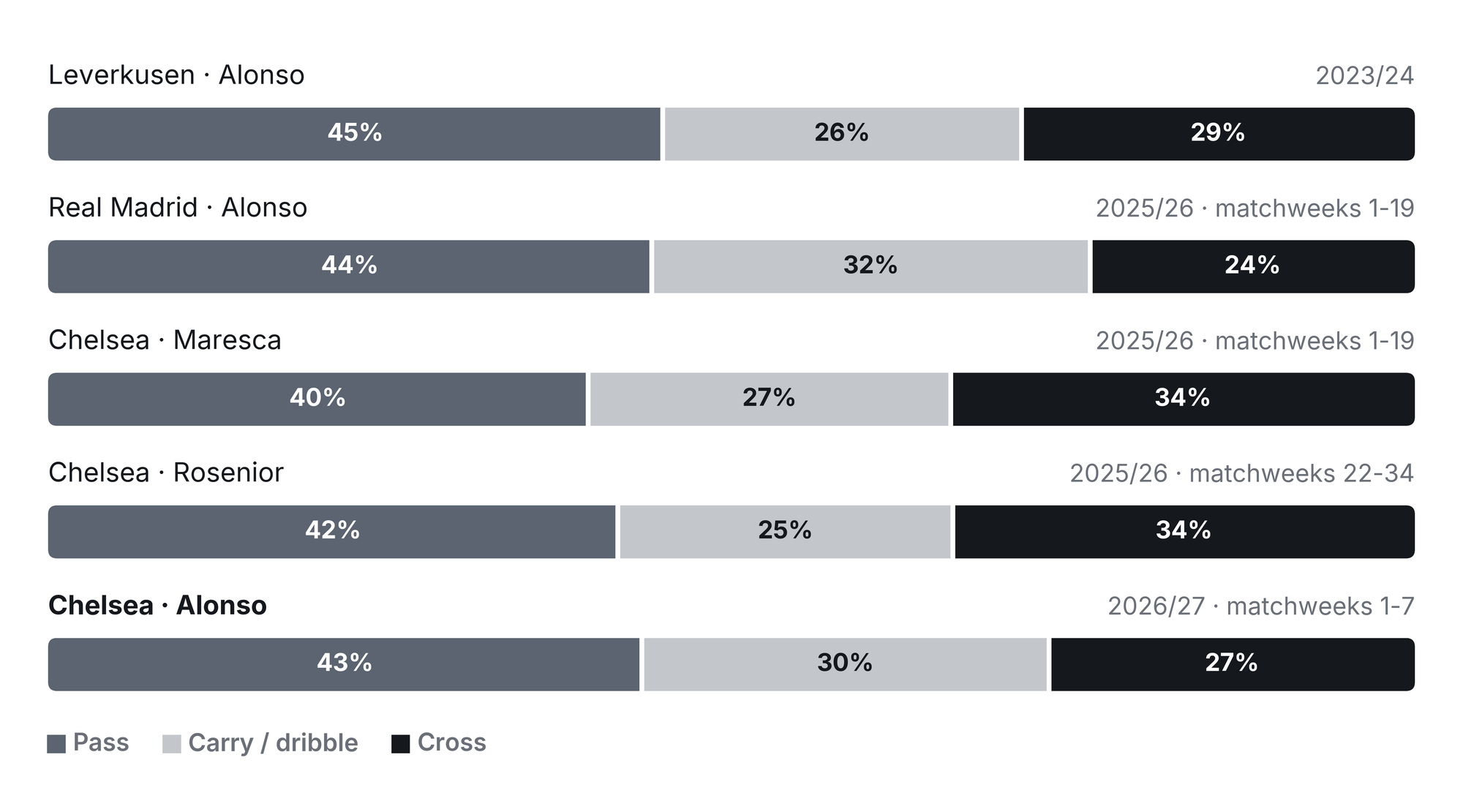
At Leverkusen, 45% of successful box entries came through passes, 26% through carries or dribbles and 29% through crosses.
Madrid followed almost the same pattern (44%, 32% and 24%), as Chelsea now do (43%, 30% and 27%).
That matters because Chelsea were not playing this way last season.
Under both Enzo Maresca and Liam Rosenior, crosses accounted for 34% of successful box entries.
Under Alonso, that share has fallen to 27%, while carries and dribbles have risen from 25-27% to 30%.
The change is modest but consistent with what his previous teams produced.
How Do Xabi Alonso Teams Enter The Opposition Box?
Chelsea are reaching the box in similar ways, but building their attacks differently.
Leverkusen averaged 124.7 receptions between the opposition lines per match, the highest figure in the Bundesliga.
Chelsea currently average just 62.7, ranking ninth in the Premier League.
They are arriving in the box through familiar methods, but without the same level of progression through the spaces between the opposition's lines.
How Do Chelsea Build From The Back?
The similarities between Alonso's Chelsea and Leverkusen sides become even clearer when looking at how they build from the back.
However, this is also where Chelsea struggle to reproduce what Leverkusen did.
Under Maresca and Rosenior, Chelsea's goalkeeper played a central role in possession, ranking first and second respectively in the Premier League for involvement in build-up.
Under Alonso, Chelsea have dropped to 18th, exactly where Leverkusen ranked during their 2023/2024 Bundesliga campaign.
The responsibility for progressing the ball now falls much more heavily on the centre-backs.
Their passing reflects that change. Chelsea's defenders now play past an average of 0.8-0.9 opponents per pass from their own third, compared with 0.6 last season, bringing them almost level with Leverkusen's 0.8.
They are also playing a greater proportion of these passes under pressure (28%, compared with 20% last season), close to Leverkusen's 30%.
These are not the numbers of a team simply looking to play long: Chelsea rank 17th in the Premier League for the proportion of long passes, another similarity with Leverkusen, who ranked 18th.
Chelsea are trying to do the same things, but they are not having the same success.
Leverkusen completed 80% of these passes, falling to 65% under pressure.
Chelsea currently complete just 67%, and only 43% when pressed.
Last season, their overall completion rate was 78%, although those passes were generally less ambitious and played under less pressure.
The individual figures reinforce the contrast.
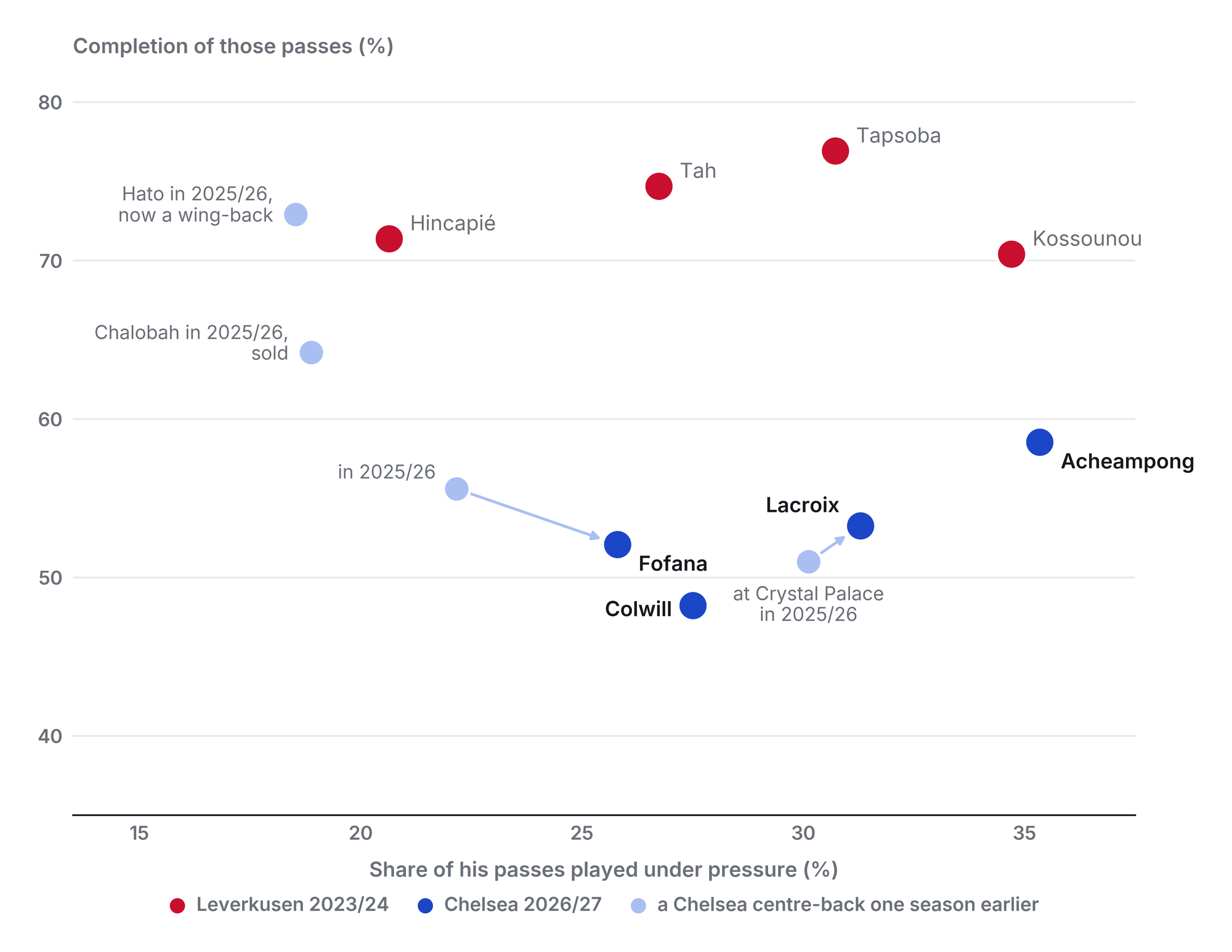
Levi Colwill completes 48% of his passes under pressure, Wesley Fofana 52%, Maxence Lacroix 53% and Josh Acheampong 59%.
At Leverkusen, Edmond Tapsoba completed 77%, Jonathan Tah 75% and Odilon Kossounou 70%.
Chelsea's centre-backs are attempting to progress the ball in a similar manner, but with considerably less success.
Centre-Back Passing Under Pressure: Bayer Leverkusen 2023/2024, Real Madrid 2025/2026 & Chelsea 2026/2027
Alonso has, however, shown flexibility in one particular aspect of the build-up: goal kicks.
During open play, Chelsea's approach remains relatively consistent regardless of the score.
Long passes account for 25% of their centre-backs' passes when level and 23% when ahead, with completion rates of 64% and 66%, respectively.
The difference appears when play restarts from the goalkeeper.
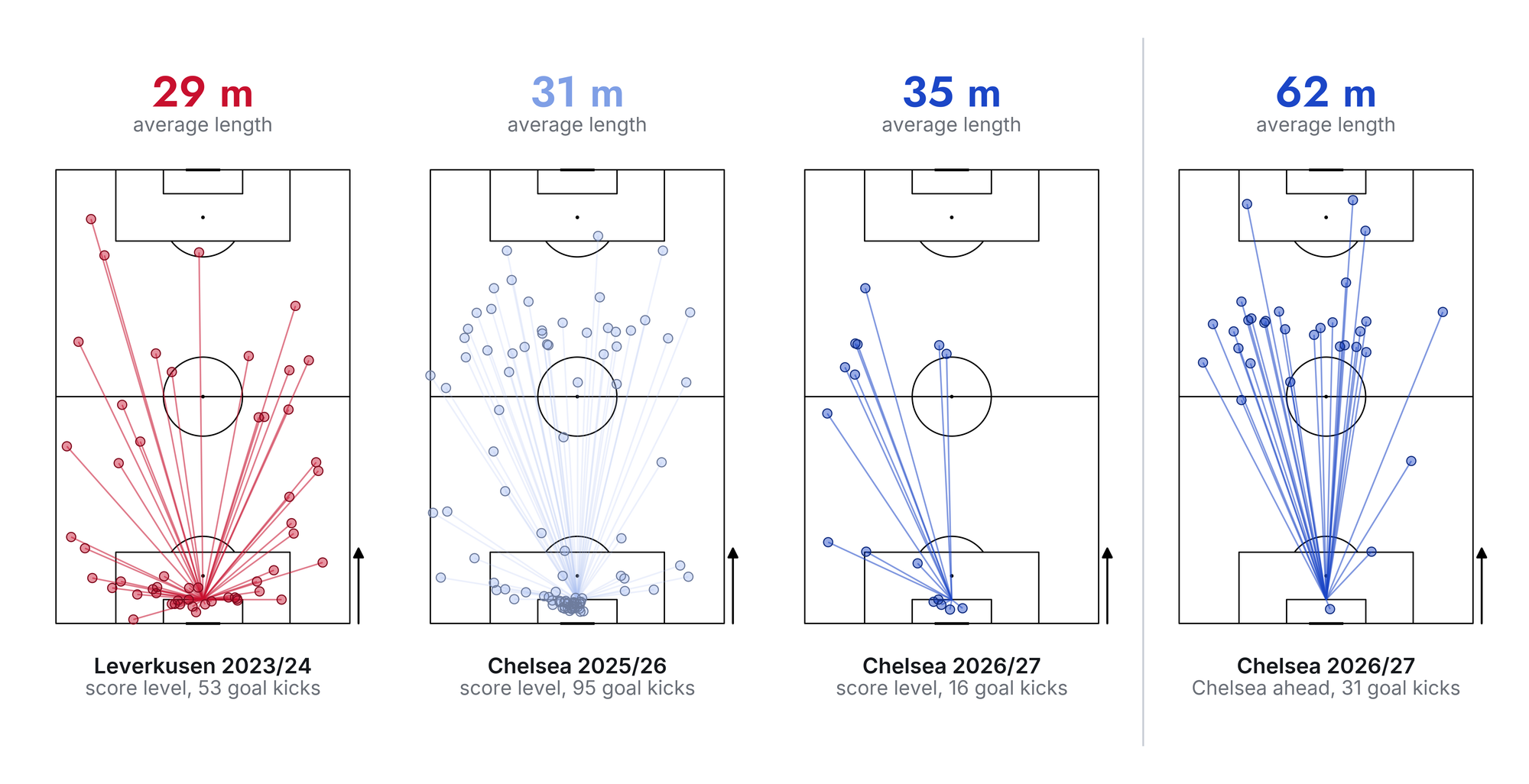
With the scores level, Chelsea's goal kicks travel an average of 35 metres, not far from Leverkusen's 29.
Once ahead, that distance rises to 62 metres, compared with 38 at Leverkusen.
Alonso seems to prefer playing long from goal kicks when Chelsea are ahead, while keeping the same approach to building from the back during open play.
Average Goal-Kick Distance By Score State: Bayer Leverkusen 2023/2024, Real Madrid 2025/2026 & Chelsea 2026/2027
The result is a Chelsea side whose defenders are being asked to take greater responsibility in possession, but whose passes are reaching the middle third no more frequently than last season.
Only 17% of passes from the defensive third reach the middle third, compared with 23% at Leverkusen, while Chelsea have fallen from third to 13th in the Premier League for build-up sequences that break the opposition's first line.
Chelsea are still struggling to play through the opposition's first line and get the ball into midfield.
Why Do Chelsea Struggle To Progress Through Midfield?
At Bayer Leverkusen, much of the team's progression came through Granit Xhaka and Exequiel Palacios.
Both were heavily involved in possession, averaging 96.5 and 92.2 passes per 90 minutes, respectively, while playing past 7.0 and 7.5 defenders with their passing.
They also completed more than 80% of their passes under pressure, allowing Leverkusen to play through midfield even when opponents pressed high.
At Chelsea, Alonso does not have the same level of passing and progression from his central midfielders.
While Leverkusen's midfield pair played past a combined 109 opponents per match, Chelsea's managed just 40.
This is one of the biggest differences between the two sides and helps explain why Chelsea average only 62.7 receptions between the opposition lines, compared with Leverkusen's 124.7.
Moisés Caicedo brings different qualities to the position.
Last season, he averaged 58.6 passes and 13.6 ball recoveries per 90 minutes, while losing possession just 9.8 times.
His strengths lie in keeping the ball, providing defensive cover and winning back possession.
Controlling the team's progression through passing, as Xhaka did at Leverkusen, is not his role.
Jordan Henderson has averaged a similar number of passes this season, although his 14.7 possessions lost per 90 are almost twice Caicedo's current number of 7.5.
Chelsea have also had little continuity in midfield.
Enzo Fernández, who played past 5.7 defenders per 90 last season, left for Manchester City in September, while Caicedo missed much of the opening seven matches through injury.
Alonso has used Roméo Lavia, Reece James and Henderson in central midfield, with Caicedo and Henderson starting together for the first time against Everton.
This is not the first time Alonso has worked with midfielders of this profile.
At Real Madrid, Aurélien Tchouaméni, Federico Valverde, Eduardo Camavinga and Jude Bellingham all averaged around 60 passes per 90 minutes, playing past between three and five defenders.
In terms of their involvement and passing progression, they were much closer to Chelsea's current midfielders than to Xhaka and Palacios at Leverkusen.