Roberto Mancini Tactics At Italy 2026/2027: Can Tactical Flexibility Revive The Azzurri? – Data Analysis

Roberto Mancini’s return to Italy has already produced three very different tactical performances.
After a disjointed opening against Belgium exposed problems between the lines, Italy responded with a fluid 4-3-3 against Türkiye, using rotations, narrow forwards and aggressive full-back movement to create passing options and overloads.
Against France, Mancini adopted a more pragmatic approach, defending in a compact 4-1-4-1 and relying on transitions.
This tactical flexibility has also changed the roles of his forwards, with Giacomo Raspadori moving inside to free Michael Kayode on the right, while Pio Esposito offers a more involved reference point through the centre.
In this Italy data analysis, we examine how Mancini has adapted the Italians' structure across these matches, how his attacking players interchange positions, and whether this flexibility can give the Azzurri a sustainable tactical identity.
A Flexible 4-3-3 Gives Mancini The Platform To Adapt Italy
Roberto Mancini has used a 4-3-3 as Italy’s starting point across all four matches, but the structure has been far from rigid.
Italy Starting XI Under Roberto Mancini Across His Four Matches In Charge
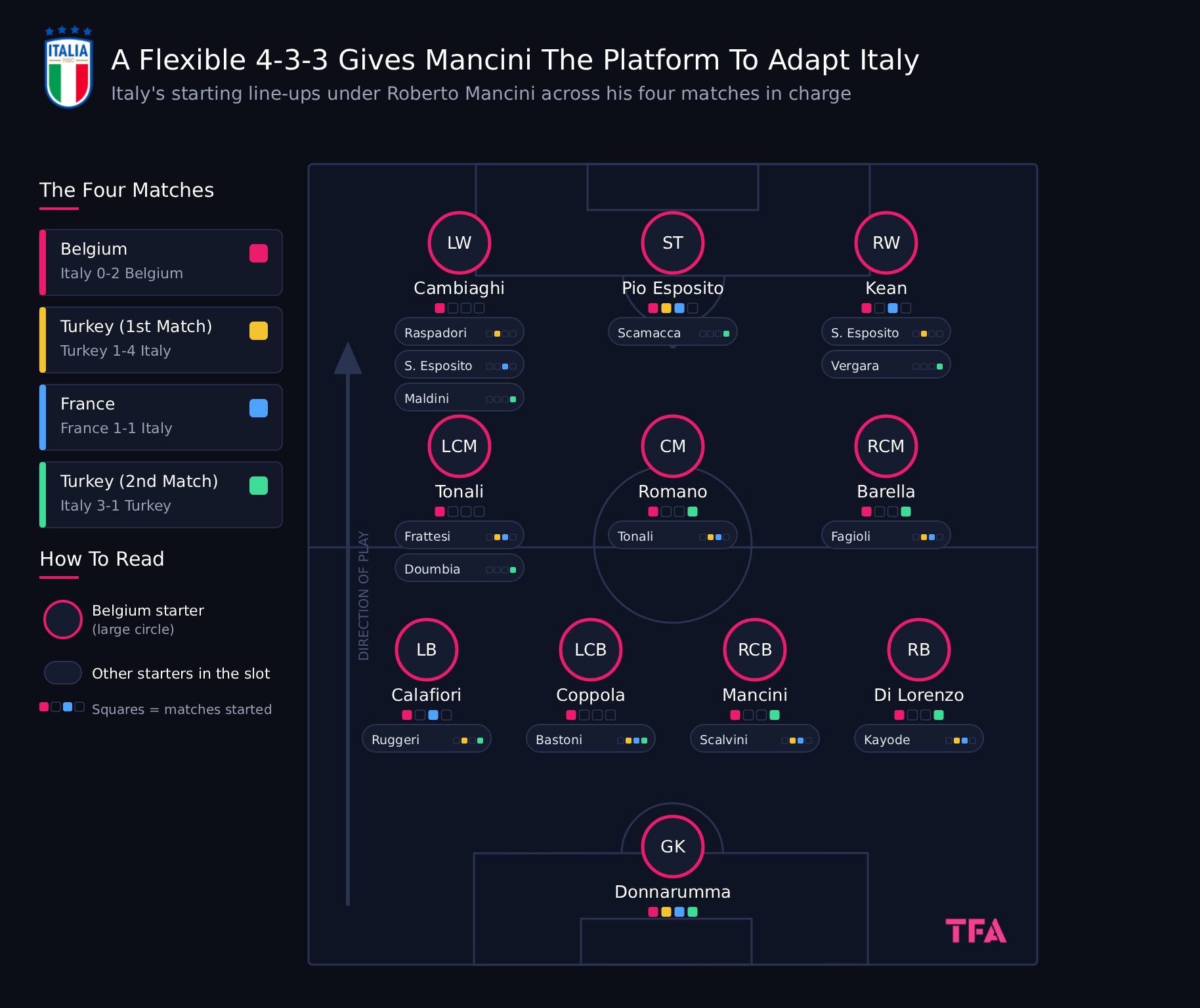
Against Belgium, Gianluigi Donnarumma was protected by Giovanni Di Lorenzo, Gianluca Mancini, Diego Coppola and Riccardo Calafiori, with Nicolò Barella, Alessandro Romano and Sandro Tonali forming the midfield while Moise Kean, Pio Esposito and Nicolò Cambiaghi made up the attack.
After Italy struggled to connect their lines, Mancini changed both personnel and roles against Türkiye, introducing Michael Kayode, Giorgio Scalvini, Alessandro Bastoni, Matteo Ruggeri, Davide Frattesi, Nicolò Fagioli, Sebastiano Esposito and Giacomo Raspadori.
The new front three offered greater positional flexibility, with Raspadori able to move inside while the full-backs provided width and Frattesi attacked space from midfield.
Against France, Mancini retained the same basic shape as that second game but restored Calafiori at left-back.
Kean also started on the right, with the Esposito brothers providing different movements.
In the return fixture against Türkiye, Mancini made sweeping changes again, retaining just Donnarumma and Bastoni from the third fixture.
The extensive rotation highlighted another aspect of Mancini's flexibility, while second-half changes brought Kayode, Calafiori and Pio Esposito into the game as Italy improved and secured a 3-1 victory.
Mancini has therefore adapted Italy through personnel, positioning and responsibilities, giving the same 4-3-3 several different tactical interpretations while maintaining a consistent structural base.
Belgium Exposed Italy Tactical Problems
Italy’s first match under Roberto Mancini exposed several problems that needed to be addressed in the games that followed.
The 4-3-3 struggled to maintain compactness when Belgium broke through the initial pressure, with spaces repeatedly appearing between Italy’s midfield and defensive lines.
This made it difficult to control Kevin De Bruyne’s movement between the lines and allowed Belgium to progress through the centre too easily.
Space Between The Lines Exposes The Italy 4-3-3 Against Belgium
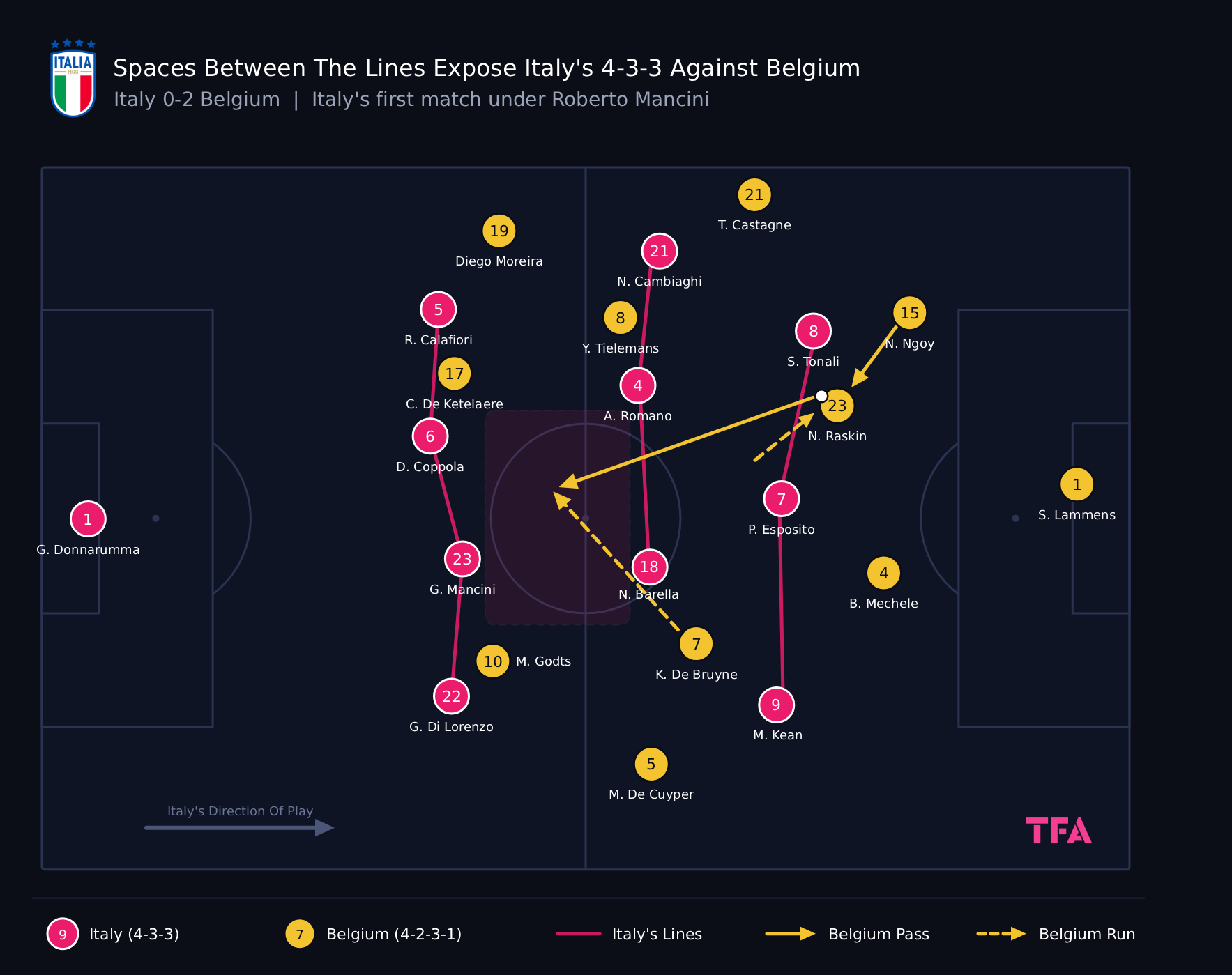
Italy also lacked consistency in possession, with their build-up becoming heavily reliant on Calafiori for progression and too many attacks developing through the same areas.
The lack of variety continued in the final third, where Italy created opportunities without consistently generating high-quality shooting situations.
They finished with 17 shots, only six on target and 2.05 xG, but failed to score, highlighting issues with both chance quality and finishing.
Chance Quality & Finishing Let Italy Down Against Belgium
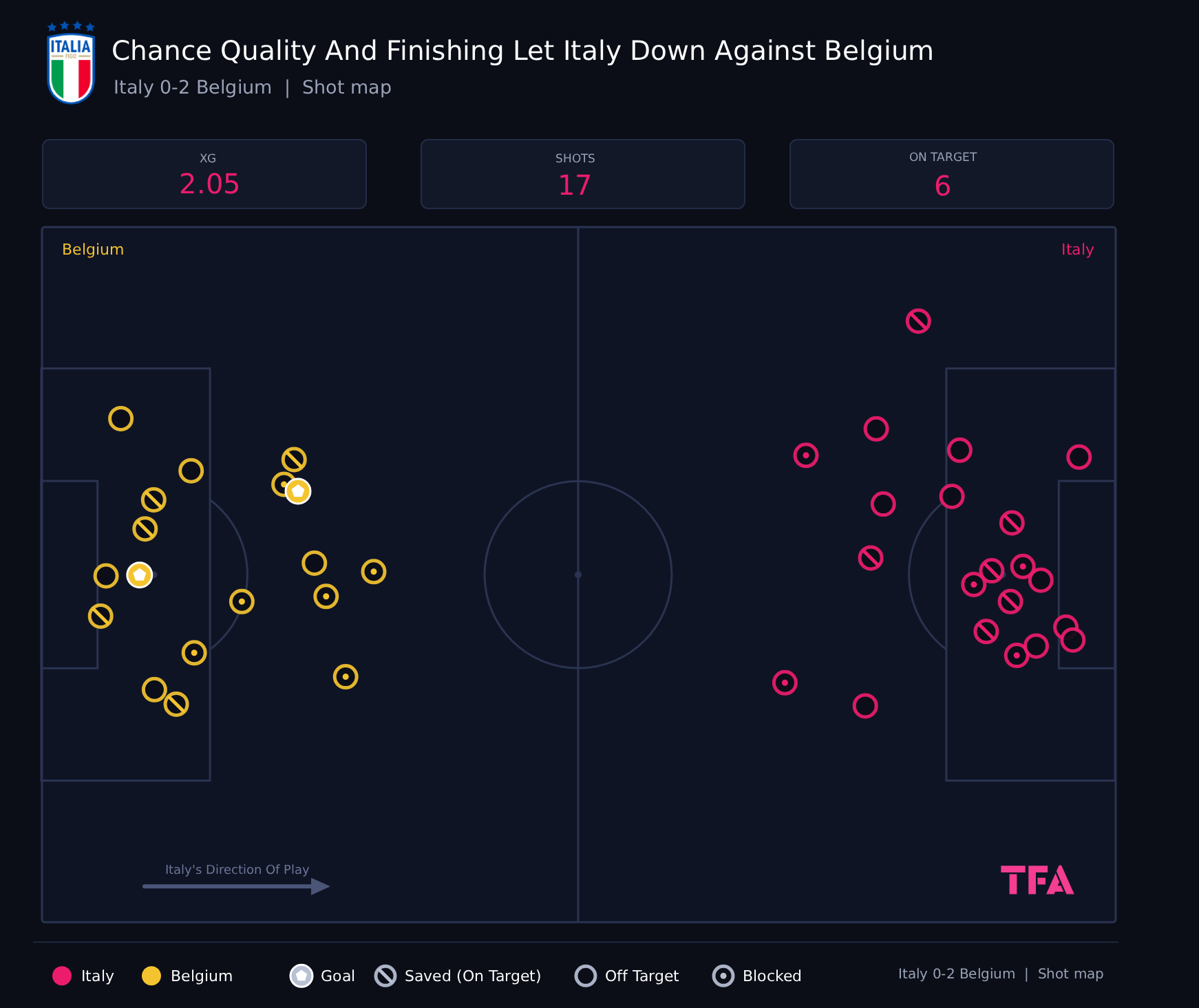
The problem was therefore not simply a failure to create opportunities, but an inability to turn possession and territory into efficient attacks.
Mancini responded in the matches that followed by changing his personnel, redistributing responsibilities and introducing greater positional freedom, giving Italy more ways to progress, attack space and create higher-quality opportunities.
Italy Fluidity Solved Several Early Problems
Italy’s response against Türkiye showed how quickly Roberto Mancini could adapt the team’s attacking structure.
Across the two meetings, Italy scored seven goals, a significant improvement from the blunt attacking display against Belgium.
The key change was greater fluidity between the lines, with midfielders and forwards constantly adjusting their positions to create closer passing options and make progression less predictable.
Italy repeatedly formed triangles and diamonds around the ball, allowing them to combine through pressure before switching play towards the space on the opposite side.