

Lewis Hall Scout Report At Newcastle United 2026/2027: Combining Centre-Back Defending With Midfield Progression - Data Analysis
Lewis Hall has become a key two-way presence for Newcastle United. This scout report analyses his defensive workload, ball recoveries, progressive passing, build-up role and set-piece delivery while identifying areas for improvement.

Lewis Hall’s defensive work is central to understanding what he offers Newcastle United.
Alongside recovering possession and helping the team play forward, the left-back carries a substantial workload inside his own penalty area.
His clearances, blocks and interceptions of crosses invite a comparison with a centre-back, although his involvement in build-up gives him a broader role.
This Lewis Hall scout report and player analysis looks at how those contributions fit together.
Hall’s numbers show greater involvement in ball recovery and progression than in open-play crossing, while set-pieces give him another opportunity to deliver into the box.
They also reveal a gap between how often he attempts certain actions and how often he completes them.
The analysis covers nine Premier League appearances in 2026/2027, using the report’s data up to 4th November 2026.
The dataset records 887 minutes, with figures expressed per 90 unless otherwise stated, and percentiles measured against other Premier League full-backs.
It remains a small sample, offering a picture of his performances so far rather than a final judgement on his game.
Lewis Hall Defensive Role At Newcastle United
Hall’s defensive contribution starts with how often he wins possession back.
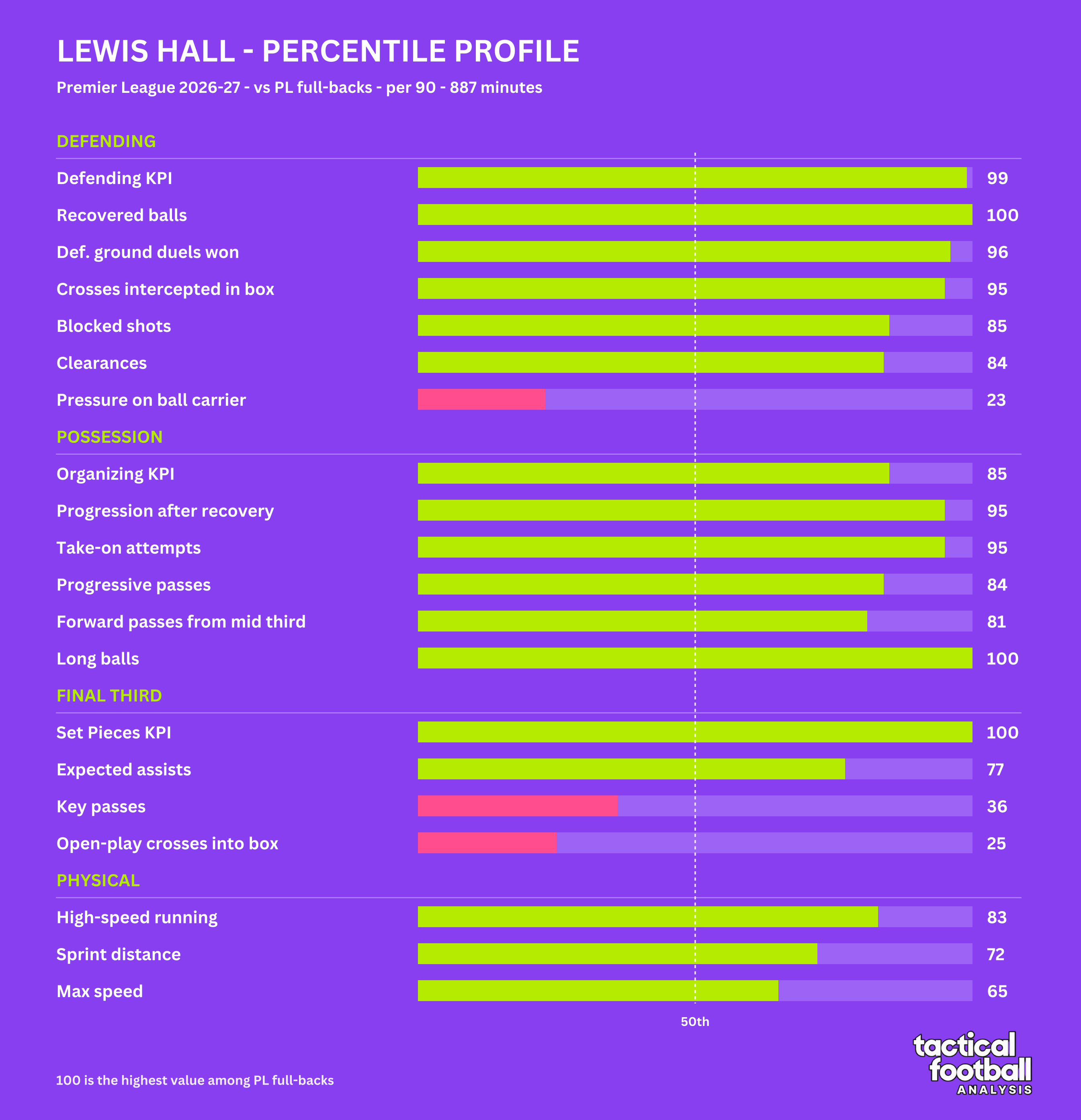
His 6.29 recoveries per 90 put him in the 100th percentile among the full-backs in the sample, while his 2.23 defensive ground duels won place him in the 96th percentile.
Newcastle’s defensive workload provides some context, but Hall is clearly heavily involved in winning the ball back.
Inside his own penalty area, the centre-back comparison begins to make sense.
Hall averages 4.06 clearances per 90, with more than half coming from headers, alongside 0.81 blocked shots.
He also intercepts 1.01 crosses into the box, a figure in the 95th percentile.
His 19.68 recorded marking actions inside the area add to that picture.
He has plenty of work to do to get close to goal, where a full-back’s responsibility extends beyond dealing with the winger on his side.
Lewis Hall Percentile Profile At Newcastle United 2026/2027
When a cross comes in from the opposite flank, a full-back may need to tuck in, track a runner and deal with a delivery beyond the centre-backs.
Hall’s numbers suggest that defending these spaces is a significant part of his workload.
That helps explain the centre-back comparison, although it does not tell us exactly how Newcastle organise their defence in each situation.
His aerial record also deserves a closer look.
Despite his high number of headed clearances, Hall has won just seven of 22 defensive aerial duels in the sample, roughly 32%.
Clearing a delivery and beating an opponent to it are different actions.
The first shows his involvement in protecting the box, while the second raises questions about his effectiveness when the ball is contested.
Hall therefore makes a substantial contribution against deliveries into the area, but there is room to improve when he has to compete for them directly.
Whether opponents deliberately target him is a separate question that would require footage to answer.
The duel figures give us a reason to examine those situations, rather than proof of an opposition strategy.
How Does Lewis Hall Respond To A Turnover?
Hall’s pressure numbers require similar care.
He records 26.89 pressures on the ball possessor per 90, placing him in the 23rd percentile, but his 29.43 actions in the report’s “press after loss” category put him in the 84th percentile.
Lower overall pressure volume does not mean he is passive immediately after possession changes hands.
These measures describe different situations.
Pressure on the ball can occur throughout an opposition possession, whereas pressing after a loss concerns the immediate response to a turnover.
Hall’s profile suggests that this short window is a more prominent part of his defensive involvement than sustained pressure on the ball.
It does not identify a precise pressing trigger or establish how high he is instructed to engage.
Winning the ball is only part of Hall’s contribution.
He also helps Newcastle move forward once they win it back, recording 4.77 progressions after a recovery per 90.
That puts him in the 95th percentile among the full-backs in the sample and helps explain his value to the team.
He can help stop an attack and start Newcastle’s next one.
Lewis Hall Ball Recoveries & Progressive Passes At Newcastle United 2026/2027
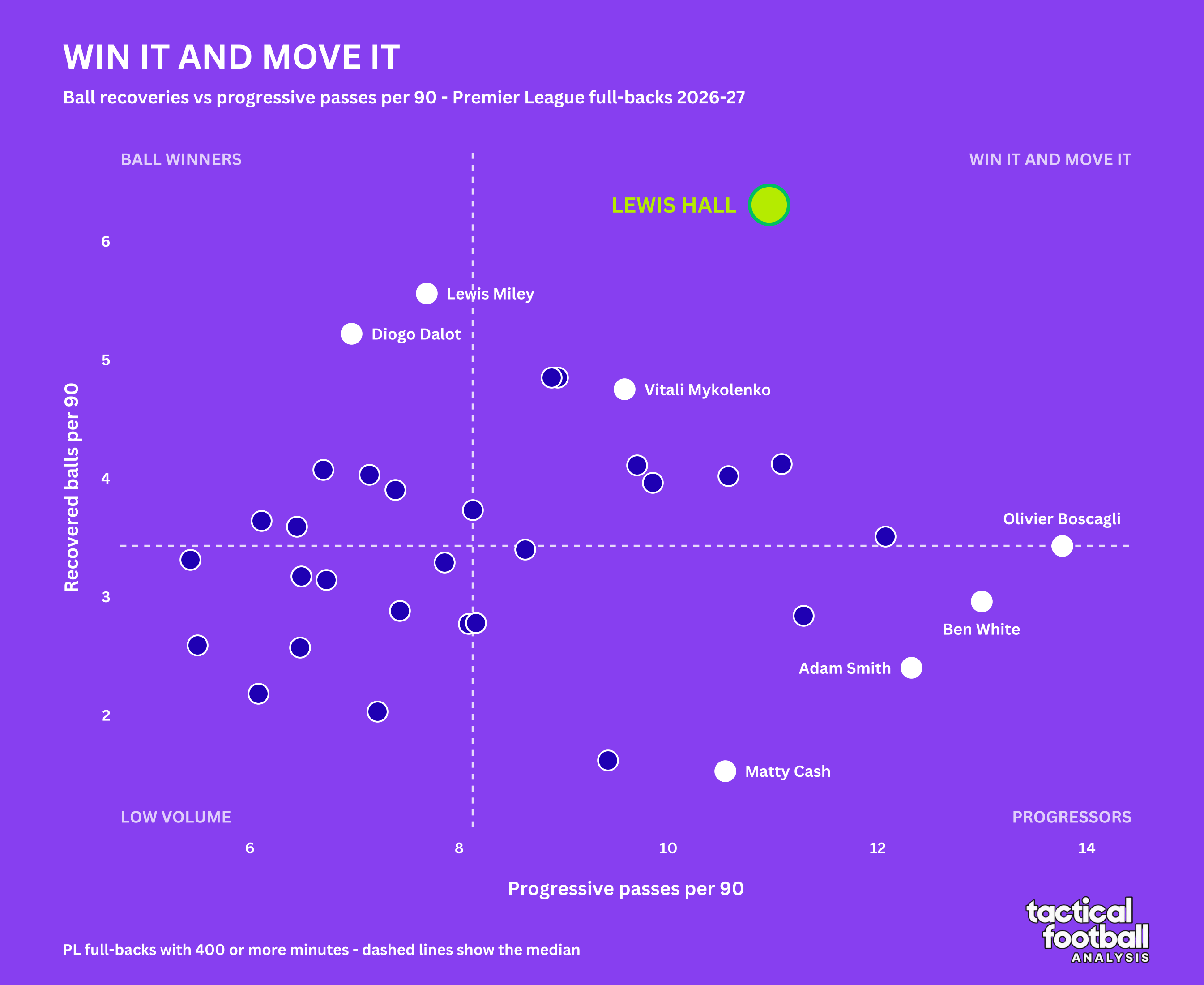
Hall stands out when you plot the two figures together.
Nobody in this group recovers the ball more often per 90, and his progressive passing is above the median, too.
A few full-backs make more progressive passes, but Hall’s contribution across both measures stands out.
The chart includes only players with at least 400 minutes.
Lewis Hall Passing & Build-Up Contribution
Newcastle use Hall heavily on the left.
He averages 73.26 touches and attempts 49.31 passes per 90, completing 41.40.
Those figures tell us how involved he is.
To understand what he does with that involvement, it helps to follow the direction of his passing.
Sideways and backwards, he gives little away.
In open play, he completes 15.02 of his 15.42 horizontal passes per 90 and 8.62 of his 8.83 backward passes.
Looking forward is more difficult.
He attempts 15.63 forward passes, with around 65% finding a teammate.
His distribution becomes less reliable when he tries to advance play, although the numbers alone cannot tell us whether each risk was justified.
A misplaced pass might surrender possession in a dangerous area or end a promising move when a simpler option was available.
Equally, a completed pass might do little to trouble the opposition.
Hall’s overall completion rate needs that context to tell us anything useful about his decisions.
His progressive passing gives us a clearer sense of his contribution.
Hall makes 10.96 progressive passes per 90, placing him in the 84th percentile.
He also completes 7.51 of his 10.65 forward passes from the middle third.
These categories overlap, so they cannot be added together, but both point to his involvement in moving Newcastle up the pitch from midfield areas.
There is another detail worth considering.
When Hall passes between the lines, the recipient has an average of 72.3 square metres of free space, compared with the report’s benchmark of 47.9.
That suggests he finds teammates with room to work in.
What they do next is a separate question, but the space available on receiving the ball helps explain the value of a pass beyond whether it simply reaches its target.
Lewis Hall Illustrative Build-Up Pattern At Newcastle United 2026/2027
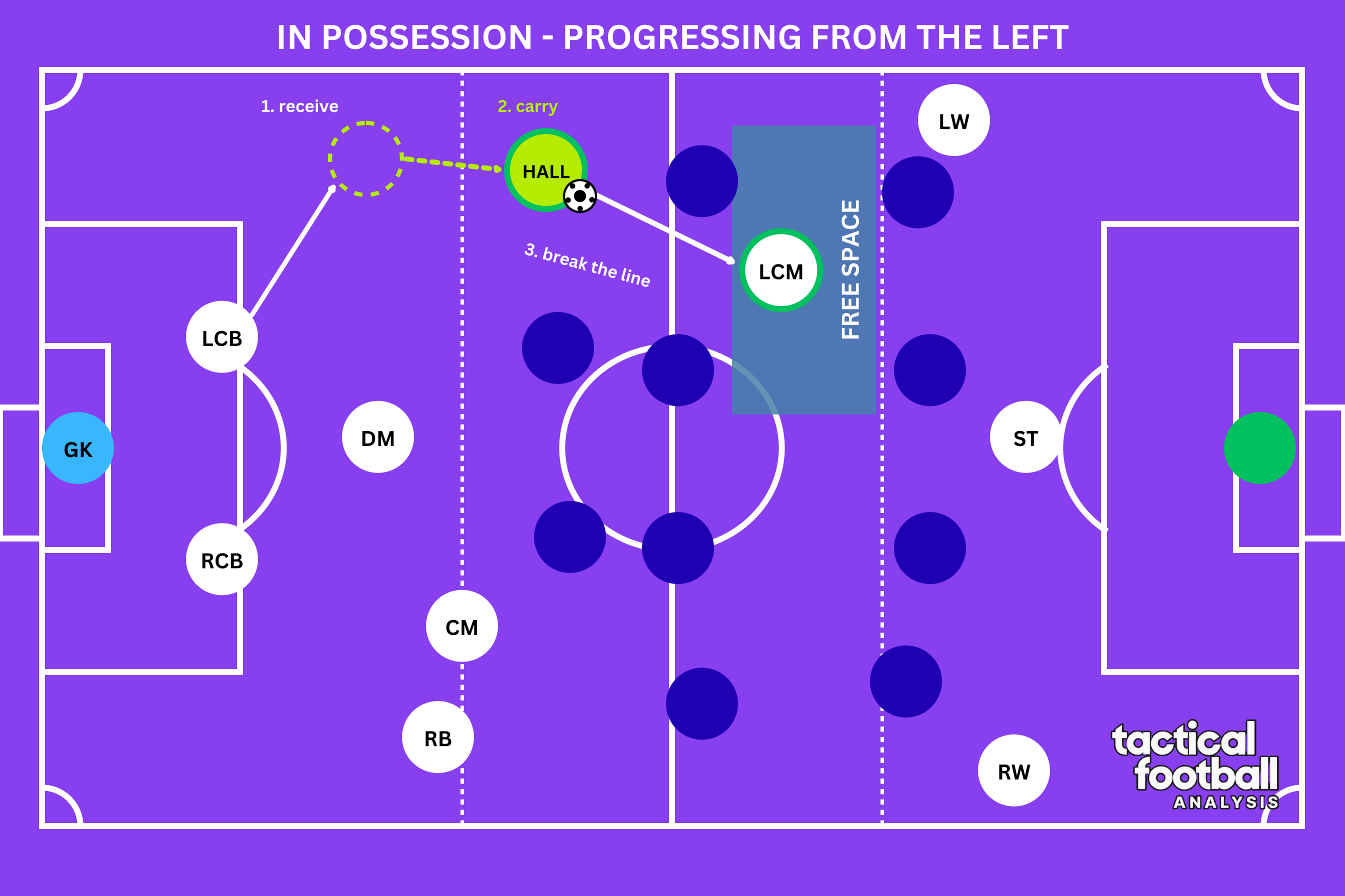
The diagram shows how this could work.
Hall takes a pass from the left centre-back, moves forward with the ball and looks for a teammate between the lines.
By advancing, he can draw an opponent towards him and open a passing route behind that player.
This illustrates the idea, rather than a sequence taken from a particular match.
Taking on an opponent gives Hall another way forward, although it does not always come off.
He attempts 2.44 take-ons per 90 and completes 1.01, a success rate of around 41%.
He is willing to beat his man, but those figures alone are not enough to describe him as someone who consistently escapes pressure.
His longer passing also needs some context.
Hall completes 0.41 of his 1.52 long balls per 90 (roughly 27%), while the report records no switches of play.
That is not necessarily a contradiction.
A long pass can travel down the same side of the pitch without switching the attack to the opposite flank.
Before concluding this range or what Newcastle ask him to do, we need to check how those actions are defined and look at the passes themselves.