

Newcastle United Vs Aston Villa [0-1] Premier League 2026/2027: How Unai Emery Tactics Punished Wasteful Magpies - Tactical Analysis
Newcastle created promising situations against Aston Villa but failed to make them count. This tactical analysis examines their wing play, high recoveries, vertical passing problems and poor final-third decision-making.

Newcastle United hosted Aston Villa in Gameweek 7 of the 2026/2027 Premier League.
The match ended with a disappointing loss for the locals and an impressive, very valuable away win for Aston Villa.
Unai Emery took the three points out of this match mainly because they knew how to exploit their momentum and score when the opportunities presented themselves, despite not being dominant in the match, neither in terms of possession nor in terms of chance creation.
Despite Newcastle being the more dominant side, they failed to score goals as they lacked the crucial final touch, both in terms of final passes and finishing inside the box.
This inability to score and exploit their successful high-recovery plan made Newcastle struggle progressively as the game got more complicated for them with time, knowing that Villa preferred to use a lower defensive block following their goal.
The match exposed the Matthias Jaissle side's strengths and weaknesses at the same time, as it confirmed that a lot of work is still needed for the team to avoid losing points at home and start being more intelligent in the attacking phase, in particular, without neglecting the required defensive fixes too.
In this tactical analysis article, we focus mainly on Newcastle’s attacking solutions and how they were able to use wing actions and high recoveries to disturb Aston Villa’s defence.
At the same time, the analysis examines their failure to convert those high recoveries into quick vertical penetrations and their poor decision-making in and around the box.
Newcastle United Vs Aston Villa Lineups & Formations
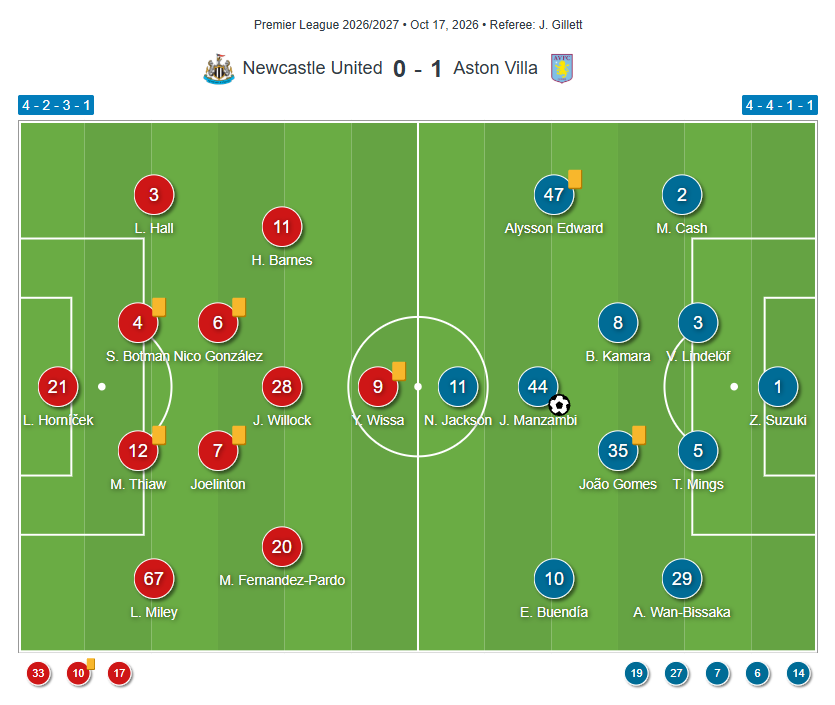
Newcastle United Lineup Vs Aston Villa
Jaissle opted for a 4-2-3-1 formation using Lukáš Horníček as a goalkeeper, and a back-four made up of Lewis Miley at right-back, Malick Thiaw and Sven Botman as centre-backs, and Lewis Hall at left-back.
In midfield, he relied on Joelinton and Nico González as central midfielders, with Harvey Barnes and Matias Fernandez-Pardo as wingers, Joe Willock as the advanced playmaker, and Yoane Wissa as the striker.
Aston Villa Lineup Vs Newcastle United
On the other side, Emery decided to use a 4-4-1-1 formation with Zion Suzuki as the goalkeeper, and a defensive line made up of Matty Cash at right-back, Victor Lindelöf and Tyrone Mings as centre-backs, and Aaron Wan-Bissaka covering at left-back.
The midfield was composed of João Gomes and Boubacar Kamara as central midfielders, Alysson and Emiliano Buendía as wingers, with Johan Manzambi used as the advanced playmaker just behind the striker, Nicolas Jackson.
Newcastle United Initial Dangerous Right-Wing Solutions
Newcastle relied on Fernandez-Pardo as a right winger in this match in an attempt to use his acceleration and playmaking traits from that side, while relying on Wissa to be the striker inside the box.
Furthermore, Willock was required to be the first player to initiate the high press, and he was successful on numerous occasions in disturbing Aston Villa’s build-up thanks to his quick and intense accelerations without the ball inside Aston Villa’s own third.
Newcastle were also capable of getting close to scoring thanks to Fernandez-Pardo’s early successful dribbling from the right wing to beat Wan-Bissaka in the duel.
This efficient attacking output from Fernandez-Pardo on the right wing was valuable for Newcastle as it provided reliable playmaking solutions, knowing that the Belgian's mindset was oriented towards getting away from his marker and providing passes/crosses towards Wissa or Willock rather than complicating things or trying to penetrate by himself each time.
This helped Newcastle be more direct and surprise Aston Villa with straightforward attacks and crosses towards the box.
Unfortunately for Newcastle, the first attempts from that right-wing were not rewarding, not because of the delivery but due to Willock’s inability to catch the ball on time, as Lindelöf was quicker in his reaction and interception of the pass.
That said, the action confirmed that Fernandez-Pardo had the potential to be extremely dangerous from that right-wing, and that Willock was already getting close to scoring but just needed more crucial movements without the ball and more determined finishing attempts.
The action also shows that Wissa failed to position himself inside the box when needed as he retreated to contribute in the playmaking process but was not reactive enough to accelerate quickly towards the box when he saw that the ball reached Fernandez-Pardo on the right wing.
Wissa has to make sure he enters the box whenever his team has the ball inside the final third in order to ensure that the team attacks in numbers and, more importantly, can rely on him for such passes.
Wissa’s presence inside the box is essential as it also blocks one or two defenders and makes it easier for those coming from the back to get the ball first without too much disturbance.
Failing to join the box when needed reduces the threat of Newcastle’s crosses and attacking actions overall.