TFA Exclusive Interview: Michael Mackin On What Does A Set-Piece Coach Do? - Tactical Theory
In Part One of our exclusive interview, set-piece specialist Michael Mackin explains his coaching principles, how he designs routines, identifies player roles, improves delivery, structures match-week preparation and uses opposed training to make set-pieces transfer into matches.

Set-pieces are becoming increasingly prominent in football, with the role of the set-piece coach shifting from a luxury to more of a necessity.
Clubs can either invest in someone to maximise their dead-ball performance or risk falling behind, losing out on double-digit points over a season.
As the role becomes more common across clubs, the obvious question is: what does a set-piece coach actually do, day to day?
Michael Mackin is one of the specialists answering that question in practice.
He started out doing remote work for teams, designing set-piece routines from the outside, also learning from Gianni Vio who was working at Tottenham Hotspur, one of the pioneers of set-piece specialisation as a standalone discipline.
Mackin picked up assignments, ideas, and teachings directly from Vio, who was responsible for Spurs' offensive set-pieces under Antonio Conte.
From there, he moved into a long spell at Burton Albion, working closely with John Brayford, who delivered the work on the pitch while Mackin focused on analysis and the attacking side.
They scored six set-piece goals in eight games during a tense run under Martin Paterson that helped keep the club up on the final day of the season.
The following years brought a string of managers: Mark Robinson, then an interim spell under Tom Hounsell, before Gary Bowyer arrived.
Since then, Mackin's career has taken him further with opposition analysis work with the Canada national team, a short spell with Derry City in Ireland, and close to a year now in the UAE, working across every youth age group, bar the U23S.
In the first of a two-part Michael Mackin interview, Mackin breaks down the principles behind his work, how he builds a culture around set-pieces, the difference between coaching a club side and an international squad, and why, as he puts it, "context is everything."
TFA: How Did You First Become Interested In Set-Pieces?
Mackin traces it back to some of the biggest moments in football history.
"If you go back in history and look at some of the biggest games in the world, a fair few of them are decided by set-piece goals," he says.
One of his earliest memories is the 1998 FIFA World Cup Final, with Zinedine Zidane scoring twice from corners and Emmanuel Petit's goal coming from a set-piece transition.
He points to Manchester United scoring twice from corners in their 1998/1999 UEFA Champions League Final win, and Didier Drogba's Champions League Final goal for Chelsea, which also came from a corner.
"All these big moments happen from set-pieces, that was like the nostalgia part."
The interest became something more structured later, shaped by two influences.
The first was a book by Gianni Vio, written in Italian, that translates roughly as the '15-Goal Striker'.
The second was rugby, where he started out.
"Rugby was very set-piece driven; a line-out for me is very similar to a corner."
A line-out involves a call, often a sequence of numbers or a colour, telling the team exactly where the ball is going and who's involved.
"Little things like this are signals for players to remember."
"When I started to break down set-pieces from rugby, I realised there was a big, big connection."
He also points to Johnny Wilkinson, the rugby kicker who worked with a dedicated kicking coach rather than leaving his delivery to chance.
"He was leaving it to high-quality practice, and he was training it."
That idea, treating delivery as a trainable skill rather than as fixed talent, is one Mackin carried directly into his work in football.
TFA: What Are Your Set-Piece Principles & Beliefs?
For Michael Mackin, effective set-piece coaching begins before the players step onto the training pitch.
He believes creating a successful set-piece programme depends on building a culture around its importance.
That starts with complete support from the head coach and is reinforced by achieving early success, helping players develop confidence and buy into the process.
From a tactical perspective, Mackin places a strong emphasis on blocks, screens and the timing of attacking runs.
Rather than every player moving at the same time, he uses specific triggers, such as the taker's signal, the first movement of the kicker, or the moment the ball is struck, to coordinate different runs and create separation from defenders.
He also favours overloading key areas of the penalty box to create numerical advantages, while remaining flexible in how those overloads are constructed.
"I've used loads of different blocks, timings, screens, picks and overloads; I've used so many different routines and strategies."
TFA: What Defines How You Approach A Set-Piece? Do You Adapt To Your Players' Strengths Or The Opposition's Structure?
According to Mackin, the answer begins with context.
"Context is everything," he says, explaining that the time available to work with players shapes his approach.
A club coach may have a full six-week pre-season to develop delivery quality, consistency, and set-piece patterns.
International coaches often have only a few days to prepare.
One of the first priorities is ensuring that set-piece takers can consistently deliver the ball into dangerous areas with confidence.
The second priority lies in identifying player profiles.
Rather than simply selecting the tallest players, Mackin evaluates who is effective in aerial situations.
"Just because they're big doesn't mean they're the best headers of the ball," he says.
Smaller players, particularly wingers, can often attack the ball more aggressively and finish headers more consistently than physically imposing centre-backs or strikers.
Training helps identify which players repeatedly direct headers on target, allowing him to select attackers based on performance.
The same philosophy extends to defending set-pieces.
Instead of matching height with height, Mackin believes the role of a man-marker is often better suited to players with quick feet.
He points to N'Golo Kanté being assigned to mark Virgil van Dijk in a memorable image from the 2019 UEFA Super Cup Final.
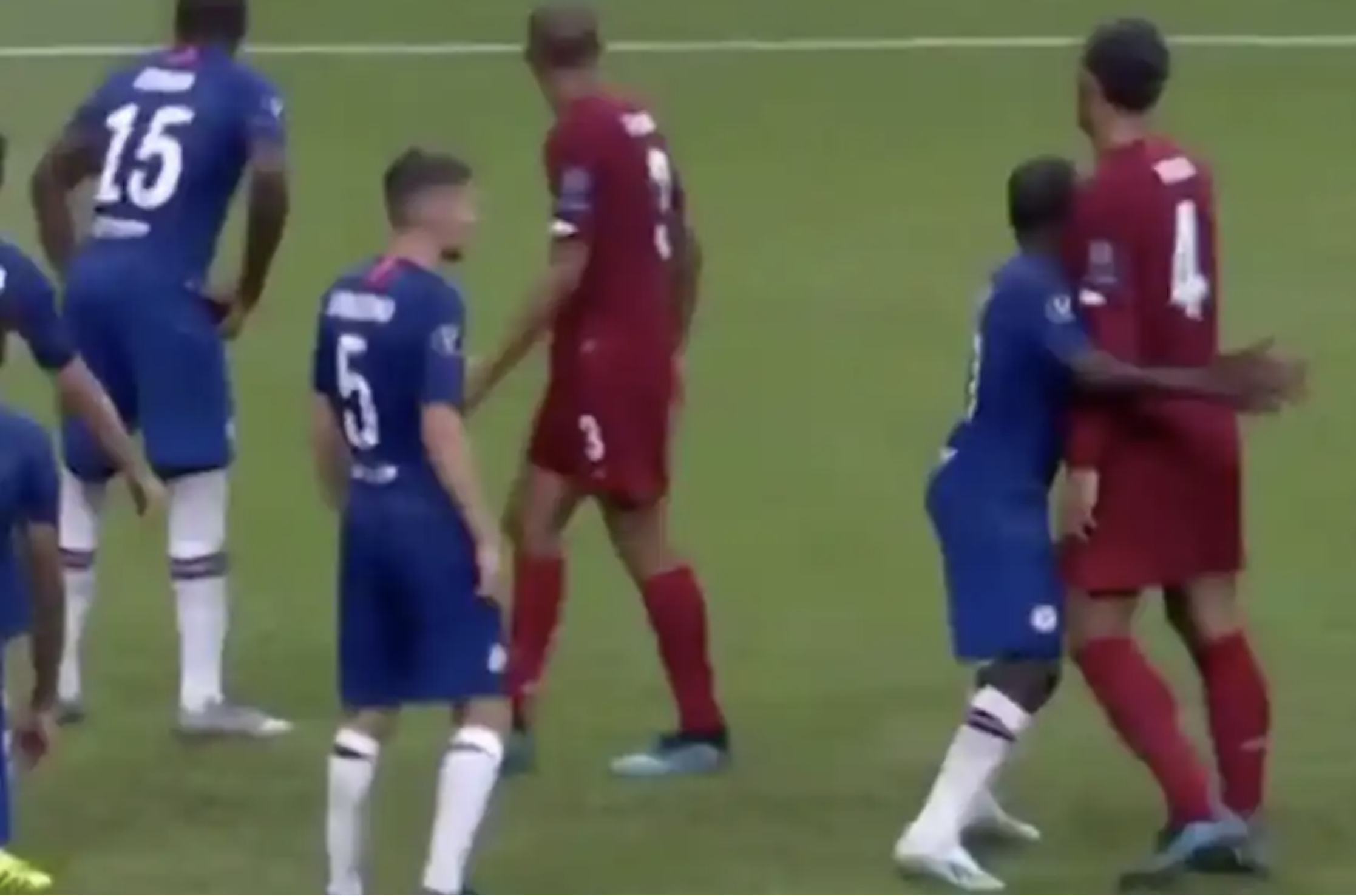
Rather than competing physically, Kanté's role was to disrupt Van Dijk's movement long enough for the zonal defenders to attack the ball.
Mackin has found success using wingers as blockers because of their agility and ability to mirror changes of direction.
Ultimately, while the opposition's defensive structure is an important consideration, Mackin's philosophy is built around maximising his players' strengths.
TFA: Would You Say You Change Your Routines Based On The Opposition, Or Do You Prefer To Keep Them Consistent So Players Become Familiar With Their Roles?
Mackin believes there's a balance between consistency and adaptation.
He describes having a "fallback routine", a pattern players know instinctively and can execute regardless of the opposition.
Familiarity with the timing of runs and movements allows players to perform with confidence, even under pressure.
"Always have that generic routine," he explains.
Alongside core routines, Mackin develops opposition-specific 'special plays'.
He's built an extensive database of corner-kick routines, analysing more than 17,000 corners from leagues around the world, reviewing all goals and high-quality chances from 27 leagues each summer.
He points to Aston Villa as a recent example, by recognising that Liverpool consistently committed only two players to defend short corners regardless of the attacking structure, Villa were able to create numerical overloads.
He stresses, though, that even the best-designed routine must suit the players available.
"Context is everything," he repeats.
Not every team has a player capable of executing the kind of finish Youri Tielemans can produce from the edge of the box.