
![Manchester City Vs Brentford [3–0] – Premier League 2025/2026: How Jérémy Doku Broke The Bees' Resistance – Tactical Analysis](https://cdn.mymidnight.blog/77f959f119f4fb2321e9ce801e2f5163/size/w1000/2026/05/Man-City-VS-Brentford-20252026.png)
Manchester City Vs Brentford [3–0] – Premier League 2025/2026: How Jérémy Doku Broke The Bees' Resistance – Tactical Analysis

Manchester City kept their Premier League title hopes alive with a 3-0 win over Brentford, although the final scoreline did not fully reflect how uncomfortable the first hour was for Pep Guardiola’s side.
Man City eventually finished with clear superiority in territory, shot volume and attacking threat, but Brentford’s compact defensive organisation, direct outlets and transitional threat made this a more complex match than the result suggests.
For long spells, the visitors were able to delay central progression, force City towards wide attacks and create enough uncertainty to make the Etihad Stadium nervous.
The decisive player was Jérémy Doku.
The Belgian winger produced another influential performance, constantly attacking Brentford’s right side before opening the scoring after 60 minutes with a curling finish from the left side of the box.
Once that first goal arrived, the game changed.
Erling Haaland added the second after 75 minutes, before substitute Omar Marmoush completed the scoring in stoppage time.
This tactical analysis will examine how Keith Andrews Brentford’s defensive block initially disrupted Manchester City, how Doku became City’s main route to chance creation, and how Guardiola’s substitutions increased the hosts’ attacking presence inside the box.
Manchester City Vs Brentford Lineups & Formations
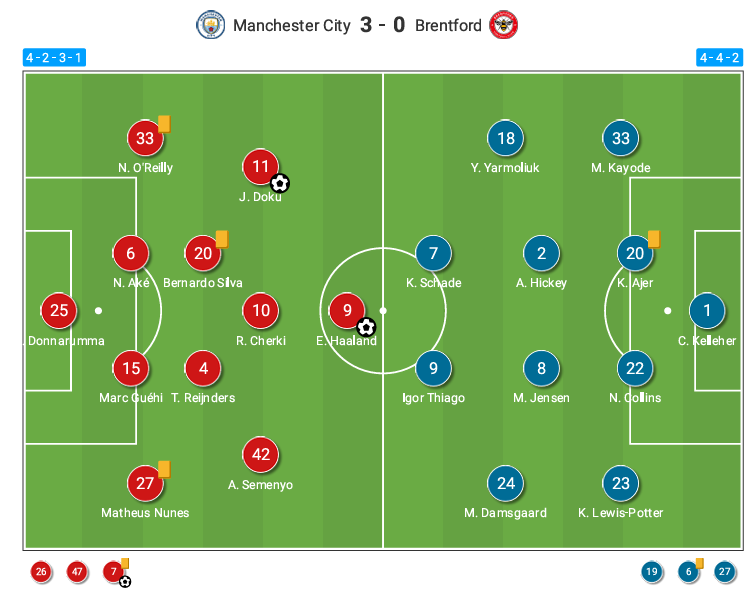
Manchester City Lineup Vs Brentford
Pep Guardiola tactics started Manchester City in a 4-2-3-1 formation.
Gianluigi Donnarumma was in goal, with Matheus Nunes at right-back, Marc Guéhi and Nathan Aké as the centre-backs, and Nico O’Reilly starting at left-back.
Tijjani Reijnders and Bernardo Silva formed the midfield double pivot.
Ahead of them, Antoine Semenyo played from the right, Rayan Cherki operated as the central attacking midfielder, and Jérémy Doku started on the left.
Erling Haaland led the line as the centre-forward.
City’s structure gave them natural width on both sides, but the left side quickly became the more important attacking route.
O’Reilly’s positioning helped Doku receive with support, while Doku’s ability to beat defenders 1v1 gave City their clearest method of destabilising Brentford’s block.
Brentford were listed in a 4-4-2, although their defensive behaviour was more important than the nominal formation itself.
Caoimhín Kelleher started in goal, with Michael Kayode, Kristoffer Ajer, Nathan Collins and Keane Lewis-Potter forming the backline.
Yehor Yarmoliuk, Aaron Hickey, Mathias Jensen and Mikkel Damsgaard made up the midfield line, while Kevin Schade and Igor Thiago played as the two highest players.
This structure gave Brentford two important advantages without the ball.
Firstly, they could protect central areas with a narrow midfield line, making it difficult for Cherki to receive cleanly between the lines.
Secondly, they kept Schade and Thiago high enough to threaten direct attacks whenever City lost the ball or left space behind their defensive line.
Brentford’s Compact Block & Direct Threat Made Manchester City Uncomfortable
Brentford’s first objective was to make Manchester City’s possession less comfortable.
They did not press recklessly throughout the pitch, but they were aggressive enough to stop City building rhythm through central areas.
Their front two helped screen passes into Reijnders and Bernardo Silva, while the midfield line narrowed around Cherki’s zone.
This was important because City’s attacking structure relies heavily on finding players between the opposition midfield and defensive lines.
If Cherki could receive, turn and combine with Haaland or the wingers, City would have been able to attack Brentford’s backline more directly.
Brentford’s compactness prevented that from happening consistently.
Instead, City were often forced to circulate across the backline before moving the ball wide.
This gave them territory, but not always immediate penetration.
Brentford’s defensive distances were generally good in the first half, particularly when City tried to access the left half-space.
Hickey and Jensen stayed close enough to protect the middle, while the wide midfielders recovered to support the full-backs.
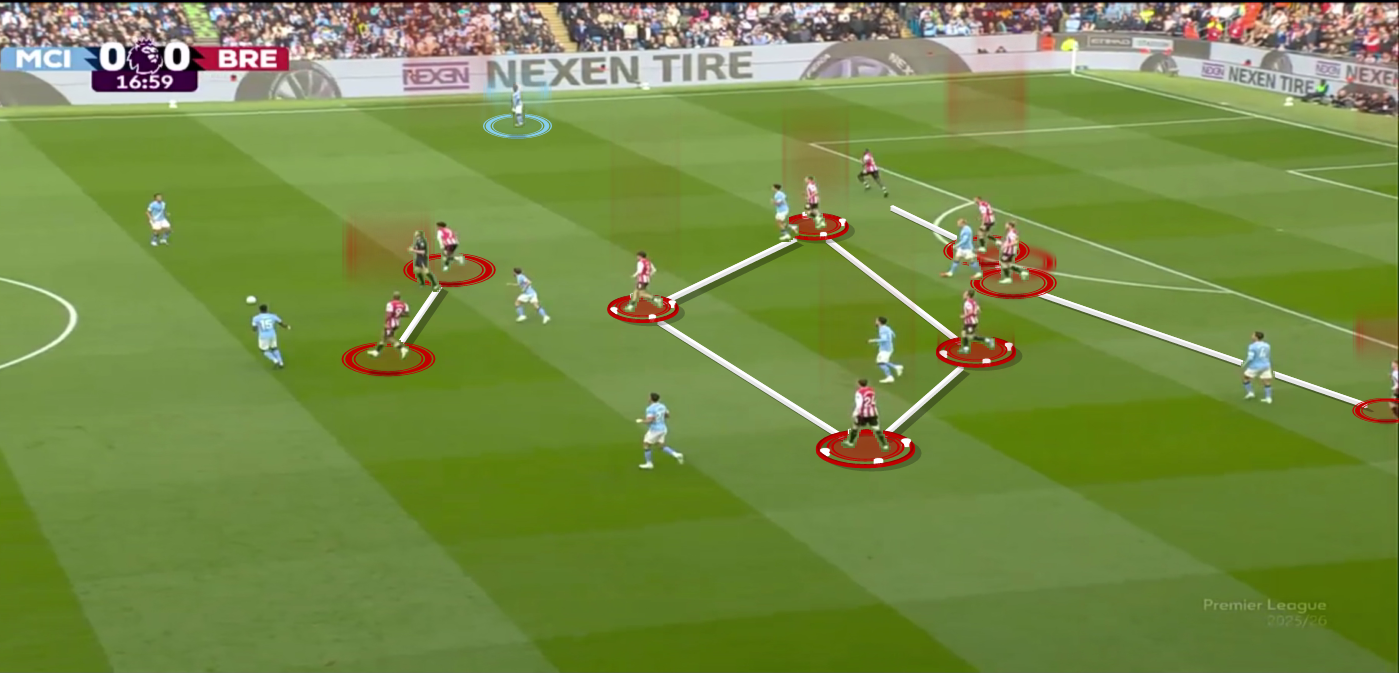
Brentford’s compact 4-4-2 defensive block protected central spaces and denied Manchester City easy access through the middle.
With the central corridor crowded, City were often forced to circulate possession towards the flanks, where Jérémy Doku offered the clearest outlet on the left.
This did not mean Brentford stopped City completely. Guardiola’s side still reached the final third regularly and produced pressure around the penalty area.
However, Brentford managed to defend many of those attacks, facing the ball, with Ajer and Collins able to protect the centre of the box and Kelleher not constantly exposed to clear chances before the opening goal.
The other key part of Brentford’s plan was their direct threat.
Schade and Thiago gave the visitors a way out whenever they regained possession.
Thiago’s physical presence allowed Brentford to contest long balls and second balls, while Schade’s pace threatened the space behind Nunes and Guéhi.
This was particularly important because it stopped City from attacking with complete security.
Every time Nunes or O’Reilly advanced, Brentford had the possibility of playing early into the channels.
Thiago could also compete directly with City’s centre-backs, giving Brentford a target when they needed to escape pressure.
Brentford’s long throws and wide deliveries added another uncomfortable element.
Against a City side who prefer to control games through possession and positioning, these moments created disorder.
Even when they did not lead to high-quality chances, they disrupted rhythm and forced City to defend more chaotic situations inside their own box.
Therefore, the first hour was not simply a case of City failing to finish.
Brentford’s defensive approach genuinely reduced City’s central access and made the match awkward.
The visitors could not sustain long periods of possession, but they did enough to make City’s control feel fragile.
Man City’s Left-Sided Attacks & Jérémy Doku Individual Superiority
As the match developed, Manchester City’s best attacking solution became increasingly obvious: isolate Doku on the left and allow him to attack Brentford’s right side.
Doku’s role was vital because City were not always finding clean advantages through their usual central combinations.
When Brentford protected the middle, City needed a player capable of creating superiority without the structure doing all the work for him.
Doku provided exactly that.
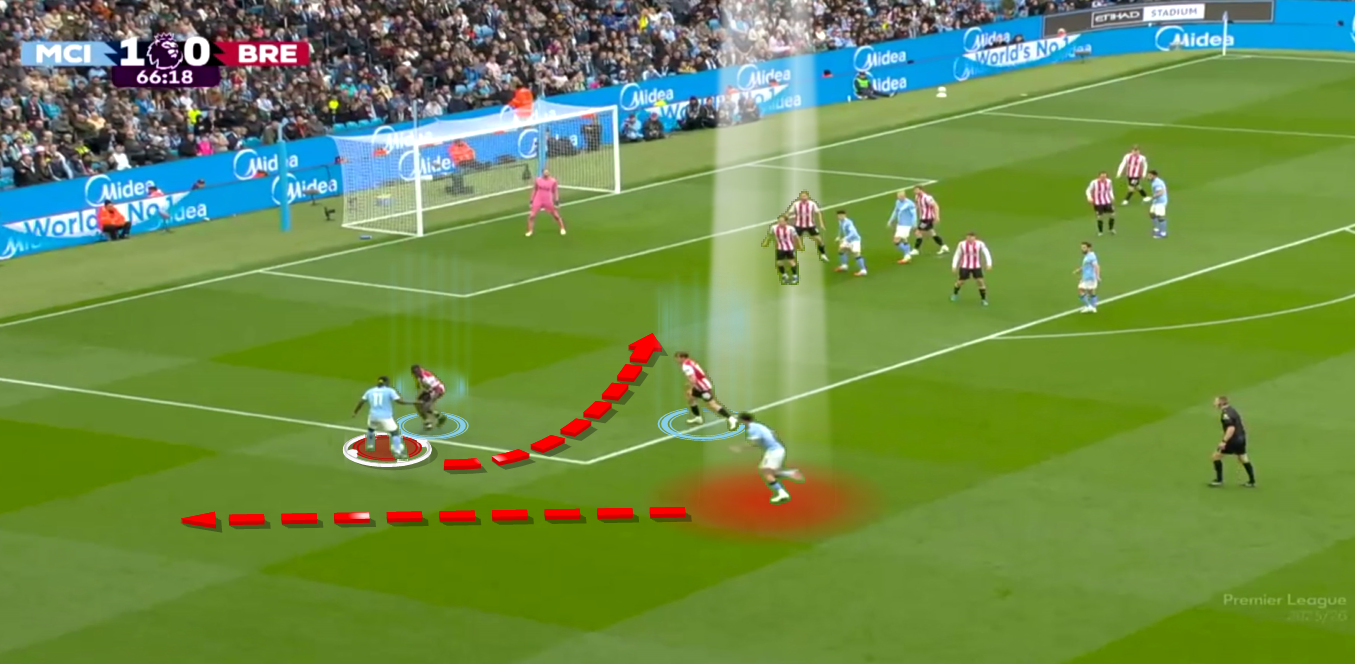
His starting position was usually high and wide on the left, stretching Brentford horizontally and pinning Kayode deep.
From there, he could receive to feet and attack directly.
The difficulty for Brentford was that Doku could beat his marker in different ways.
If Kayode got tight, Doku could accelerate outside.
If the defender protected the byline, Doku could shift inside onto his right foot.
If Brentford sent an extra player across, City could use O’Reilly or a nearby midfielder to continue the attack.
![Olympique De Marseille Vs PSG [1-2] Ligue 1 2026/2027: How Bruno Génésio Transitions Troubled PSG - Tactical Analysis](https://cdn.mymidnight.blog/77f959f119f4fb2321e9ce801e2f5163/size/w600/2026/09/Marseille-Vs-PSG-2026_2027---Tactical-Analysis.png)
![Fulham Vs Manchester United [1-1] Premier League 2026/2027: How Álvaro Arbeloa Tactics Exposed The Red Devils' Problems - Tactical Analysis](https://cdn.mymidnight.blog/77f959f119f4fb2321e9ce801e2f5163/size/w600/2026/09/Fulham-FC-Vs-Man-United-2026_2027---Tactical-Analysis.png)
![AS Roma Vs Inter Milan [2-2] Serie A 2026/2027: When Undefeated Giallorossi Attack Met Nerazzurri Comeback Resilience - Tactical Analysis](https://cdn.mymidnight.blog/77f959f119f4fb2321e9ce801e2f5163/size/w600/2026/09/AS-Roma-Vs-Inter-Milan-2026_2027---Tactical-Analysis.png)
![Real Sociedad Vs Bournemouth [1-2] Europa League 2026/2027: How Do Marco Rose Pressing Tactics Work? - Tactical Analysis](https://cdn.mymidnight.blog/77f959f119f4fb2321e9ce801e2f5163/size/w600/2026/09/Real-Sociedad-Vs-Bournemouth-20262027---Tactical-Analysis-1.png)
![AC Milan Vs Benfica [0-2] Europa League 2026/2027: How Marco Silva Tactics Exposed Rúben Amorim Defensive Problems - Tactical Analysis](https://cdn.mymidnight.blog/77f959f119f4fb2321e9ce801e2f5163/size/w600/2026/09/AC-Milan-Vs-Benfica-20262027---Tactical-Analysis.png)
![Sunderland Vs AZ Alkmaar [1-0] Europa League 2026/2027: Why The Black Cats Make Better Underdogs - Tactical Analysis](https://cdn.mymidnight.blog/77f959f119f4fb2321e9ce801e2f5163/size/w600/2026/09/Sunderland-Vs-AZ-Alkmaar-20262027---Tactical-Analysis.png)
![Leeds United Vs Newcastle United [4-1] Premier League 2026/2027: Why Did Daniel Farke Tactics Dominate The Magpies? - Tactical Analysis](https://cdn.mymidnight.blog/77f959f119f4fb2321e9ce801e2f5163/size/w600/2026/09/Leeds-United-Vs-Newcastle-2026_2027---Tactical-Analysis.png)
![Real Sociedad Vs Atlético Madrid [0-3] La Liga 2026/2027: How Diego Simeone Tactical Precision Rescued A Late Victory - Tactical Analysis](https://cdn.mymidnight.blog/77f959f119f4fb2321e9ce801e2f5163/size/w600/2026/09/Real-Sociedad-Vs-Atl--tico-Madrid-20262027---Tactical-Analysis-1.png)