
![Manchester City Vs Arsenal [2–1] – Premier League 2025/2026: How Man City Reignited Title Race – Tactical Analysis](https://cdn.mymidnight.blog/77f959f119f4fb2321e9ce801e2f5163/size/w1000/2026/04/Manchester-City-Vs-Arsenal-20252026.png)
Manchester City Vs Arsenal [2–1] – Premier League 2025/2026: How Man City Reignited Title Race – Tactical Analysis

Manchester City hosted Arsenal in what could prove to be one of the most decisive fixtures of the Premier League season; the clash ended in a 2-1 win for the Citizens.
This win gives Man City a chance to get back in front in the title race, as it puts them three points behind the Gunners with a game in hand.
This puts extra pressure on Mikel Arteta's Arsenal and their chances of winning the Premier League title, after spending most of the season at the top of the standings.
Arsenal recently put themselves in trouble by dropping points, paving the way for an experienced team like Manchester City to mount a potentially historic comeback that could destroy what Arsenal have been building towards.
In this tactical analysis, we explore Arsenal’s first and second-half tactics, how they sought to stop Manchester City’s threats, and how the Citizens responded.
Manchester City Vs Arsenal Lineups & Formations
Let's look at how both managers set up their teams for this clash.
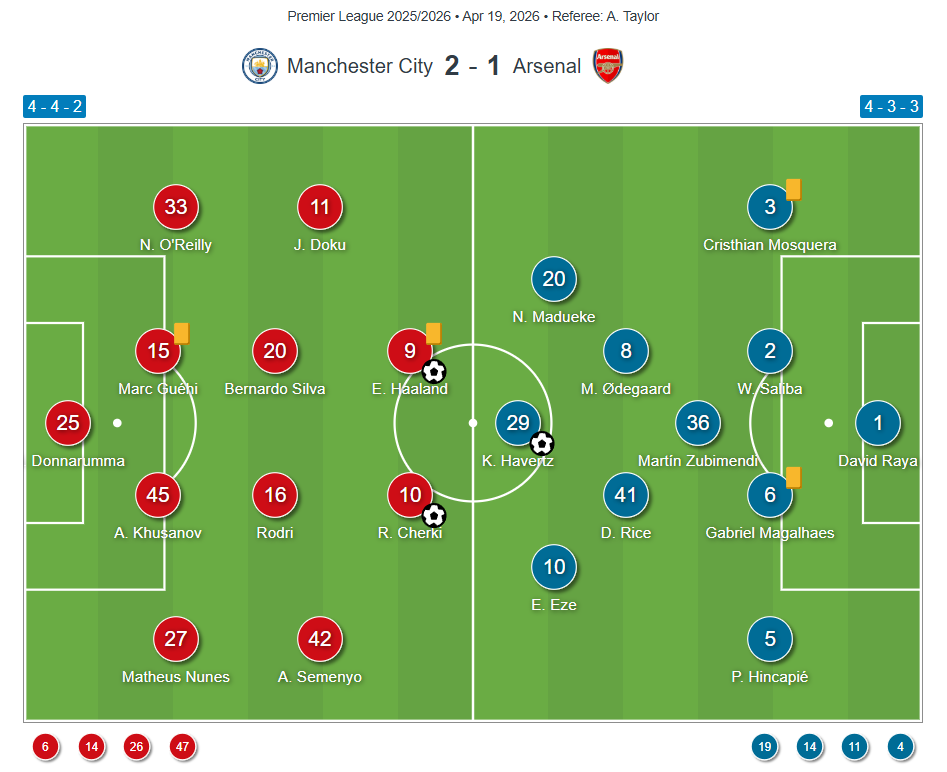
Manchester City Lineup Vs Arsenal
Pep Guardiola opted for a 4-4-2 formation, relying on Gianluigi Donnarumma in goal, and a defensive line of Abdukodir Khusanov and Marc Guéhi as centre-backs, flanked by Matheus Nunes on the right and Nico O’Reilly on the left as full-backs.
Bernardo Silva and Rodri were the two central midfielders, with Antoine Semenyo as the right winger, Jérémy Doku as a left winger, Rayan Cherki as a second striker, and Erling Haaland as the main striker.
Arsenal Lineup Vs Manchester City
On the other side, Mikel Arteta preferred to start the match in a 4-3-3 formation, with David Raya in goal and a back four of William Saliba and Gabriel Magalhães as the right and left centre-backs, and Cristhian Mosquera and Piero Hincapié as the right and left full-backs.
The midfield was composed of Martín Zubimendi as a defensive midfielder, with both Declan Rice and Martin Ødegaard as central midfielders.
And in attack, Arsenal relied on both Noni Madueke and Eberechi Eze on the wings, with Kai Havertz playing up front.
Man City Crucial Penetrations Vs Arsenal High Pressing Plan & Impactful Second-Half Changes
Manchester City tactics started the match with more ambition to attack and dictate the game, even though the rhythm was intense from both sides.
Man City looked more confident, more organised in attack, and more ambitious to take risks to reach Arsenal’s goal.
And that’s what they did in the first minutes as they relied on penetrations from the wings, thanks to Doku and Semenyo’s 1v1 skills to beat their direct opponents and have a chance for crossing or providing final passes to the direction of Haaland inside the box.
This straightforward, anticipated attacking solution worked immediately for Manchester City, as Arsenal’s players tried to limit such actions but were not organised enough to do so.
Arsenal did not counter Manchester City’s initial attacking attempts with a clear defensive system, relying solely on direct duels and not resorting to double-marking instructions in specific areas or on specific players.
This lack of defensive plans made Manchester City more dangerous and left Arsenal looking more confused in the defensive phase.
Arsenal Counter-Attacking Failure
Arsenal looked hesitant and lacked determination even in attack, despite having the chance to counter Manchester City’s missed attacks with quick, dangerous counterattacks.
However, Arsenal failed to do so, especially during their first attempts, mainly due to wrong decision-making in terms of key passes.
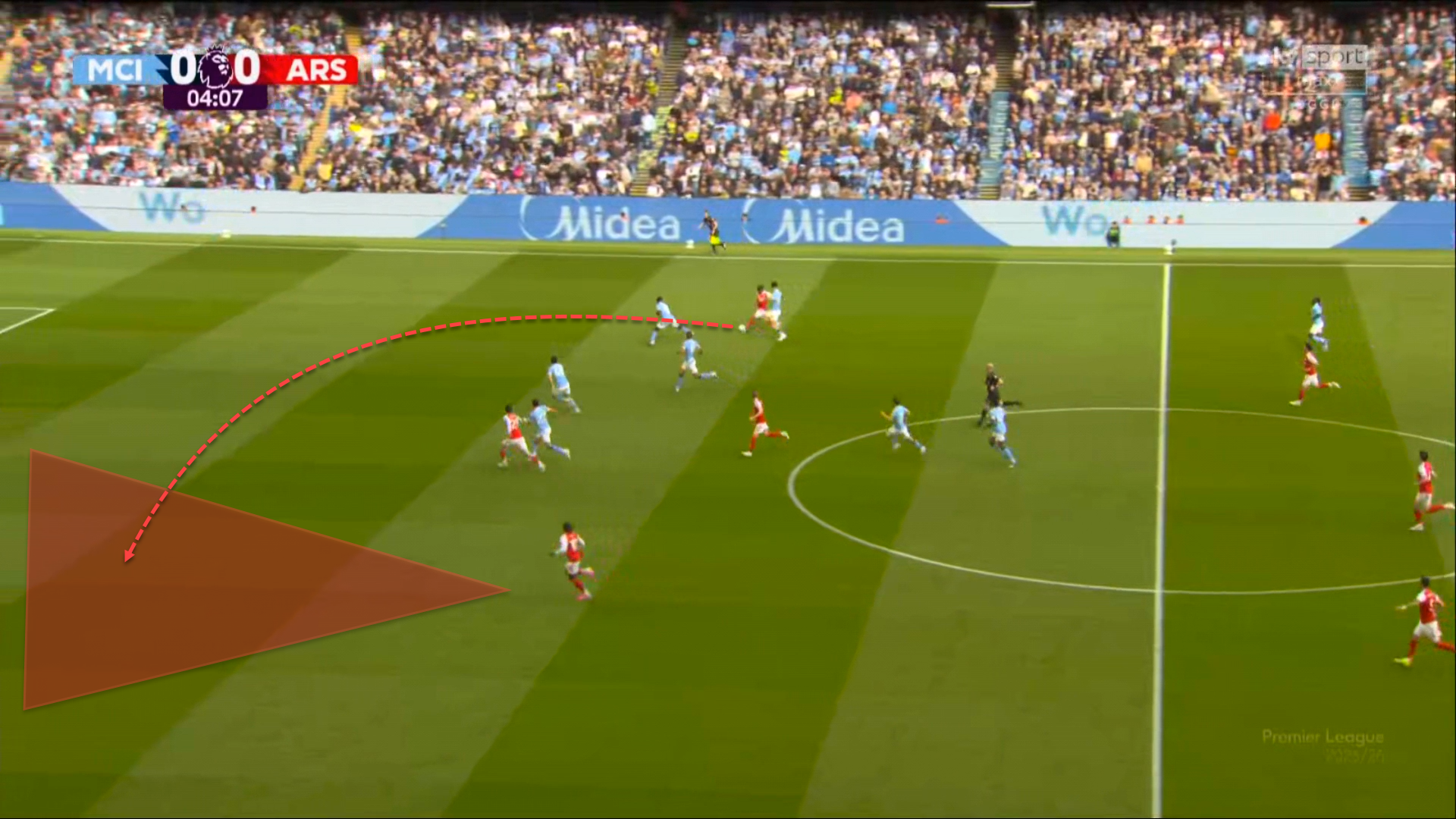
As an example, the following counterattacking action that came after Manchester City’s first dangerous action saw Madueke miss a golden opportunity to score a goal that would have changed the whole situation and the events of the match.
Finding the opportunity to advance in a four-vs-four situation but failing to make an accurate pass to Eze, who was completely unnoticed and unmarked on the left wing, was a very disappointing decision by Madueke.
In fact, Madueke failed in his execution of that crucial pass, giving the ball away to Manchester City’s goalkeeper instead of providing an assist to Eze, who could more likely have scored, as a through pass towards the coloured area would have made the job very simple for a talented winger like Eze.
Failing to exploit such counterattacking situations and the spaces that Manchester City left behind after attacking was one of Arsenal’s crucial tactical errors in the first part of the match.
Arsenal High Pressing Plan
That said, Arsenal took more risks following those minutes and started applying more determined high pressing, with the idea of preventing Manchester City from building up from the back with ease, and trying to make high recoveries as much as possible.
Arsenal succeeded in doing so on more than one occasion, and that helped them in launching quick counterattacks and exploit their numerical superiority inside Manchester City’s final third.
However, the problem is that there was always something wrong in these Arsenal attempts: Most notably, their final pass and finishing.
Arsenal’s risky high-pressing plan inside Manchester City’s own third worked well and helped them prevent Manchester City from advancing and create dangerous situations on the Citizens’ defence as well.
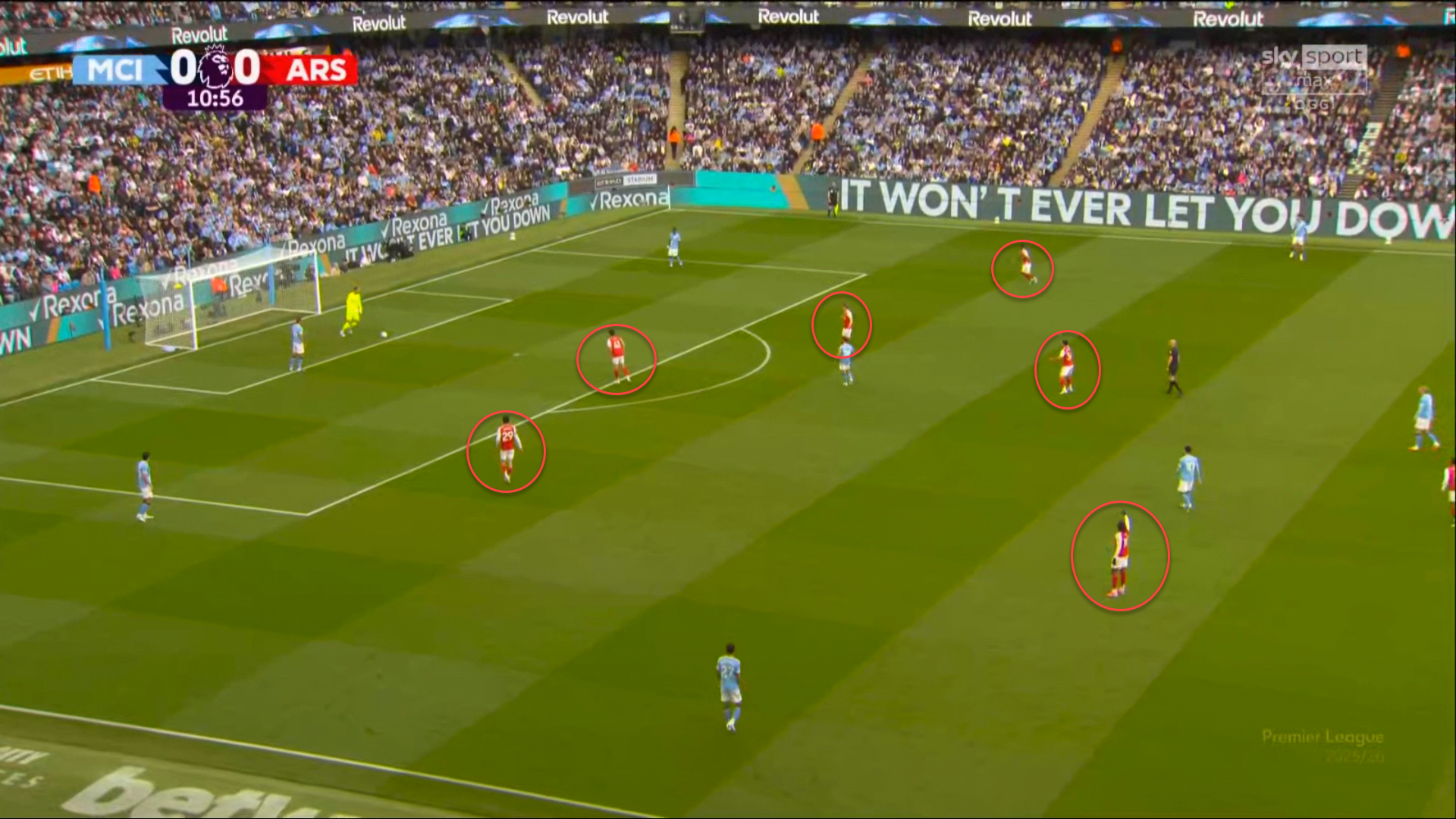
The following picture shows Arsenal’s high pressing with six players inside Manchester City’s own third in an attempt to oblige them to opt for long passing instead of building up from the back.
And in case the goalkeeper passes the ball to his limited options, the ball holder would be obliged to either opt for crossing towards Haaland or to the wings, or risk advancing with short passes and therefore give an opportunity for Arsenal’s players to intercept the ball.
In this situation, for instance, Donnarumma preferred to play a short pass to Guéhi, but the latter did not see any passing options, so he decided to pass the ball back to Donnarumma.
The Italian goalkeeper was then obliged to resort to a long pass towards Haaland, who also retreated to his team’s own half in order to help with the build-up.
But Arsenal were prepared for this solution as well, and Saliba was attentive and anticipatory enough to beat Haaland in the aerial duel.
Arsenal’s plan limited Manchester City’s attacking attempts for a while and was useful; however, the only problem was that the Gunners failed to exploit it well enough from an attacking perspective.
But despite that, Havertz’s determination in the high-pressing attempts helped him be rewarded with a goal, surprising Donnarumma and forcing him into a crucial error after his slow control and long-passing attempt.
So even though Arsenal did not use their high recoveries in the needed way, they still succeeded in scoring thanks to their high pressing plan.
Manchester City Dangerous Penetrations
Despite Arsenal’s remarkable high pressing and high recovery attempts in order to prevent Manchester City from advancing, the Gunners failed to defend well enough when Manchester City succeeded in reaching Arsenal’s final third.
Arsenal knew that Manchester City can be very dangerous if given the opportunity to reach the final third more frequently, and that’s one of the reasons why they resorted to spending more energy in the high pressing attempts.
Manchester City’s first goal can only confirm Arsenal’s worries as the Citizens succeeded in scoring as soon as they had a moment of possession inside Arsenal’s own third, with Cherki benefiting from his teammate’s pass, dribbling past two opponents and shooting with accuracy before the third defender arrives.
It was an action that highlighted the vulnerability of Arsenal’s 1v1 defending and their lack of solutions against Manchester City’s talented attacking players inside the final third.
Arsenal Second-Half Defensive Change
Despite Arsenal’s equaliser, Manchester City remained the better side from an attacking perspective, creating more chances through their quick transitions, especially in the second half, when Arsenal were unable to be as disciplined and aggressive in their high pressing as in the first half.
This helped Manchester City become more dangerous, even though the Citizens made crucial errors during some of those attacking transitions, which prevented them from scoring.
These errors were mainly due to misunderstandings among the players regarding movement and passing.
At the same time, some were also caused by the lack of precision in Manchester City’s players’ first touches and by poor finishing on some occasions.
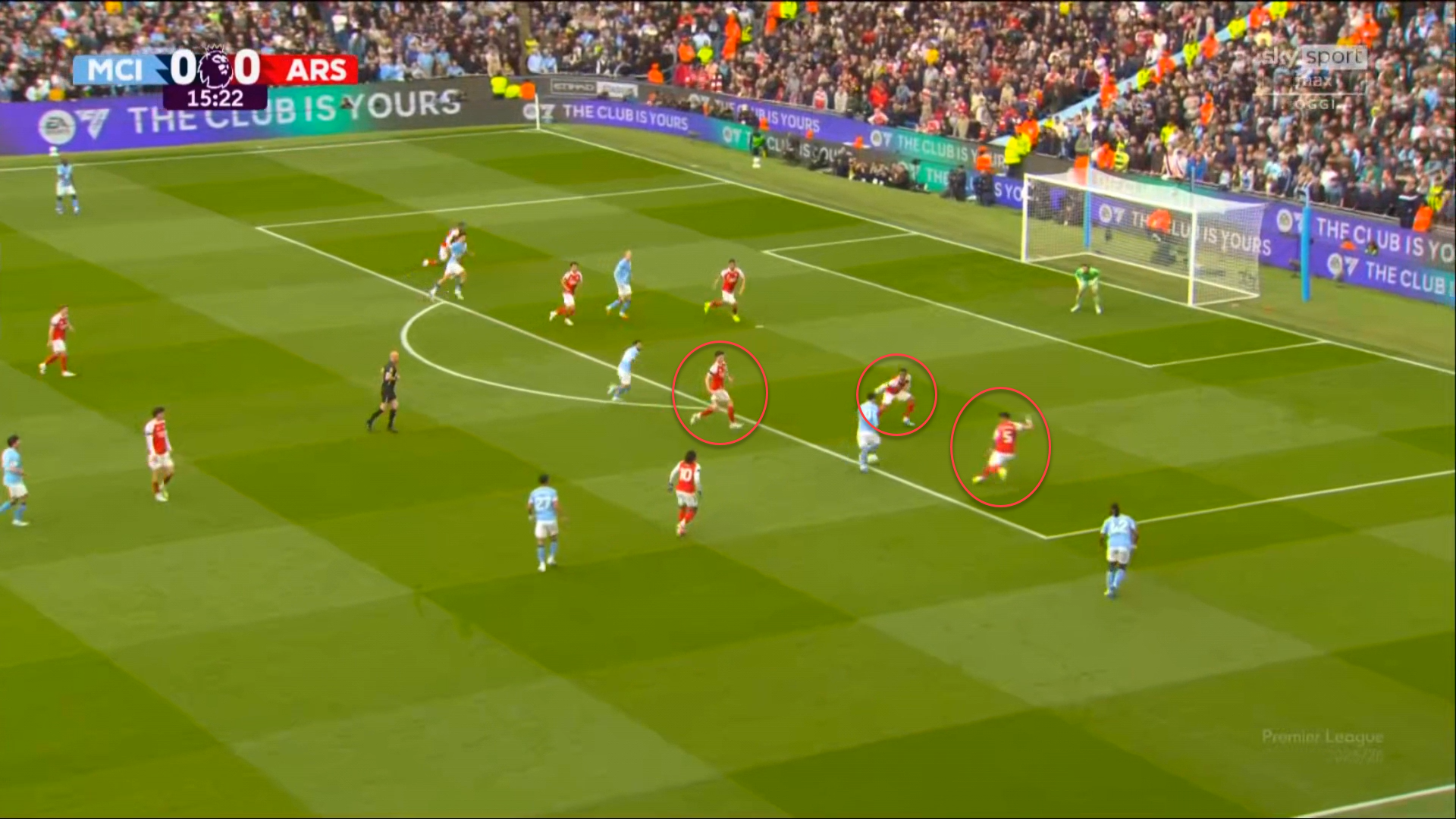
As the second half progressed, Arsenal switched their approach since they were no longer able to finish the match with the same system, and therefore resorted to defending in a more central, condensed area than in the first half, when the Gunners were much higher, as shown in Figure 3.
In fact, Arsenal defended with an even lower defensive line than the one shown in the picture below for most of the second half, which gave Manchester City the opportunity to create more chances, especially from the wings.
![Barcelona Vs Real Madrid [1-2] La Liga 2026/2027: How José Mourinho Tactics Outmanoeuvred Hansi Flick At Camp Nou - Tactical Analysis](https://cdn.mymidnight.blog/77f959f119f4fb2321e9ce801e2f5163/size/w600/2026/10/Barcelona-Vs-Real-Madrid-2026_2027--Tactical-Analysis.png)
![Liverpool Vs Brighton & Hove Albion [2-0] Premier League 2026/2027: How Andoni Iraola Tactics Turned Defensive Solidity Into Victory - Tactical Analysis](https://cdn.mymidnight.blog/77f959f119f4fb2321e9ce801e2f5163/size/w600/2026/10/Liverpool-Vs-Brighton-2026_2027--Tactical-Analysis.png)
![Napoli Vs AS Roma [3-3] Serie A 2026/2027: How Napoli Threw Away Two Leads Against Gian Piero Gasperini Tactics - Tactical Analysis](https://cdn.mymidnight.blog/77f959f119f4fb2321e9ce801e2f5163/size/w600/2026/10/Napoli-Vs-AS-Roma--2026_2027--Tactical-Analysis-1.png)
![Juventus Vs Rennes [2-2] Europa League 2026/2027: How I Bianconeri Created Chances But Failed To Finish The Job - Tactical Analysis](https://cdn.mymidnight.blog/77f959f119f4fb2321e9ce801e2f5163/size/w600/2026/10/Juventus-Vs-Rennes-2026_2027----Tactical-Analysis.png)
![Bayern Munich Vs Arsenal [2-2] Champions League 2026/2027: How Vincent Kompany & Mikel Arteta Tactics Cancelled Each Other Out - Tactical Analysis](https://cdn.mymidnight.blog/77f959f119f4fb2321e9ce801e2f5163/size/w600/2026/10/Bayern-Munich-Vs-Arsenal-2026_27---Tactical-Analysis.png)
![PSG Vs Barcelona [4–2] – Champions League 2026/2027: PSG Attacking Persistence Exposes Barcelona Defensive Problems – Tactical Analysis](https://cdn.mymidnight.blog/77f959f119f4fb2321e9ce801e2f5163/size/w600/2026/10/PSG-Vs-Barcelona----Tactical-Analysis-1.png)
![Brighton & Hove Albion Vs Crystal Palace [5-0] Premier League 2026/2027: How Fabian Hürzeler Combined Pressing & Positional Rotations To Dominate The M23 Derby - Tactical Analysis](https://cdn.mymidnight.blog/77f959f119f4fb2321e9ce801e2f5163/size/w600/2026/10/Brighton---Hove-Albion-Vs-Crystal-Palace-2026_2027----Tactical-Analysis-1.png)
![Newcastle United Vs Aston Villa [0-1] Premier League 2026/2027: How Unai Emery Tactics Punished Wasteful Magpies - Tactical Analysis](https://cdn.mymidnight.blog/77f959f119f4fb2321e9ce801e2f5163/size/w600/2026/10/Newcastle-United-Vs-Aston-Villa---Tactical-Analysis.png)