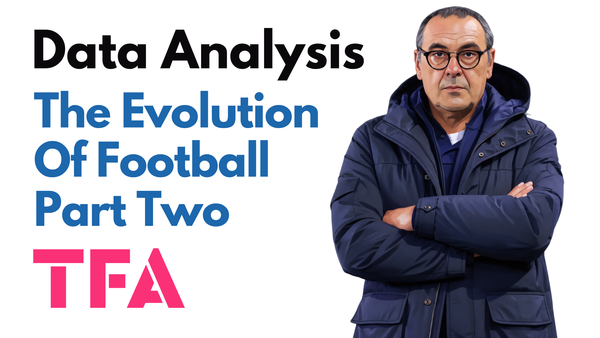

Has Modern Football Really Changed? 10 Years Of Premier League & La Liga Stats Reveal The Tactical Evolution – Data Analysis
Has modern football undergone a tactical revolution, or simply entered another cycle? This data analysis examines a decade of changes in progression, pressing, line-breaking passes and defensive intensity.

Modern football is often described as being in the middle of a tactical revolution.
Discussion around the rise in vertical football and the decline of possession-based play have become increasingly common, leading many to believe that the sport has fundamentally changed.
But how much of that is supported by the data, and how much is driven by perception?
In Zonal Marking, Michael Cox highlights that football doesn't evolve in a straight line, but through tactical cycles, where every dominant philosophy eventually creates the conditions for a new response.
From total football to pressing, possession football and counterpressing, the game continuously adapts rather than following a single permanent direction.
This data analysis examines whether the current perception of football’s evolution is supported by measurable evidence.
By comparing key tactical metrics across multiple seasons, including possession, directness, pressing and transitions, we determine whether the fundamentals of the game have genuinely changed or whether modern football remains another stage in its ongoing tactical cycle.
What Defines A Style Of Play In Football?
Before attempting to determine whether football has genuinely changed, it is first necessary to establish what actually defines a style of play.
Tactical identity cannot be measured through isolated matches or individual trends; instead, it must be assessed through consistent performance indicators over a prolonged period.
A genuine tactical shift should therefore be reflected in the underlying data rather than short-term perception.
For this analysis, we focus on five fundamental components that shape how teams play: pressing, possession, passing, directness, and transitions.
Together, these metrics provide a broad picture of both in-possession and out-of-possession behaviour, allowing us to compare how the game has evolved across multiple seasons.
By examining long-term trends rather than isolated examples, we can establish whether football has undergone a meaningful tactical transformation or whether the core principles of the game have remained largely unchanged despite the changing narratives surrounding them.
From Passing Lanes To Running Lanes: Has Vertical Progression Changed?
While modern football is often portrayed as moving away from possession-based play, the data suggests a more nuanced tactical evolution.
Over the last decade in the Premier League, progression has not disappeared, but the method of achieving it has changed.
Rather than relying primarily on progressive passing to advance possession, teams are increasingly carrying the ball themselves.
This raises an important question: has the game's verticality remained constant while the mechanisms behind it have evolved?
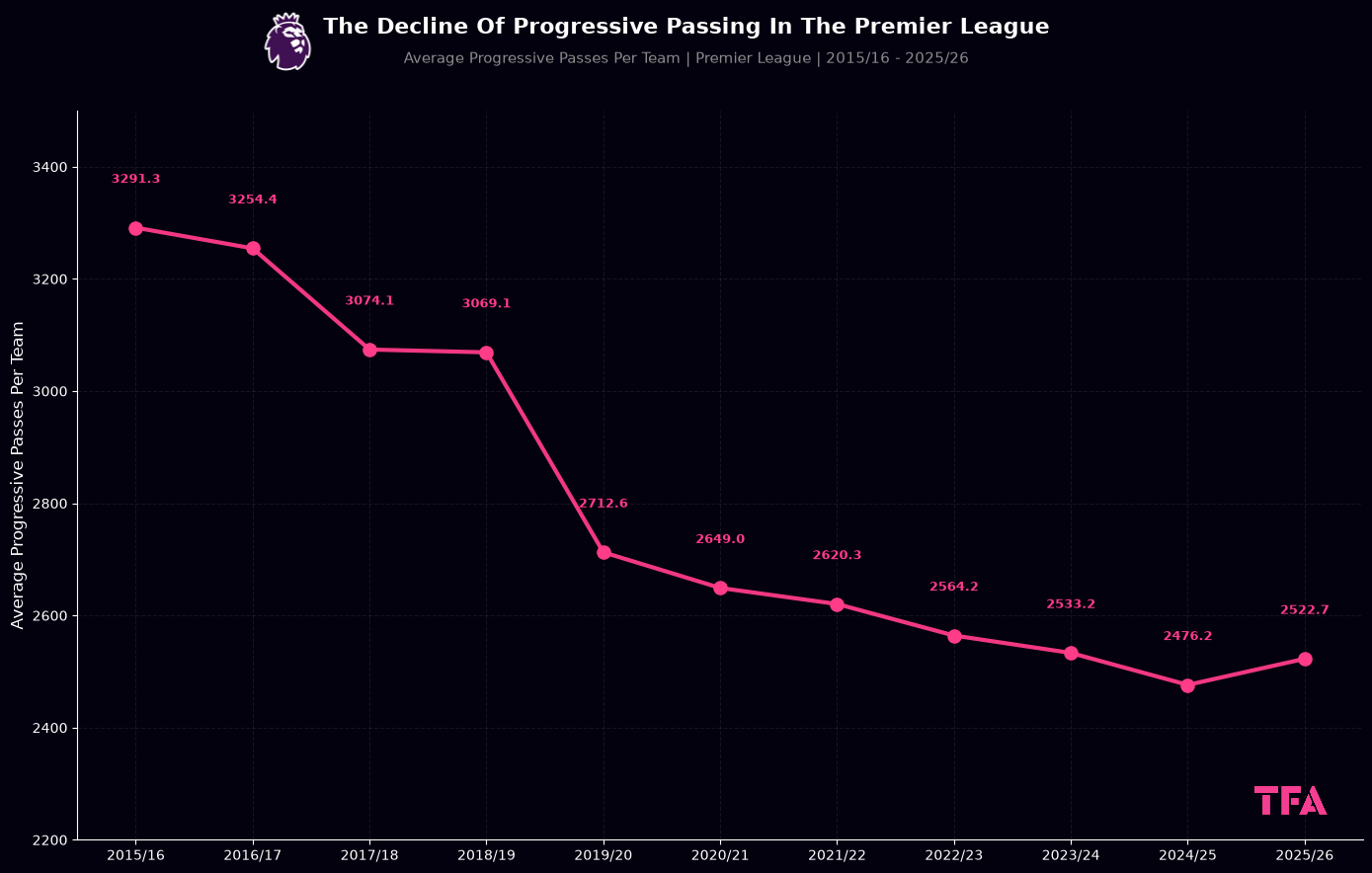
The first league-wide trend highlights this shift clearly: between 2015/2016 and 2025/2026, the average number of progressive passes per team declined from 3,291.3 to 2,522.7.
Average Progressive Passes Per Team, Premier League 2015/2016-2025/2026
Meanwhile, progressive runs more than doubled from 281.2 to 626.1.
Average Progressive Runs Per Team, Premier League 2015/2016-2025/2026
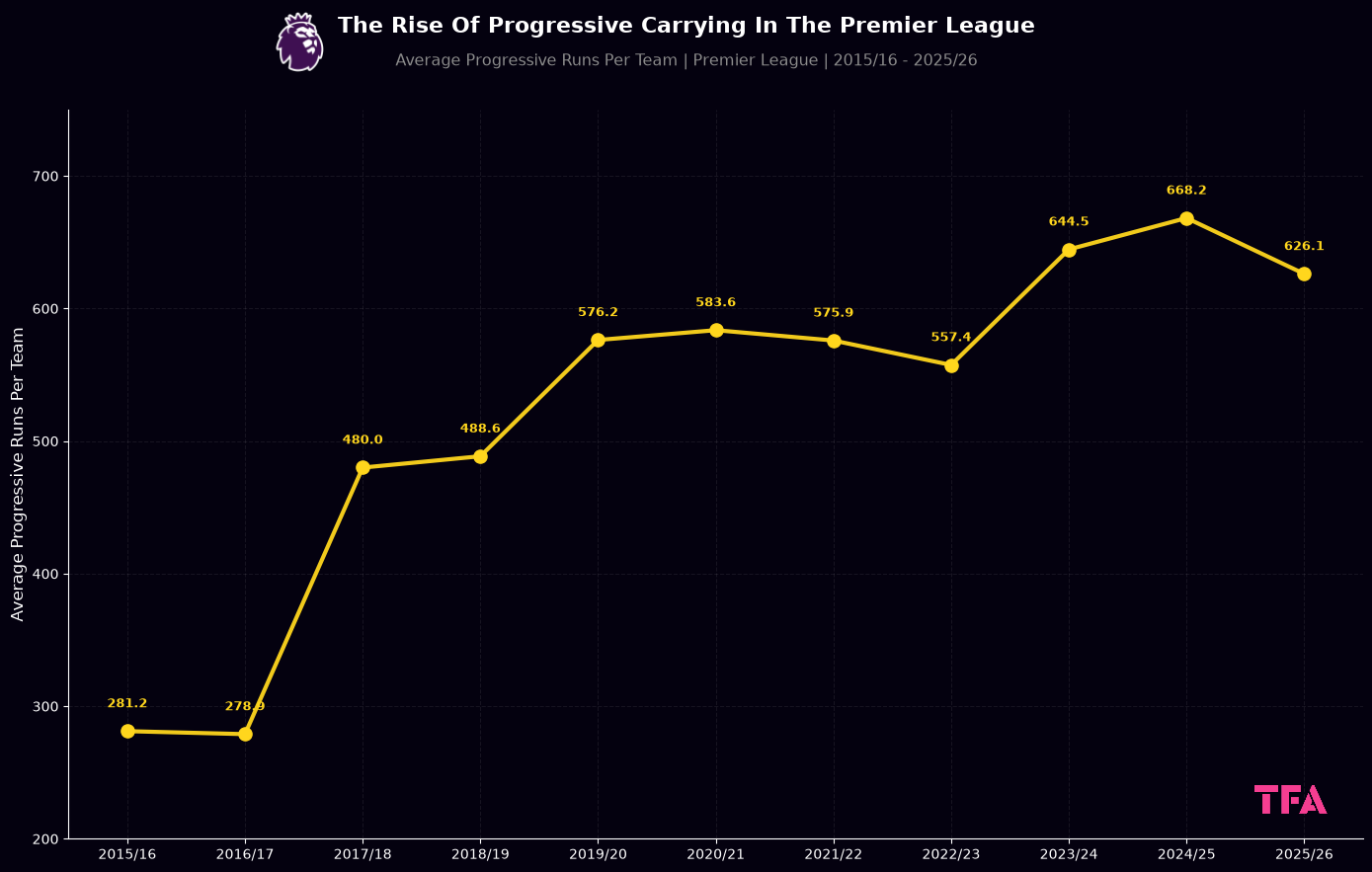
The inverse relationship remains remarkably consistent throughout the entire 11-season sample.
As progressive passing gradually decreased almost every season, progressive carrying followed the opposite trajectory, reaching its highest levels in recent campaigns.
Premier League teams appear to have altered how they gain territory, increasingly favouring ball-carrying over circulating possession through successive forward passes.
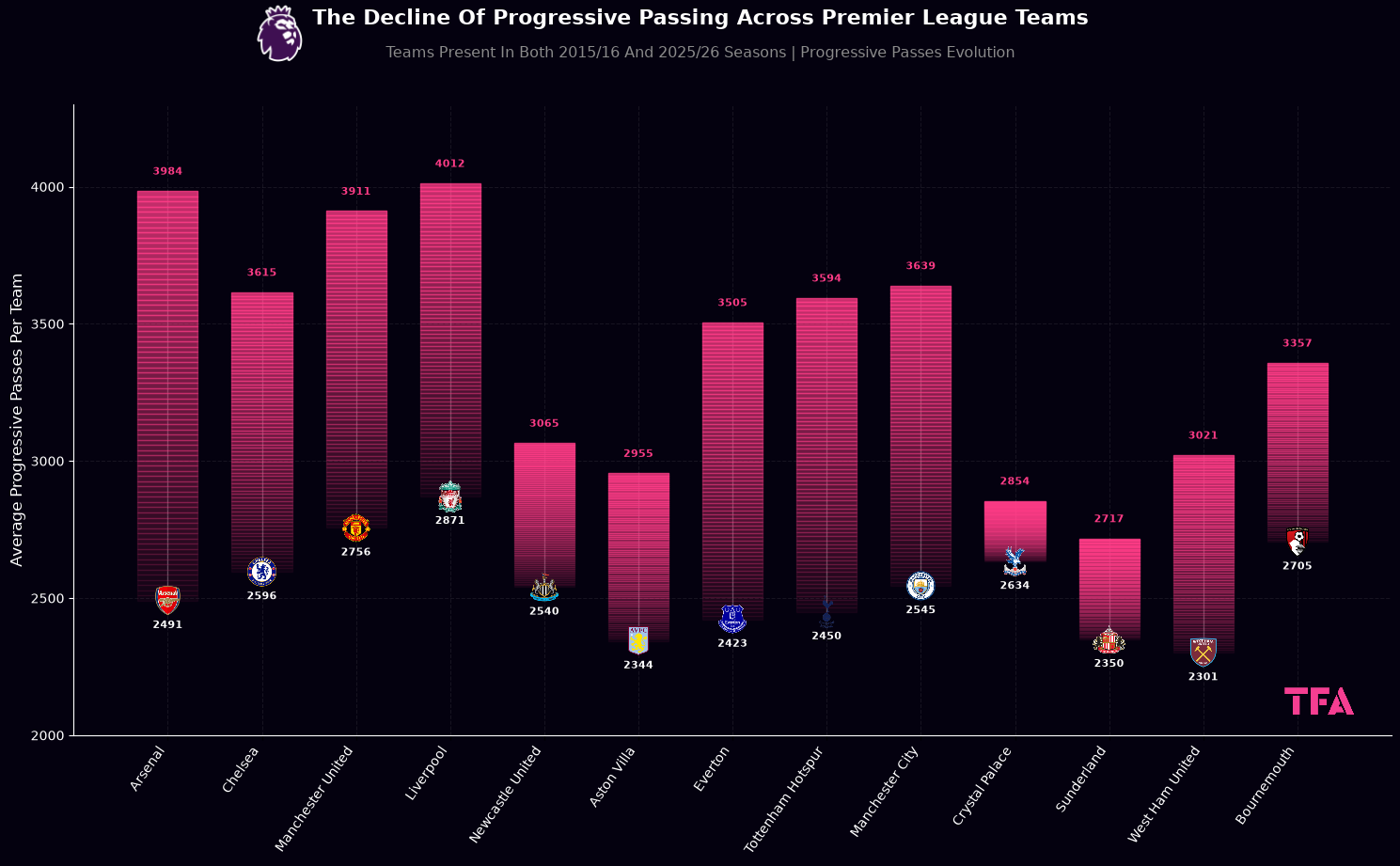
The club-level data reinforces this conclusion; almost every established Premier League side recorded a substantial reduction in progressive passes over the decade.
The Decline Of Progressive Passing Across Premier League Teams Present In Both 2015/2016 & 2025/2026 Seasons