
![Nottingham Forest Vs FC Porto [1–0] – UEFA Europa League 2025/2026: A Professional Display Under Vitor Pereira Tactics – Tactical Analysis](https://cdn.mymidnight.blog/77f959f119f4fb2321e9ce801e2f5163/size/w1000/2026/04/Nttm-Forest-Vs-FC-Porto-20252026.png)
Nottingham Forest Vs FC Porto [1–0] – UEFA Europa League 2025/2026: A Professional Display Under Vitor Pereira Tactics – Tactical Analysis

Nottingham Forest hosted FC Porto on Thursday night in the 2nd leg of the Europa League at the City Ground, with both teams having drawn 1-1 the week before in Portugal.
Francesco Farioli Porto tactics dominated their home leg, creating 2.16 expected goals to Forest's 0.45.
Forest would have felt lucky on the night, with a bizarre Martim Fernandes own goal from just inside his own half levelling Willian Gomes early opener.
Both teams went into this game after positive results over the weekend.
Vítor Pereira style of play drew 1-1 with Champions League chasing Aston Villa, pushing them three points above the relegation zone thanks to Tottenham Hotspur loss away at Sunderland.
Porto kept their five-point lead at the top of Portugal's top-flight Primeira Liga, thanks to a 3-1 win away at Estoril (although rivals Sporting CP have a game in hand).
Like the first leg, this game was heavily influenced by early events.
Porto had looked the more positive of the two teams, then, just eight minutes in, Jan Bednarek caught Chris Wood high in a 50-50.
After a somewhat lengthy VAR check, referee Danny Makkelie went to the screen and gave the Polish defender his marching orders.
It then took Forest just four minutes to take advantage, as some high pressure and a massive deflection saw Morgan Gibbs-White break the deadlock, with the only goal of the game.
This was a game shaped by one team knowing how to use their numerical advantage, forcing their opposition into mistakes and making the most of the space, while the other never adjusted to being a man down.
This Nottingham Forest Vs FC Porto tactical analysis focuses on how Forest managed to exploit their opposition through central progression and 1v1s in wide areas, and how Porto struggled to ever get a foothold, although they will rue hitting the woodwork twice.
Nottingham Forest Vs FC Porto Lineups & Formations
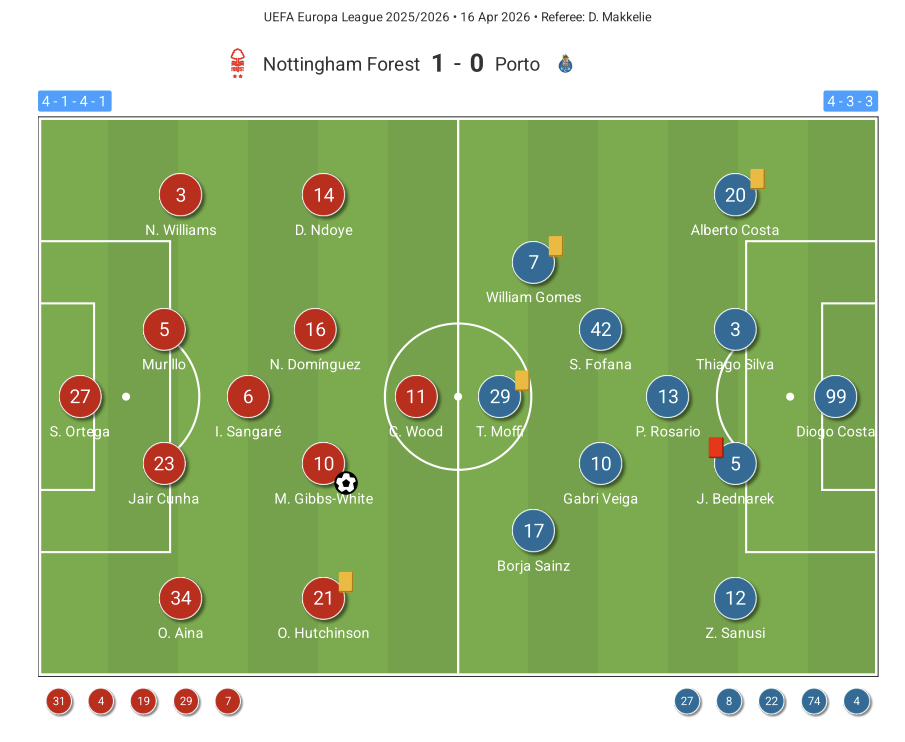
Both sides had rested some key players in their league fixtures at the weekend, despite the importance of the games at both ends of the table.
Pereira made five changes from the Villa game and opted for a 4-2-3-1 (Forest had used a back three in the first leg).
Stefan Ortega replaced Matz Sels in goal.
At centre-back, Murillo retained his place, while Jair Cunha replaced Nikola Milenković.
They were flanked by Neco Williams and Ola Aina.
Nicolás Domínguez partnered with Ibrahim Sangare in the base of midfield, and there were two changes in the attacking unit, with Dan Ndoye replacing Callum Hudson-Odoi and Chris Wood coming in for Igor Jesus.
Gibbs-White and Omari Hutchinson stayed in the side.
Wood was forced off after 16 minutes, never recovering from the red-card tackle and was replaced by Jesus.
Hudson-Odoi replaced Hutchinson at half-time but had to be replaced himself with 20 minutes to go by Dilane Bakwa.
Morato for Murillo was another enforced change, while Milenković came on for Ndoye as Forest tried to manage the game.
Porto made one more change than Forest from the weekend, as Farioli looked to match them with a 4-2-3-1 of their own.
Diogo Costa remained in goals, and the only change in defence was the veteran Thiago Silva replacing Jakub Kiwior, with Alberto Costa, Bednarek and Zaidu Sanusi joining him.
Pablo Rosario and Seko Fofana created the base in midfield, with Borja Sainz, Gabri Veiga and Willian Gomes ahead of them (matching the first leg lineup).
Terem Moffi kept his place up front from the first game, too.
After Bednarek's early red, Farioli opted not to make a substitution but instead placed Rosario in central defence.
He then tried to freshen things up with a quadruple substitution at half-time.
Victor Froholdt, Alan Varela, Jakub Kiwior and Francisco Moura replaced Veiga, Sainz, Costa and Sanusi.
Deniz Gul came on in the 66th minute for Moffi as Porto were chasing an equaliser.
Nottingham Forest Vs FC Porto: Another Fast Start
In the first leg, our FC Porto Vs Nottingham Forest tactical analysis noted how fast a start Porto had to the game, with Moffi missing a good chance inside the first minute; that happened again in the second leg.
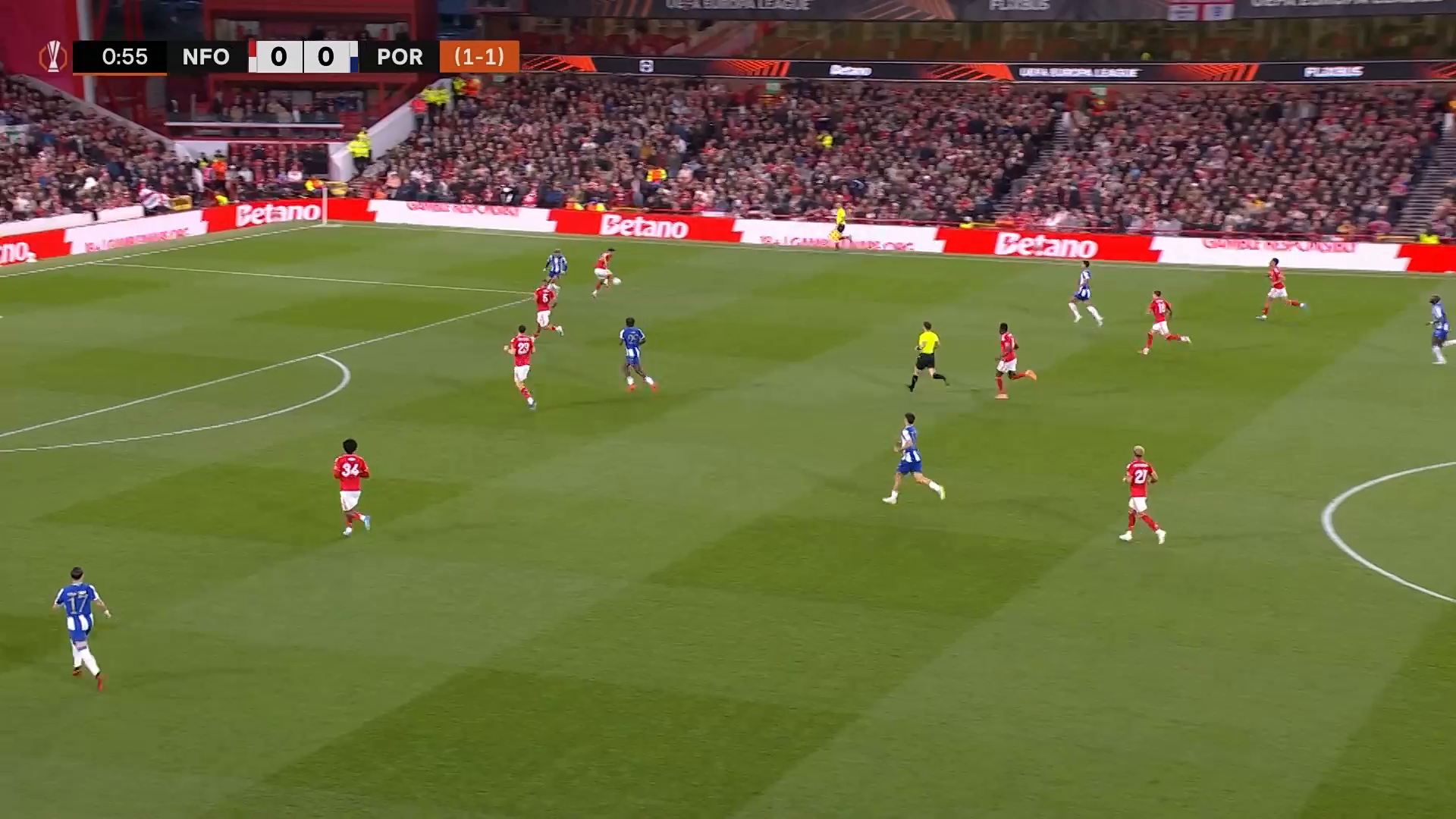
Porto tries to bait the press, in typical Farioli fashion, then goes long to Gomes.
Forest seem set up in their defensive structure, but a heavy touch from Williams leaves them in the situation below.
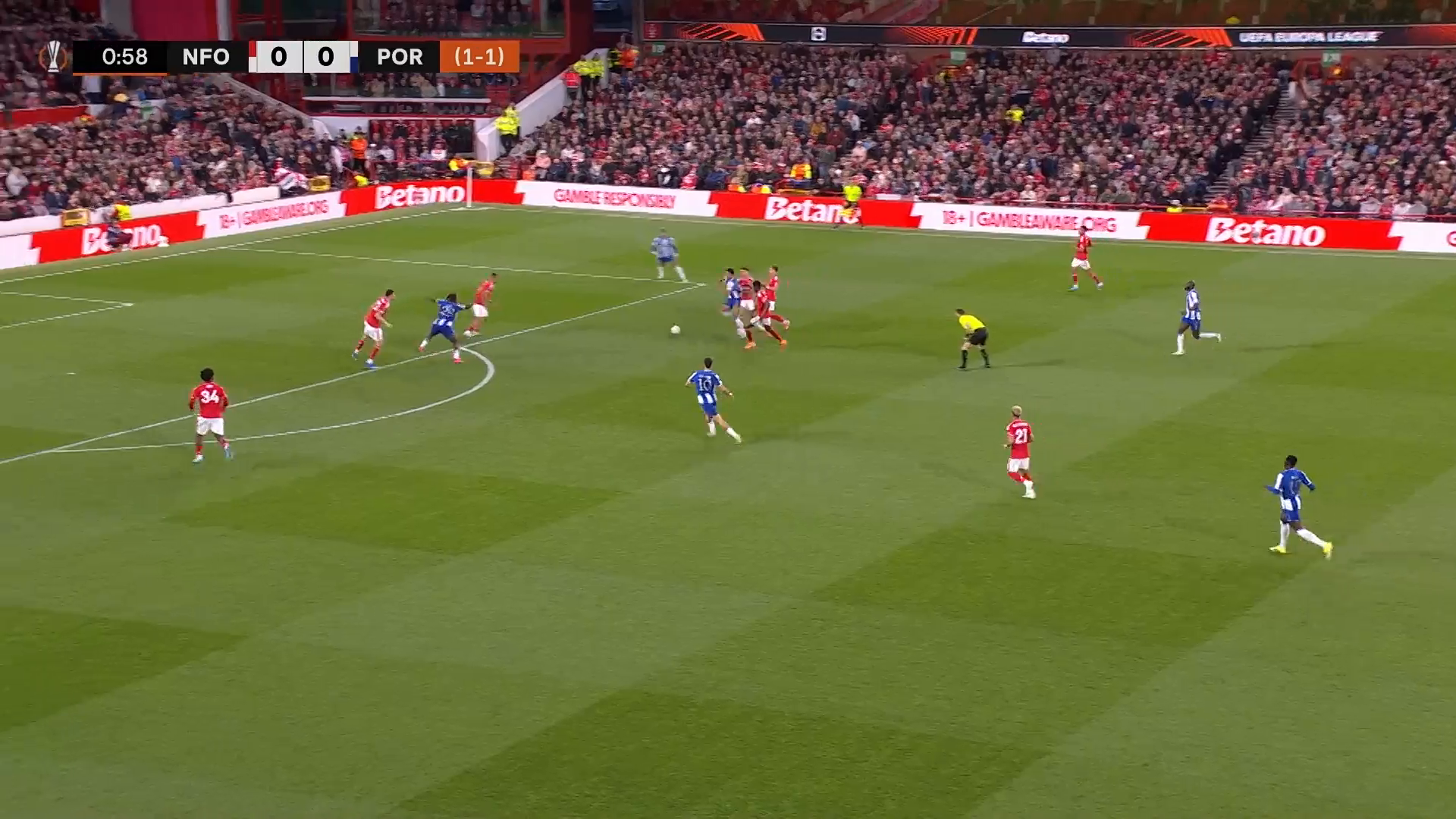
Costa then plays Moffi in behind, who just has Ortega to beat.
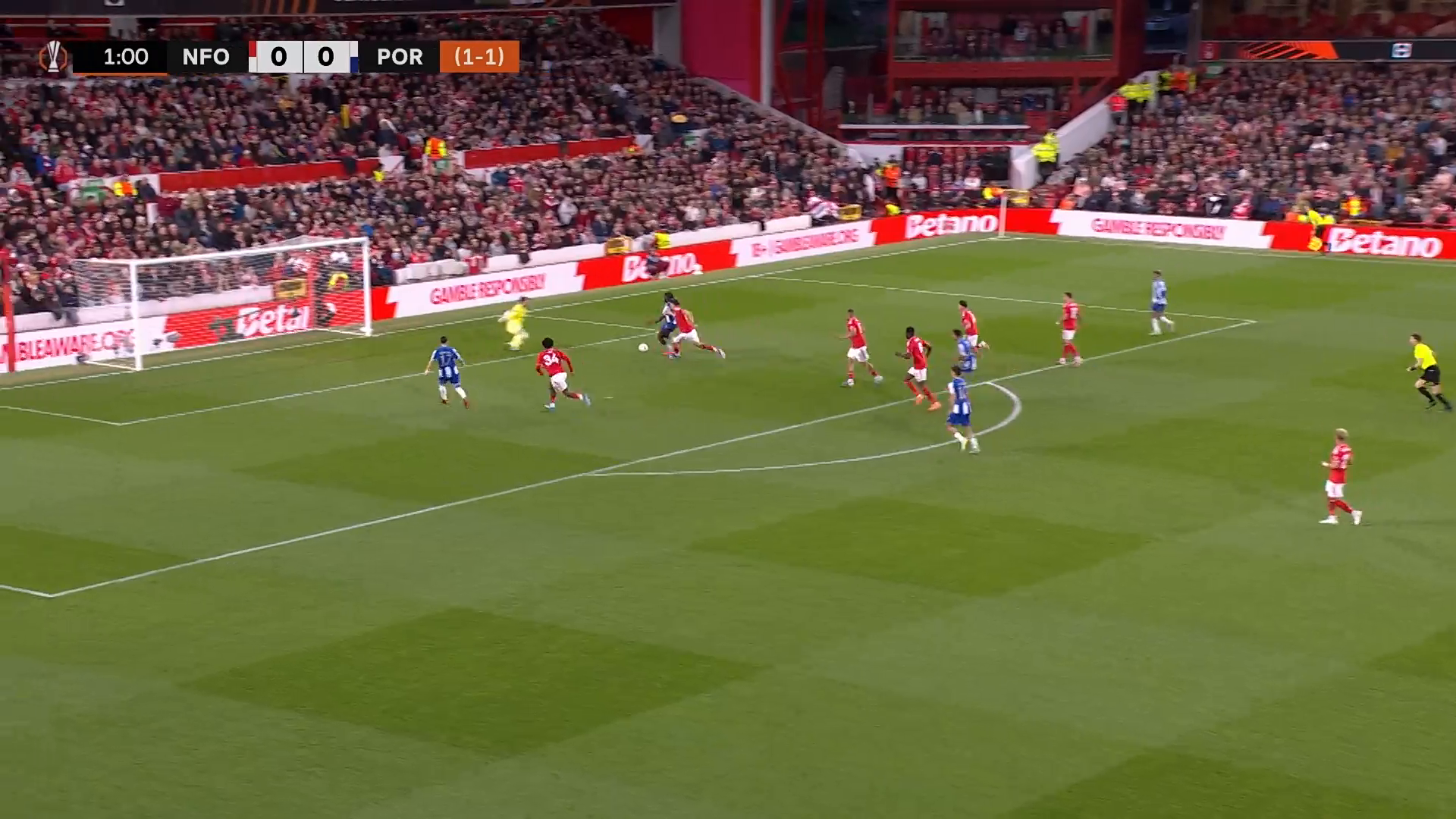
He tries to be too gentle with his finish, attempting a deft dink over the goalkeeper, who stays strong and blocks the shot.
The early indication was that Porto would be the dominant force in this tie.
They looked confident on the ball and dominated possession, forcing Forest into turnovers.
Then, with just eight minutes on the clock, the entire tie changed.
Forest build out from the back, with Ortega giving it to Cunha in his own box, who gets the ball out wide to Aina.
Aina plays it to Hutchinson, who plays a sweeping pass into the central area, hitting his centre-forward, Chris Wood.
Bednarek tries to steal the ball but hits Wood in the knee, and a lengthy check ends with a red card.
It took the Nottingham side just four minutes to take advantage.
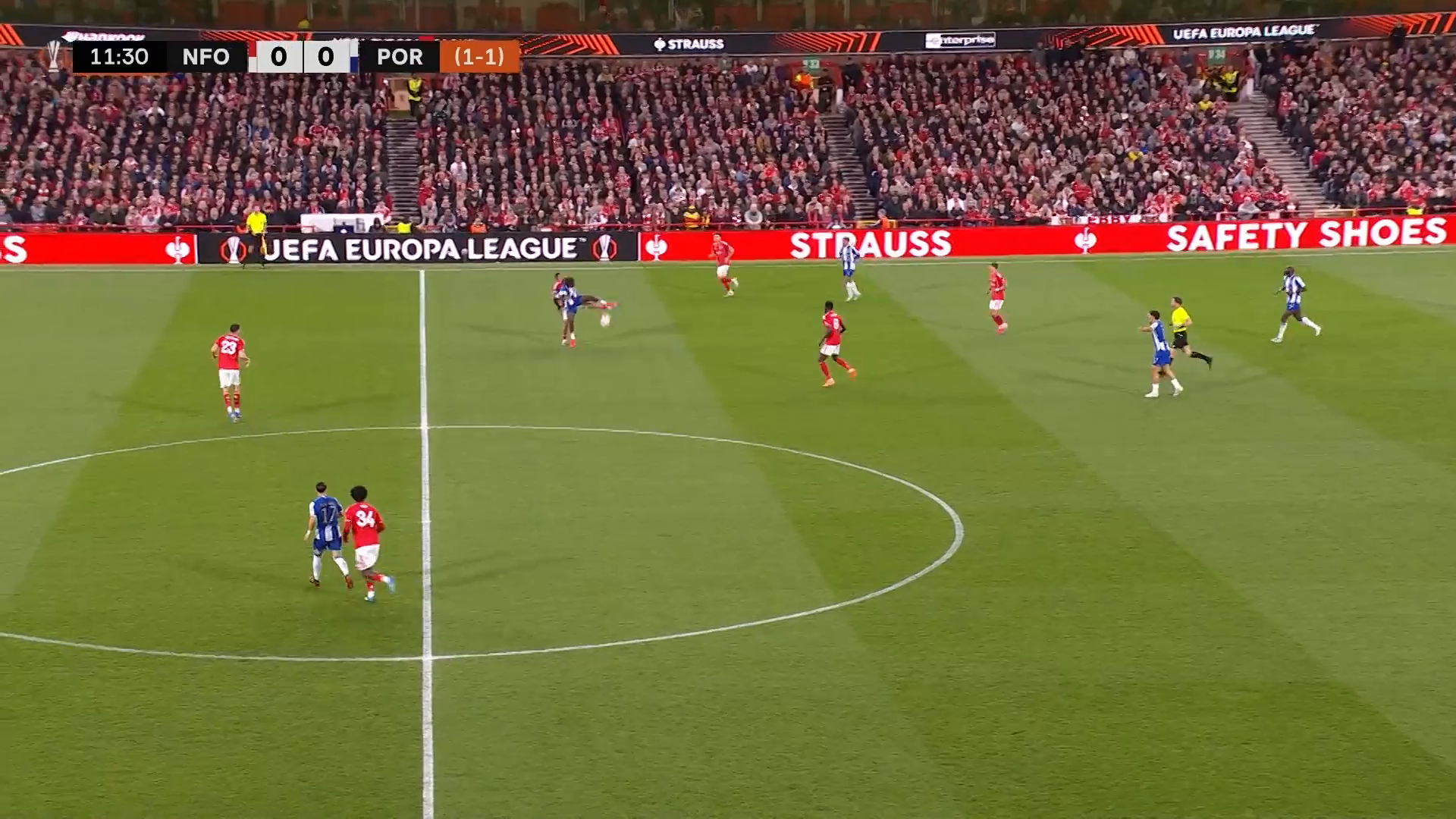
FC Porto attempted to go long, a tactic they did continuously throughout the game.
Moffi is not strong enough, and they are outnumbered in the middle of the park.
The ball bounces around until it ends up in the feet of Gibbs-White.
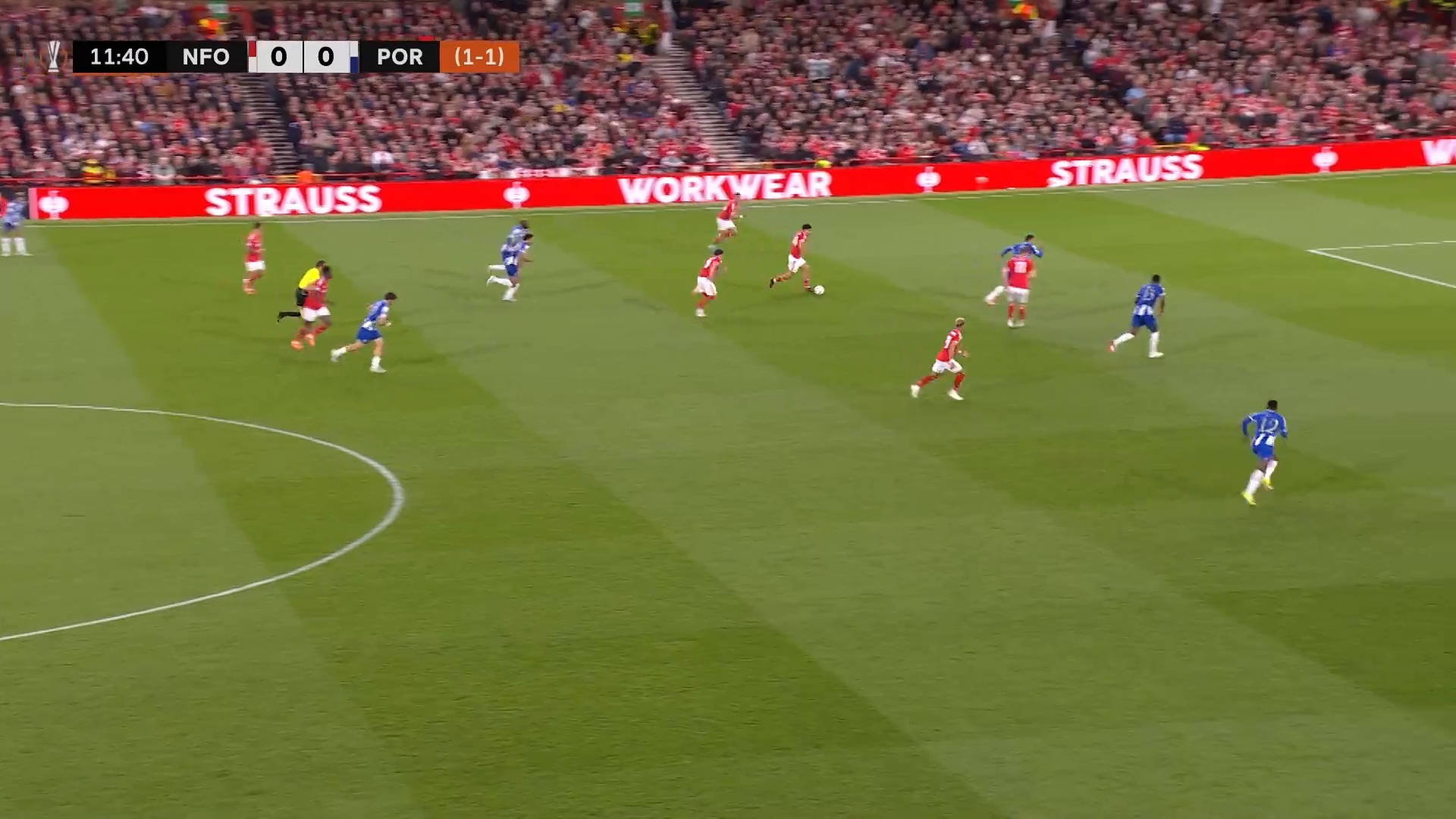
Suddenly, Porto are caught in transition, and Forest outnumber them four to three.
Gibbs-White has the option to play it out wide to Ndoye, but opts to keep driving into the box.
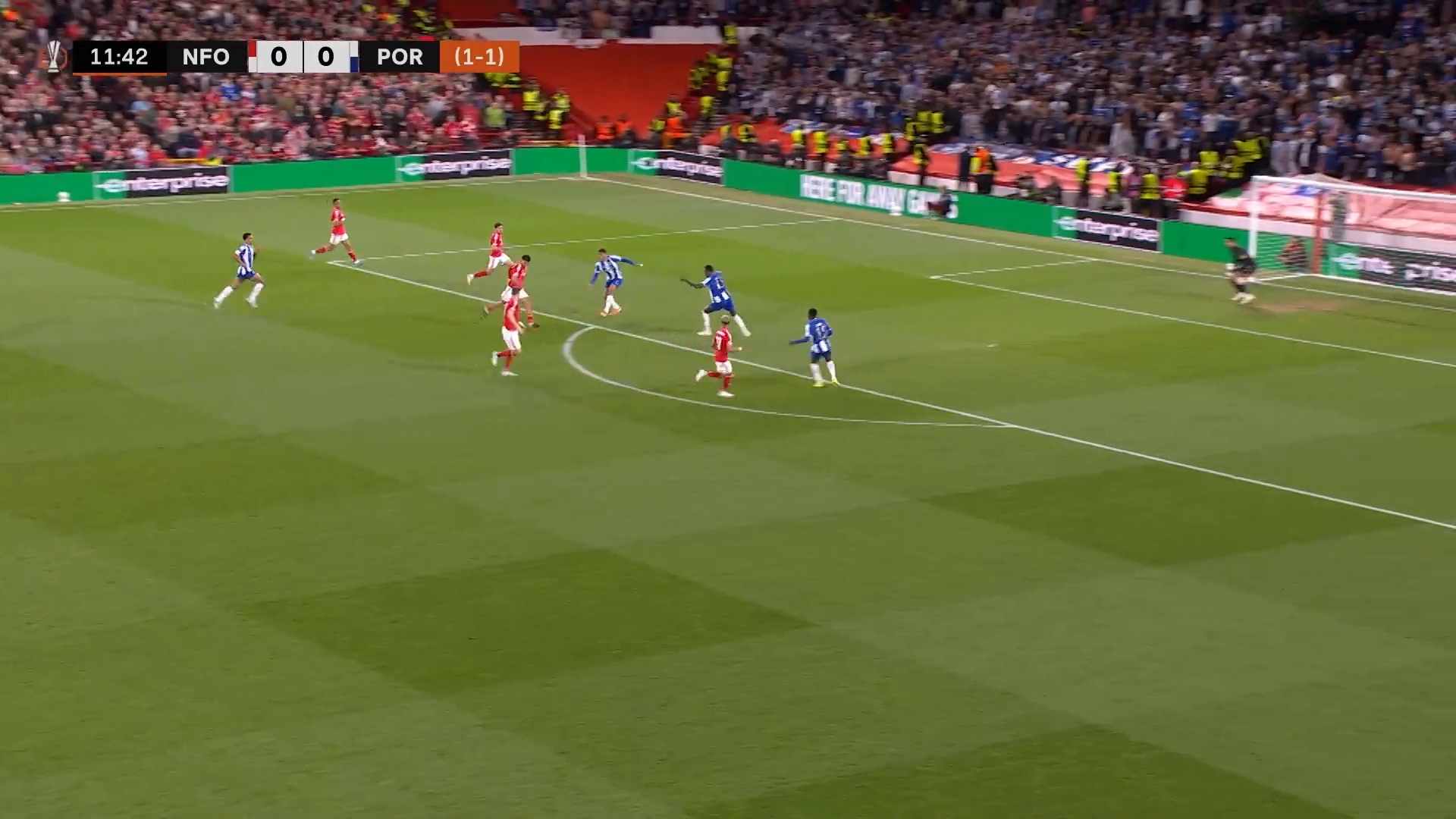
Porto's defenders don't know who to mark, whether to go to the ball or not, and in the end, do a whole lot of nothing.
They back off until Gibbs-White feels he can get a good shot off, there's a huge deflection, and Costa can't do anything to keep it out.
There's a huge element of fortune to the goal, but it's extremely poor from Porto's perspective.
They lost the ball in their own half and were outnumbered in defensive areas.
Part of this may be down to Farioli.
He didn't take off an attacker to be more structurally sound after the red.
Instead, he opted to drop Rosario back into the defensive line.
It meant Porto's midfield was down a man, which opened up the pitch time and time again.
Nottingham Forest Vs FC Porto: Game Management
Porto hit the bar twice in this game.
![Celta Vigo Vs Juventus [1-2] Europa League 2026/2027: How The Old Lady Escaped With A Late Comeback Despite Predictable Attacking Play - Tactical Analysis](https://cdn.mymidnight.blog/77f959f119f4fb2321e9ce801e2f5163/size/w600/2026/10/Celta-Vigo-Vs-Juventus---Tactical-Analysis.png)
![Real Sociedad Vs Bournemouth [1-2] Europa League 2026/2027: How Do Marco Rose Pressing Tactics Work? - Tactical Analysis](https://cdn.mymidnight.blog/77f959f119f4fb2321e9ce801e2f5163/size/w600/2026/09/Real-Sociedad-Vs-Bournemouth-20262027---Tactical-Analysis-1.png)
![AC Milan Vs Benfica [0-2] Europa League 2026/2027: How Marco Silva Tactics Exposed Rúben Amorim Defensive Problems - Tactical Analysis](https://cdn.mymidnight.blog/77f959f119f4fb2321e9ce801e2f5163/size/w600/2026/09/AC-Milan-Vs-Benfica-20262027---Tactical-Analysis.png)
![Sunderland Vs AZ Alkmaar [1-0] Europa League 2026/2027: Why The Black Cats Make Better Underdogs - Tactical Analysis](https://cdn.mymidnight.blog/77f959f119f4fb2321e9ce801e2f5163/size/w600/2026/09/Sunderland-Vs-AZ-Alkmaar-20262027---Tactical-Analysis.png)
![SC Freiburg Vs Aston Villa [0–3] – UEFA Europa League Final 2025/2026 – Tactical Analysis](https://cdn.mymidnight.blog/77f959f119f4fb2321e9ce801e2f5163/size/w600/2026/05/UEFA-Europa--League-Final-20252026.png)
![Nottingham Forest Vs Aston Villa [1–0] – UEFA Europa League Semi-Final First Leg 2025/2026: A Proper High-Stakes Clash Defined By Fine Margins – Tactical Analysis](https://cdn.mymidnight.blog/77f959f119f4fb2321e9ce801e2f5163/size/w600/2026/05/Nottingham-Forest--Vs-Aston-Villa-20252026.png)