
![Canada Vs Bosnia & Herzegovina [1–1] – FIFA World Cup 2026: Strong Foundations, Limited End Product – Tactical Analysis](https://cdn.mymidnight.blog/77f959f119f4fb2321e9ce801e2f5163/size/w1000/2026/06/Canada-Vs-BIH-World-Cup-2026.png)
Canada Vs Bosnia & Herzegovina [1–1] – FIFA World Cup 2026: Strong Foundations, Limited End Product – Tactical Analysis

All three host nations have now played their first game of the 2026 FIFA World Cup.
Both Mexico and the United States enjoyed comfortable victories in matchday one, while Canada fought back from a goal down against Bosnia and Herzegovina to earn a point in Toronto.
Canada generated more chances than their opponents and looked the likelier of the two sides to find a winner.
Bosnia and Herzegovina found their lead when Jovo Lukić converted from a set-piece in the 21st minute and defended diligently until the dam eventually burst in the 78th minute as a result of substitute Cyle Larin’s strike.
This tactical analysis examines the 1-1 draw, focusing on Canada’s in-possession approach, how they attempted to break down their opponents and why they struggled to create clear-cut chances throughout the contest, along with both teams’ respective pressing approaches.
Canada Vs Bosnia And Herzegovina Lineups & Formations
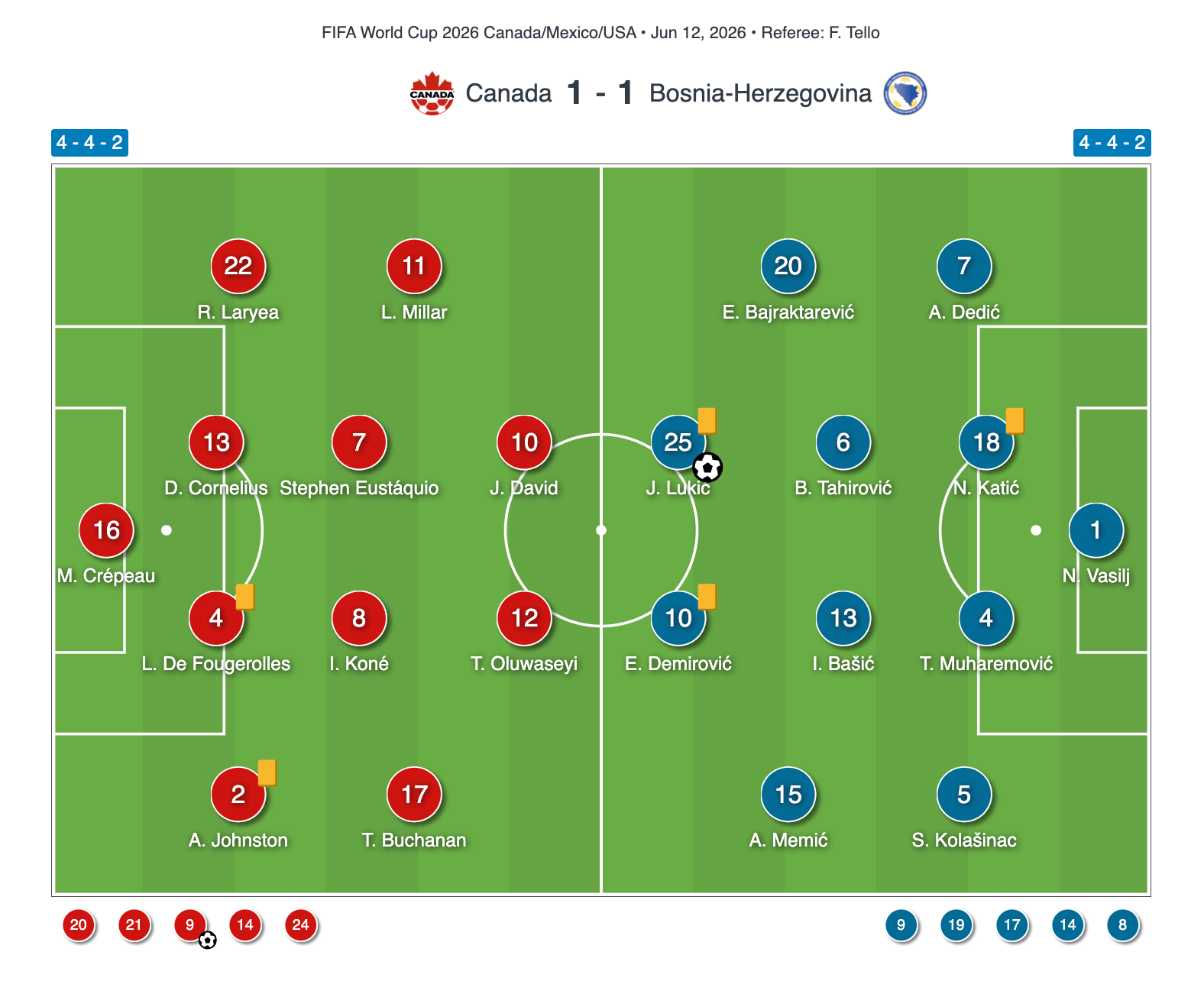
Canada Lineup Vs Bosnia And Herzegovina
Both teams set up in a 4-4-2 formation on paper, but Jesse Marsch’s Canada played much more like a 4-2-2-2 on the pitch.
Maxime Crépeau started in goal for the hosts behind a back four consisting of Alistair Johnston, Luc de Fougerolles, Derek Cornelius, and Richie Laryea (from right to left).
Ismaël Koné and Stephen Eustáquio started in central midfield, with Tajon Buchanan and Liam Millar on the right and left wing, respectively.
Tani Oluwaseyi and Jonathan David occupied the Canadian centre-forward positions.
Marsch made a total of five substitutions during the match, three of which came just after the hour mark when Jacob Shaffelburg, Promise David, and Ali Ahmed replaced Liam Millar, Jonathan David, and Tajon Buchanan.
Goalscorer Larin came on for Oluwaseyi in the 76th minute, and Canada’s final change saw Stephen Eustáquio make way for Jonathan Osorio just after the 90-minute mark.
Bosnia And Herzegovina Lineup Vs Canada
Sergej Barbarez lined the visitors up in a 4-4-2 with Nikola Vasilj in goal behind Amar Dedić (right-back), Nikola Katić (right centre-back), Tarik Muharemović (left centre-back) and Sead Kolašinac (left-back).
Benjamin Tahirović and Ivan Bašić started in central midfield, with Esmir Bajraktarević on the right wing and Amar Memić on the left.
Goalscorer Lukić started up front alongside Ermedin Demirović.
Like Marsch, Barbarez also made five substitutions over the course of the game.
Two of Bosnia and Herzegovina’s subs came just after the hour mark at the same time as Canada’s first three changes, as Armin Gigović and Samed Baždar replaced Bašić and Lukić.
Then, in the 74th minute, Ivan Šunjić and Kerim Alajbegović were introduced in place of the two starting wingers, before Bosnia and Herzegovina’s final substitution saw Kolašinac make way for Dženis Burnić in the 83rd minute.
Canada Vs Bosnia And Herzegovina Stats
Per Wyscout, Canada generated 2.01 expected goals to Bosnia and Herzegovina’s 0.94.
This reflects Bosnia and Herzegovina’s mindset of protecting their lead following the 21st-minute opener (they generated just 0.15 xG after the goal, while Canada generated just 0.16 before Bosnia and Herzegovina’s opener).
Canada took almost twice as many shots as Bosnia and Herzegovina (13 to seven), but both teams had an equal number of shots on target (three apiece).
While they had lots of the ball and took their fair share of shots, Canada struggled creatively, with Bosnia and Herzegovina largely limiting their clear-cut opportunities and producing some impressive individual moments in defence to deal with some of the most glaring chances the home side did create.
Canada made three times as many high recoveries as Bosnia and Herzegovina (24 to eight), underlining the more effective high press employed by Jesse Marsch’s team.
Neither team looked to string together lengthy periods of possession, with the hosts averaging an average of 3.27 passes per possession and the visitors making just 2.24 passes per possession.
Bosnia and Herzegovina’s long pass percentage of 19.12% was the highest recorded in the first four matches of the 2026 FIFA World Cup, indicative of the deliberate, direct style of play that Sergej Barbarez oversaw in this game, looking to bypass midfield and advance the ball quickly into the final third to generate individual 1v1 duels for their forwards and wingers against the Canadian defenders.
Canada Tactics Vs Bosnia And Herzegovina In Possession
Canada’s shape was quite narrow during the ball progression phase.
If the ball was on one particular side of the pitch, the ball-near winger would hold the width on that side, but the ball-far winger would drift into a more central position, enabling easier combinations with the forwards should they drop in centrally.
This narrow positioning from the ball-far winger also reflects an emphasis from Jesse Marsch on having an aggressive counterpress ready to pounce on the opposition should a turnover occur inside the final third.
Instead of being positioned wide and isolated on the far touchline, Canada opt to have the player in a position where they can help their side regain possession more quickly.
Both of Canada’s forwards were able to drop into midfield to receive in a typical ‘10’ position, combine with the midfielders/wingers or turn and play a through pass to runners in behind, while they had to be equally comfortable making those runs in behind off the defenders’ shoulders, ensuring their movement remained unpredictable for the opposing defenders.
The wingers, central midfielders, and even full-backs would also have to be prepared to attack the space behind the opposing backline.
Canada’s full-backs inverted quite often during the ball progression and chance creation phases, sometimes sitting deep, just in front of the two centre-backs, and sometimes advancing to occupy one lane in the highest line of attack.
![Tottenham Hotspur Vs Everton [0-0] Premier League 2026/2027: Why Can't Spurs Score? - Tactical Analysis](https://cdn.mymidnight.blog/77f959f119f4fb2321e9ce801e2f5163/size/w600/2026/09/Tottenham---Vs-Everton-20262027---Tactical-Analysis.png)
![West Ham United Vs Wrexham [6-0] EFL Championship 2026/2027: The Cost Of Passive Defending Against Smart Movement - Tactical Analysis](https://cdn.mymidnight.blog/77f959f119f4fb2321e9ce801e2f5163/size/w600/2026/09/West-Ham-United-Vs-Wrexham-2026_2027---Tactical-Analysis.png)
![Fenerbahçe Vs AS Roma [1-1] Champions League 2026/2027: How İsmail Kartal's Compact Defence Limited Gian Piero Gasperini's Attack - Tactical Analysis](https://cdn.mymidnight.blog/77f959f119f4fb2321e9ce801e2f5163/size/w600/2026/09/Fenerbah--e-Vs-Roma-20262027---Tactical-Analysis.png)
![Liverpool Vs Atlético Madrid [2-1] Champions League 2026/2027: How The End-To-End Battle Fell In Andoni Iraola's Favour - Tactical Analysis](https://cdn.mymidnight.blog/77f959f119f4fb2321e9ce801e2f5163/size/w600/2026/09/Liverpool-Vs-Atl--tico-Madrid-2026_2027---Tactical-Analysis.png)
![Real Madrid Vs Inter Milan [2-1] Champions League 2026/2027: Why Cristian Chivu Tactics Struggled Against José Mourinho Defensive Strategy - Tactical Analysis](https://cdn.mymidnight.blog/77f959f119f4fb2321e9ce801e2f5163/size/w600/2026/09/Real-Madrid-Vs-Inter-Milan-2026_2027---Tactical-Analysis.png)
![Everton Vs Manchester United [2-2] Premier League 2026/2027: Why The Red Devils Left Two Points Behind - Tactical Analysis](https://cdn.mymidnight.blog/77f959f119f4fb2321e9ce801e2f5163/size/w600/2026/09/Everton-Vs-Man-United-2026_2027---Tactical-Analysis.png)
![Arsenal Vs Chelsea [2-1] Premier League 2026/2027: How Mikel Arteta Attacking Dynamism Opened Chelsea - Tactical Analysis](https://cdn.mymidnight.blog/77f959f119f4fb2321e9ce801e2f5163/size/w600/2026/09/Arsenal-Vs-Chelsea-2026_2027---Tactical-Analysis.png)
![Newcastle United Vs Bournemouth [2-2] Premier League 2026/2027: Marco Rose Vs Matthias Jaissle In A Red Bull Pressing Battle - Tactical Analysis](https://cdn.mymidnight.blog/77f959f119f4fb2321e9ce801e2f5163/size/w600/2026/09/Newcastle-Vs-Bournemouth-2026_2027----Tactical-Analysis.png)