How To Coach Emergency Defending Like Virgil Van Dijk – Tactical Theory

Innovative coaching methods are continually being developed, introduced, and implemented in world football.
Perhaps more than ever, these innovations include the defensive side of the game.
This tactical theory focuses on exercises that develop players’ 'emergency defending' skills.
For the purposes of this tactical analysis, emergency defending is defined as any situation where the back line is left exposed, in or around their box, with no protection from the midfield.
This could result from a counterattack or a sustained positional attack that has led to a box entry with a shot at goal imminent.
Emergency defending is required when the situation is urgent, and desperate measures are needed to prevent the opposition from scoring.
This tactical theory offers three exercises specifically designed to improve defence in emergency situations.
These football training exercises can be used in conjunction with one another to form part of an emergency defending session or as stand-alone exercises.
Liverpool's Virgil van Dijk will be used as a model performer, with his defensive tactics incorporated into this analysis.
Defending One-On-One
A key element of emergency defending is a player's ability to defend one-on-one.
As is their ability to turn a two-against-one into a one-against-one, which will also be analysed in this section.
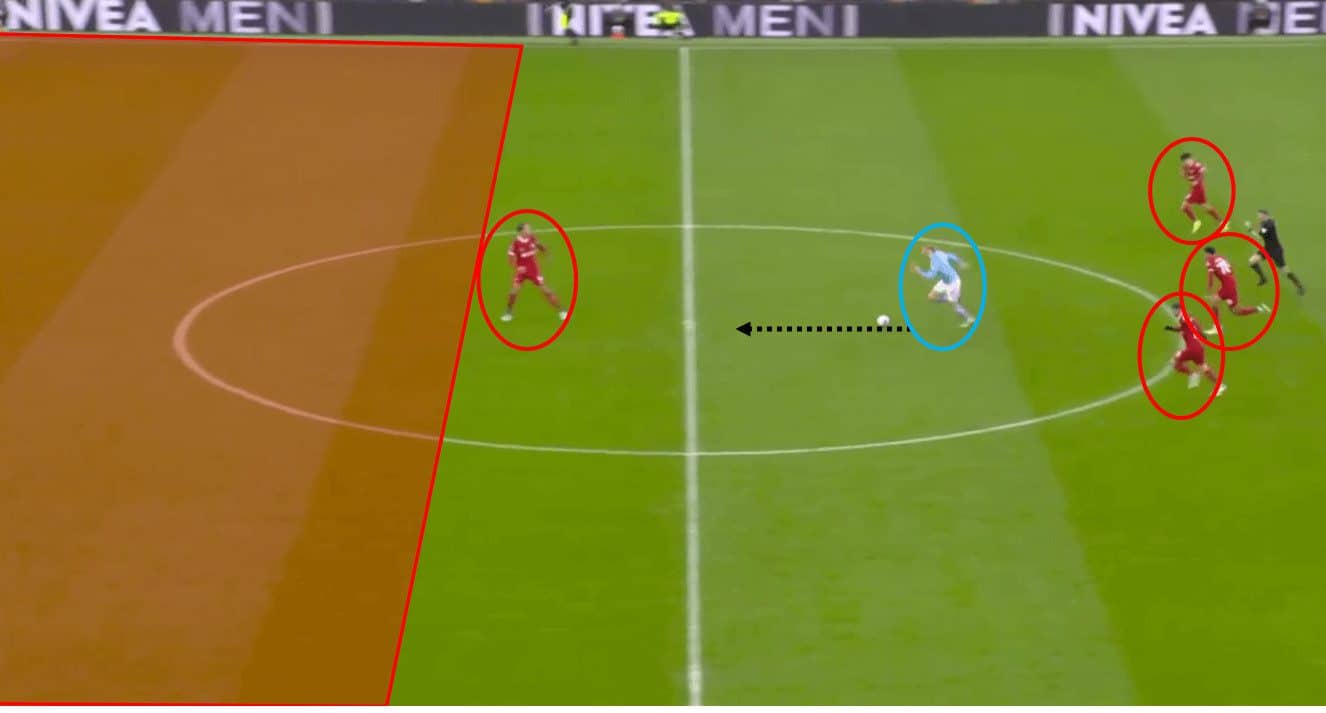
The above image is from a previous Premier League match between Manchester City and LFC.
While still far from his goal, Virgil van Dijk has been left in a very compromising position with Man City’s Erling Haaland bearing down on him after a turnover of possession.
When Haaland receives the ball, he does precisely what he should, driving directly at Van Dijk.
This is an attempt to pin the centre-back and quickly create a one-against-one before the Dutchman’s recovering defenders can help.
Van Dijk recognises this, and his first reaction is to drop off and defend the vast space behind him.
This is an attempt to delay the play until reinforcements arrive.
His body shape is already side-on, allowing him to sprint easily towards his own goal should the ball be put into the space behind him.
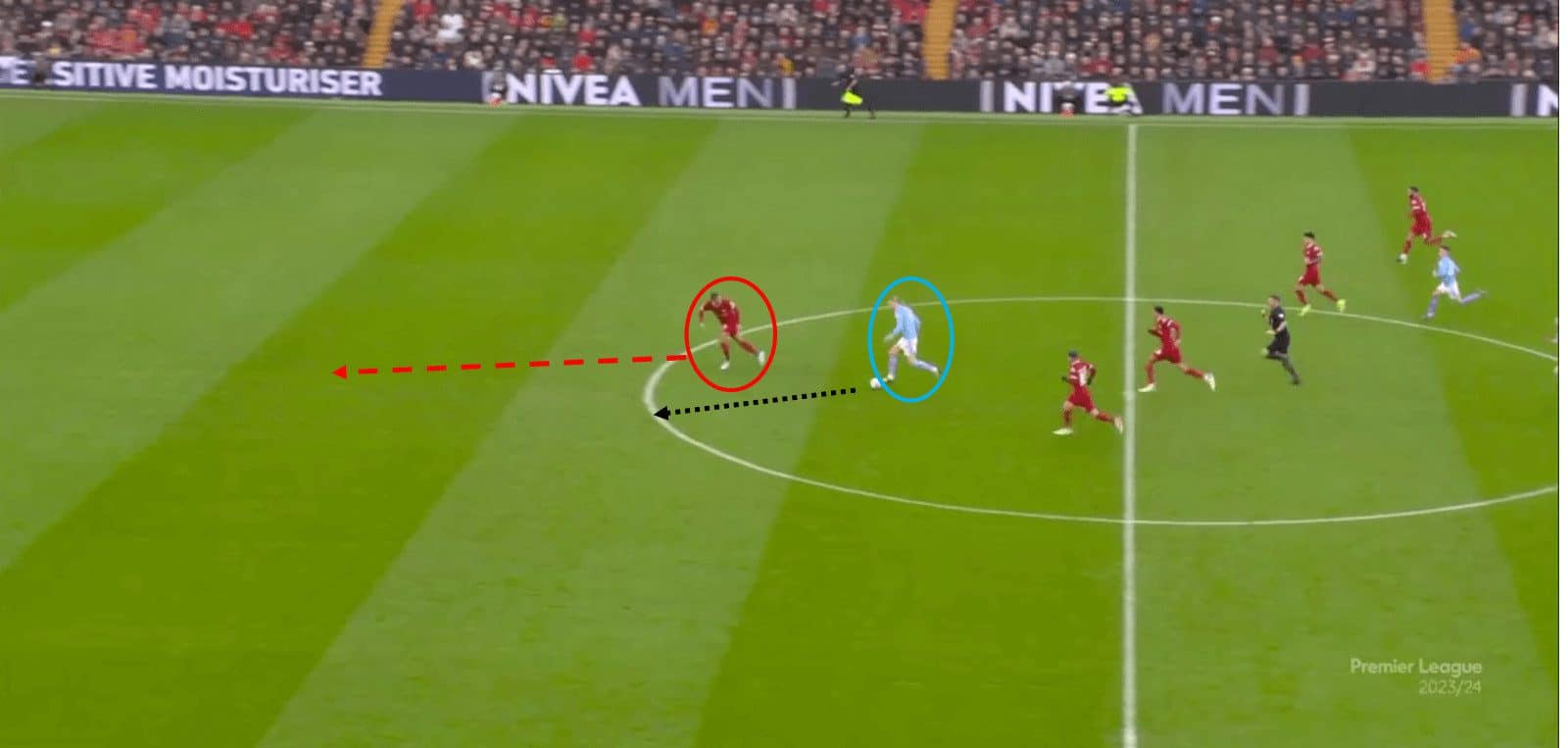
As Haaland gets closer to Van Dijk, the defender turns so his body is now completely facing his own goal.
He is also opening himself up slightly with his movement to stop Haaland from being able to take the ball to his right.
While this may be showing Haaland onto his stronger left foot, it is also where the closest Liverpool defender is, and it is too far from the goal to worry about the striker shooting.
The exaggeration of Van Dijk’s positioning also makes Haaland's next action predictable, for both Van Dijk and his teammates sprint back.
As Haaland sways from side to side with the ball, Van Dijk tries to maintain the same distance between them and mirrors his movements.
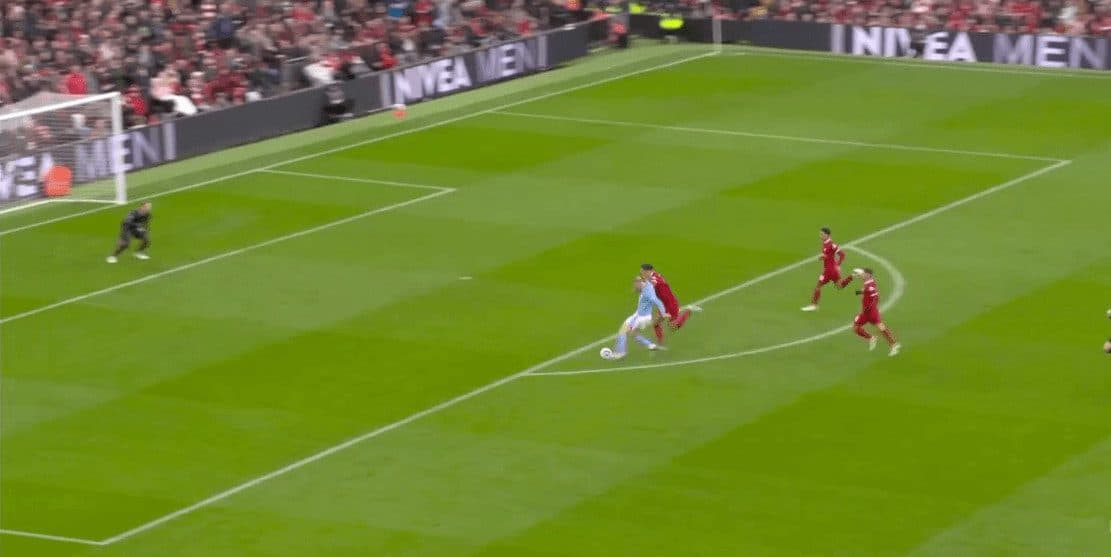
With Van Dijk having delayed Haaland enough that the recovering defenders are about to help out, Haaland is forced to take his shot from outside the box.
Considering the position Van Dijk was initially put in, this is a success.
Statistically, even from the best striker in the world, the goalkeeper would be likely to save a shot from this position.
On top of this, and something Van Dijk does regularly, he applies physical pressure to the forward just as he is about to shoot.
This off-balances the attacker and, in this case, makes Haaland fall to the floor as he is shooting.
The result is a relatively tame strike.
Whilst a foul is unlikely given for this, it is slightly risky.
However, Van Dijk is clever enough to do this outside of the box, where the worst-case scenario would be a free kick.
The way Van Dijk calmly dealt with the best striker in the world, when so exposed, shows exactly why he has been so pivotal to Jurgen Klopp's success over the years.
One-Against-One Exercise
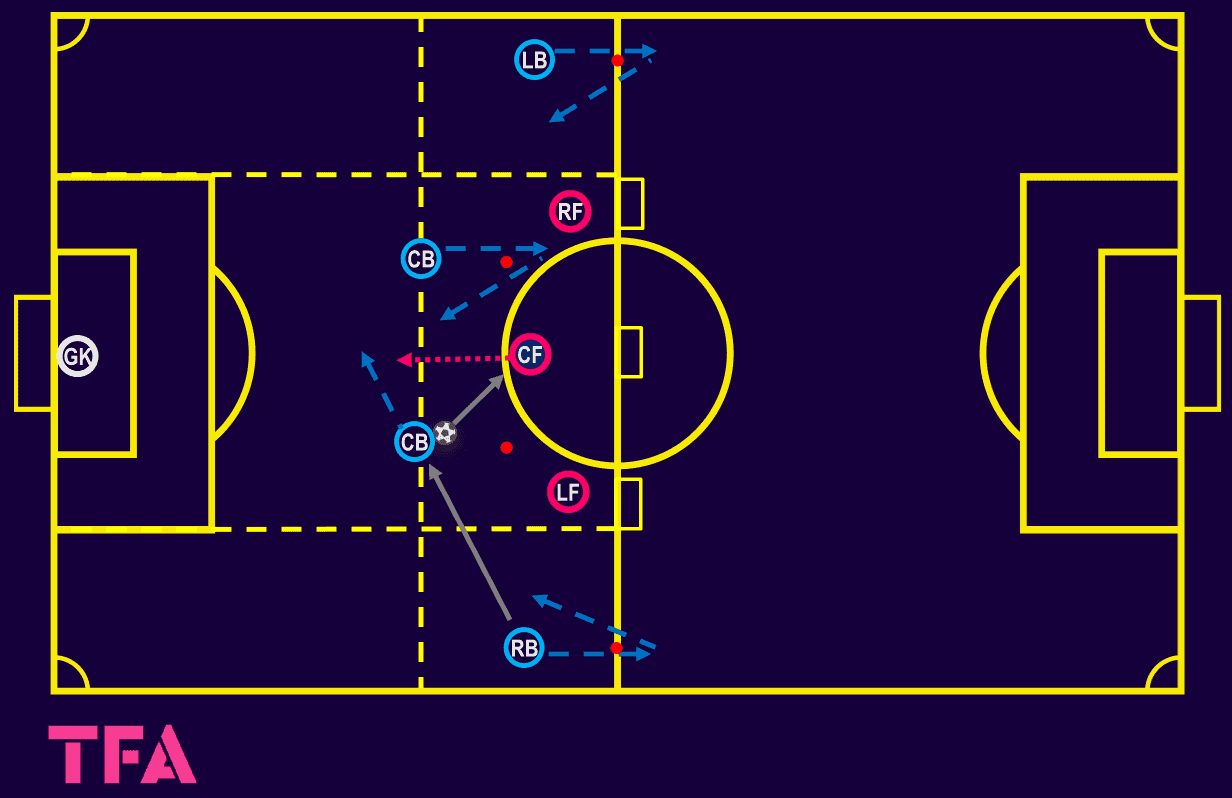
The above exercise is designed to replicate the counter-attacking scenario Van Dijk found himself in.
The drill begins with the back four moving the ball.
They do this, holding their expansive positions as if they are building out against a mid-block.
The coach then shouts a signal for possession to be deliberately given away by passing to one of the three forwards.
When one of the front three receives the ball, they should do exactly as Haaland did and drive towards goal with the ball.
The other three defenders are still involved as recovering defenders.
To join the play, they must first run around one of the red cones (or poles) before sprinting back to help their teammate.
The idea of being the active defender is rewarded for delaying the play with reinforcements.
If the defending team regains possession, they attack the three mini-goals placed at the halfway line.
At the coach's discretion, the other attacking players can also join the attack, either straight away or with a similar delay as with the defenders.
This could allow two players to attack as soon as possession is gained to create a two-on-one.
Similar to Van Dijk's movements when showing Haaland to one side, the defender should exaggerate their positioning in this scenario to cut off the passing option.
This can, effectively, create a one-on-one.
Coaches should emphasise, in the initial stage, delaying the play, not getting too close to the attacker, and mirroring the attacker's movements.
They should also attempt to make the play as predictable as possible.
When defending against two attackers, the sole defender should make the situation more manageable by turning it into a one-on-one.
Only when the attacker with the ball commits to attacking by themselves, i.e., takes an aggressive touch forward with their head down, should the defender fully engage.
Defenders should be discouraged from diving in or leaving their feet.
These should be the last resort in any defensive situation, as if it goes wrong, it can leave the defender out of position or lead to an unnecessary foul.
Low Block Defending
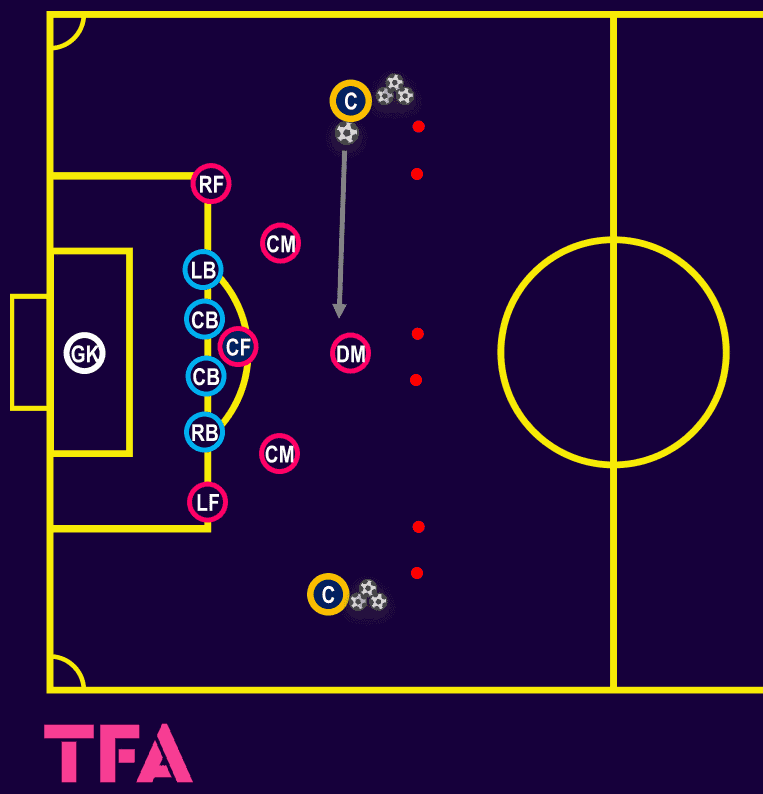
This exercise is designed to work on the backline defending when they are exposed at the edge of their 18-yard box.
In this case, a back four must try to avoid being conceded on when outnumbered by six attacking players.
The drill begins with a coach on one side (yellow) feeding the ball to any attacking player.
The attacking team then plays freely, trying to score in the full-sized goal.
As soon as the ball is lost or goes out of play, the coach on the opposite side puts another ball in play.
Normal game rules, including offside, apply.
To encourage a high speed of play and to give an impetus to the attacking team, the attackers should be given a limited amount of time, for example, 90 seconds, to attack the goal.
The aim is to score as many goals as possible in that time period.
They can be awarded points for both shots taken and additional points for goals scored.
Encouraging as many shots as possible should create lots of opportunities for defenders to work on their emergency defending skills.
The defenders should initially be coached to move as a unit and encouraged to display the typical principles of a successful defensive group.
It is essential, however, and the main purpose of the exercise, that they are coached on how to react when this goes wrong, and the opposition gets behind them or enters the box.
This includes having the correct body shape to efficiently close down the next pass, being brave and having the desire to block shots, and understanding when to commit or delay the play.
The defender's awareness of their positioning, especially in relation to the goal and goalkeeper, is vital to prevent clear shots at goal.
The defensive unit should also be encouraged to clear their box as much as possible.
As soon as the play goes dead, in expectation of the next ball, or when the opposition passes backwards, the defending players should push up to the edge of the box as fast as they can.
This, of course, helps them to put pressure on the ball and play attacking players still in the box offside.
It also means that should the attacking team shoot and the ball hit any of the defenders, the deflection does not happen too late for the goalkeeper to react to.
The defending team's first priority is always to get the ball out of the box and away from their goal.