Pre-Season Football Rondos & Possession Drills: Training Exercises To Play Like Celtic & Real Madrid - Tactical Theory

Rondo and possession exercises are now staples in most modern football coaches' repertoires.
They can, and should, be used throughout the season.
However, they can be particularly useful to coaches during pre-season as a way to break down the components of a particular game model while providing enough intensity to increase players' cardiovascular capacity.
For this tactical theory article, a ‘rondo’ is defined by the static nature of the players in the attacking, or in-possession, team and the defending players moving within a designated area.
Possession games, on the other hand, are differentiated here by their more fluid nature.
All players are freer to move, resulting in a more ‘game-like’ feel.
From an attacking point of view, the aim of both is to improve a team's ability to keep the ball with, ideally, a target for them to play to.
These games are also a great way to embed good pressing in terms of the individual technical aspects, as well as tactical and psychological factors, of reacting quickly to turnovers of possession.
Improving pressing further raises the level of possession performance, as players are forced to play quicker and make better decisions with the ball.
This tactical analysis will analyse different components of rondo and possession exercises, break down their uses, and offer example exercises that the world's top coaches are using.
This training analysis will show how these rondos translate to real game scenarios, along with in-match examples from Celtic and Real Madrid from last season's pre-season.
Over The River Rondo
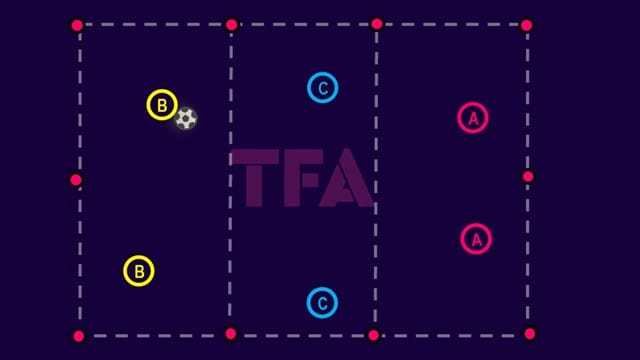
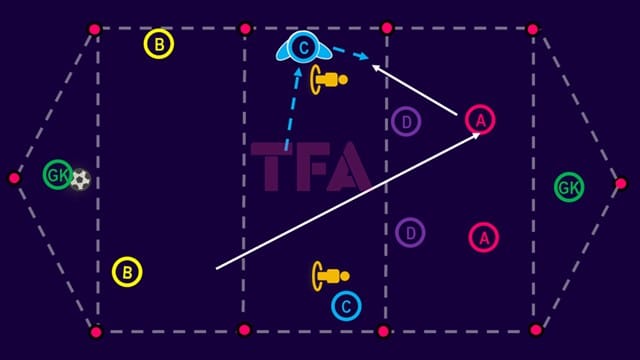
As shown above, the typical ‘over the river’ rondo contains three central boxes with three teams or pairs.
The aim is for the two teams in the end boxes to keep possession of the ball, usually for a predetermined number of passes, before transferring to the opposite box.
The middle team, shown as ‘C’, must press into the end box that contains the ball and can win their way out of defending by intercepting the ball.
The exercise, in its most basic form, focuses on players' ability to handle one-on-one pressure and their ability to protect the ball if there is no immediate passing option.
With this set-up, and depending on which position or part of the field the exercise is being used to improve, a condition of having to dribble, rather than pass, out of the end box and into the middle before playing into the target players can be implemented.
The following two rondos are both spin-offs of this classic rondo design.
Full-Back Rondo
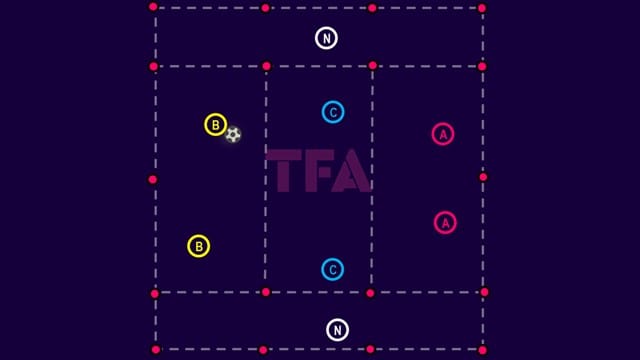
To work specifically on playing with a back four and double pivot whilst being pressed by two forwards, ‘full-backs’ can be introduced.
These neutral players play in two side channels and support whichever centre-back pairing has possession of the ball.
These players can operate in a “safe zone,” where they cannot be pressed or put under full pressure.
Of course, this gives the in-possession team a numerical advantage, but it also allows them to work on when to break the press while swinging the ball.
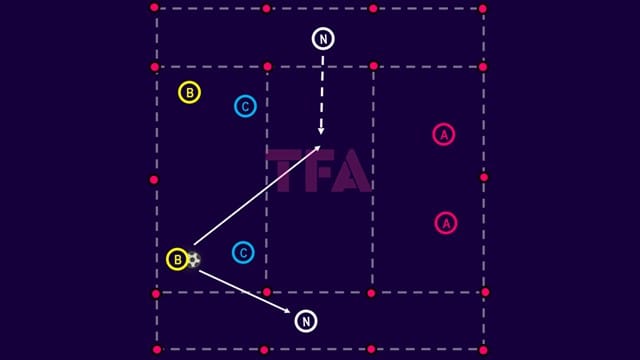
The rules for progressing the ball in this rondo can be adapted to suit the coach's tactical preference.
For example, the coach may or may not want the full-backs to receive in the middle side zone.
When positioned in the middle side zone, they could represent an inverted full-back who is receiving beyond the first line of pressure.
Coaches may also allow for inverted full-backs to sneak into the central area, on the blindside of the pressing ‘forwards’, allowing them to work on their timing and body shape to receive in this area.
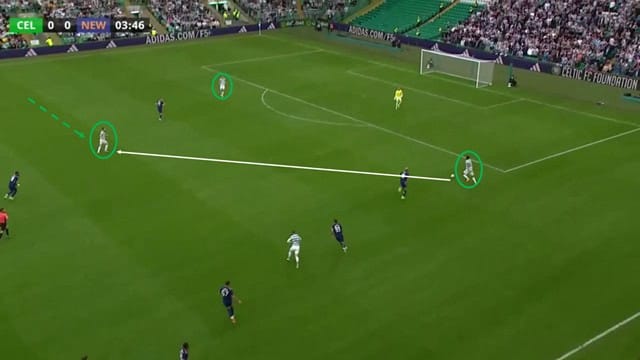
This allows players to mimic the scenario above from Celtic’s pre-season victory over Premier League Newcastle United at Celtic Park last season, albeit in a condensed area.
At the top of the image, Celtic’s right-back, Anthony Ralston, who, just as one of the two Newcastle forwards has begun to step towards the ball-far centre-back, has sneaked into the pocket of space that’s been created.
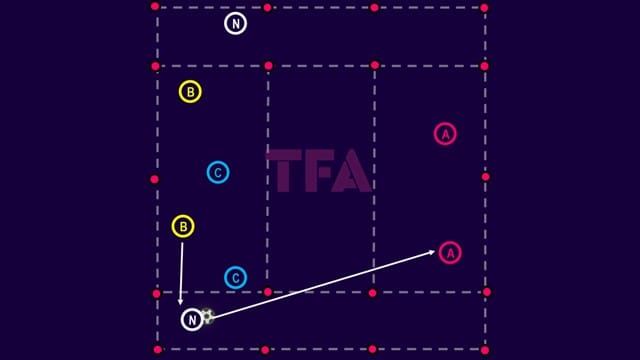
If the aim is to draw the opposing wingers deep, or give the central forwards more ground to cover, as shown in the image above, the coach may only want the full-back receiving in the end boxes.
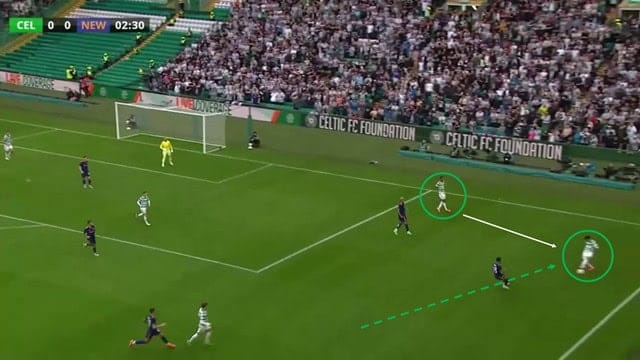
This scenario mimics the one mentioned earlier from the same match, where Brendan Rodgers has his full-backs drop very deep, to the same line as his centre-backs.
Encouraging the opposition to press high in the wide area.
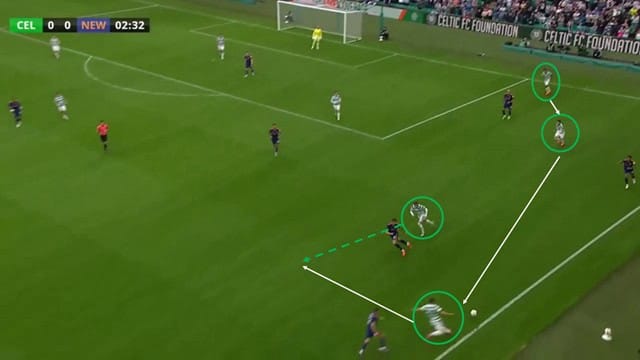
This creates space behind the pressing player for Celtic’s wide forward to drop into to receive.
Celtic then uses this space for the winger to combine with his central midfielder, who can then receive behind the opposition's midfield line.
Double-Pivot Rondo
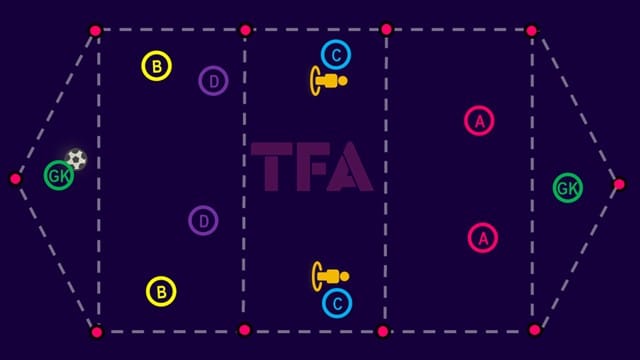
This rondo mimics midfielders receiving from their centre-backs while playing in a double pivot.
The tactical aim of the exercise is to improve the defensive midfielder's decision-making on when to show for the ball, the appropriate body orientation, and when to bounce the ball back or play forward.
Depending on the coach's preference, two additional neutral players may be added on either end of the area.
These two players represent goalkeepers and provide an overload for the in-possession team.
The goalkeepers, or neutral players, operate in a triangle, which, according to the coach’s discretion, can be assigned as a safe zone where they cannot be pressed.
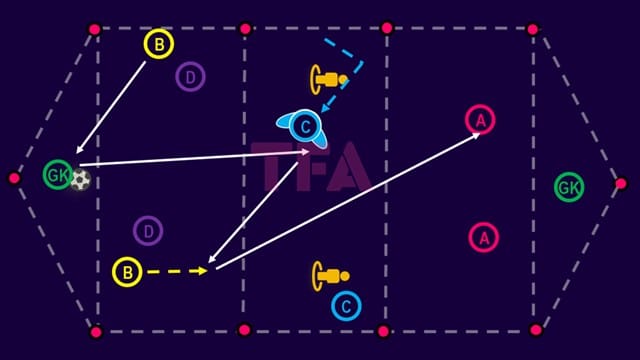
The midfielders should position themselves behind the opposing midfielders (mannequins) and work on their timing of either moving towards the ball or pulling off to the side.
As shown above, should the opportunity arise to receive in front of the mannequins, the ball should be bounced back, ideally with the midfielder's far foot, with the central defender playing the line-breaking pass.
After bouncing the ball, the midfielder should make the movements shown above to both clear the space for the forward pass and allow quick supporting of the ball when it reaches the forwards.
When receiving on the side of the mannequins, they can open their body up and play forward.
An alternative, more advanced option is for the midfielders to find each other before the ball is transferred to the opposite box.
This requires effective communication and well-coordinated supporting movements underneath the ball.
To make the speed of this combination game realistic, both midfielders have just one touch each (two total between them) to lay the ball off and play forward.
Back Four Possession Game
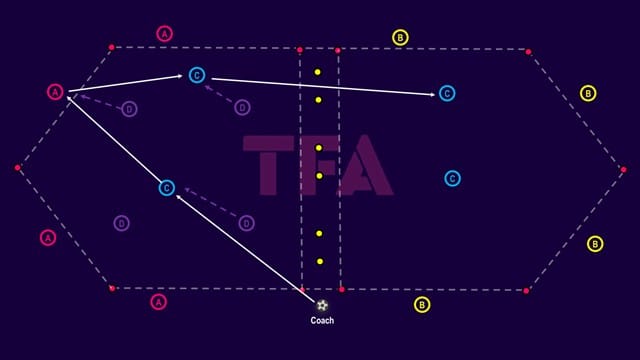
This possession practice, which contains slightly more fluid movements than a traditional rondo, is designed to allow teams to work on their back four shape while, as with the rondo above, playing with a double pivot.
These lines can be used as concrete boundaries or simply as a guide for where the backline should be positioned.
Four teams of four (16 players total) are created, with two of the teams positioned on the outside of the area in a position resembling a back four.
Four midfielders, shown as ‘C’ (blue), are separated with two in one half and two in the other.
The attacking team aims to combine for a predetermined number of passes before transferring the ball from one side to the other.
Depending on the level of player being worked with, the passes can either be required to be passed through one of the three yellow gates, or these gates could be used to provide extra points to the attacking team should they manage to pass through them.
The purple team, ‘D’, is the defending team.
They are tasked with preventing the ball from being switched from side to side.
They should react quickly and put immediate pressure on the ball when it is there.
Two of the defending players should act as central forwards, applying pressure to the back four.
The two remaining defenders should act as central midfielders.
They need to press the opposition midfielders whilst screening progressive passes played through the yellow gates and into the opposite side of the grid.
If these players win the ball, they should switch it to the opposite side and replace the players on the outside of the half they are in.
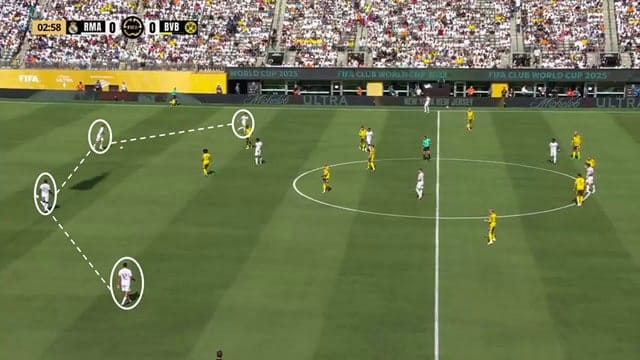
The starting positions of the players representing the back four can be particularly useful for teams that implement a narrow ‘C’ shape in their build-up play.
This set-up can be seen in Real Madrid's FIFA Club World Cup win over Borussia Dortmund last season.
A major benefit of this setup is that the proximity of each of the four defenders and the two defensive midfielders allows the ball to be moved quickly between players.
Almost as soon as it is passed to one player and the defending team reacts, it is moved to another.
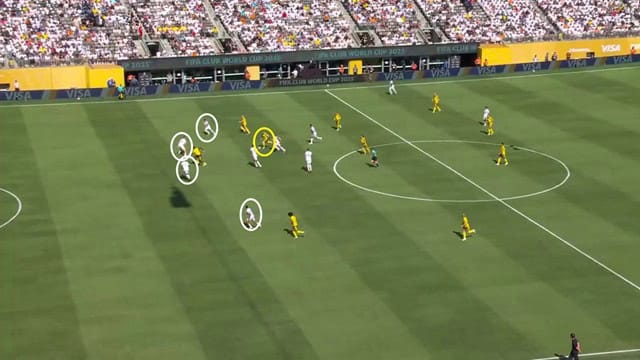
Another, and perhaps the determining factor when implementing this positioning, is that it provides greater security against counterattacks and allows for quicker recovery of the ball should it be lost.