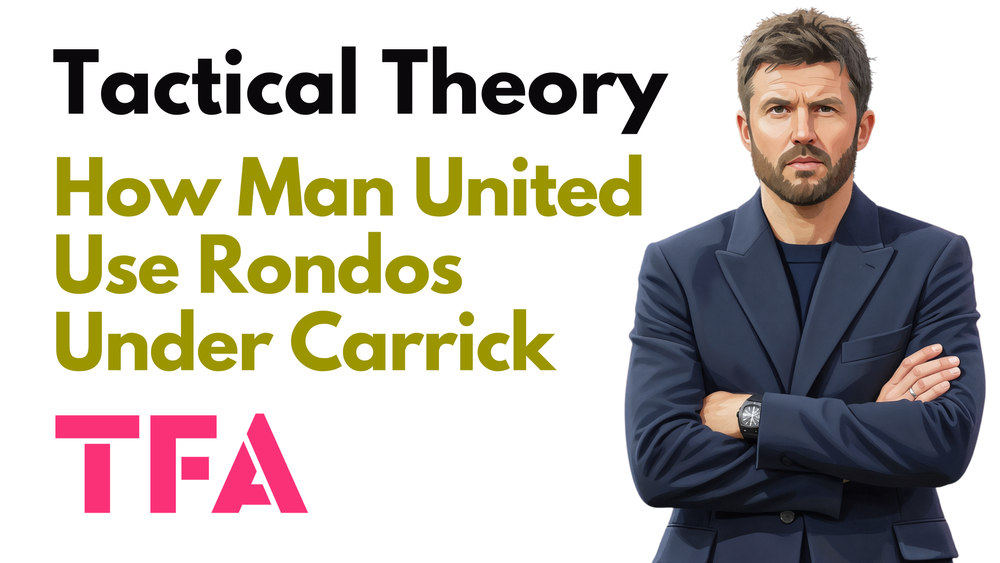
The Value Of Rondos: How Michael Carrick Applies The Principles At Manchester United – Tactical Theory
Discover how rondos develop quick decisions, press resistance and progressive combinations, with Michael Carrick's Manchester United demonstrating how those training principles transfer into matches.

What Is A Football Rondo?
The next time you attend a live football match, try to see if you can catch players performing the 'rondo'.
It's almost like a game of piggy in the middle.
The players in the drill with the ball must circulate possession as quickly as possible, without the players pressing them being able to get a touch.
The aim of the players with the ball on the outside is to keep it away from those who are trying to press them and get a touch.
It's a short, quick exercise that keeps players' blood flowing whilst also having a bit of fun.
It's even common to see managers join in with this exercise as a light-hearted touch.
Antonio Conte was seen in 2020 at Inter Milan before the Europa League Final, joining in and sliding-tackling a player.
However, the rondo is an effective exercise that demonstrates a player's ability to perform close control, the observable benefits of which can and should be seen in games.
The rondo is an exercise that warrants further exploration with regard to its in-game value.
In this tactical theory piece, we examine the value of the training-ground exercise and how Manchester United have displayed the observable benefits last season under Michael Carrick's tactics.
What Is The Value Of The Rondo?
Although the exercise places players in situations of numerical superiority, it also tests their ability to think quickly and devise solutions when they are closed down.
The tight areas mean that the rondos, though valuable to any player, are most likely suitable for defenders or midfielders tasked with getting their teams out of pressure.
Several unique variations of the rondo exercise exist, many of which have been explored and detailed by coach Kevin Martin here at Tactical Football Analysis.
Kevin previously explained the value of rondos in pre-season training for sides like Celtic and Real Madrid, for instance, and guided us through how to implement rondos in training sessions at any level.
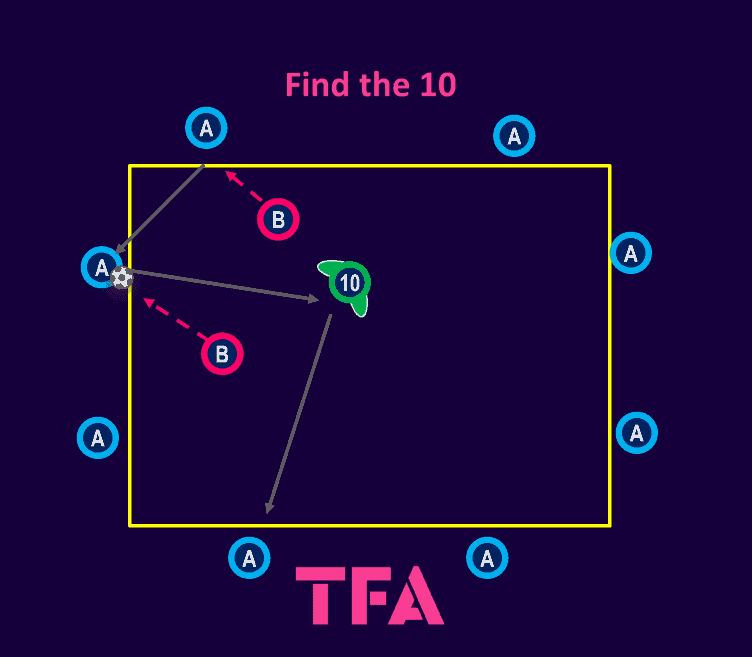
See an example of a relatively common 'find the 10' rondo above.
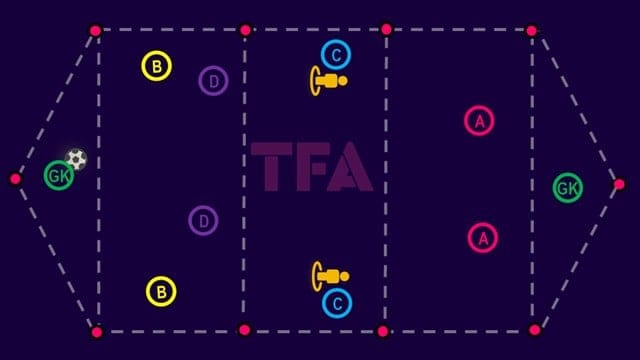
Another variation, a double-pivot rondo, is shown in the second image.
The smaller the area for the rondo, the more practice footballers have in terms of using their body, be it chest, head or with their feet, to quickly use deft touches to get past their opponent.
Before the Xabi Alonso era at Real Madrid, Carlo Ancelotti's Los Blancos side relied on rondos to help find spontaneous solutions to the press.
Rondos are great for this, as you have to act quickly when pressed.
The onus is on two players to track down the outside players who are quickly exchanging the ball.
The importance lies in how quickly the players react and in the type of touch they use to keep the ball moving.
They must stretch to reach the ball if the pass they receive beforehand is poor or slightly off target.
This is where the value comes from.
Think of Real Madrid (as we are on the topic) in the Champions League versus Manchester City over the last few years.
They didn't have much of the ball, so when they did, they needed to find space swiftly.
Given the way City presses high, you need players on the ball who can pass to each other quickly under pressure.
It's more difficult to do if you concentrate on defending for most of the game.
The value of rondos is substantial even for teams that don't have much possession of the ball for a game.
It's also for teams that counterattack quickly.
When a team presses quickly, moving from their rest defence to commit retrievals to maintain pressure in attack, what should they do?
Get the ball forward quickly whilst finding their own teammates under pressure.
To highlight its importance, one of the most influential managers of all time, Johan Cruyff, commented on why a rondo is so crucial:
“Everything that goes on in a match, except shooting, you can do in a rondo; the competitive aspect, fighting to make space, what to do when in possession and what to do when you haven’t got the ball, how to play ‘one touch’ soccer, how to counteract the tight marking and how to win the ball back.”
Instant decision-making, team morale, synergy, forming relationships, and getting to know one another all happen in the rondo.
The variations and specifics of a rondo can serve multiple purposes, such as demonstrating which player is ineffective under pressure or who the best presser is on the team.
This can directly contribute to a style of play.
Roberto de Zerbi's entire style of play is based on pressure, timing, and the movement of his players in possession, waiting for a team to push up and press before driving the ball past them.
It may not appear so at first, but the rondos are crucial to both in- and out-of-possession principles.
How Have Michael Carrick's Manchester United Benefitted From Rondos?
Under Michael Carrick's tactics, Manchester United played the two best teams in the league, Mikel Arteta's Arsenal and Pep Guardiola's Manchester City, and defeated them.
They then went on to beat Fulham 3-2 in a problematic performance before defeating Tottenham Hotspur 2-0 and drawing 1-1 with West Ham United this week.
The way they are playing under Carrick and using rondos has made a clear difference.
Having an attack featuring Benjamin Šeško, Bryan Mbeumo and Matheus Cunha, with Bruno Fernandes creating chances, means you are a team that can outscore opponents.
They’ve scored 11 goals in five games, and this is how the profiling of this team should’ve always been: not set up to dominate possession with no penetration, but to attack teams.
It’s their ability to get a foot on the ball and play in tight spaces with one-touch and two-touch football that's notably improved under Michael Carrick's style of play.
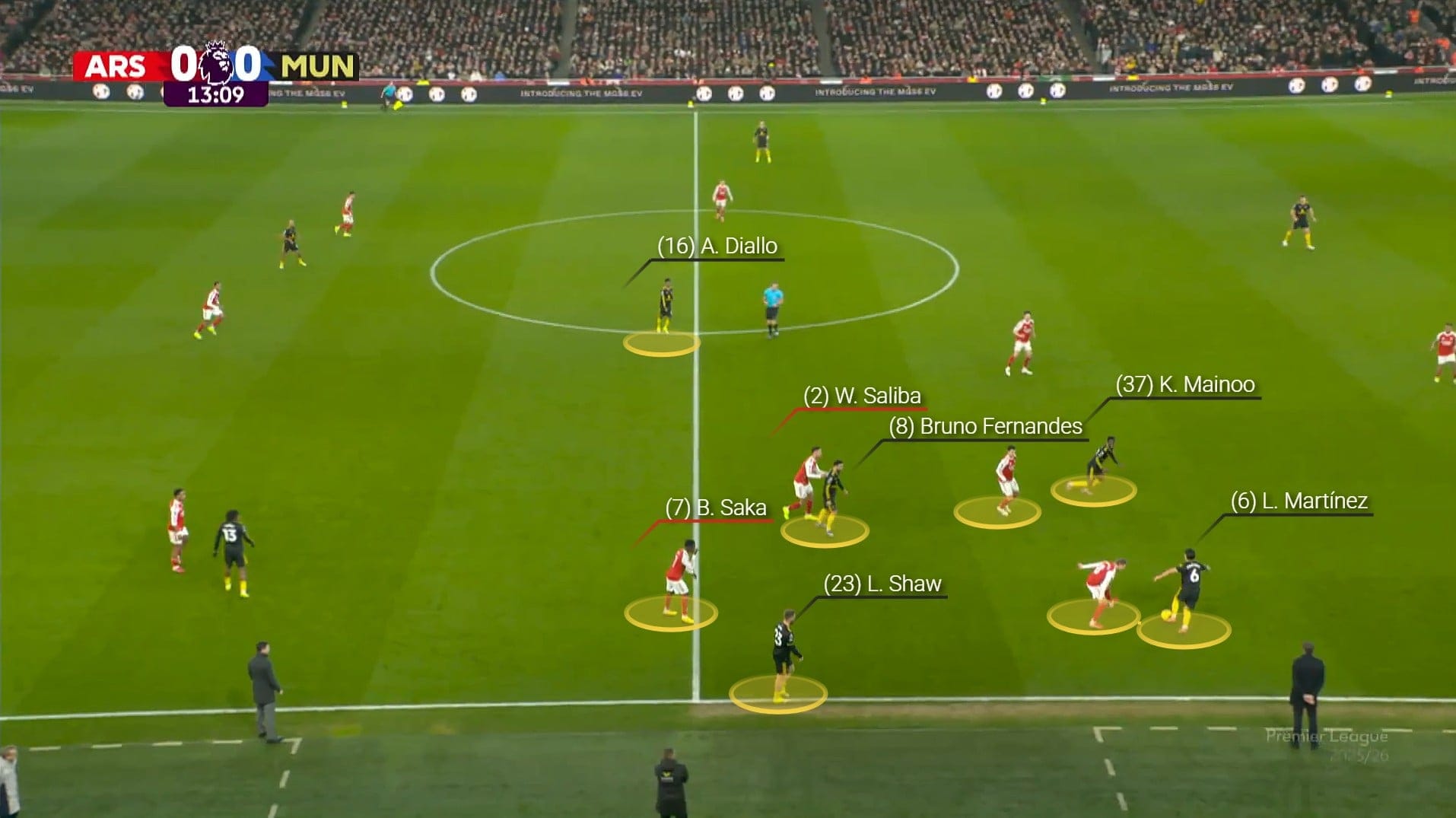
The addition of Kobbie Mainoo back to the team helps.
Still, the difference is that when they have the ball wide, a central midfielder or another attacker is waiting for an inside pass, with a winger ready to push on in behind.
It seems Carrick has given the team a license to express itself; confidence is flowing, and they are therefore comfortable even in tight spaces, which Arsenal and City didn’t expect.
The results have given them the confidence, but playing in the manner that they have in these three games by connecting better in wide areas is indicative of a team miles more confident on the ball.
Versus Man City and Fulham, there were periods when United needed to steady themselves under pressure.
They did this by comfortably playing the ball between them, progressing upfield through successive passes.
The spine of Lisandro Martínez, Harry Maguire, Bruno Fernandes, and Casemiro is deliberate.
They are all players who take risks first and play the pass forward.
It hasn’t been noted enough that, among the centre-backs at United, Carrick is opting for a Maguire-Martínez partnership, who are a huge influence on this team in getting the ball forward.
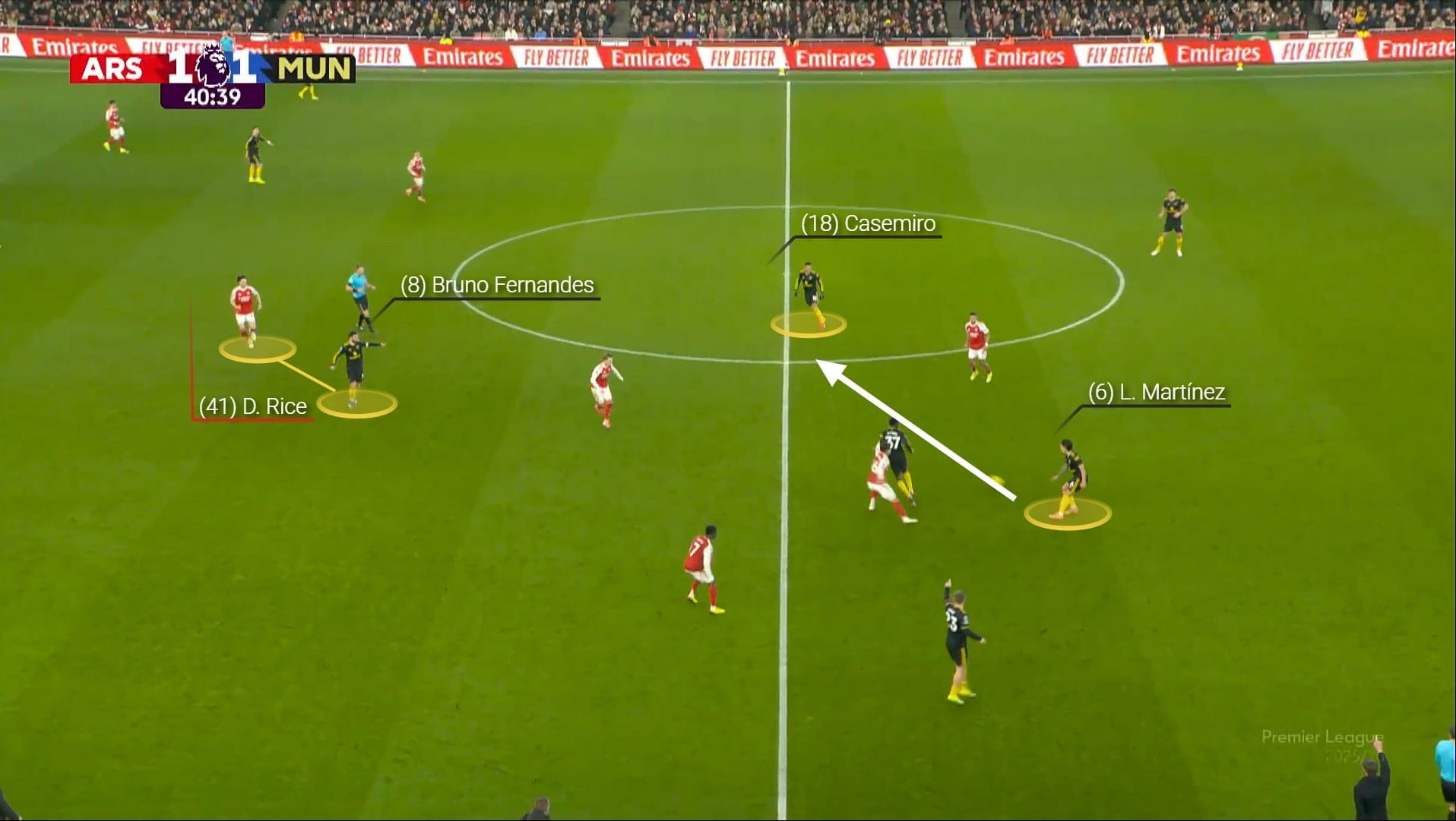
The progression in the image above is one observable benefit of the 'rondo'; however, in this case, Arsenal have numerical superiority.
Whilst under pressure, Martínez has to find a quick pass to Casemiro.