What Is Positional Exchange In Modern Football? Marcelo Bielsa Principles & Joaquín Papa Independiente Del Valle Tactics – Tactical Theory
Positional exchange in modern football has established itself as an indispensable tool for breaking down the rigidity of well-structured defensive systems.

What Is Positional Exchange In Football?
Positional exchange in modern football has established itself as an indispensable tool for breaking down the rigidity of well-structured defensive systems.
Far from being an abstract concept or a display of improvisation, functional position-switching responds to a systemic principle for both attacking and defending.
In the attacking phase, the primary objective of positional exchange is to create movement.
This is achieved through penetrative runs, or movement in depth to reach advanced areas and threaten the opponent's backline or dropping movements targeting slightly deeper zones, which offer clean passing options and potentially pin markers.
On the contrary, during the defensive or out-of-possession phase, players exchange positions to paradoxically destroy the opponent's off-the-ball movement during their attacking phase; in this scenario, position-switching implies changing marking assignments in real time and coordinating cover with teammates to prevent the opponent from disorganising the structure.
Marcelo Bielsa, who most recently coached Uruguay in the 2026 FIFA World Cup, repeatedly emphasises the significance of this concept in his lectures and conferences: "Starting from their initial position, every player moves up or down, and also moves from the flank to the centre if playing wide, and vice versa.
Mobility on the pitch means that all 10 outfield players have three alternative positions in addition to their starting role".
For Bielsa, if a team remains static in its tactical positions during the attack, it becomes highly predictable and easy to neutralise.
In this tactical theory, we delve into the importance of positional exchange, taking Joaquín Papa’s Independiente del Valle as an example.
Marcelo Bielsa & The Configuration Of Pairs Per Lane
To understand how positional exchange is tactically enabled, one must look at the spatial distribution of the pitch.
The foundation of the legendary Argentinian coach's game philosophy lies in creating attacking pairs per lane: left, central, and right.
The mathematical reason behind this rule is conclusive: "I am interested in having two players in each lane.
Because if there aren't two, there is one.
And if there is only one, there can be no exchange of positions".
If a longitudinal channel has only a single footballer, any movement will break space occupation or leave the lane completely deserted.
The existence of a pair in the same channel ensures that while one player vacates a zone through a run, the second automatically occupies that space or compensates for the height, guaranteeing the fluidity and continuity of play.
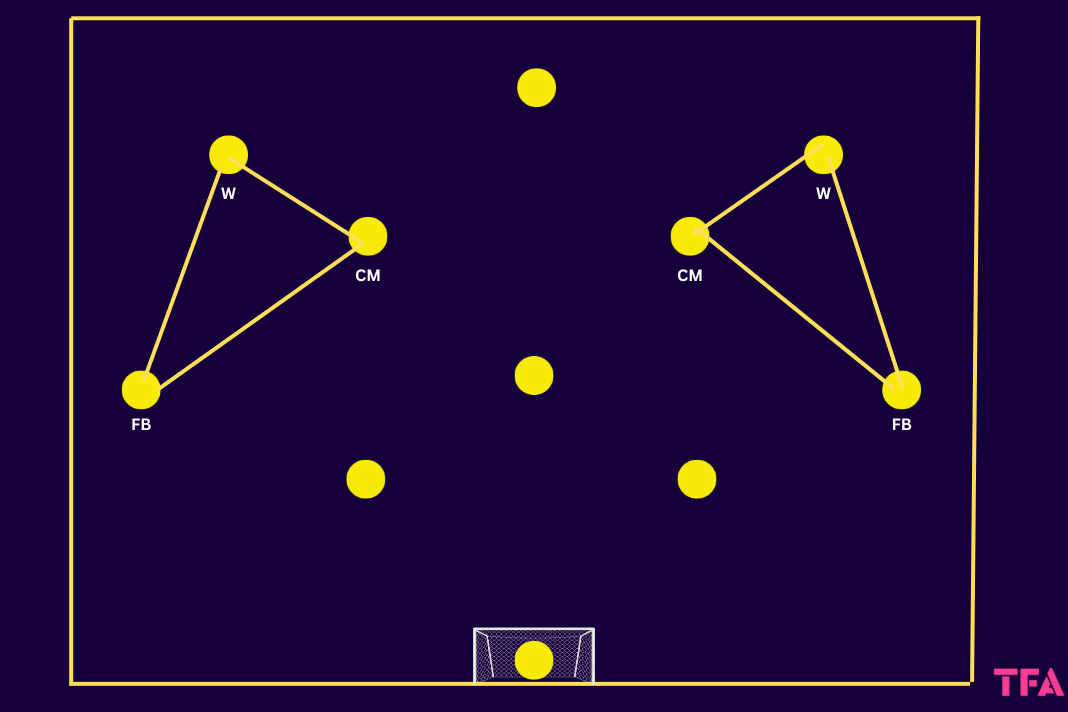
These attacking pairs out wide or inside also have the virtue of drawing in a third player, such as a central midfielder, generating the famous "attacking triangles" that multiply diagonal passing options and open up pathways against low blocks.
Versatility: The Example Of The Box-To-Box Midfielder
For position-switching to be effective, versatility is a fundamental pillar.
It is not about moving around the pitch chaotically, but possessing the mobility and tactical reading to adapt to the opponent or attack neglected zones, given that the guiding principle of attack is to reach a place where the opponent does not expect me.
A clear example of this dynamism is the alternative positioning of a box-to-box midfielder throughout a match:
- Penetrative run to an attacking midfielder position: Inserting into the pocket between the lines.
- Penetrative run to a winger position: Providing width when the nominal winger tucks inside.
- Dropping movement to a defensive midfielder position: Offering support at the base of the play for a clean build-up and maintaining structural balance.
Off-The-Ball Mechanisms & Patterns At Independiente Del Valle
Bringing this theoretical framework to the pitch through video analysis of Joaquín Papa's team in the Copa Libertadores reveals interaction patterns where space occupation ceases to be fixed and becomes a constant flow of support and penetrative runs.
First, the mechanism of lane compensation between winger and full-back stands out.
Within this behaviour, the winger executes a dropping movement out wide along the touchline to receive with time and facing forward; this reception immediately drags the opponent's full-back out of their defensive line.
Simultaneously and with perfect synchronisation, the team's own full-back makes a deep penetrative run into the interior channel, exploiting the unguarded space between the opponent's centre-back and the full-back who stepped up to press.