
![Arsenal Vs Atlético Madrid [1-0] – Champions League Semi-Final Second Leg 2025/2026 – Tactical Analysis](https://cdn.mymidnight.blog/77f959f119f4fb2321e9ce801e2f5163/size/w1000/2026/05/Arsenal-Vs-Atle--tico-Madrid-20252026.png)
Arsenal Vs Atlético Madrid [1-0] – Champions League Semi-Final Second Leg 2025/2026 – Tactical Analysis

Arsenal hosted Atlético Madrid in London, with the visitors seeking their third Champions League final under Diego Simeone, having fallen short of the title in 2014 and 2016, losing on both occasions to Real Madrid.
Mikel Arteta's side, of course, had an equally defined objective: to reach the final of Europe's most prestigious club competition for the first time in 20 years, since the days of Arsène Wenger.
With the first leg leaving everything wide open after a cagey 1-1 draw in the Spanish capital, the return leg in London promised to mirror the tight, tactical character seen on the other side of the bracket: a closed game defined by the fine margins of success and error.
The match unfolded exactly as expected.
Despite a marked territorial dominance, Arsenal found in El Cholo’s boys their kryptonite when it came to breaking down low blocks.
Conversely, the visitors also encountered a defensive hurdle in Arteta’s side, who have mastered the art of the retreat and control in prolonged static defending.
Ultimately, Arsenal secured the win through a solitary Bukayo Saka goal just as the first half was drawing to a close, managing the result to finally secure their place in the Champions League Final after two decades, awaiting their opponent PSG in Budapest, Hungary.
In this tactical analysis, we break down the key tactical details of the Gunners' second-leg triumph.
Arsenal Vs Atlético Madrid Lineups & Formations
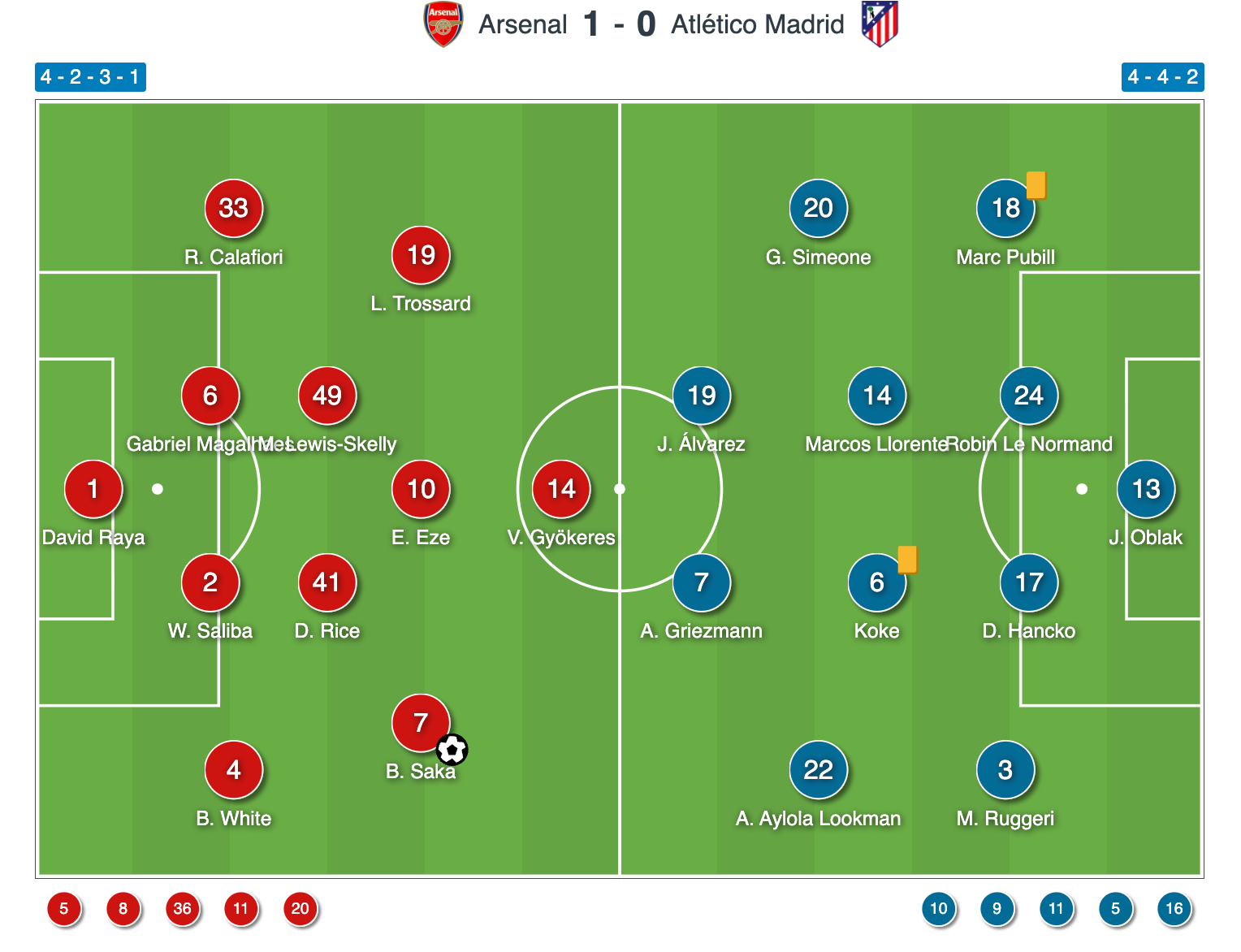
Mikel Arteta tactics opted for continuity, fielding an unchanged Arsenal XI from their recent outing against Fulham.
David Raya started in goal, protected by the now-iconic centre-back pairing of William Saliba and Gabriel Magalhães.
Ben White and Riccardo Calafiori took their places as the starting full-backs, offering a blend of defensive solidity and technical buildup.
In the engine room, Declan Rice anchored the midfield, providing a platform for the creative duo of Myles Lewis-Skelly and Eberechi Eze to operate as advanced interiors.
The frontline saw Leandro Trossard and Bukayo Saka providing width and trickery, flanking the physical presence of Viktor Gyökeres at the tip of the attack.
For Atlético Madrid, Diego Simeone tactics welcomed Jan Oblak back to the starting lineup for this crucial Champions League clash.
The visitors lined up with a back-three consisting of Dávid Hancko, Robin Le Normand, and Marc Pubill, while Matteo Ruggeri and Giuliano Simeone provided the width as wing-backs.
The midfield was anchored by the double pivot of Koke and Marcos Llorente.
Further forward, Ademola Lookman and Antoine Griezmann operated as wide playmakers, tasked with creating opportunities for the lone striker, Julián Álvarez.
Atlético Madrid Strong Start Without The Ball
Simeone’s men were clear from the start: they implemented a proactive plan within their prolonged defensive process in a mid-block.
Within a 5-4-1 structure out of possession, featuring a hardworking Griezmann as a right-sided midfielder, the goal was to negate Arsenal’s interior circulation and prevent them from forcing lateral shifts.
While Arsenal enjoyed territorial dominance and early possession in the opposition half, this initially translated into safety passes and restarts in the face of Los Colchoneros' aggressive jumps and harassment within the block.
Their second line was heavily involved in preventing clean receptions and turns.
Under this scenario, neither Eze nor Lewis-Skelly could impose themselves in the opening minutes, unable to contact the ball or, when they did, receiving in uncomfortable conditions with their backs to goal and an opponent ready to jump.
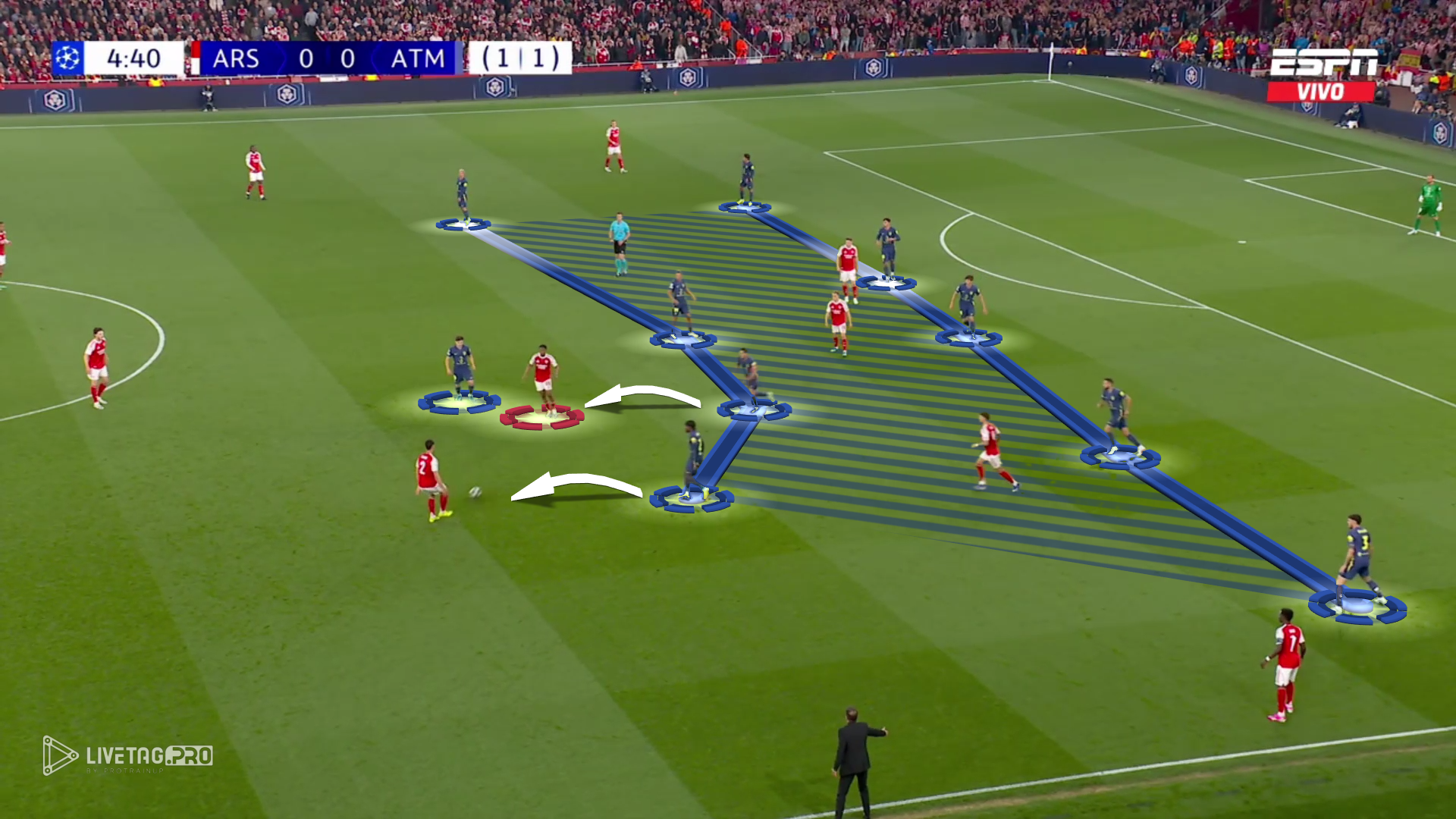
In this state of comfort without the ball, Atlético de Madrid also found effective scenarios to exercise a high press through individual man-marking, the advancement of their second line, and lateral shifting efforts led by Julián Álvarez.
This neutralized much of the buildup potential from David Raya’s feet, forcing him into direct play or forcing Arsenal’s primary passers into complex 'outside-in' or long-distance deliveries.
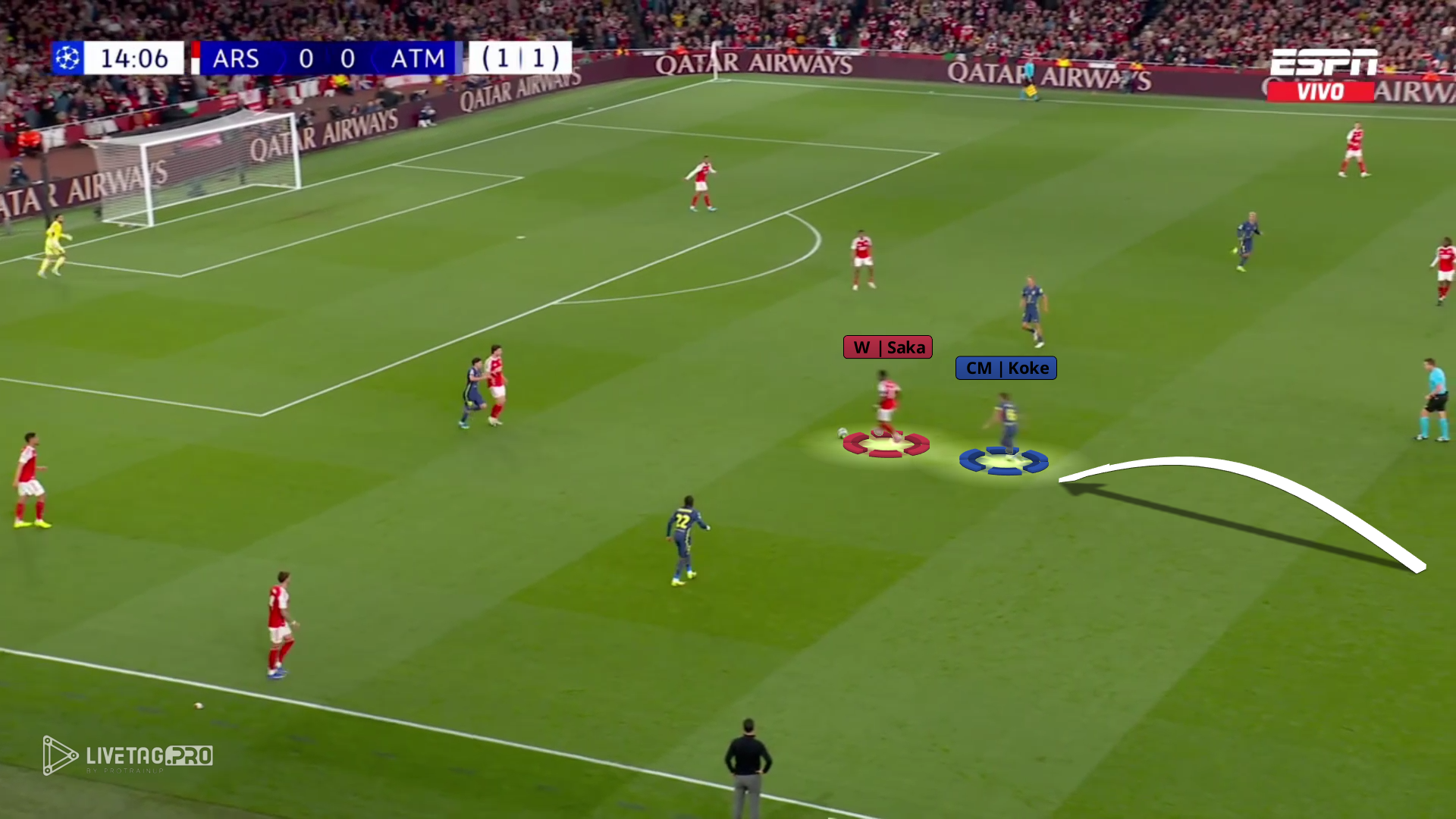
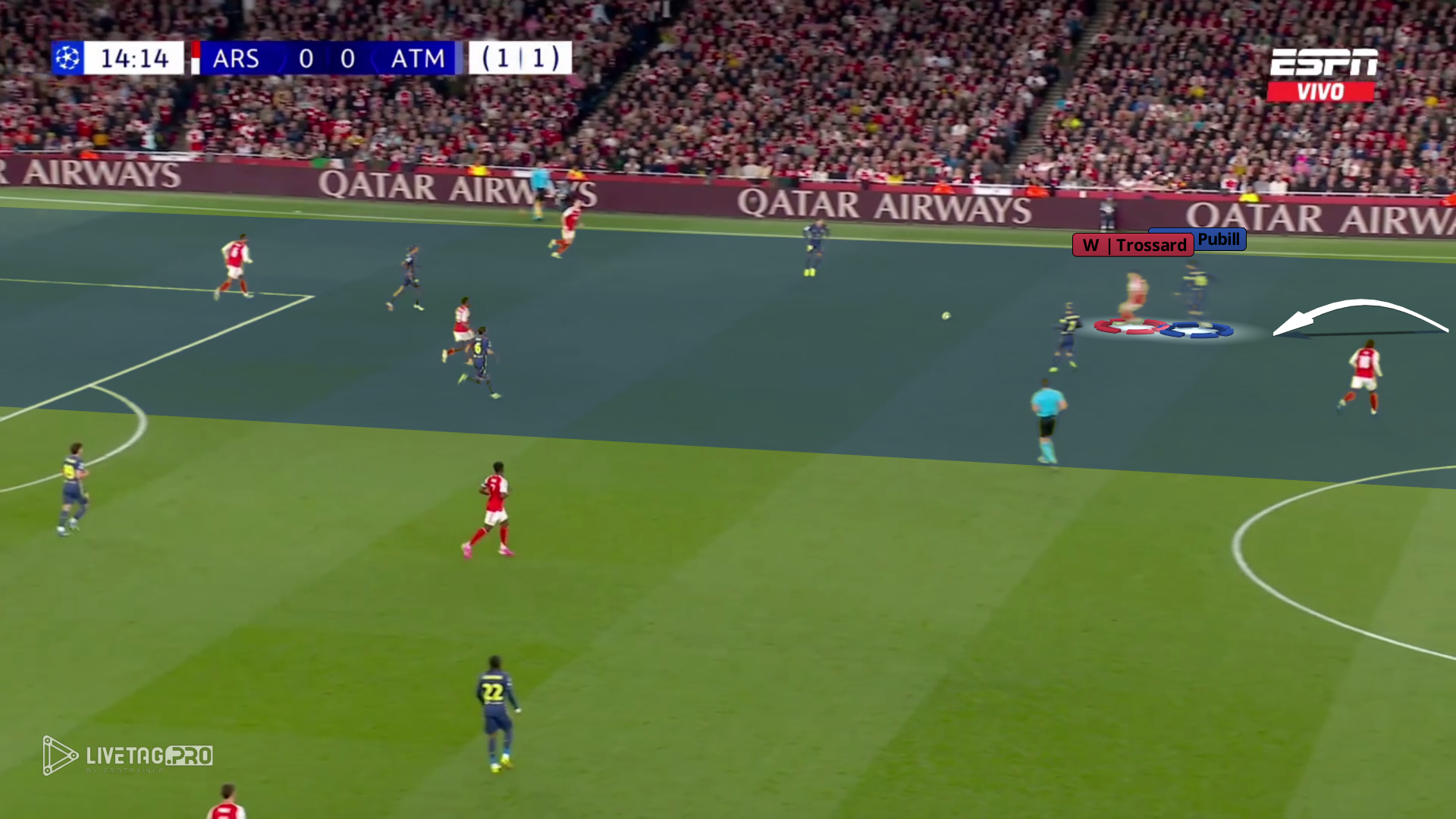
Through this work in the middle third and in Arsenal’s construction phase, Atlético managed to neutralise the receptions of the Gunners' most dangerous players, particularly Bukayo Saka, who was often forced to restart play upon receiving, lacking the options to turn and face the pitch.
However, as the minutes ticked by, Saka began to discover the necessary solutions.
Arsenal Growth
The hosts' possession began to feel more organic as the half progressed, with Trossard dictating the rhythm in attack and a more liberated Saka.
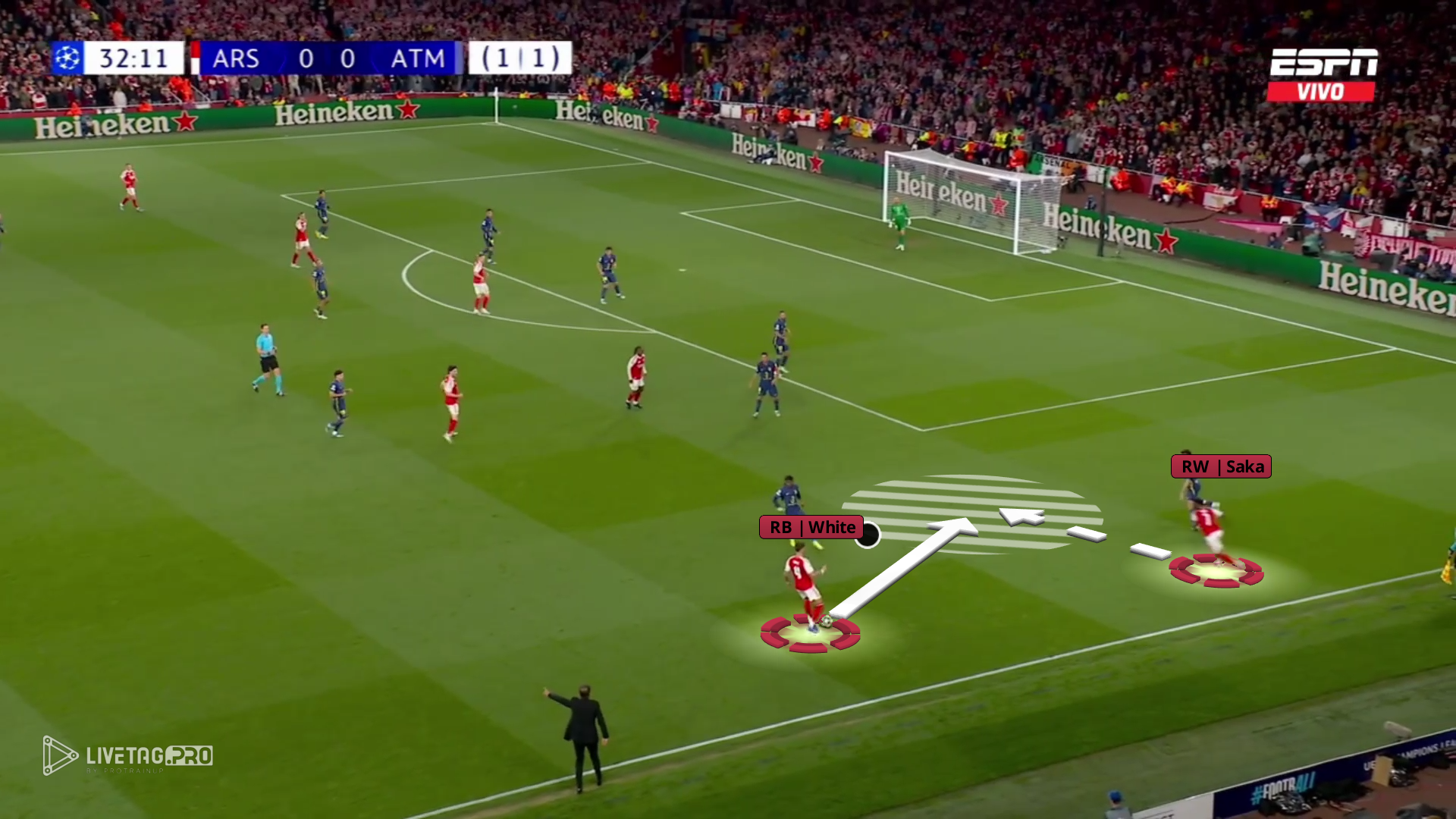
Much of this growth can be attributed to the connection between the English winger and Ben White: a partnership that is proving to be one of the most potent assets in the Londoners' late-season form.
The full-back has been regaining his best form, and his 'socio-affective' chemistry with Saka is capable of dismantling any block.
It was a standout performance from White, who supported his flank by providing the best player on the pitch with the correct pass tension and direction, stimulating Saka’s creativity and drive on his inverted foot.
![Olympique De Marseille Vs PSG [1-2] Ligue 1 2026/2027: How Bruno Génésio Transitions Troubled PSG - Tactical Analysis](https://cdn.mymidnight.blog/77f959f119f4fb2321e9ce801e2f5163/size/w600/2026/09/Marseille-Vs-PSG-2026_2027---Tactical-Analysis.png)
![Fulham Vs Manchester United [1-1] Premier League 2026/2027: How Álvaro Arbeloa Tactics Exposed The Red Devils' Problems - Tactical Analysis](https://cdn.mymidnight.blog/77f959f119f4fb2321e9ce801e2f5163/size/w600/2026/09/Fulham-FC-Vs-Man-United-2026_2027---Tactical-Analysis.png)
![AS Roma Vs Inter Milan [2-2] Serie A 2026/2027: When Undefeated Giallorossi Attack Met Nerazzurri Comeback Resilience - Tactical Analysis](https://cdn.mymidnight.blog/77f959f119f4fb2321e9ce801e2f5163/size/w600/2026/09/AS-Roma-Vs-Inter-Milan-2026_2027---Tactical-Analysis.png)
![Real Sociedad Vs Bournemouth [1-2] Europa League 2026/2027: How Do Marco Rose Pressing Tactics Work? - Tactical Analysis](https://cdn.mymidnight.blog/77f959f119f4fb2321e9ce801e2f5163/size/w600/2026/09/Real-Sociedad-Vs-Bournemouth-20262027---Tactical-Analysis-1.png)
![AC Milan Vs Benfica [0-2] Europa League 2026/2027: How Marco Silva Tactics Exposed Rúben Amorim Defensive Problems - Tactical Analysis](https://cdn.mymidnight.blog/77f959f119f4fb2321e9ce801e2f5163/size/w600/2026/09/AC-Milan-Vs-Benfica-20262027---Tactical-Analysis.png)
![Sunderland Vs AZ Alkmaar [1-0] Europa League 2026/2027: Why The Black Cats Make Better Underdogs - Tactical Analysis](https://cdn.mymidnight.blog/77f959f119f4fb2321e9ce801e2f5163/size/w600/2026/09/Sunderland-Vs-AZ-Alkmaar-20262027---Tactical-Analysis.png)
![Leeds United Vs Newcastle United [4-1] Premier League 2026/2027: Why Did Daniel Farke Tactics Dominate The Magpies? - Tactical Analysis](https://cdn.mymidnight.blog/77f959f119f4fb2321e9ce801e2f5163/size/w600/2026/09/Leeds-United-Vs-Newcastle-2026_2027---Tactical-Analysis.png)
![Real Sociedad Vs Atlético Madrid [0-3] La Liga 2026/2027: How Diego Simeone Tactical Precision Rescued A Late Victory - Tactical Analysis](https://cdn.mymidnight.blog/77f959f119f4fb2321e9ce801e2f5163/size/w600/2026/09/Real-Sociedad-Vs-Atl--tico-Madrid-20262027---Tactical-Analysis-1.png)