
Massimiliano Allegri Tactics At AC Milan 2025/2026: Structural Issues Behind Their Poor Form – Tactical Analysis

AC Milan have been on a rocky run of form in Serie A of late, with a 1-0 loss at Napoli, a 0-3 loss at home to Udinese, a 0-0 draw with Juventus and a 2-0 loss at Sassuolo, accompanied by just a sole victory, 0-1 away to relegated Hellas Verona, in their last five league games.
Still, they are just three points behind Napoli and remain two points ahead of Juventus, occupying third place in the Serie A table.
That said, I Rossoneri should take care in their remaining games, as while it's in their hands, they are at risk of dropping out of the UEFA Champions League spots.
In this Massimiliano Allegri tactical analysis, we look at I Rossoneri's recent performances, focusing on their attacking problems and what needs to change to better suit the team's ambitions.
AC Milan Attacking Performances & Weaknesses
Against Juventus, Milan succeeded in slowing and disrupting Juventus’ build-up attempts early in the match, thanks to their solid man-marking and distribution during the non-possession phase.
The pressure applied to the ball holder inside Juventus’ half forced the opponents to play with their backs to Milan’s goal and often led them to resort to either backward or vertical passes.
However, those vertical passes were usually intercepted.
Applying pressure, especially from the flanks, to prevent Juventus’ skilful players from advancing, was important for Milan to force I Bianconeri to progress through the middle and have their passes intercepted thanks to Milan's numerical superiority in that area.
The 3v2 in that area favoured Milan, leaving little space for Khéphren Thuram and Manuel Locatelli to move and act.
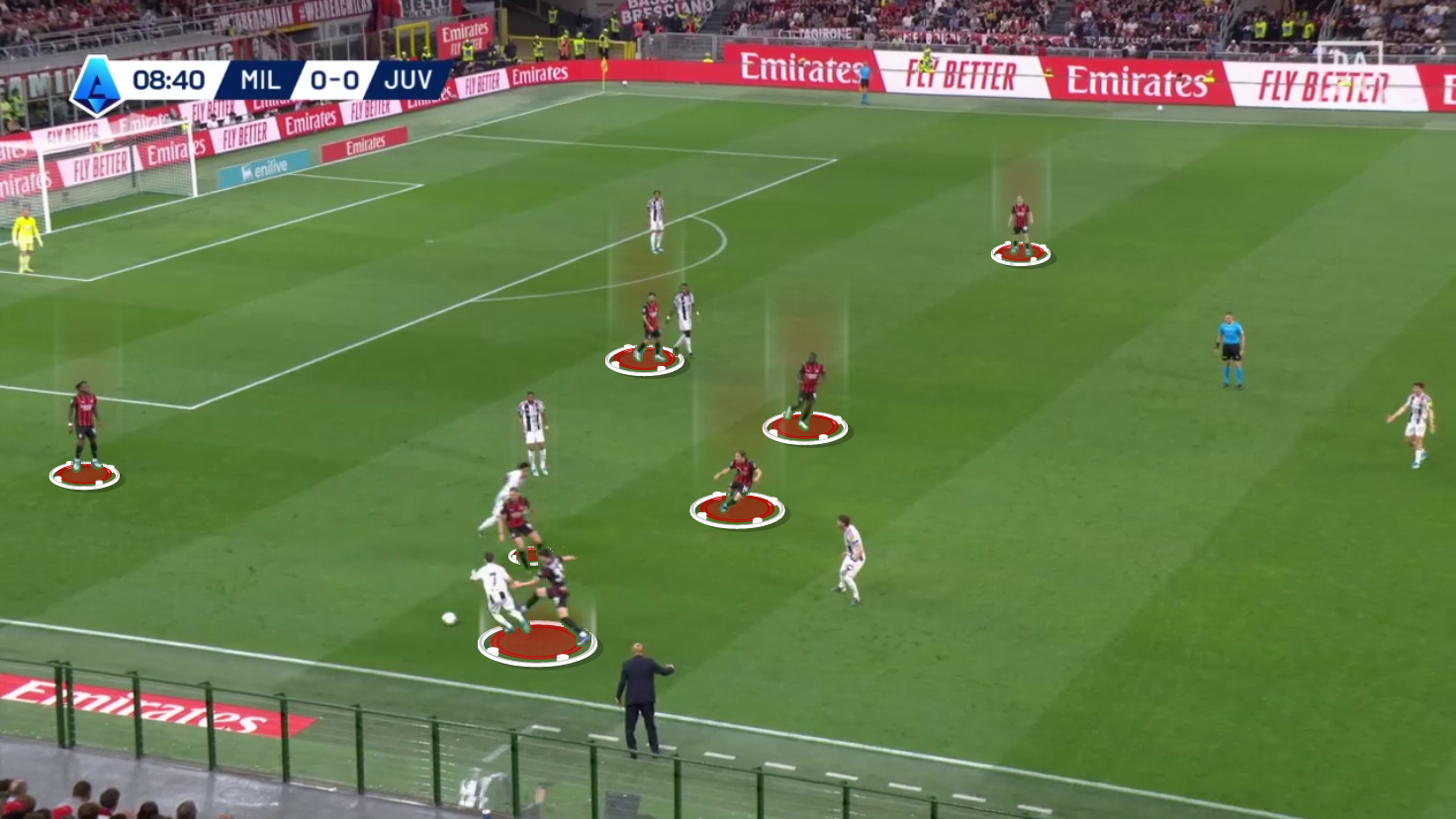
The following picture highlights the efficient Milan high press inside Juventus’ half.
They committed seven players in this action, with Davide Bartesaghi forcing his direct opponent to retreat rather than cut inside.
Milan's repeated attempts to prevent such dribbles, and towards the middle, helped a lot in preventing Juventus from building their actions the way they are used to and obliged them to resort to alternative solutions that are not as efficient as their usual build-up from the back.
Milan Vertical Passing & Chance Creation
Milan also showed against Juventus that they can penetrate the final third, with crucial vertical line-breaking passes.
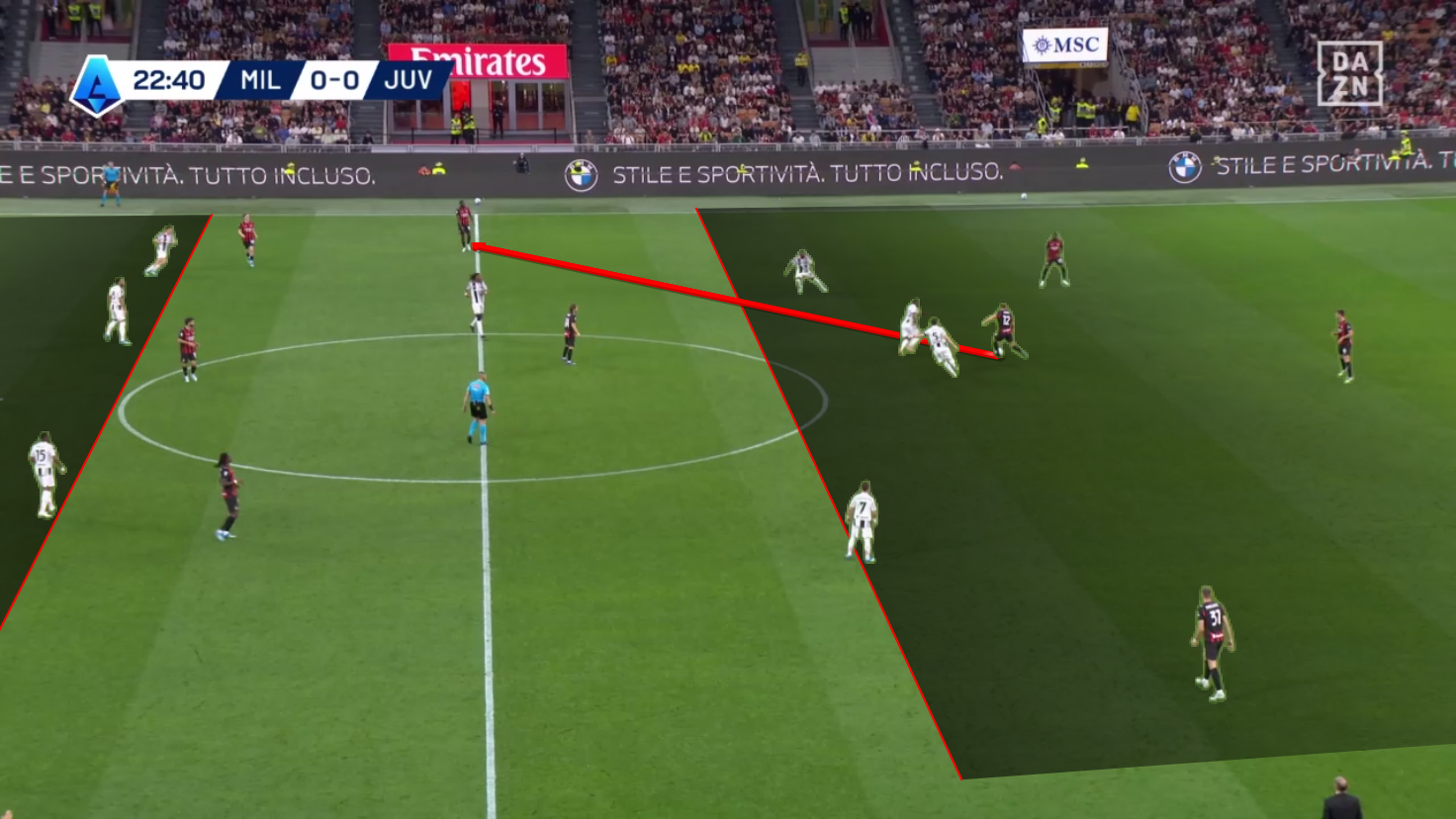
Following Massimiliano Allegri’s instructions to rely further on vertical passing, Adrien Rabiot made himself available to receive a pass in his team’s half, and exploited the intense Juventus marking applied on him by two players, with two other players standing on almost the same line.
He exploited that by finding the trajectory to provide a vertical pass to Youssouf Fofana, eliminating those four players from the action and giving Fofana the opportunity to advance quickly and use that numerical superiority in Milan’s favour.
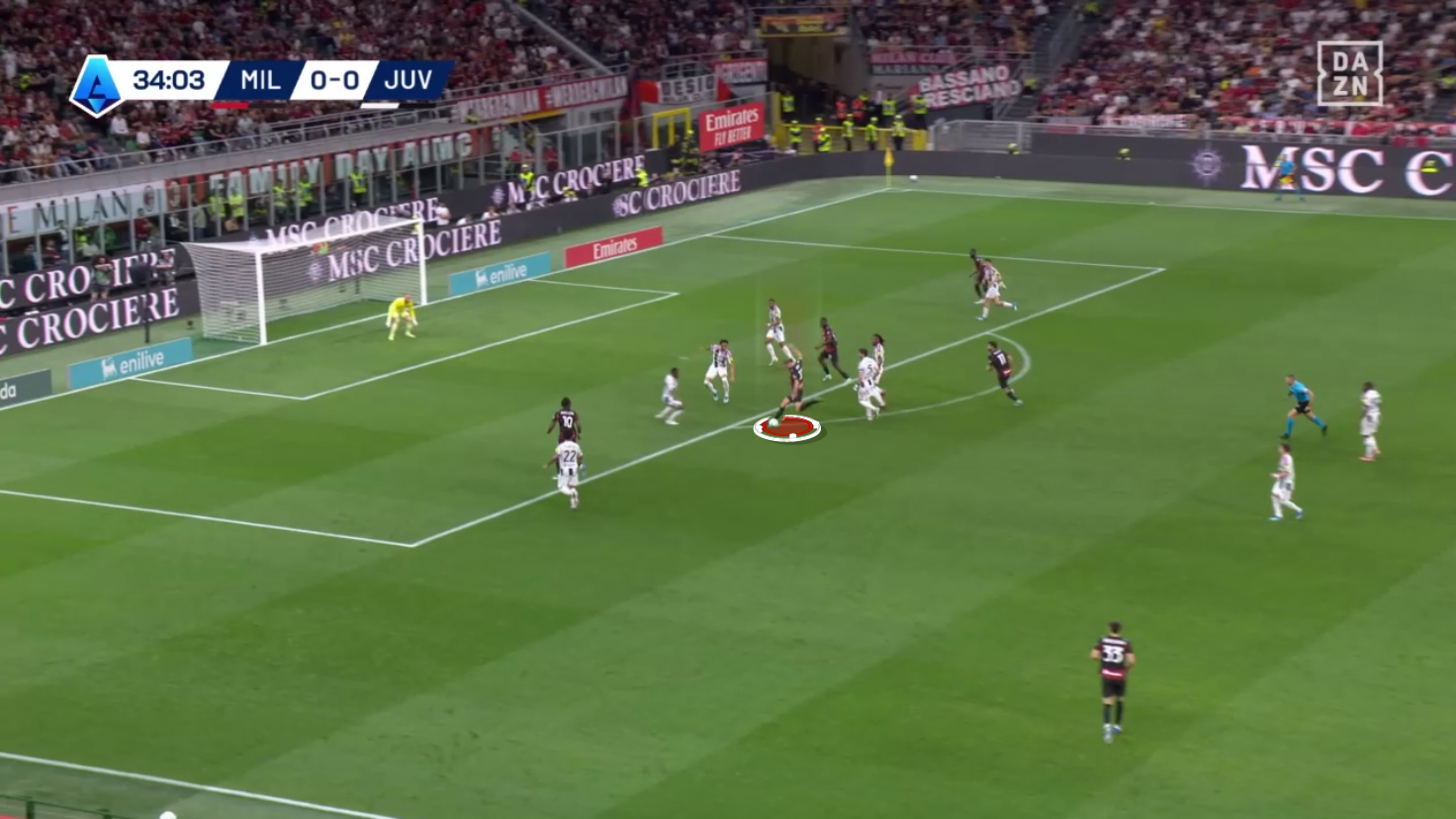
Fofana was intelligent enough to quickly dribble past his opponent and accelerate until he reached the edge of the box.
But his final pass/finishing decision-making was poor, as his shot went off target and, more importantly, he had better options, such as passing to Alexis Saelemaekers, who was better positioned to score.
Such actions have been recurrent in Milan's latest games, as I Rossoneri rely heavily on key passing and line-breaking passes, whether from Luka Modrić or Adrien Rabiot, towards one of the attacking players or to Youssouf Fofana, who usually advances in such situations.
Milan Reliance On Midfielders Inside The Box
One effective attacking solution Milan employ when chasing the game is to intensify their midfielders' presence in the final third and in the box whenever possible.
This has been recurring for Milan in several recent games.
Allegri relies heavily on Fofana and Rabiot to advance and contribute to goals.
One example sees Rabiot moving well without the ball in the final third when he received an accurate pass in the direction of his run, allowing him to get past his markers and shoot on goal despite the opponent's attempts to prevent him from finding shooting positions.
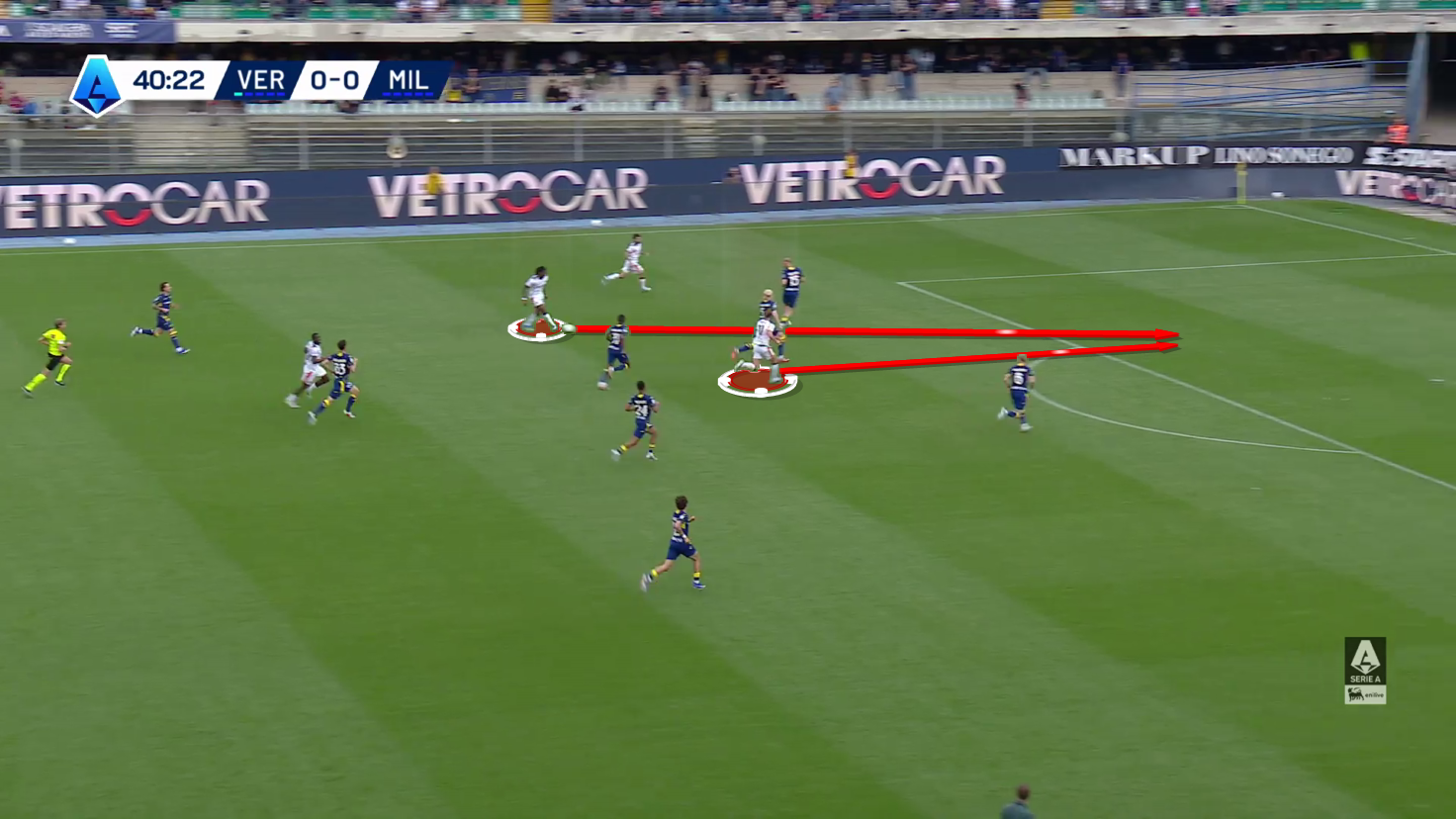
A very similar, more concrete example of Milan's midfielders' active involvement in attacking play was evident in the previous fixture against Hellas Verona.
In that game, Rabiot was advancing without the ball, and the chemistry between him and Rafael Leão was very rewarding, as he turned that action into a goal, thanks mainly to his instinct for goal and exceptional shooting from distance.
That said, Milan are not exploiting these qualities in the best possible way right now as the chemistry between Leão and Rabiot does not work well when Leão plays as a striker, since he gets marked more often and cannot find spaces or time for intelligent passing exchanges like he does when playing on the wing.
The proof of that was that Leão succeeded in providing the assist to Rabiot mainly because he retreated from the box and leaned towards the left to receive the ball freely and have space to advance, dribble, pass, or shoot.
Playing on the left wing would therefore guarantee similar situations more often than when playing as a striker, and would eventually produce more dangerous chances for Milan.
Milan Lack Of Chemistry Inside The Final Third
Milan try to diversify their attacks, for instance, with Leão dropping into midfield and being involved actively in the playmaking process as he attracts players and leaves spaces in attack, whether for Christian Pulisic or for the players coming from behind like Fofana, Rabiot, Saelemaekers, or Bartesaghi.