
Coaching Centre-Back Build-Up Play Like Brighton – Tactical Theory

Whether playing against a high press or a low block, the centre-back's role is key in the build-up phase and breaking the first line of pressure.
Playing out from the back involves much more than simply being comfortable on the ball.
The modern centre-back must be equipped in various ways to beat their direct opponent.
This tactical analysis explores the technical nuances modern centre-backs utilise during the build-up phase, with examples from Premier League side Brighton & Hove Albion and Allsvenskan side BK Häcken.
Attacking The Space

One of the most effective ways a centre-back can beat the first line of pressure is to carry the ball at their feet.
It not only takes the defender past the opposition's forward line, but it can also create an overload in midfield.
At some point, the opposition's central midfielder is forced to engage with the player on the ball, opening up passing options.
In the above example, taken from Häcken in the Swedish Allsvenskan, the left centre-back has just received the ball from his left-back.
The ball-near opposition striker is attempting to cut the field in half and trap the centre-back on that side.
The centre-back takes a big, aggressive first touch, removing the striker from the game.
Aided by his central midfielders' movement (circled), the centre-back takes the ball beyond the first line of pressure and is free to run at the opposition’s midfield.
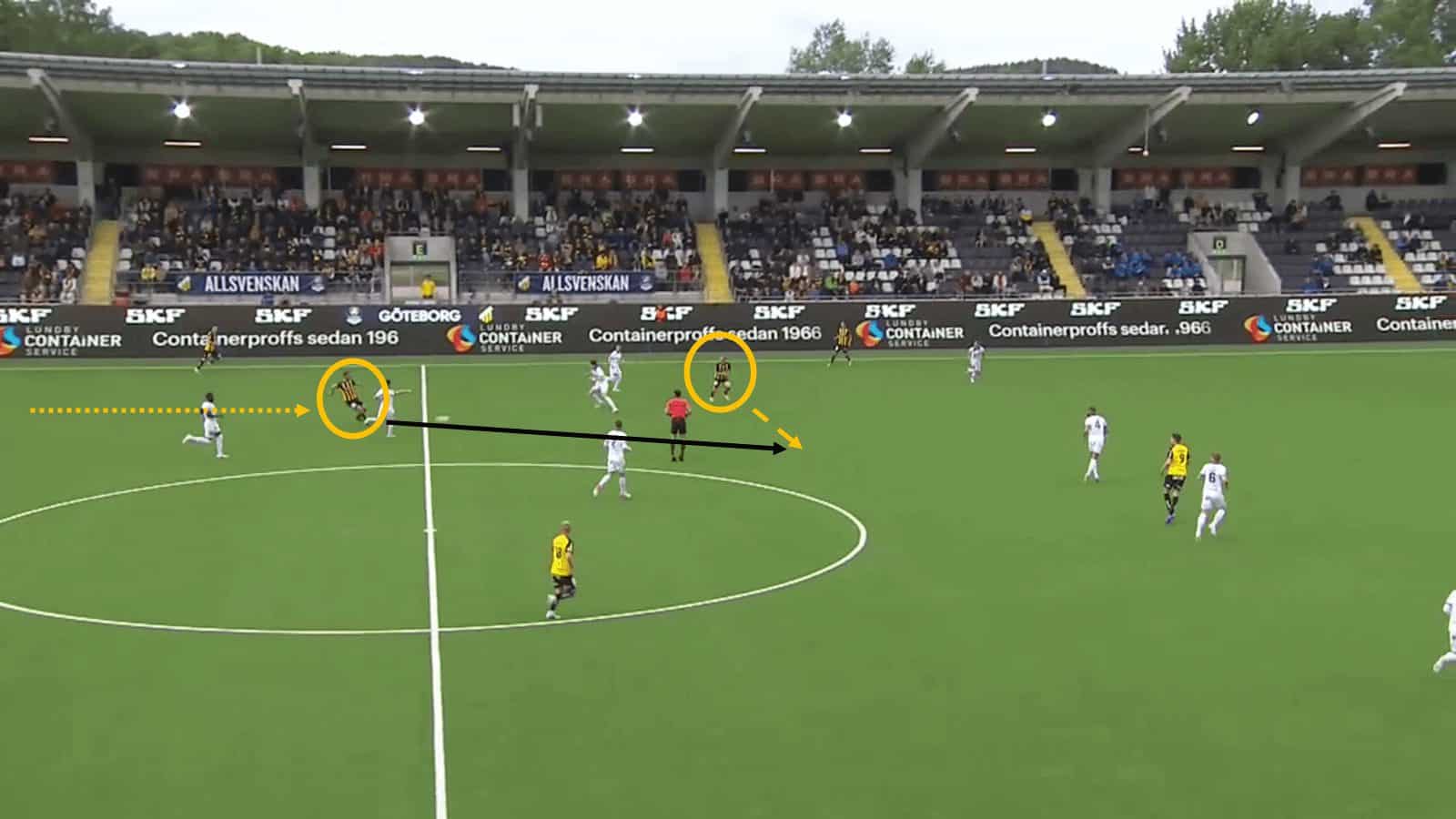
Now, with the opposition midfielders' eyes focused on the ball, his teammate can sneak behind them from a wide to a central position.
The wide player can move unnoticed and receive a pass, allowing him to go directly at the opposition's backline.
Attacking The Space From A Switch Of Play

The above tactical diagram shows the benefits of attacking the space from a switch of play against a mid or low block.
In addition to bypassing the first line of pressure, this makes it very difficult for the opposition's midfield to shift across the pitch behind their forwards.
Thus, space remains in the wide area, which could lead to a one-on-one situation between the winger and the opposition full-back.
The centre-back must take an aggressive first touch forward and must also continue driving forward in a straight line, as opposed to a diagonal line towards the next pass.
This will usually lead to the widest, in this case, left, midfielder running directly to the ball.
At the point of engagement, the centre-back can release the ball to one of the wide players.
An alternative for centre-backs to travel with the ball into space is to dribble the ball towards the closest opposition forward.
Similar to the previous scenario described, this freezes the forward in place.
Passing options behind the forward are created by stopping the forwards from shifting to cover space.
Foot On The Ball

The above image shows Brighton’s Jan Paul van Hecke standing still at the edge of his box with the sole of his foot on the ball.
A centre-back usually does this in order to bait the forward into pressing the ball.
When playing against a compact mid-block, this draws the forward ahead of his line of confrontation, creating space behind him.
The forward jumping prematurely is the trigger for the in-possession team's midfielders’ movements.
Even at the top level, where teams are prepared to face this situation, it is very hard to resist the temptation to jump, especially when impatient fans are on your back.
In this situation, much closer to Brighton’s own goal, Van Hecke does not have any clear passing options.
Crystal Palace are in complete control of the situation.
It is only when van Hecke puts his foot on the ball that both forwards closest to the ball lose their patience and jump at the defender.
This gives the Dutch centre-back a simple 10-yard pass to his midfielder, Billy Gilmour.
The former Chelsea player can then receive acres of space and do as he likes with the ball.
From a technical standpoint, controlling the ball under the sole of the foot makes it easier to play the next pass.
It is a common technique found in the very technical game of futsal.
In different situations from the above, it can be used to protect the ball.
It’s an effective way of keeping the ball far from the defending player whilst allowing the in-possession player to turn easily.
In this scenario, it allows the ball to be quickly rolled to either side, depending on where the pressure comes from, to set up a line-breaking pass.
The ball can even be manipulated if the centre-back is forced to go sideways or backwards to the goalkeeper.
The precision of the sole of the foot roll allows the next action to be a firm pass on the ground or even a long, high ball in behind.
Although this looks easy and is simple enough to understand, it is rare to have the composure to stay on the ball in this situation.
It takes patience and trust in your teammates to make movements as soon as the opposition engages in their press.
Passing Exercise

The practices described in this section are designed to work on the individual technical elements and decision-making of centre-backs.
This simple passing exercise, which can be incorporated as part of a warm-up, allows defenders to work on attacking the space ahead of them before playing a firm, line-breaking pass.