
![Manchester United Vs Liverpool [3–2] Premier League 2025/2026: How Michael Carrick Tactics Exploited Arne Slot's Defensive Weaknesses - Tactical Analysis](https://cdn.mymidnight.blog/77f959f119f4fb2321e9ce801e2f5163/size/w1000/2026/05/Man-United--Vs-Liverpool-20252026.png)
Manchester United Vs Liverpool [3–2] Premier League 2025/2026: How Michael Carrick Tactics Exploited Arne Slot's Defensive Weaknesses - Tactical Analysis

Manchester United hosted Liverpool at Old Trafford on Sunday, and the game ended in an entertaining 3-2 win that keeps the Red Devils in a solid third place.
The win further guarantees UEFA Champions League football for Michael Carrick's Manchester United next season, while it leaves Arne Slot Liverpool sharing points with Aston Villa for fourth and fifth.
The loss for Liverpool marks the first time in Premier League history that both Manchester United and Manchester City have completed a double over the Reds, raising fresh concerns about whether Arne Slot's job is safe over the summer.
In this tactical analysis article, we analyse Manchester United’s attacking performance and how they exploited Liverpool’s defensive weaknesses through counterattacks and second balls.
Manchester United Vs Liverpool Lineups & Formations
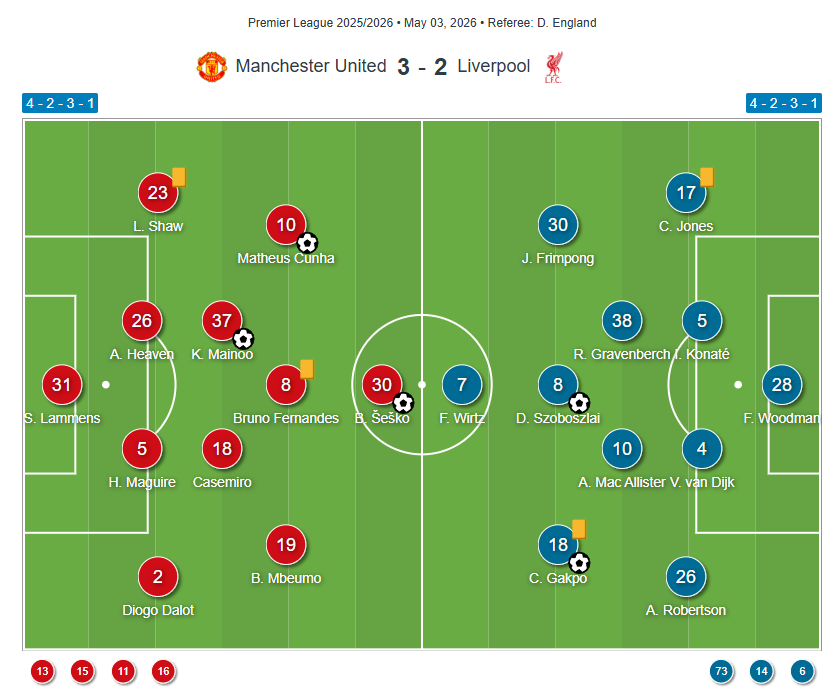
Manchester United Lineup Vs Liverpool
Michael Carrick started the match in a 4-2-3-1 formation, with Senne Lammens as the goalkeeper and a defensive line of Harry Maguire, Ayden Heaven at centre-back, with Luke Shaw at left-back, and Diogo Dalot at right-back.
The midfield featured Kobbie Mainoo and Casemiro as central midfielders, with Bryan Mbeumo and Matheus Cunha as wingers, Bruno Fernandes as the advanced playmaker, and Benjamin Šeško as the team’s striker.
Liverpool Lineup Vs Manchester United
On the other side, Arne Slot also started in a 4-2-3-1 formation, with Freddie Woodman in goal and a defensive line comprising Virgil van Dijk and Ibrahima Konaté at centre-back, Curtis Jones at right-back, and Andy Robertson at left-back.
The midfield was made up of Alexis Mac Allister and Ryan Gravenberch, with Cody Gakpo and Jeremie Frimpong as wingers, and Dominik Szoboszlai as the advanced playmaker behind Florian Wirtz.
Manchester United Efficient Counterattacking Tactics
Manchester United showed more desire and ambition to score from the start of the match as they were better organised and more dangerous with and without the ball.
This means that Manchester United were quick to find attacking solutions when in possession and quick to get the ball back when they lost it.
The team’s ambitious approach and dynamic high-pressure after losing the ball helped them gain more possession, disrupt Liverpool’s build-up from the back, and continuously threaten their shaky defence.
Manchester United did so with several attacking solutions, most of which involved serving Šeško in the box and putting him in favourable positions to score.
Manchester United Effective Reliance On Benjamin Šeško
Even though the reliance on Šeško was not always rewarding, as he was not always able to win duels against Liverpool’s defenders, his presence in the box ensured the necessary attacking depth and helped Manchester United find more space on the wings, in the half-spaces, and behind those defenders.
The positioning of Šeško in that area and his movements inside the box disturbed Liverpool’s slower defenders.
They made it easier for Mbeumo, Fernandes, and Cunha to penetrate, cut inside, and exploit the spaces behind Šeško to create the necessary danger.
Furthermore, Manchester United’s wing overlaps and ability to beat Liverpool’s players with ease put more pressure on Liverpool’s centre-backs in their battle against Šeško.
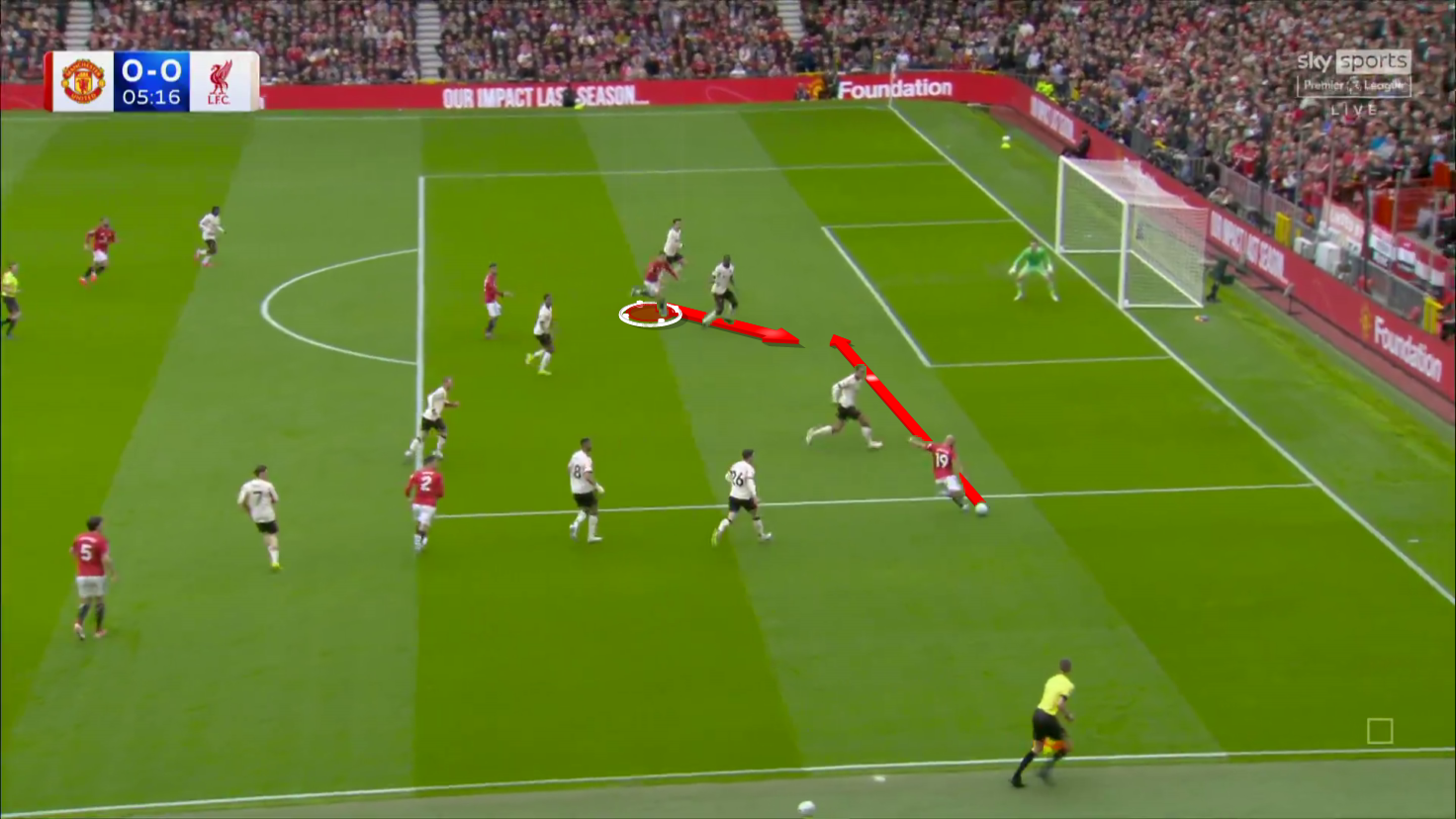
Manchester United were able to serve Šeško with ease from both wings, and Konaté looked in trouble whenever he was trying to catch Šeško during such moments.
The following action highlights one of the many times Šeško escapes marking and tries to anticipate the pass from the wing, with Konaté struggling to reach the ball first and deflecting it into a corner after Šeško shoots.
Manchester United Exploitation Of Liverpool Poor Set-Piece Defending
What followed these direct, vertical attacks from Manchester United was obviously set-pieces, since Liverpool failed to win the ball back and counter Manchester United’s attempts.
Liverpool were also unable to defend set-pieces effectively and were not as reactive as needed in such situations, allowing Manchester United to gain the advantage and be more dangerous in this regard.
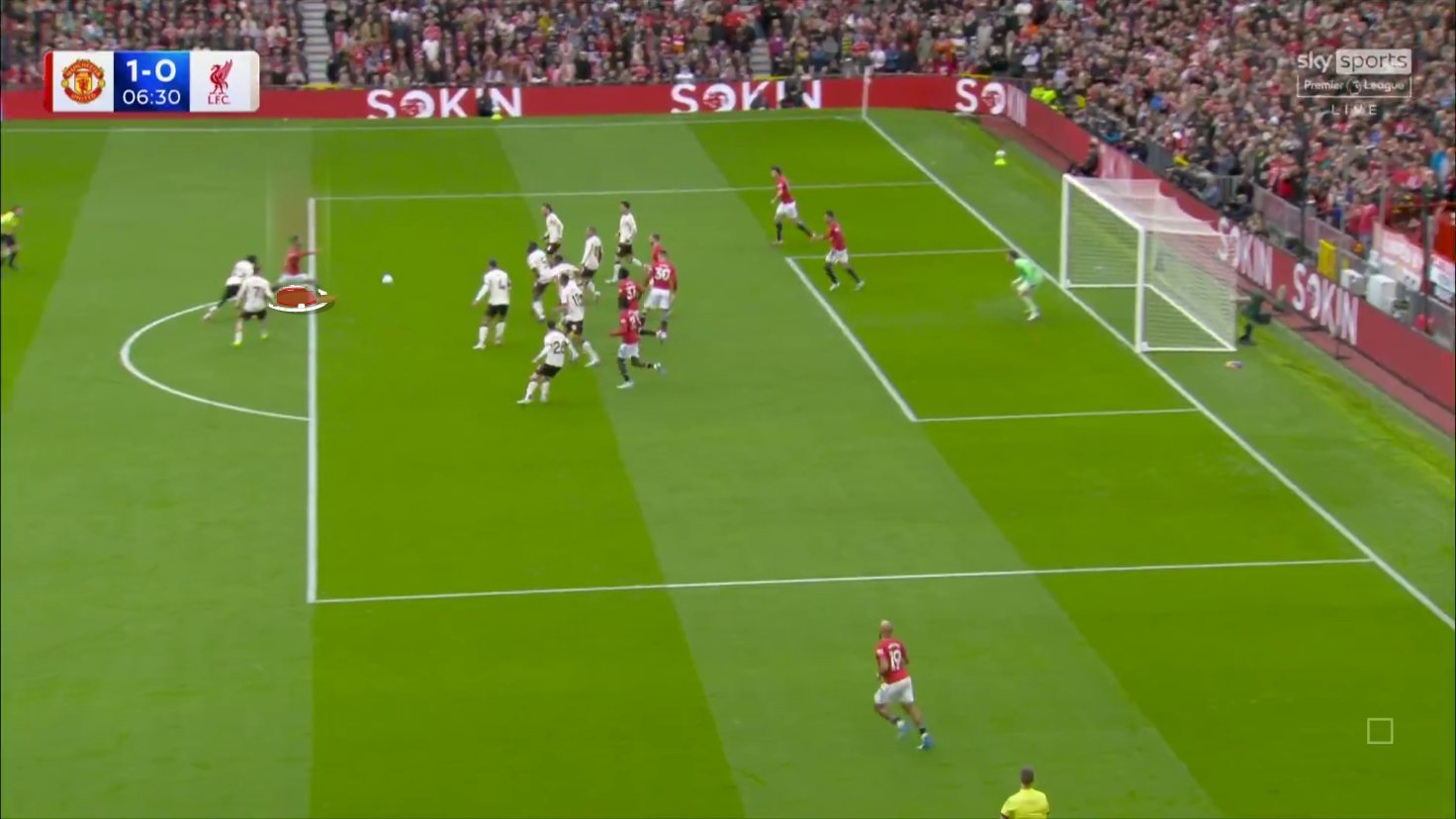
In particular, Manchester United’s first goal action was born from a corner-kick that was not well cleared from Liverpool, which allowed Cunha to win the second ball and shoot on goal.
As the ball was deflected, Cunha won another second ball, and none of the appearing Liverpool players tried to advance to prevent him from shooting again, neither by a sliding tackle to anticipate a potential shot, nor by just running and standing in front of him to make the shot hit the body of that defender.
This absence of concrete defensive reactions to Manchester United’s attempts, and the passive way of dealing with many of the situations created, whether on the wings or inside the final third, was worrying for Liverpool, as it cost them goals and led to numerous dangerous actions conceded.
More importantly, the way Liverpool defended passively to Cunha’s attempt was even more negatively impactful than expected, as Cunha’s shot touched Mac Allister’s body slightly to change its trajectory and further complicate the goalkeeper’s saving attempt.
This means that Mac Allister’s potential advance towards Cunha to prevent the shot, or an attempt at a sliding tackle, would have prevented the shot and avoided helping Cunha score thanks to the deviation.
This goal action confirms Liverpool’s defensive problems, including a lack of communication, a lack of effective defensive leadership, slow defending, passive man-marking, and a lack of intelligent reactions at key moments.
Manchester United Quick & Dangerous Counterattacking
Liverpool’s reaction after conceding the goal was not dangerous, as the absence of a proper striker in their formation made things easier for Manchester United in the defensive phase and allowed them to defend with more numbers, with LFC failing to ensure the needed attacking depth.
Despite better ball circulation and more active possession phases, Liverpool failed to look dangerous against Manchester United’s defence, as there were no planned solutions, only desperate attempts that looked rather improvised.
This paved the way for Manchester United to exploit Liverpool’s period of doubt in both phases and to launch counterattacks to further penalise their weaknesses.
Manchester United tactics looked very dangerous in attacking transitions thanks to their players' accurate, intelligent passing, quick progression with the ball, and well-timed off-the-ball movement from almost all players.
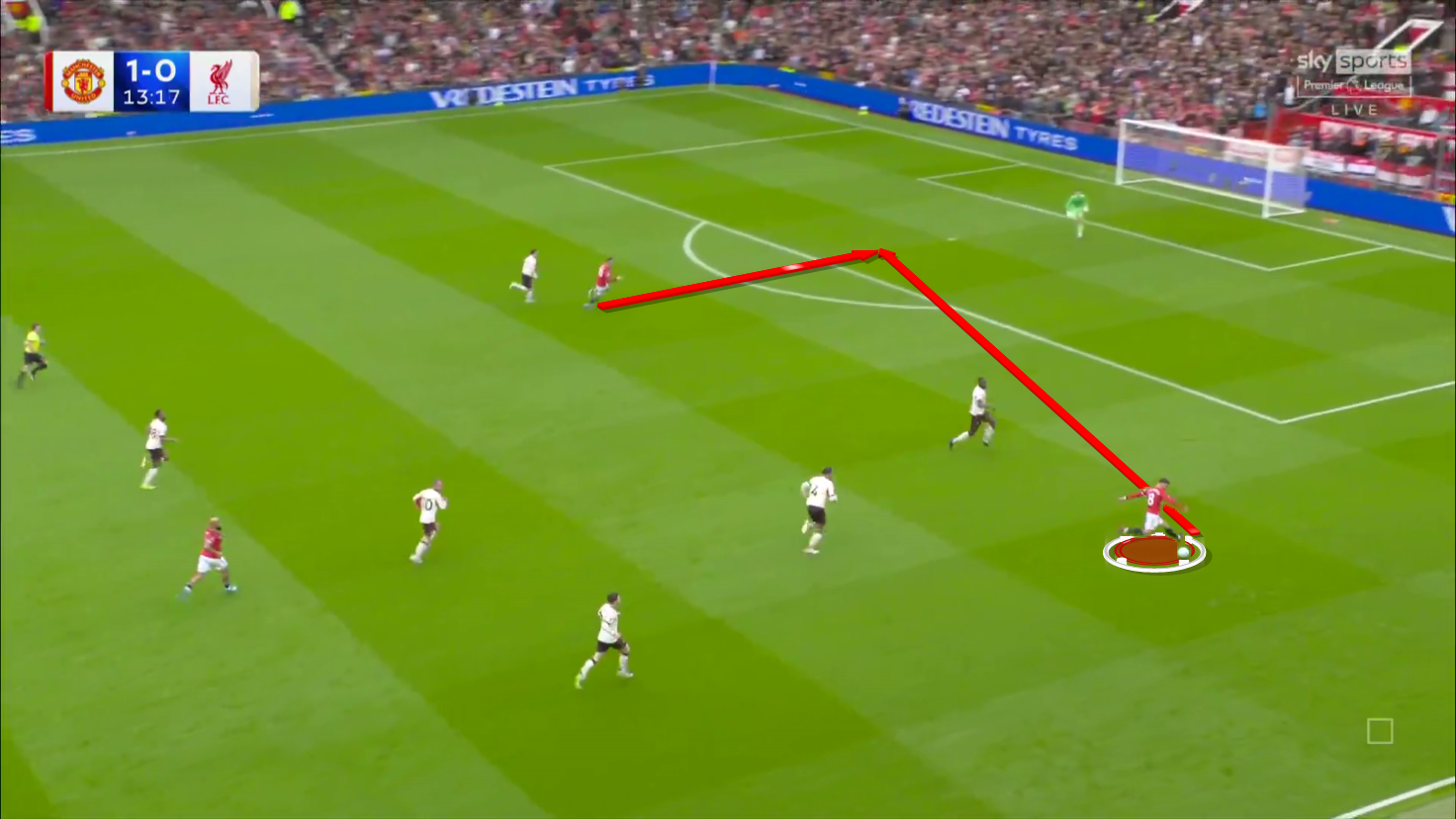
Manchester United’s second goal came from an excellent counterattack that began with a Mainoo interception and a quick passing exchange among Fernandes, Casemiro, and Mbeumo.
The latter’s ability to dribble quickly and avoid his direct marker, while Fernandes made forward movement and asked for the ball in space, helped Manchester United make this attacking transition very smooth.
Mbeumo passed the ball to Fernandes at the right time to break Liverpool’s second defensive line and allow Fernandes to get the opportunity to provide an assist to Šeško, as Fernandes had the space and time to do so.
And once again, Liverpool’s passive defending played a role in making these actions very dangerous, as Konaté left too much space for Fernandes here and was late in marking him tightly.
Fernandes was also intelligent in quickly opting for a through pass towards Šeško’s run, creating a perfect goalscoring possibility for the team’s striker.
Although Šeško failed to convert that pass into a goal due to his poor finishing, he remained focused and well-positioned to receive a header from Fernandes and exploit the goalkeeper’s failed saving attempt to add the second goal.
![Olympique De Marseille Vs PSG [1-2] Ligue 1 2026/2027: How Bruno Génésio Transitions Troubled PSG - Tactical Analysis](https://cdn.mymidnight.blog/77f959f119f4fb2321e9ce801e2f5163/size/w600/2026/09/Marseille-Vs-PSG-2026_2027---Tactical-Analysis.png)
![Fulham Vs Manchester United [1-1] Premier League 2026/2027: How Álvaro Arbeloa Tactics Exposed The Red Devils' Problems - Tactical Analysis](https://cdn.mymidnight.blog/77f959f119f4fb2321e9ce801e2f5163/size/w600/2026/09/Fulham-FC-Vs-Man-United-2026_2027---Tactical-Analysis.png)
![AS Roma Vs Inter Milan [2-2] Serie A 2026/2027: When Undefeated Giallorossi Attack Met Nerazzurri Comeback Resilience - Tactical Analysis](https://cdn.mymidnight.blog/77f959f119f4fb2321e9ce801e2f5163/size/w600/2026/09/AS-Roma-Vs-Inter-Milan-2026_2027---Tactical-Analysis.png)
![Real Sociedad Vs Bournemouth [1-2] Europa League 2026/2027: How Do Marco Rose Pressing Tactics Work? - Tactical Analysis](https://cdn.mymidnight.blog/77f959f119f4fb2321e9ce801e2f5163/size/w600/2026/09/Real-Sociedad-Vs-Bournemouth-20262027---Tactical-Analysis-1.png)
![AC Milan Vs Benfica [0-2] Europa League 2026/2027: How Marco Silva Tactics Exposed Rúben Amorim Defensive Problems - Tactical Analysis](https://cdn.mymidnight.blog/77f959f119f4fb2321e9ce801e2f5163/size/w600/2026/09/AC-Milan-Vs-Benfica-20262027---Tactical-Analysis.png)
![Sunderland Vs AZ Alkmaar [1-0] Europa League 2026/2027: Why The Black Cats Make Better Underdogs - Tactical Analysis](https://cdn.mymidnight.blog/77f959f119f4fb2321e9ce801e2f5163/size/w600/2026/09/Sunderland-Vs-AZ-Alkmaar-20262027---Tactical-Analysis.png)
![Leeds United Vs Newcastle United [4-1] Premier League 2026/2027: Why Did Daniel Farke Tactics Dominate The Magpies? - Tactical Analysis](https://cdn.mymidnight.blog/77f959f119f4fb2321e9ce801e2f5163/size/w600/2026/09/Leeds-United-Vs-Newcastle-2026_2027---Tactical-Analysis.png)
![Real Sociedad Vs Atlético Madrid [0-3] La Liga 2026/2027: How Diego Simeone Tactical Precision Rescued A Late Victory - Tactical Analysis](https://cdn.mymidnight.blog/77f959f119f4fb2321e9ce801e2f5163/size/w600/2026/09/Real-Sociedad-Vs-Atl--tico-Madrid-20262027---Tactical-Analysis-1.png)