How Mikel Arteta Arsenal Tactics Are Reshaping Tactical Landscape Of Premier League 2025/2026 – Data Analysis

The Premier League has increasingly trended towards a more conservative and risk-averse tactical landscape, where structural control is prioritised over attacking spontaneity.
This evolution is closely linked to the growing influence of Mikel Arteta and his 2025/2026 Arsenal side.
After falling short in multiple competitions in previous seasons, often due to defensive lapses and overly aggressive attacking phases, Arteta has recalibrated his approach towards lower tempo circulation, positional discipline, and a strong emphasis on rest defence.
This shift reflects a clear attempt to eliminate volatility and minimise transitional exposure.
In this data analysis, we explore how this adaptation has extended beyond Arsenal, influencing league-wide tactical behaviour, as numerous sides adopt similar structures in a bid for control, ultimately reshaping the Premier League into a more controlled, less vertically dynamic competition.
Arsenal’s Set-Piece Dominance: A Strategic Shift Towards Controlled Efficiency
A defining feature of Mikel Arteta’s 2025/2026 iteration of Arsenal has been the deliberate elevation of set-pieces as a primary attacking weapon, reflecting a broader commitment to controlled, low-variance football.
In a season where dead-ball situations have reached unprecedented prominence across the Premier League, Arsenal have emerged as the most productive side in this phase, registering 19 goals from set-pieces, accounting for roughly 30% of their total output.
Arsenal Goal Distribution 2025/2026 - Open Play Supported By Elite Set-Piece Efficiency
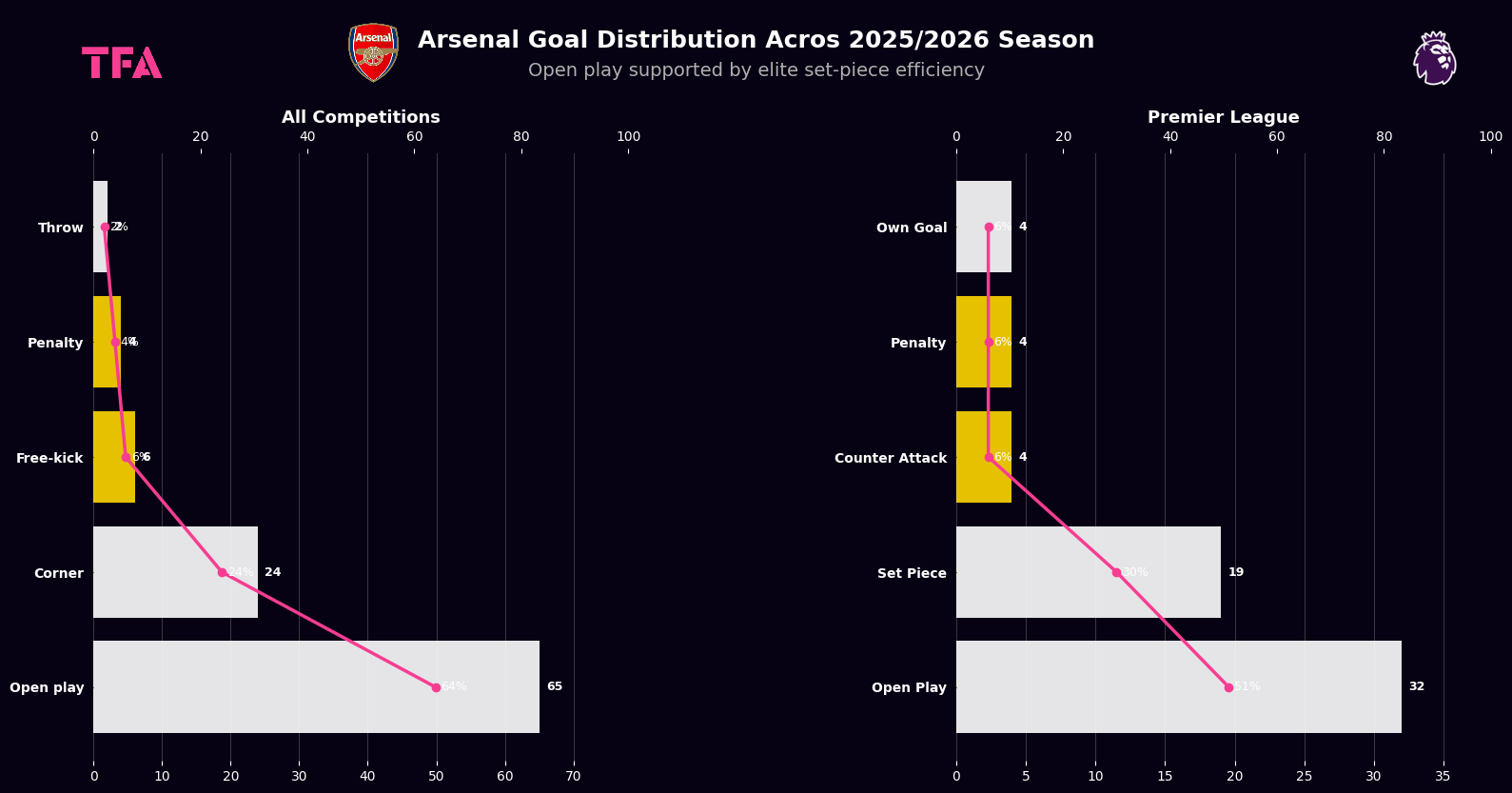
This represents their most efficient return from such situations in recent years and underlines a clear strategic emphasis.
Under the guidance of Arsenal set-piece specialist Nicolas Jover, Arsenal have developed a reputation for structured routines, innovative blocking schemes, and precise delivery mechanisms, allowing them to consistently generate high-quality chances without relying on open-play dynamism.
While open play still accounts for just over half of their goals (51%), the relative share highlights a shift: decisive moments are increasingly manufactured through rehearsed situations rather than fluid attacking sequences.
This trend aligns with Arteta’s broader tactical recalibration towards risk minimisation and territorial control.
By leaning on set-pieces to break deadlocks and close out matches, Arsenal reduce transitional exposure and avoid chaotic game states, reinforcing the report’s central thesis, control, rather than spontaneity, now defines elite performance in the league.
Arsenal’s Offensive Evolution: From Peak Transitional Verticality To Sterile Possession & Controlled Tempo Management
Arsenal’s attacking trajectory across the 2025/2026 season reflects a clear ideological duality within Mikel Arteta’s tactical framework, initially driven by a deliberate pursuit of vertical acceleration and transitional sharpness.
As articulated early in the campaign, “When it comes to chaos, I want to be the best…” Arteta’s ambition was to dominate all game states, including high-tempo transitional phases.
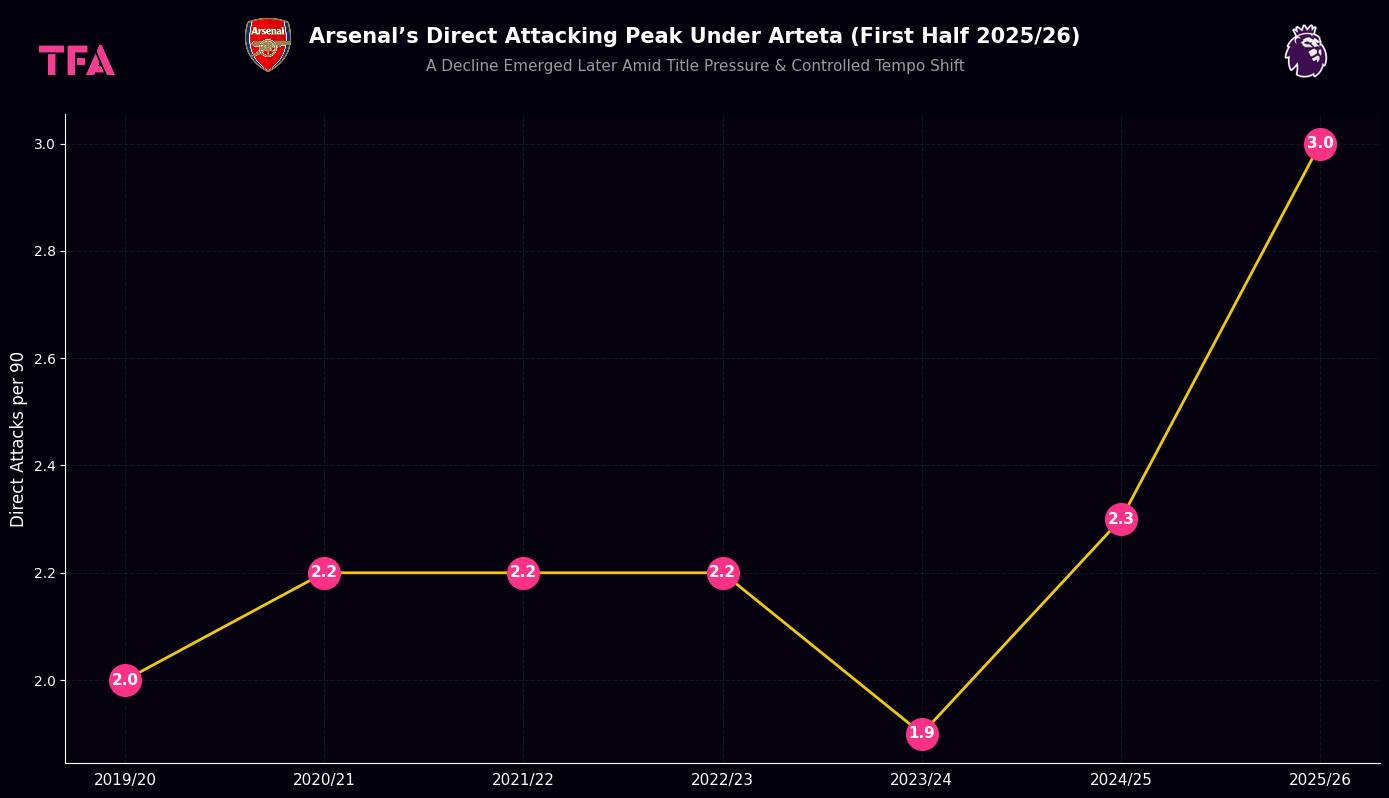
This vision materialised most clearly in January, when Arsenal reached their peak in direct attacking output, recording 3.0 fast transitions per 90 ending in a shot, their highest figure since Arteta’s appointment in 2019.
Arsenal’s Direct Attacking Peak Under Arteta - First Half 2025/2026 Season
These sequences were not merely reactive counters, but structured, pre-conditioned accelerations designed to exploit disorganisation with precision and speed.
However, as the season progressed, contextual pressures, including title race management, accumulated physical load, and the psychological weight of securing a major trophy, triggered a notable recalibration.
By April, Arsenal’s direct attacking frequency had dropped significantly to 1.15 per 90, signalling a shift away from vertical risk towards controlled possession.
Their build-up became increasingly sterile, prioritising circulation security over penetration.
This evolution underscores a pragmatic adaptation, reducing volatility, minimising transitional exposure, and favouring territorial dominance as Arsenal advanced deeper into both domestic and European competitions.
Arsenal’s Attacking Zones: Half-Space Reliance Within A Structured 3-2-4-1 Framework
Arsenal’s attacking structure during the 2025/2026 season has been heavily oriented around half-space occupation, particularly within Arteta’s flexible 3-2-4-1 shape in possession when Riccardo Calafiori moves infield.
Progression is frequently initiated through a dynamic midfield base capable of releasing early vertical passes into the channels, allowing Arsenal to bypass initial pressure and access advanced wide zones before opposition blocks are fully established.
Arsenal Attacking Zone Distribution In Premier League From 2023/2024 To 2025/2026
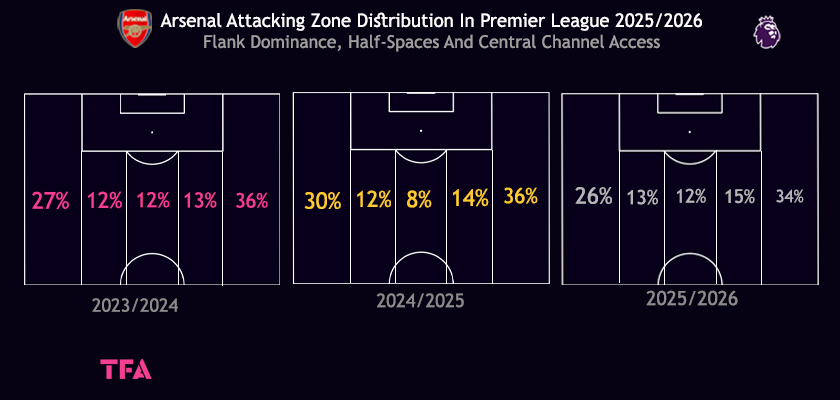
The right flank has remained the primary corridor of progression, accounting for a larger share of final-third entries, with Bukayo Saka operating as the central reference in the right half-space, supported by underlapping and overlapping movements that destabilise defensive lines.
On the opposite side, Gabriel Martinelli and Leandro Trossard provide width and diagonal penetration, while Noni Madueke offers additional isolation quality.
These wide-to-half-space combinations have been Arsenal’s main creative mechanism in open play, even in the absence of Martin Ødegaard, with a significant proportion of chances originating from the right half-space.
This attacking model has recently declined due to reduced individual output from the wingers, particularly Bukayo Saka, whose pre-injury return of just two goals in his last 15 Premier League matches has significantly impacted Arsenal’s overall attacking efficiency in the second half of the season.
Arsenal’s Late-Season Drop-Off: Control Overload & The Cost Of Caution In The Title Run-In
Across the past four Premier League seasons, Arsenal have shown a recurring pattern of strong point accumulation followed by late-stage instability, and the 2025/2026 campaign has reinforced this trajectory.
Arsenal’s Points Trajectory Pattern Across Last Four Campaigns Under Arteta
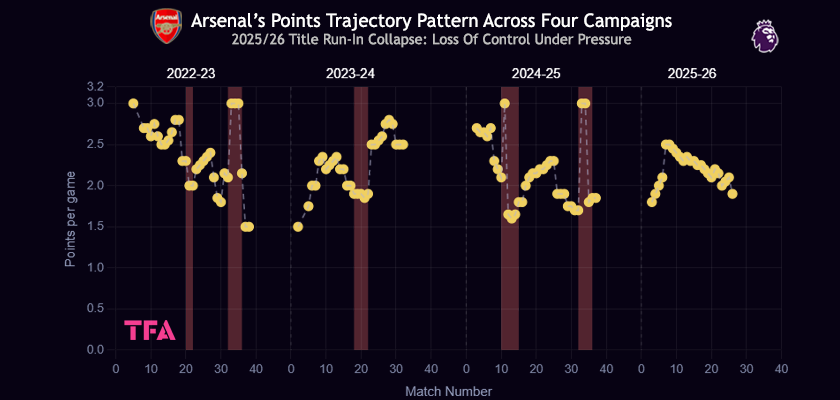
This season, Arteta’s side established early dominance, building a significant lead at the top and, at one stage, extending their advantage to a commanding margin that positioned them as clear favourites for the title.
As the competitive pressure intensified, familiar structural and contextual issues resurfaced.
In the decisive final phase, Arsenal’s output declined sharply, dropping 17 points across their last 13 league matches, a collapse that allowed Manchester City to re-enter the title race with renewed momentum.
Recent results indicate a clear loss of control in outcomes despite maintained structural control in performance, highlighting the limitations of their low-risk approach.
This downturn has been compounded by Bukayo Saka’s injury absence, which disrupted their primary attacking outlet, alongside an increased tactical emphasis on rest defence and game-state management.
The resulting reduction in attacking fluency has contributed to Arsenal dropping critical points in the final matches, ultimately turning a previously controlled title charge into a finely balanced, high-pressure contest once again.
Premier League Man-Oriented Pressing: Arteta’s Influence Or Collective Reaction?
Mikel Arteta has explicitly pointed to a growing structural issue within the Premier League, namely the increasing prevalence of aggressive, man-oriented pressing schemes applied across the full length of the pitch.
His observation reflects a broader tactical shift: opponents are no longer selectively pressing in phases but instead committing to sustained man-to-man engagements that drastically reduce both time and space in possession.
This evolution has had a direct impact on Arsenal’s attacking dynamics throughout the 2025/2026 season, particularly when examined through PPDA metrics.
In matches where the opposition PPDA drops below 10, indicating highly intense pressing, Arsenal consistently encounter significant constraints in build-up progression and final-third execution.
Data from this season highlights several such cases, including fixtures against Brighton (7.12), Tottenham Hotspur (7.24), Wolverhampton Wanderers (9.81), and Manchester United (8.20), where opponents applied relentless pressure and limited Arsenal’s ability to sustain controlled circulation.
Arsenal PPDA Dynamics Vs Sub-10 Aggressive Opponents - Premier League 2025/2026
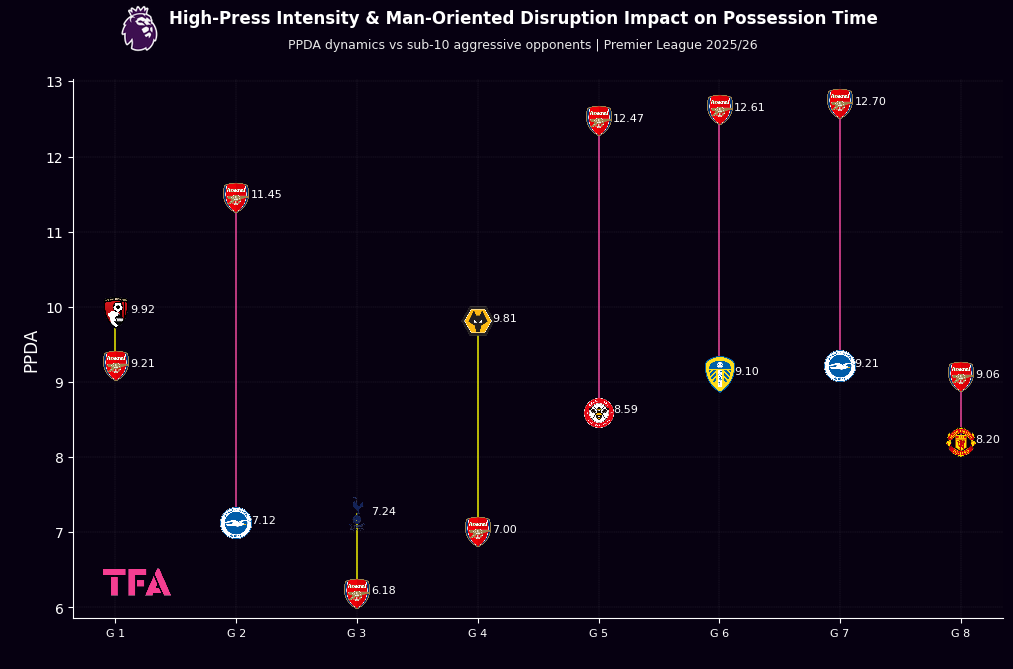
The consequence of this league-wide adoption is a form of structural compression: attacking phases become increasingly sterile, not solely because of Arsenal’s own risk-averse adjustments, but because opponents deny the temporal and spatial conditions required for fluid combination play.