
![Bayern Munich Vs Real Madrid [4-3] – Champions League 2025/2026: Why Vincent Kompany Tactics Progressed – Tactical Analysis](https://cdn.mymidnight.blog/77f959f119f4fb2321e9ce801e2f5163/size/w1000/2026/04/FC-Bayern-Vs-Real-Madrid-20252026.png)
Bayern Munich Vs Real Madrid [4-3] – Champions League 2025/2026: Why Vincent Kompany Tactics Progressed – Tactical Analysis

After a successful first leg away at the Santiago Bernabéu, Bayern Munich hosted Real Madrid at the Allianz Arena for the second leg of the 2025/2026 edition of the UEFA Champions League quarter-final.
The Bavarians won 4-3 (6-4 on aggregate) in a dramatic contest that saw an early mistake by Manuel Neuer kick-start the scoring, with Madrid leading 3-2 at half-time.
The second half saw Vincent Kompany tactics in full control as Bayern Munich style of play grabbed two late goals to seal their ticket to a Champions League semi-final vs PSG.
In this Bayern Munich Vs Real Madrid tactical analysis, we aim to highlight how both halves played out from Bayern Munich’s perspective, as well as their strengths and areas of struggle.
Bayern Munich Vs Real Madrid Lineups & Formations
Let us look at how Vincent Kompany and Álvaro Arbeloa fielded their squads.
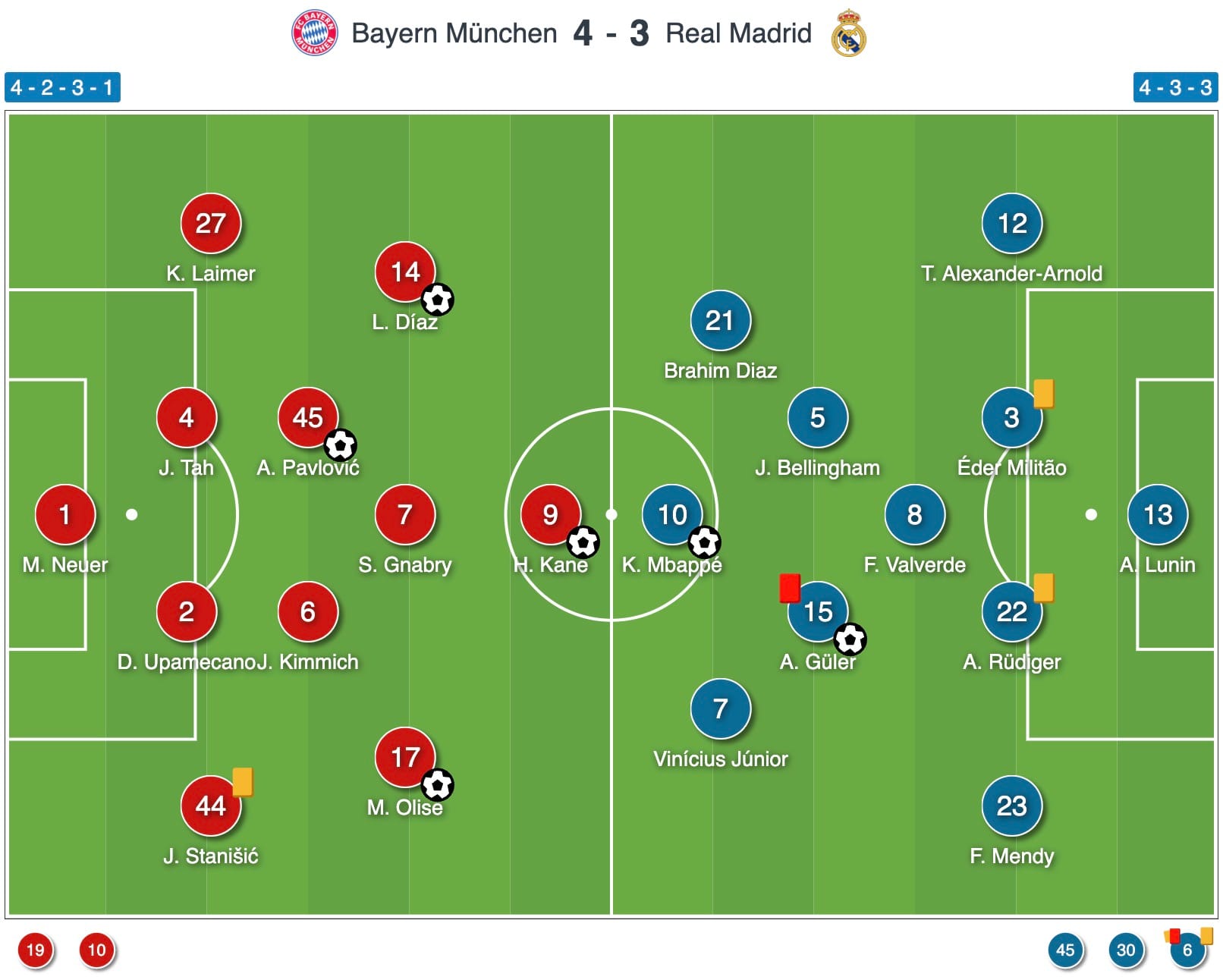
Bayern Munich Lineup Vs Real Madrid
The hosts, FC Bayern, played in a 4-2-3-1 formation.
Skipper Manuel Neuer started in goal.
The back four were Josip Stanišić (right-back), Dayot Upamecano (right centre-back), Jonathan Tah (left centre-back), and Konrad Laimer (left-back).
Stanišić was replaced by Alphonso Davies in the 46th minute.
Joshua Kimmich and Aleksandar Pavlović played as the double pivot.
Michael Olise (right) and Luis Díaz (left) played as the wingers; Serge Gnabry operated as the attacking midfielder right behind striker Harry Kane.
Jamal Musiala came on for Gnabry at the 61st minute.
Real Madrid Lineup Vs Bayern
The visitors, Real Madrid, lined up in a 4-3-3 formation under Álvaro Arbeloa tactics.
Andriy Lunin started between the sticks, behind a back four of Trent Alexander-Arnold (right-back), Éder Militão (right centre-back), Antonio Rüdiger (left centre-back), and Ferland Mendy (left-back).
Thiago Pitarch replaced Alexander-Arnold in the 90th minute.
Skipper Federico Valverde, Jude Bellingham, and Arda Güler were the midfield three.
The latter was replaced by Franco Mastantuono (90’).
Brahim Díaz (right) and Vinicius Júnior (left) were the wingers.
The former was replaced by Eduardo Camavinga (62’).
Kylian Mbappé played as the striker.
Bayern Munich Weaknesses Vs Real Madrid
The game started with Neuer’s unforced error: the German misplaced a pass in the defensive third, attempting to play it wide when pressed on his stronger side.
Arda Güler took no time to find the back of the net upon intercepting the pass.
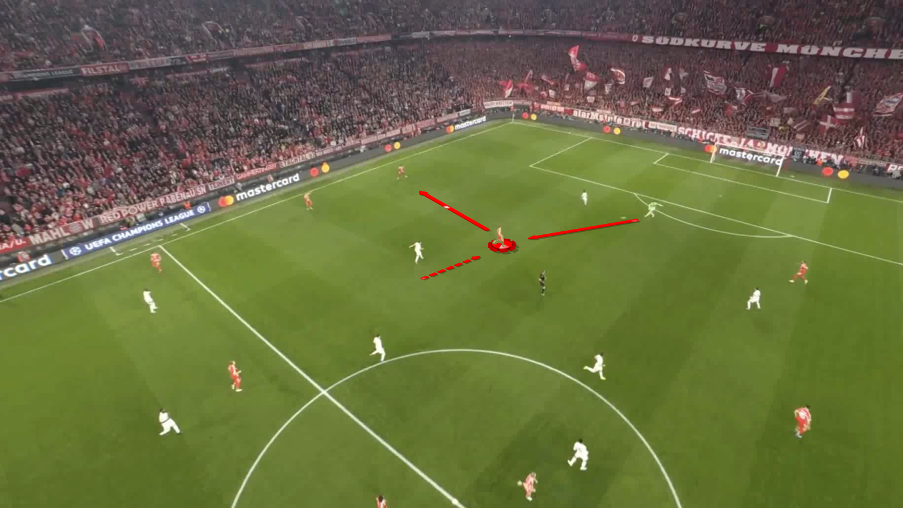
A simple solution could have been to find Kimmich, who had enough time and separation to find the wide pass.
In this scenario, playing it long is always acceptable, which is what he attempted to do for the next few minutes after this error.
An open transitional game is the best-case scenario for a side like Real Madrid; the first half had more of these moments.
A key reason for this was getting easy access to the space behind Bayern’s pressure.
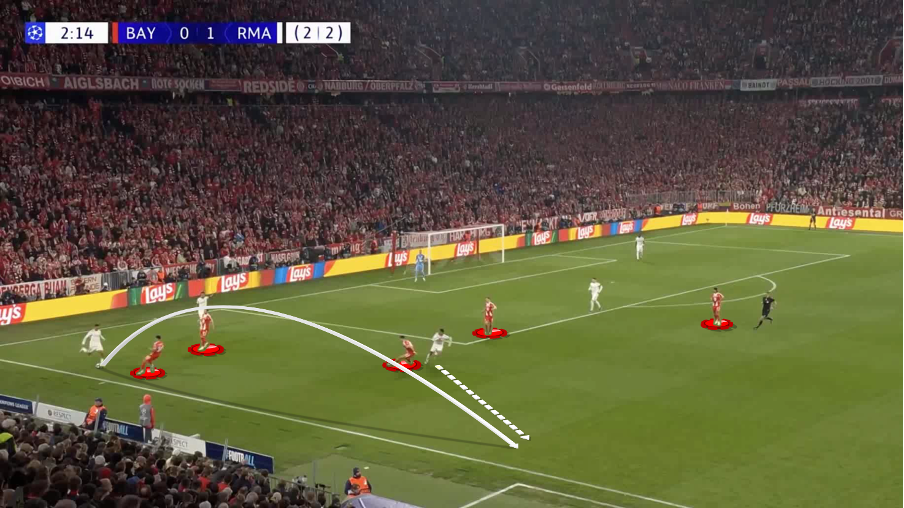
Bayern pressed with numbers; however, during the first half, Madrid were clever not to force short passes in build-up.
They targeted runners to receive chipped passes behind the first wave of pressure, which usually comprised about five players.
By progressing in this manner, they were quick to make final-third entries; most of their progressions came either from fast breakaways or from direct play in build-up.
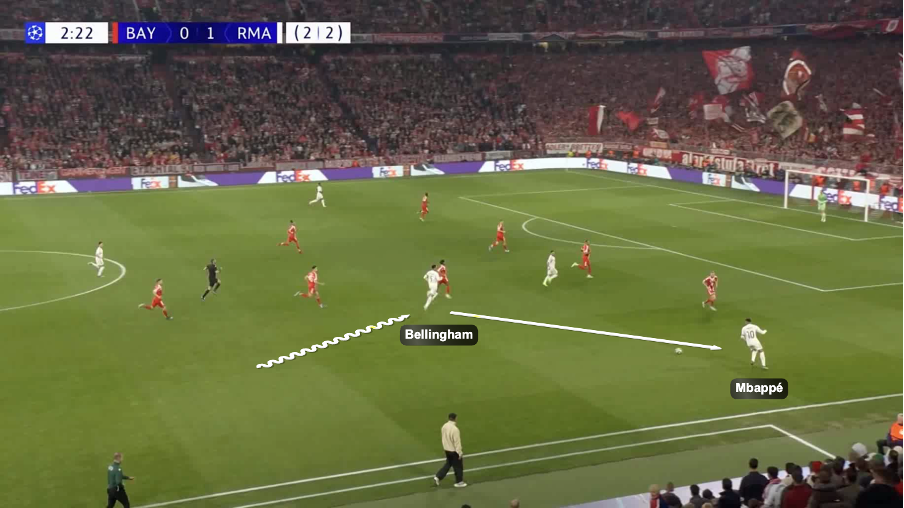
Madrid’s players, namely Bellingham, Güler, and Brahim Díaz, made progressive carries to eventually hand the ball to either Vinícius or Mbappé, who peeled wide to get on the ball more often.
Here, the Frenchman receives the ball from Bellingham in the wide channel.
From these positions, he either looked to link up and move infield or take on isolated defenders.
With the number of attacks rising, Bayern faced struggles in negative transition, especially when their centre-backs were isolated in a 1v1 against Vinícius or Mbappé.
![Celta Vigo Vs Juventus [1-2] Europa League 2026/2027: How The Old Lady Escaped With A Late Comeback Despite Predictable Attacking Play - Tactical Analysis](https://cdn.mymidnight.blog/77f959f119f4fb2321e9ce801e2f5163/size/w600/2026/10/Celta-Vigo-Vs-Juventus---Tactical-Analysis.png)
![Villarreal Vs Napoli [3-1] Champions League 2026/2027: How Iñigo Pérez Tactics Exploited Massimiliano Allegri Mistakes - Tactical Analysis](https://cdn.mymidnight.blog/77f959f119f4fb2321e9ce801e2f5163/size/w600/2026/10/Villarreal-Vs-Napoli---Tactical-Analysis.png)
![Manchester City Vs PSG [2-4] Champions League 2026/2027: How Luis Enrique Tactics Controlled The Key Moments - Tactical Analysis](https://cdn.mymidnight.blog/77f959f119f4fb2321e9ce801e2f5163/size/w600/2026/10/Manchester-City-Vs-PSG---Tactical-Analysis.png)
![Borussia Dortmund Vs Werder Bremen [2-2] Bundesliga 2026/2027: How Daniel Thioune Tactics Earned A Late Comeback With 29% Possession - Tactical Analysis](https://cdn.mymidnight.blog/77f959f119f4fb2321e9ce801e2f5163/size/w600/2026/10/Borussia-Dortmund-vs-Werder-Bremen---Tactical-Analysis.png)