
![England Vs Argentina [1–2] – FIFA World Cup 2026: How Thomas Tuchel Tactics Lost Control – Tactical Analysis](https://cdn.mymidnight.blog/77f959f119f4fb2321e9ce801e2f5163/size/w1000/2026/07/England-Vs-Argentina--World-Cup-2026-1.png)
England Vs Argentina [1–2] – FIFA World Cup 2026: How Thomas Tuchel Tactics Lost Control – Tactical Analysis
England faced Argentina in the 2026 FIFA World Cup semi-finals, and the match represented another tense battle that will be remembered by football fans for years to come. The match saw Argentina making a historic comeback against England after going a goal down.

England Vs Argentina World Cup 2026 Match Overview
England faced Argentina in the 2026 FIFA World Cup semi-finals, and the match represented another tense battle that will be remembered by football fans for years to come.
The match saw Argentina making a historic comeback against England after going a goal down.
Lionel Scaloni’s men scored two goals late in the game to book their place in the World Cup Final against Spain.
Argentina’s journey in this World Cup has already been outstanding, and promises to become historic if they succeed in lifting the trophy.
They had hard-fought wins and comebacks against all of Cape Verde, Egypt, Switzerland, and now England, showing why they are the defending champions.
On the other hand, England’s dream of lifting the World Cup has once again turned into a nightmare as Thomas Tuchel’s team failed to protect their lead and did not manage their advantage well.
England missed the chance of reaching the final and will therefore play against France for the third spot.
In this World Cup tactical analysis, we look at the reasons for England’s loss and how Argentina succeeded in completing their comeback.
England Vs Argentina Lineups & Formations
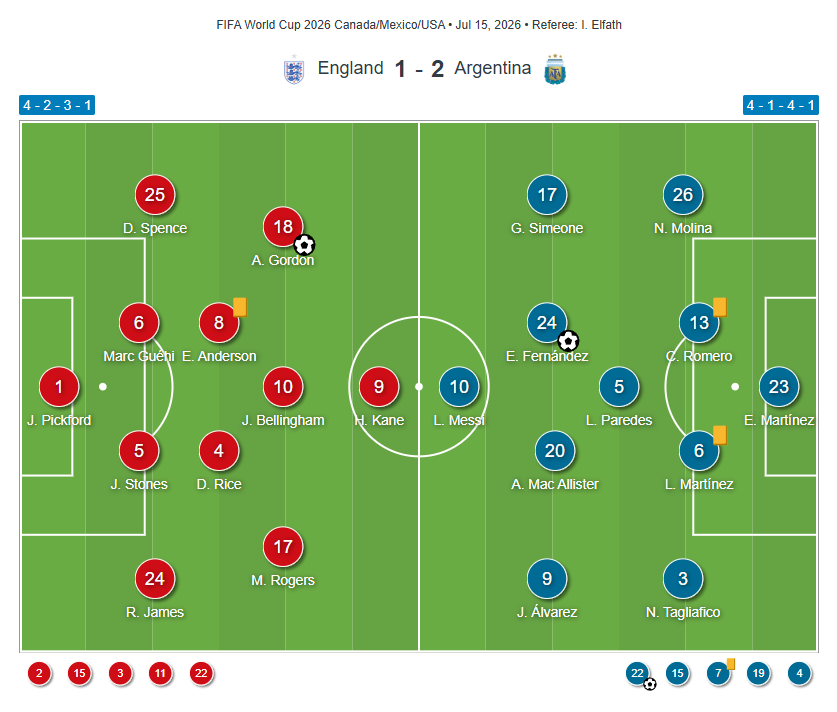
England Lineup Vs Argentina
Tuchel started the match using the 4-2-3-1 formation with Jordan Pickford as a goalkeeper, and a back-four defence made up of Reece James as a right-back, John Stones and Marc Guéhi as centre-backs, and Djed Spence as a left-back.
The midfield was composed of Declan Rice and Elliot Anderson as central midfielders, Jude Bellingham as an advanced playmaker, with Anthony Gordon and Morgan Rogers on the wings, and Harry Kane as the centre-forward.
Argentina Lineup Vs England
For Argentina, Scaloni used a 4-1-4-1 formation with Emiliano Martínez as a goalkeeper, and a defensive line made up of Cristian Romero and Lisandro Martínez as centre-backs, Nahuel Molina as a right-back, and Nicolás Tagliafico as a left-back.
The midfield was composed of Leandro Paredes as a defensive midfielder, with Enzo Fernández and Alexis Mac Allister as central midfielders, Julián Alvarez and Giuliano Simeone as wingers, and Lionel Messi as the centre-forward.
Argentina High Defending & Aggressive Defensive Plan
Argentina started the match in an aggressive and highly physical way, as they wanted to provoke England and turn the match into a physical battle, a type of game that suits the Argentinian team.
The use of several powerful midfield players in addition to Simeone, who is a winger known for his disciplined, consistent, and aggressive defensive contribution, consolidates the idea of trying to prevent England from building up attacks or advancing with ease.
Committing fouls and pushing England’s players to get angry and avoid duels was Argentina’s plan to defend against England in midfield, and therefore avoid defending against England inside their own third.
Scaloni was aware of the fact that defending against England inside his team’s own third would eventually lead to goals conceded, as England are known for exploiting crosses very well and have some reliable shooting from distance abilities too.
Also, what made Scaloni resort to this plan was his awareness of the team’s struggles in the defensive line, and especially in aerial duels.
Therefore, it was more useful for Argentina to defend high against England, even if that obliged the Argentinians to play a very physical game and commit a lot of fouls, as that was part of the plan.
England Playmaking Plans & Issues Suffered Against Argentina Defensive Approach
It is true that England were able to advance through the wings on more than one occasion, relying on the work of Rogers/James and Gorodon/Spence using overlaps, accelerations, and trying to cross towards the box or cutting inside to the box.
These plans were relatively dangerous but did not make a difference for England, as Argentina predicted such plans and applied double marking and sometimes triple marking on the ball holder on both wings.
This led England’s wingers and full-backs to try dribbling past more than one player each time they wanted to cross or penetrate towards the box.
In terms of duels, Argentina’s double marking made the difference and their aggressive style of defending paid off during such situations that required well-timed interceptions and exceptional defensive decision-making, too.
Furthermore, it was complicated for England to advance through the middle as Bellingham was tightly marked even when he retreated to midfield.
Being unable to make his usual dangerous penetrations with the ball due to Argentina’s interceptions of the ball from him and the fact that they also committed fouls on him to prevent him from accelerating towards the final third made England unable to reach the box and Harry Kane easily.
This created a gap between the team’s midfield and attacking line, as it was complicated to unlock spaces within or behind Argentina’s defensive line, too.
At the same time, England’s build-up solutions were predictable to Argentina, and we saw Argentina’s players anticipating Pickford’s passing destinations and using that to launch counterattacks from high recoveries.
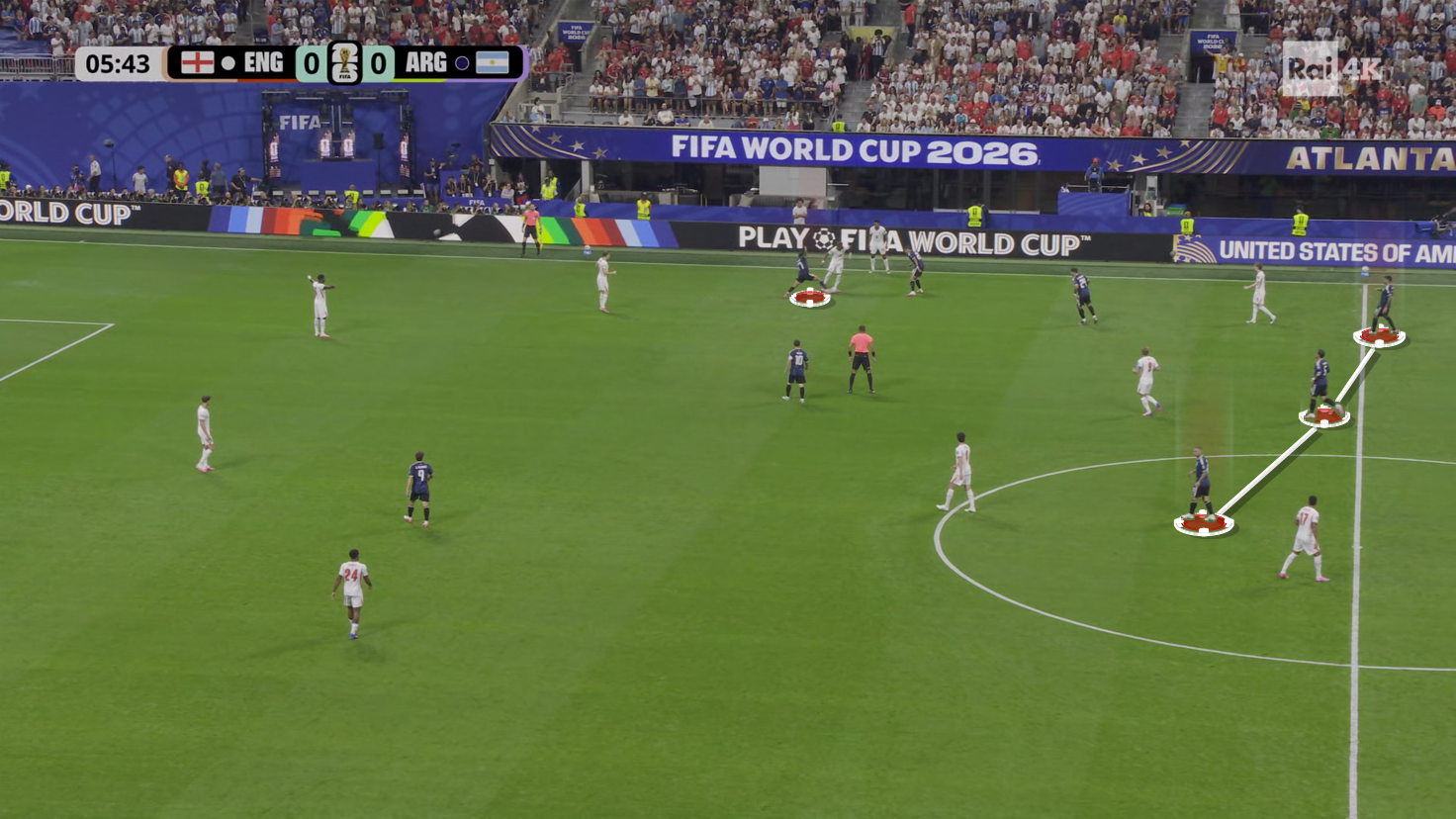
The following video shows one of these valuable recoveries made by Argentina, mainly because Argentina looked a bit more active in their high pressing, as they also showed that they have studied England’s build-up passing preferences well enough to predict them right more than once.
In this particular action, Romero predicted Pickford’s potential pass to Bellingham and was quick enough to anticipate the Real Madrid midfielder, creating an excellent situation for all of Messi, Alvarez, and Fernández, who were all inside England’s own third.
The three players failed in dealing well enough with this situation, as Messi did not notice Fernández’s run behind him and intercepted Alvarez’s pass, which was destined for Fernández.
The lack of understanding in this action prevented Argentina from scoring a goal on that occasion, as Fernández was completely unmarked when he was about to receive that key pass.
![Villarreal Vs Napoli [3-1] Champions League 2026/2027: How Iñigo Pérez Tactics Exploited Massimiliano Allegri Mistakes - Tactical Analysis](https://cdn.mymidnight.blog/77f959f119f4fb2321e9ce801e2f5163/size/w600/2026/10/Villarreal-Vs-Napoli---Tactical-Analysis.png)
![Manchester City Vs PSG [2-4] Champions League 2026/2027: How Luis Enrique Tactics Controlled The Key Moments - Tactical Analysis](https://cdn.mymidnight.blog/77f959f119f4fb2321e9ce801e2f5163/size/w600/2026/10/Manchester-City-Vs-PSG---Tactical-Analysis.png)
![Borussia Dortmund Vs Werder Bremen [2-2] Bundesliga 2026/2027: How Daniel Thioune Tactics Earned A Late Comeback With 29% Possession - Tactical Analysis](https://cdn.mymidnight.blog/77f959f119f4fb2321e9ce801e2f5163/size/w600/2026/10/Borussia-Dortmund-vs-Werder-Bremen---Tactical-Analysis.png)
![Croatia Vs Spain [1-2] UEFA Nations League 2026/2027: How Slaven Bilić High Pressing Tactics Troubled Spain - Tactical Analysis](https://cdn.mymidnight.blog/77f959f119f4fb2321e9ce801e2f5163/size/w600/2026/10/Croatia-Vs-Spain--1-2--UEFA-Nations-League-20262027---Tactical-Analysis.png)
![Scotland Vs Switzerland [0-3] UEFA Nations League 2026/2027: How Aggressive Pressing Backfired & Murat Yakin Took Advantage - Tactical Analysis](https://cdn.mymidnight.blog/77f959f119f4fb2321e9ce801e2f5163/size/w600/2026/10/Scotland-Vs-Switzerland-20262027---Tactical-Analysis.png)
![Olympique De Marseille Vs PSG [1-2] Ligue 1 2026/2027: How Bruno Génésio Transitions Troubled PSG - Tactical Analysis](https://cdn.mymidnight.blog/77f959f119f4fb2321e9ce801e2f5163/size/w600/2026/09/Marseille-Vs-PSG-2026_2027---Tactical-Analysis.png)
![Fulham Vs Manchester United [1-1] Premier League 2026/2027: How Álvaro Arbeloa Tactics Exposed The Red Devils' Problems - Tactical Analysis](https://cdn.mymidnight.blog/77f959f119f4fb2321e9ce801e2f5163/size/w600/2026/09/Fulham-FC-Vs-Man-United-2026_2027---Tactical-Analysis.png)