Roberto Martínez Tactics At Portugal 2026: Why Did The World Cup Project Fail & What Will Jorge Jesus Change? – Tactical Analysis
Portugal entered the 2026 FIFA World Cup as one of the tournament favourites after an impressive three-year spell under Roberto Martínez tactics, which included a perfect UEFA Euro 2024 qualifying campaign and victory in the 2024/2025 UEFA Nations League.

What Happened To Portugal At The 2026 World Cup?
Portugal entered the 2026 FIFA World Cup as one of the tournament favourites after an impressive three-year spell under Roberto Martínez tactics, which included a perfect UEFA Euro 2024 qualifying campaign and victory in the 2024/2025 UEFA Nations League.
However, expectations were not met when Seleção das Quinas were eliminated by Spain in the Round of 16.
The disappointing World Cup campaign brought Martínez's tenure to an end.
Portugal's early exit from the 2026 FIFA World Cup was not the result of a single tactical mistake but of a series of structural issues that became increasingly evident throughout the tournament.
This World Cup tactical analysis deconstructs the key operational breakdowns in Martínez's tactics, from squad utilisation and player management to the build-up phase, attacking patterns in the final third, and defensive transitions.
Portugal Squad Management & Player Utilisation
One of the main areas of analysis during Portugal's 2026 FIFA World Cup campaign was Martínez's squad utilisation.
With arguably one of the most talented squads in the tournament, Portugal possessed elite options across all positions.
However, questions emerged regarding whether the selection choices, player roles and distribution of minutes allowed the team to maximise its potential.
The players who carried the heaviest workload throughout the tournament were Diogo Costa and Renato Veiga, who played every minute of Portugal’s World Cup campaign.
The goalkeeper and the centre-back accumulated the maximum possible playing time, completing 518 minutes.
Cristiano Ronaldo was also one of the most heavily utilised players, accumulating 490 minutes and remaining a central figure in Portugal’s attacking structure.
In contrast, several players didn't receive any playing time despite being part of the squad.
Goalkeepers José Sá and Rui Silva, centre-back Gonçalo Inácio, and forward Gonçalo Guedes remained unused throughout the tournament, raising questions about squad rotation.
One of the most debated decisions of Portugal’s World Cup campaign was the limited utilisation of Gonçalo Ramos.
Despite being a 2025/2026 UEFA Champions League winner with Paris Saint-Germain and one of the most in-form attacking options in the squad, the forward played only 58 minutes and still scored an important goal against Croatia off the bench.
Many questioned whether Portugal could have benefited from giving him more opportunities, especially considering his movement, intensity and ability to attack space.
Ronaldo’s importance to the national team was never in doubt, and he still finished as Portugal’s top scorer with three goals.
However, there was debate over whether his minutes should have been managed more carefully, particularly in matches such as Uzbekistan, where Portugal led 3–0 at half-time and could have reduced his workload while giving more playing time to Ramos, Guedes or Francisco Trincão.
Bruno Fernandes and Bernardo Silva were also part of the discussion.
Fernandes arrived off the back of an excellent 2025/2026 Premier League season with Manchester United, but appeared affected by the physical demands of a long campaign.
Silva, expected by many to be one of Portugal’s key players due to his quality and experience, played only 133 minutes, raising further questions about whether Martínez fully utilised the talent available in the squad.
Ultimately, the criticism was not about the lack of quality in Portugal’s squad, but whether Martínez found the right balance between experience, freshness and tactical flexibility.
Roberto Martínez Tactics
High Build-Up
Portugal consistently built from the back using a positional structure that placed several players in front of the opposition's first pressing line, most frequently with Vitinha, Fernandes or João Neves dropping to receive from the centre-backs.
Vitinha, in particular, became the focal point of the build-up, often dropping so deep that he almost took the ball directly from the centre-backs' feet before initiating the attack.
By positioning him so deep, Portugal relied on one of their most creative midfielders primarily as a build-up facilitator rather than allowing him to influence the final third, where his vision and passing ability could create decisive opportunities.
However, this structure often created an unintended consequence.
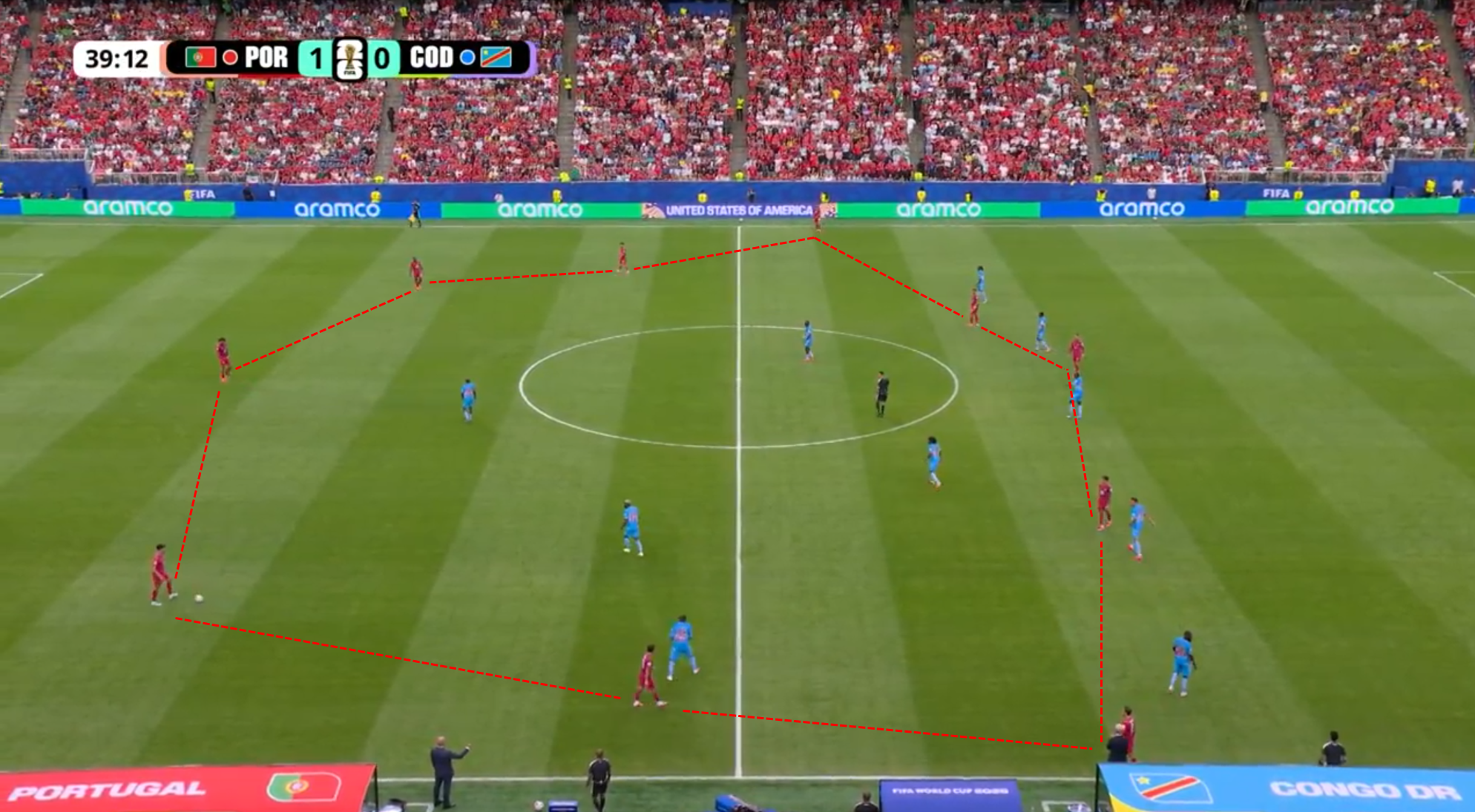
By positioning multiple players in front of the first line of pressure, Portugal frequently lacked players occupying the spaces between the opposition's midfield and defensive lines.
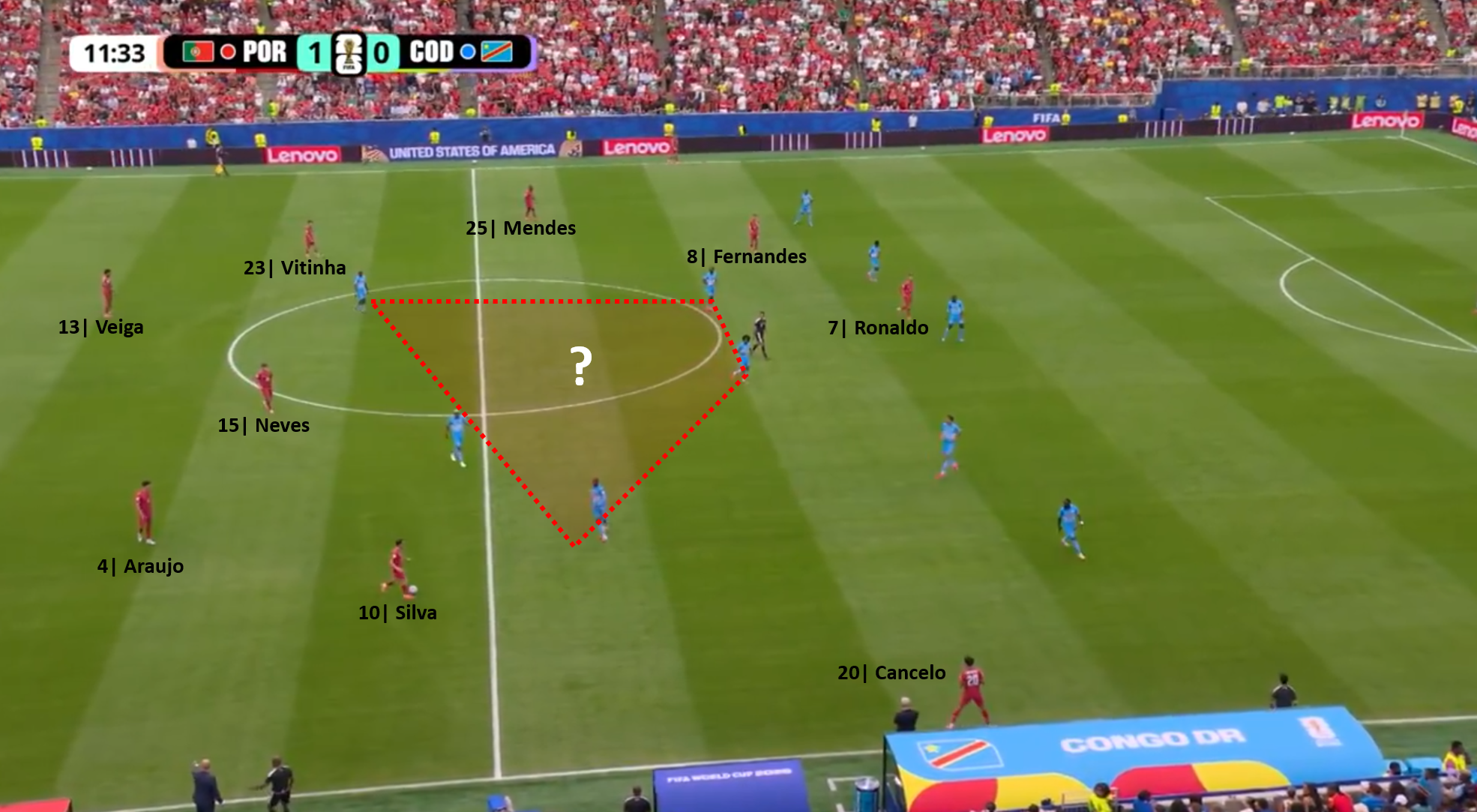
At times, the team's positional structure resembled a 'doughnut build-up': players occupied the outside of the structure while the central space remained empty, leaving no player available to receive between the lines and turn towards goal.
As a result, possession circulated around the opposition rather than through it.