
![Como Vs Inter Milan [3–4] – Serie A 2025/2026: Cesc Fàbregas' Attacking Masterclass Meets Defensive Frailty – Tactical Analysis](https://cdn.mymidnight.blog/77f959f119f4fb2321e9ce801e2f5163/size/w1000/2026/04/Como-Vs--Inter-Milan-20252026.png)
Como Vs Inter Milan [3–4] – Serie A 2025/2026: Cesc Fàbregas' Attacking Masterclass Meets Defensive Frailty – Tactical Analysis

Como hosted Inter Milan at the San Siro in Gameweek 32 of Serie A, and they came very close to beating I Nerazzurri, only to concede four soon after and finish the match with a painful 3-4 loss.
The loss complicates things for Cesc Fàbregas's Como regarding their UEFA Champions League qualification hopes, but they remain in the race for those top-four spots and, more importantly, in a place that qualifies them for a European competition.
On the other hand, Inter Milan succeeded in passing the complicated Como test after struggling to keep up with their powerful attacking tactics.
Winning this match brings Inter Milan much closer to the Serie A title, as they are now just a few points away, with Napoli and AC Milan remaining distant from the top spot.
In this tactical analysis article, we look at Como’s attacking ideas, how they scored twice against Inter Milan in the first half, and why they failed to protect their lead in the end.
Como Vs Inter Milan Lineups & Formations
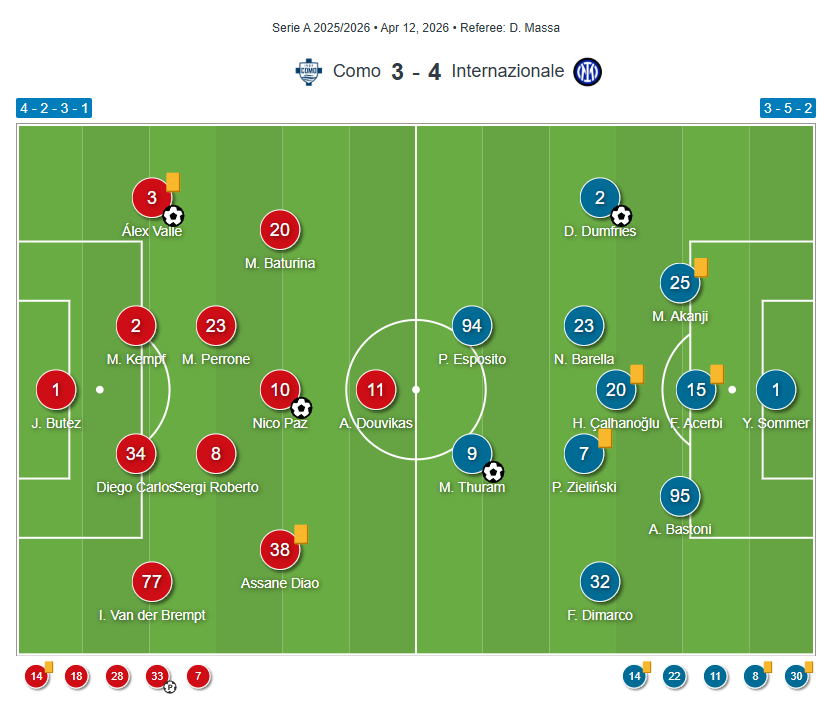
Cesc Fàbregas started the match in a 4-2-3-1 formation, with Jean Butez as the goalkeeper, Marc-Oliver Kempf and Diego Carlos as centre-backs, Ignace Van der Brempt as a right-back, and Álex Valle as a left-back.
The midfield comprised Sergi Roberto and Máximo Perrone as central midfielders, with Martin Baturina and Assane Diao as wingers, Nico Paz as the advanced playmaker, and Anastasios Douvikas as the team’s main striker.
On the other hand, Cristian Chivu lined his team up in their usual 3-5-2 formation, with Yann Sommer occupying his usual spot in goal behind the centre-backs Alessandro Bastoni, Manuel Akanji, and Francesco Acerbi.
Denzel Dumfries and Federico Dimarco started as the two wing-backs, while the midfield was made up of Nicolò Barella, Hakan Çalhanoğlu, and Piotr Zieliński.
Up front, Pio Esposito and Marcus Thuram started as the two strikers.
Como Outstanding Attacking Performance Vs Inter Milan Maturity
The match started with high intensity, as both teams were capable of attacking well and penetrating each other’s defensive lines: Inter Milan through vertical passing directed in behind the opposing defensive line, and Como through quick short passes and penetrations from the middle, towards Inter Milan’s final third.
Como were even more dangerous than Inter Milan during the opening minutes as they reached Inter Milan’s penalty box more frequently and got close to scoring.
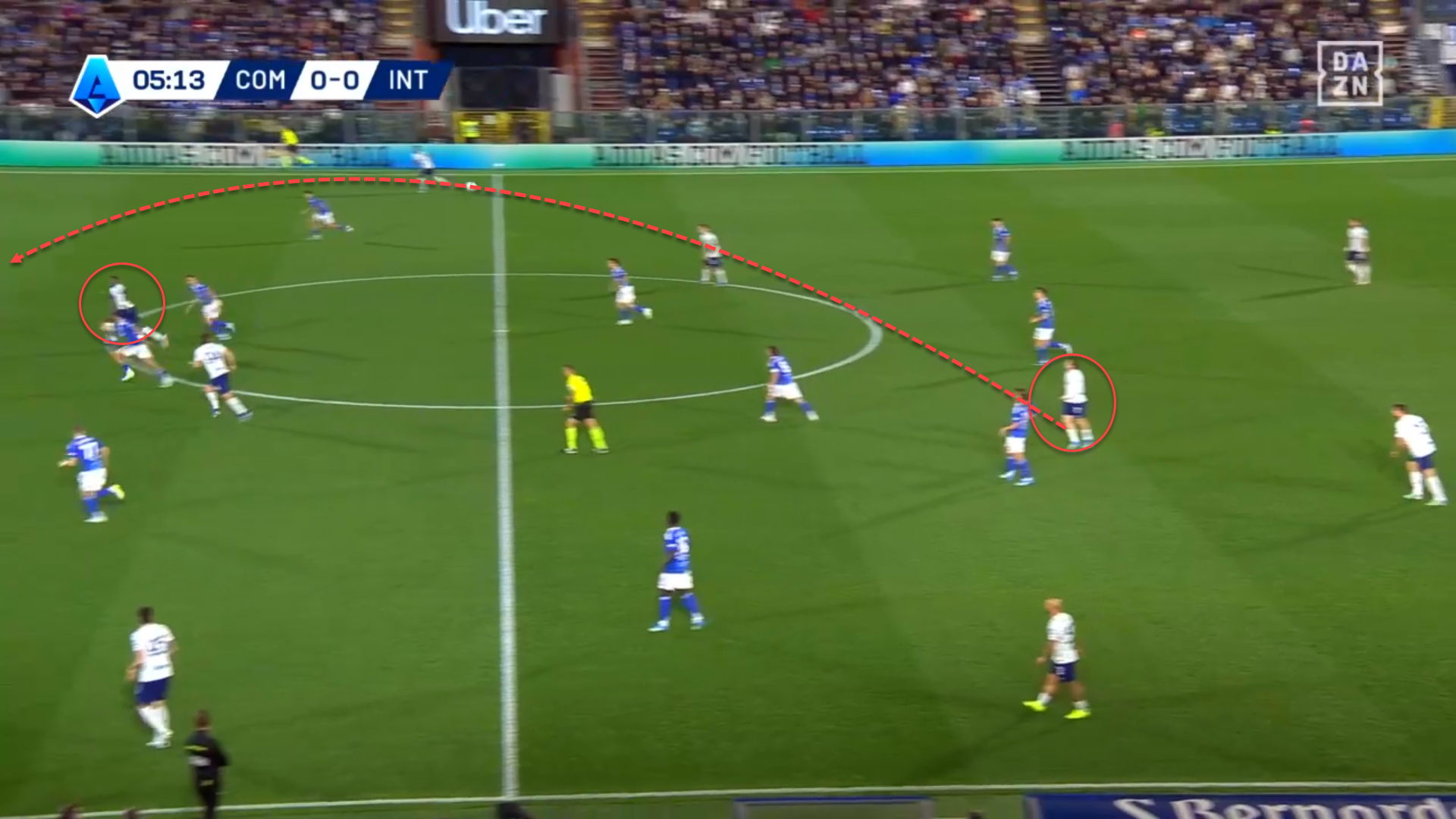
Inter Milan’s solution to counter Como’s possession phases and high-pressing system was to surprise their advanced defensive line with vertical passes, high or low.
We saw this strategy repeated more than once, especially during the opening minutes of the match, with Thuram always positioning himself in suitable spots and trying to escape marking to exploit the spaces behind that defensive line.
Inter Milan's Reliance On Vertical Passing To Break Como's High Defensive Line
Both Akanji and Zieliński were able to serve Thuram with through passes and long passes.
Zieliński was excellent in spotting Thuram’s intelligent movement towards the back of Como’s defensive line and serving him at the right moment.
However, Thuram was unable to beat the goalkeeper in the duel, as the latter went out of his zone and cleared the ball.
Thuram lacked reactivity in these situations and did not believe in his ability to win the duel against the goalkeeper.
Inter's finishing and decision-making after receiving such through passes and long passes towards the back of Como’s defensive line were not very successful in the first part of the match, and that’s mainly what prevented them from scoring early.
The game remained balanced for much of the first half, with both Inter Milan and Como trying to exploit advancing defensive lines, but without any clear-cut opportunities.
Despite creative movements without the ball from Paz and the fact that he received passes between the lines, the Argentinian international failed to provide accurate final key passes to follow the forward movements and penetrations of Baturina and, especially, Douvikas.
This failure to exploit the spaces left at the back of Inter Milan’s defensive line was Como’s main issue in this match.
They were unable to deal well with the situations they were able to create in attack, despite succeeding in advancing more often and keeping possession until reaching Inter Milan’s penalty area.
What enabled Como to create numerous attacking actions and have more possession in Inter Milan’s final third was their effective high recoveries and ability to use a high-pressing system, which led Inter Milan’s players to lose the ball before reaching Como’s half on many occasions.
This helped Como a lot in limiting Inter Milan’s possession in their half, thereby avoiding retreating to defend in their own half and passively conceding Inter Milan’s possession and attacks.
Como’s approach was therefore positive, but the problem was that Como were unable to finish their attacks with real threats to the Nerazzurri goal.
Como intensified their high press and recoveries as the game progressed; they became more threatening to Inter Milan’s defence, mainly thanks to their very courageous attitude and approach to the match.
Thinking about advancing and playing an attacking match against Inter Milan while relying on quick possession and avoiding losing time in the build-up from the back was efficient, as it did not allow Inter Milan to organise their defensive line well after losing the ball.
This led to identifying spaces and half-spaces where Como’s attacking players moved well without the ball, to occupy at the right time and provide key passing solutions.
Como Attacking & Progressive Style Of Play Vs Inter Milan
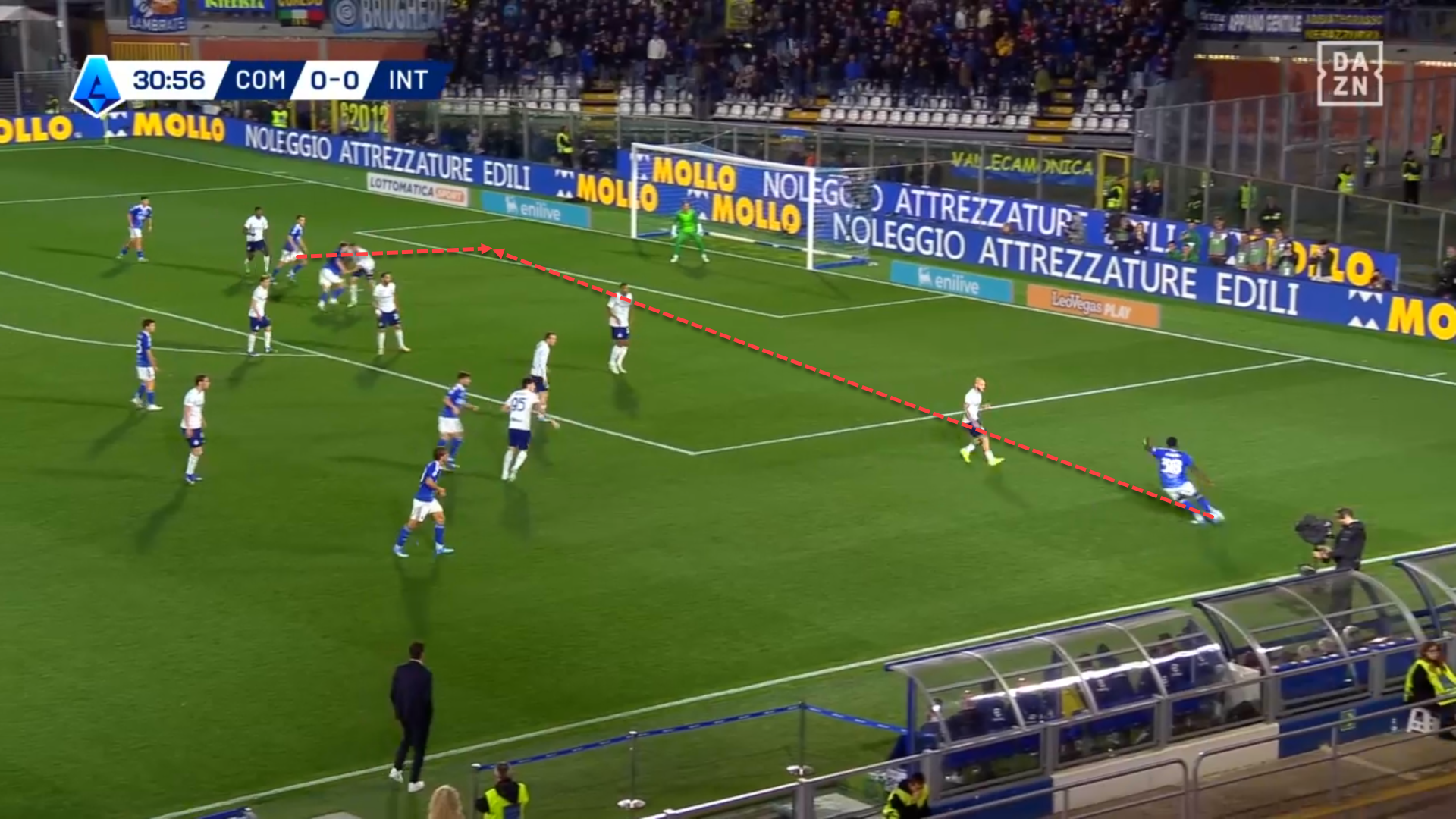
One of the key actions that highlighted this playing system and how it disrupted Inter Milan’s organisation occurred in the 30th minute, when the goalkeeper did not waste time in the build-up from the back and was able to launch a quick attack thanks to a first-time through pass to the right wing.
Having the reflexes, vision, and awareness to launch a quick attack illustrates how this whole team works with the same mentality, including the goalkeeper.
The latter was reactive enough to accelerate Como’s potential attack with one pass towards Diao, which made Como reach Inter Milan’s half very quickly.
Diao then exploited the spaces he found on the right wing and advanced quickly before dribbling towards the middle, circulating the ball with Perrone, Paz, and Baturina, who were very dynamic and continued moving to provide passing options each time.
Diao received a pass towards the right wing and launched a through pass in the form of a cross with a first-time touch to surprise Inter Milan’s defence, but Douvikas’ goalscoring attempt was blocked by Dumfries, who was attentive enough in his man-marking of the striker.
Furthermore, Perrone had the advantage on the second ball and was able to anticipate his direct marker and shoot, but his shot hit his teammate, before Valle won the third ball but failed to score as his shot was also deflected thanks to Dumfries’s crucial sliding deviation.
The action confirms Como's attacking mentality and sheds light on their inability to finish with the same quality as their playmaking, which prevents this team from becoming even more powerful, especially against top sides.
On the other hand, Inter Milan’s crucial interceptions and deflections highlight their attentive and decisive defensive approach, as Inter Milan’s defenders resisted Como’s recurrent attacks and prevented them from scoring, thanks mainly to their strict man-marking and ability to anticipate Como’s shooting decisions.
![Borussia Dortmund Vs Werder Bremen [2-2] Bundesliga 2026/2027: How Daniel Thioune Tactics Earned A Late Comeback With 29% Possession - Tactical Analysis](https://cdn.mymidnight.blog/77f959f119f4fb2321e9ce801e2f5163/size/w600/2026/10/Borussia-Dortmund-vs-Werder-Bremen---Tactical-Analysis.png)
![Croatia Vs Spain [1-2] UEFA Nations League 2026/2027: How Slaven Bilić High Pressing Tactics Troubled Spain - Tactical Analysis](https://cdn.mymidnight.blog/77f959f119f4fb2321e9ce801e2f5163/size/w600/2026/10/Croatia-Vs-Spain--1-2--UEFA-Nations-League-20262027---Tactical-Analysis.png)

![Scotland Vs Switzerland [0-3] UEFA Nations League 2026/2027: How Aggressive Pressing Backfired & Murat Yakin Took Advantage - Tactical Analysis](https://cdn.mymidnight.blog/77f959f119f4fb2321e9ce801e2f5163/size/w600/2026/10/Scotland-Vs-Switzerland-20262027---Tactical-Analysis.png)
![Olympique De Marseille Vs PSG [1-2] Ligue 1 2026/2027: How Bruno Génésio Transitions Troubled PSG - Tactical Analysis](https://cdn.mymidnight.blog/77f959f119f4fb2321e9ce801e2f5163/size/w600/2026/09/Marseille-Vs-PSG-2026_2027---Tactical-Analysis.png)
![Fulham Vs Manchester United [1-1] Premier League 2026/2027: How Álvaro Arbeloa Tactics Exposed The Red Devils' Problems - Tactical Analysis](https://cdn.mymidnight.blog/77f959f119f4fb2321e9ce801e2f5163/size/w600/2026/09/Fulham-FC-Vs-Man-United-2026_2027---Tactical-Analysis.png)
![AS Roma Vs Inter Milan [2-2] Serie A 2026/2027: When Undefeated Giallorossi Attack Met Nerazzurri Comeback Resilience - Tactical Analysis](https://cdn.mymidnight.blog/77f959f119f4fb2321e9ce801e2f5163/size/w600/2026/09/AS-Roma-Vs-Inter-Milan-2026_2027---Tactical-Analysis.png)
![Real Sociedad Vs Bournemouth [1-2] Europa League 2026/2027: How Do Marco Rose Pressing Tactics Work? - Tactical Analysis](https://cdn.mymidnight.blog/77f959f119f4fb2321e9ce801e2f5163/size/w600/2026/09/Real-Sociedad-Vs-Bournemouth-20262027---Tactical-Analysis-1.png)