
Cristian Chivu Tactics At Inter Milan 2025/2026: From PSG Collapse To Historic Double – Tactical Analysis

Following the departure of Simone Inzaghi to Al-Hilal, Cristian Chivu took charge of Inter Milan during a difficult period.
The humiliating 5-0 defeat to Paris Saint-Germain in the UEFA Champions League Final and losing the Scudetto to rivals Napoli on the final day of the 2024/2025 season had shattered morale within the squad.
A member of Inter’s 2010 treble-winning side under José Mourinho, Chivu arrived needing an immediate rebuild.
In this tactical analysis, we take a look at Chivu's tactical and set-piece ideas that have guided Inter to a historic double.
Inter Milan Formations & Key Players 2025/2026
Chivu initially introduced a 3-4-1-2 system at Inter Milan, but disappointing performances at the Club World Cup prompted a return to the more familiar 3-5-2 system used under Simone Inzaghi.
Chivu retained the core of Inzaghi’s squad, with Lautaro Martínez enjoying another prolific campaign and emerging as a leading contender for the Capocannoniere award.
Injuries to Lautaro and Marcus Thuram opened the door for Sebastiano Pio Esposito, who developed into one of the revelations of the season.
Petar Sučić proved an effective replacement for Henrikh Mkhitaryan, while injuries to Denzel Dumfries allowed Carlos Augusto and Luis Henrique to gain valuable minutes.
In defence, Benjamin Pavard was replaced by former Manchester City defender Manuel Akanji.
Inter Milan In-Possession Tactics
Inter often build in a 4-2-4 shape (as seen in Figure 1) with a heavy emphasis on fluidity and positional rotations.
The deep-lying playmaker, usually Hakan Çalhanoğlu, drops into the defensive line to help form a back three during the initial build-up phase.
This movement allows Alessandro Bastoni to push wider and operate almost as an auxiliary left-back, while Manuel Akanji remains a right-back.
The structure gives wing-backs Federico Dimarco and Denzel Dumfries the freedom to advance aggressively and occupy positions similar to wide forwards high up the pitch.
Ahead of them, Nicolò Barella and Sučić operate as a double pivot tasked with facilitating central progression.
However, Inter’s build-up is far from rigid.
There are very few fixed positions within the back six, as players constantly rotate to destabilise opposition marking schemes.
At times, one of the central defenders will step into midfield while Barella or Sučić temporarily drops into the vacated defensive slot.
These exchanges are designed to confuse markers, disrupt pressing references and create new passing angles during circulation.
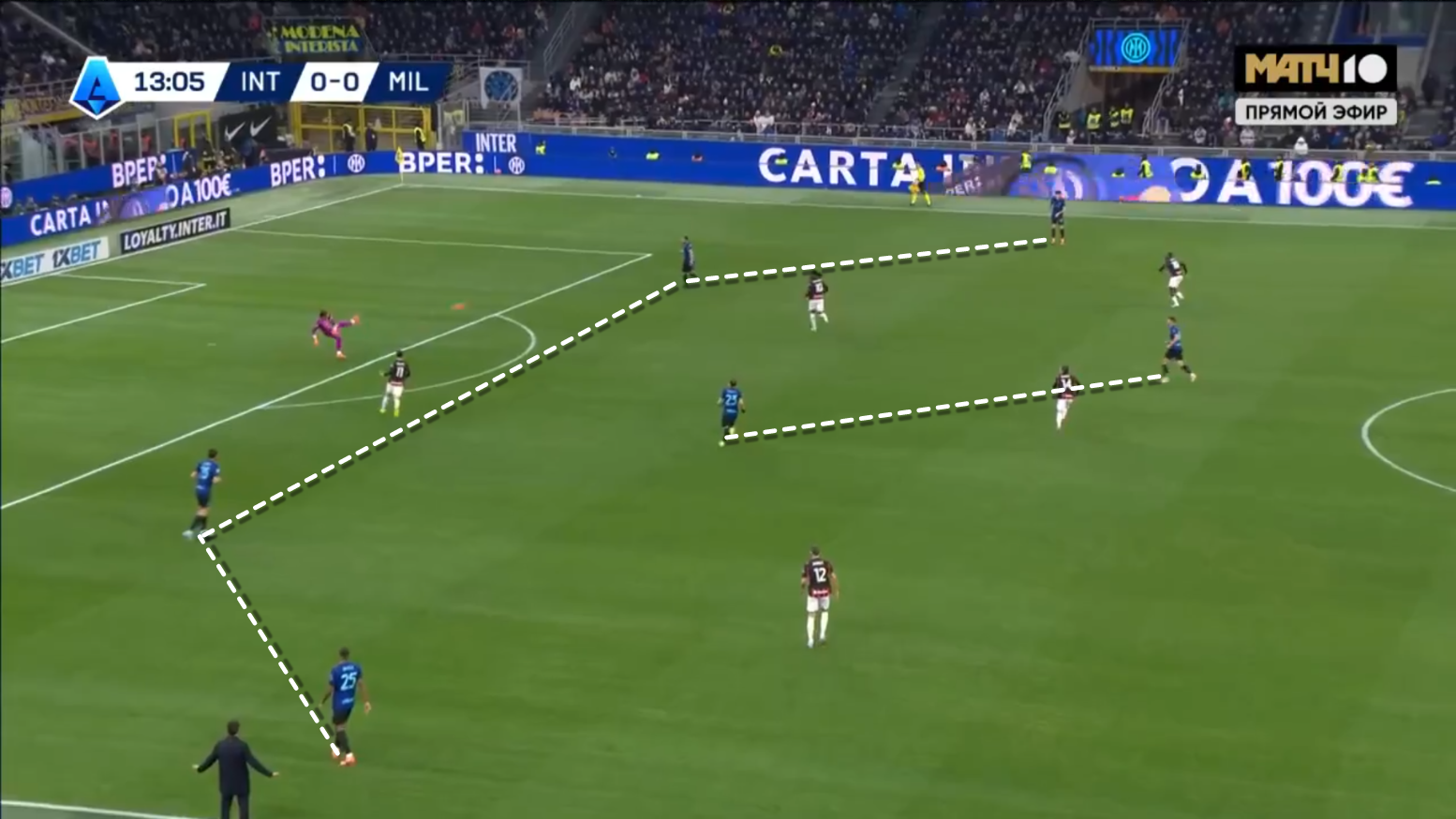
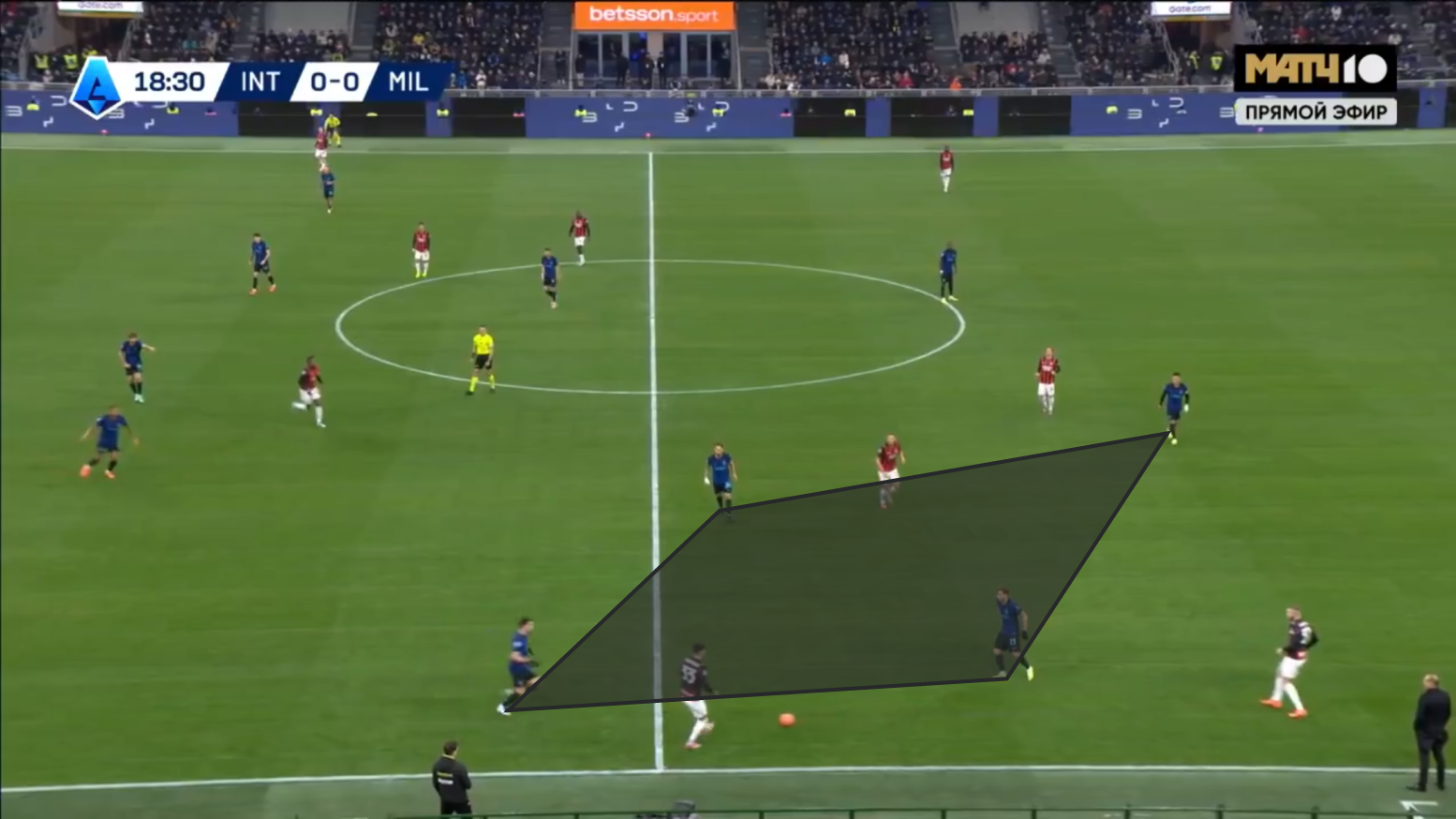
When pressed high, Inter frequently form passing diamonds in deeper zones to create numerical superiority around the ball, as seen in Figure 2.
Their rotations and spacing allow them to escape pressure through short combinations and quick positional exchanges.
Another recurring strategy involves deliberately baiting opposition forwards into pressing aggressively, which in turn opens spaces between the first and second defensive lines.
Once these gaps appear, Inter look to progress vertically through midfield and attack the exposed central spaces before the opposition can recover their shape.
If the midfield double pivot becomes overloaded centrally, Inter are comfortable shifting towards a wider build-up structure.
In these situations, they utilise passing-around-the-corner combinations to bypass pressure and progress play down the flanks.
The wing-backs become crucial outlets in these sequences, particularly due to their advanced positioning and ability to receive the ball on the move in open space.
In the attacking phase, Thuram remains high to pin opposition central defenders and stretch the last line horizontally.
Meanwhile, Lautaro regularly drops into deeper zones to connect play and create pockets of space between midfield and defence.
His movements force defenders into difficult decisions, as stepping out to follow him can leave gaps for runners beyond the defensive line.
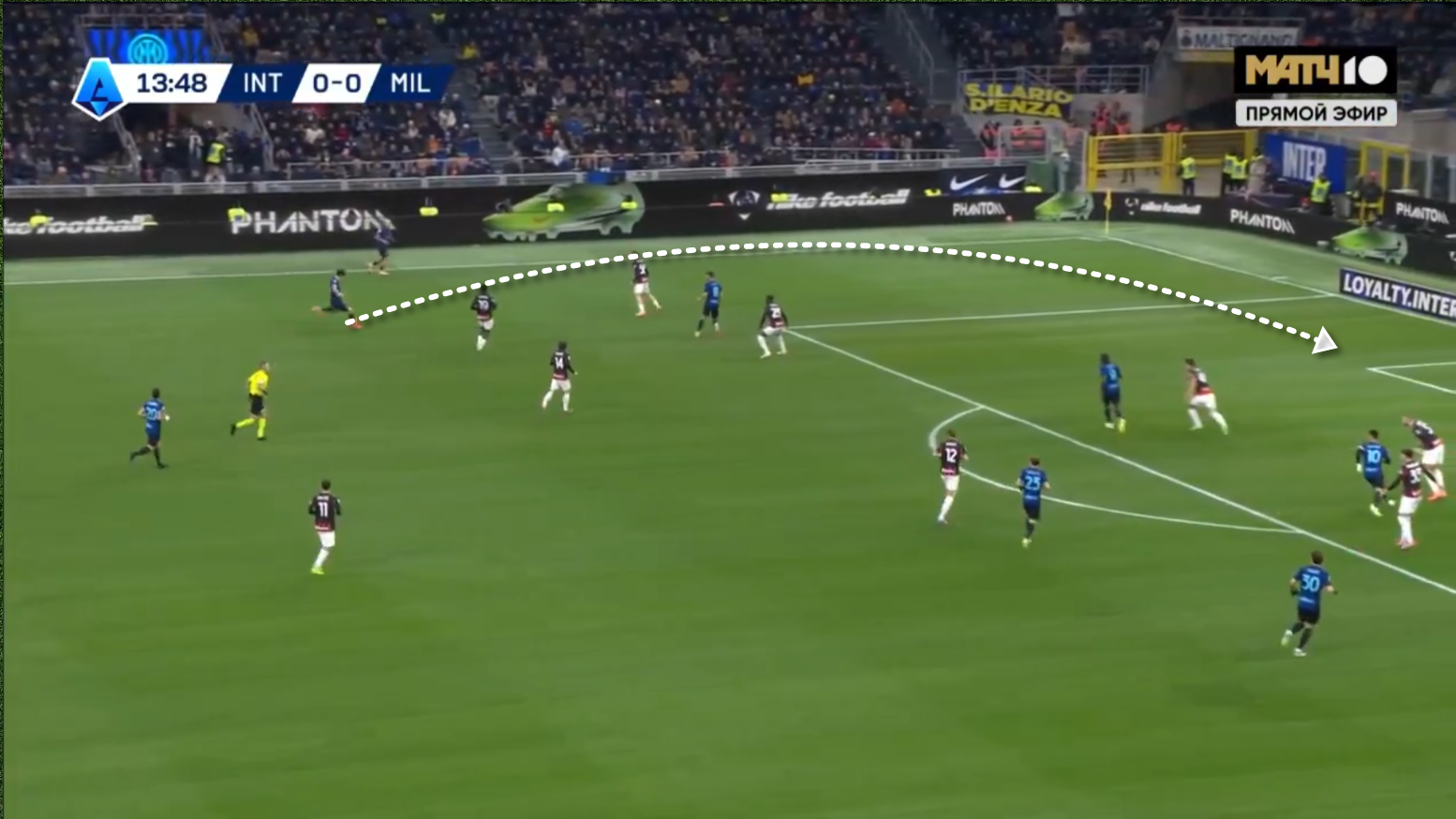
Inter also look to exploit early crossing situations, as seen in Figure 3, particularly through Dimarco, whose delivery from advanced wide areas is one of the side’s most dangerous weapons.
These early crosses are intended to catch the defence off guard before they can fully organise themselves inside the penalty area.
Out-of-possession transitions are also carefully managed under Cristian Chivu.
Whenever the opposition regains possession and attempts to sustain attacks inside Inter’s half, Chivu often positions one of his 'eights' higher up the pitch as an immediate outlet for counterattacks.
This provides Inter with a vertical threat during defensive phases and ensures they can quickly break forward once possession is recovered.
Inter Milan Out-Of-Possession Tactics
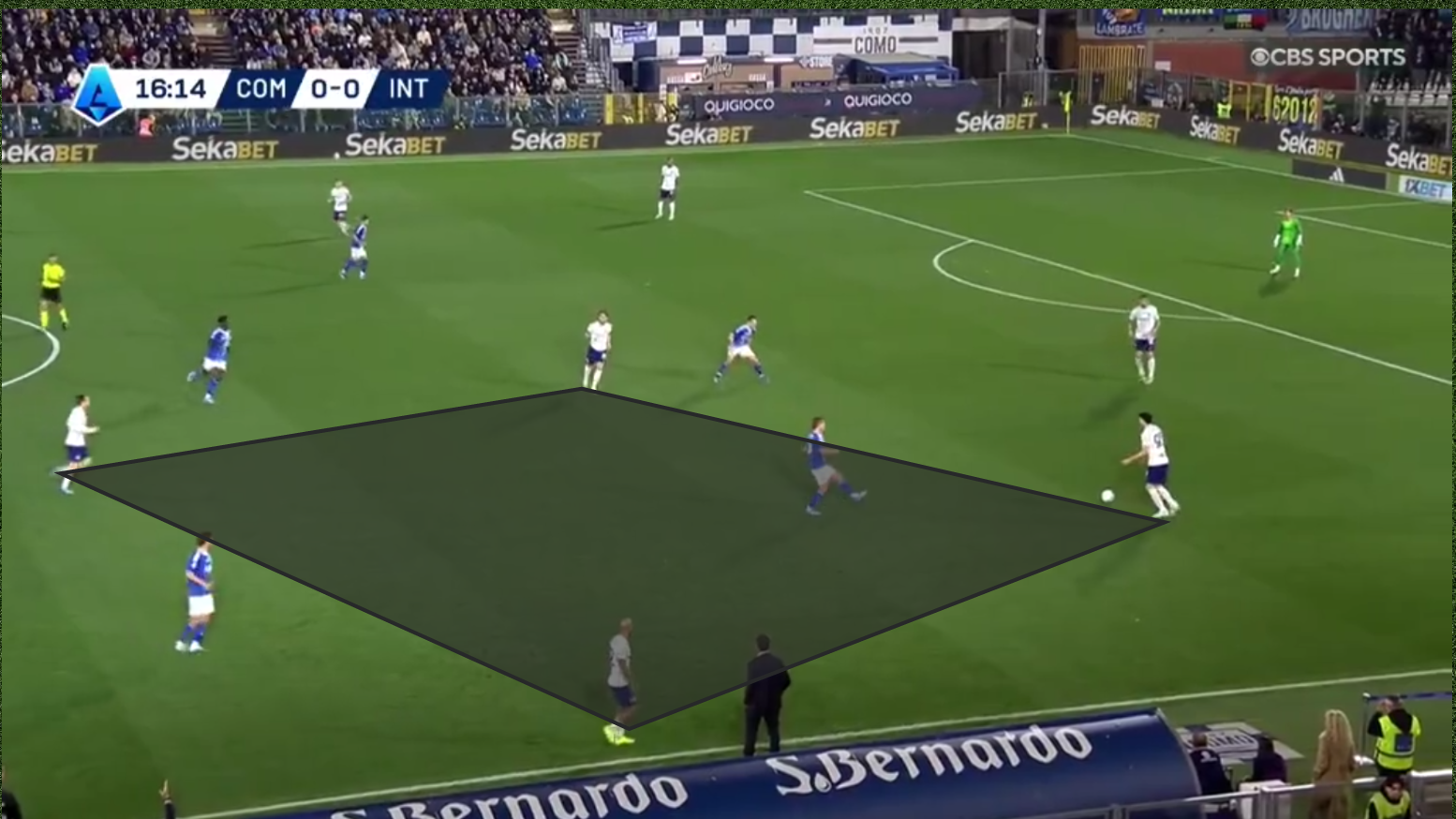
Out of possession, Inter Milan employ a highly aggressive, man-oriented pressing structure, as seen in figure 4, designed primarily to protect the central zones of the pitch.
The objective is to deny opponents access through the middle and instead force progression towards the touchline, where pressing traps can be activated more effectively.
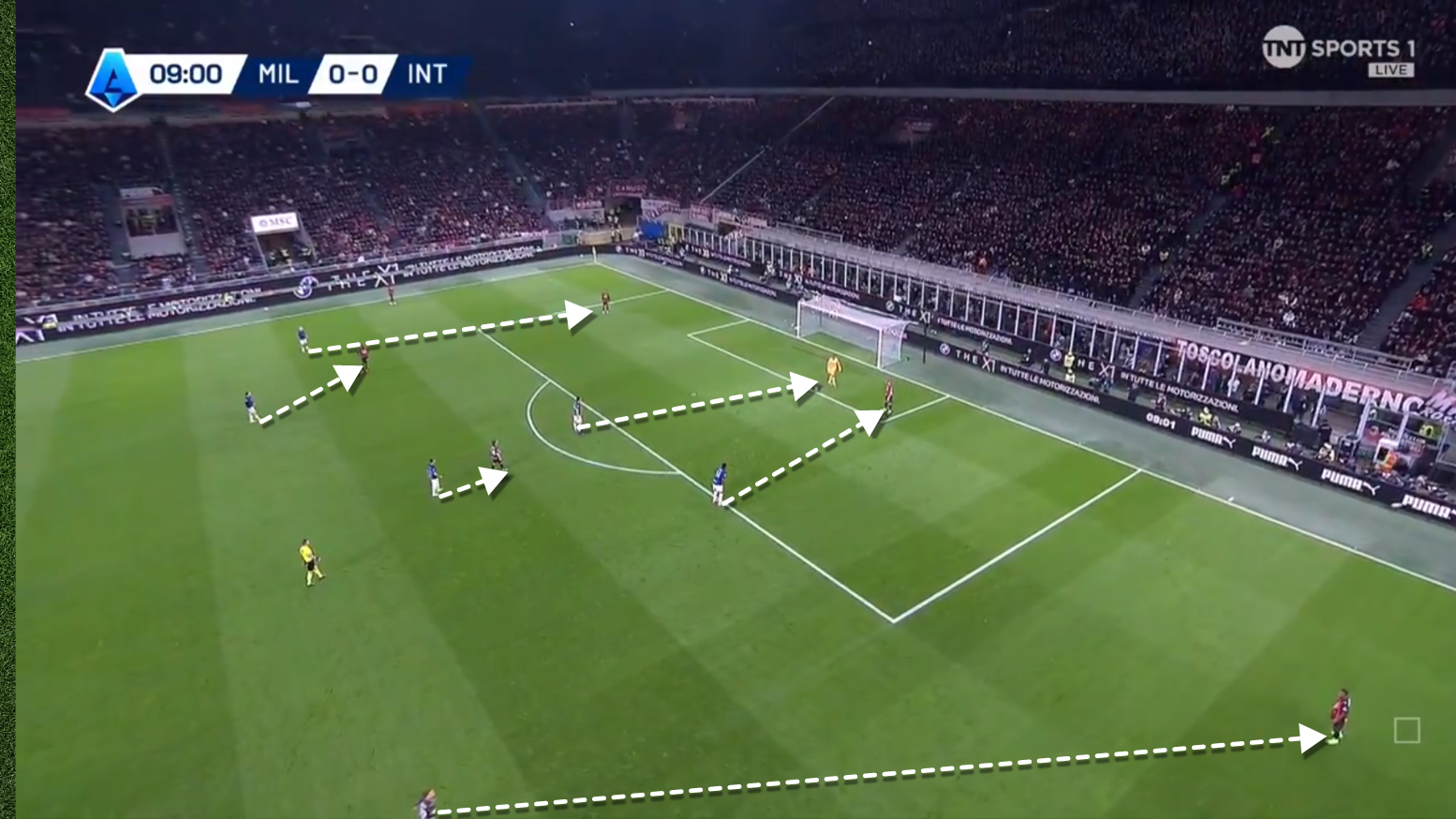
Once the opposition is guided wide, Inter initiate horizontal pressing movements, with multiple players collapsing on the ball carrier, using the byline as an additional defender to limit escape routes.
A key feature of the press is the way it is divided into two coordinated sections, with Çalhanoğlu acting as the central reference point.
Depending on which side the opposition attempts to build through, Çalhanoğlu and the near-sided 'number eight' narrow the available space aggressively in order to compress the passing lanes around the ball, as seen in Figure 5.
This creates local numerical superiority and allows Inter to suffocate central combinations before the opponent can progress into midfield.
If the opposition succeeds in bypassing the initial line of pressure, Inter quickly retreat into a more stable 5-3-2 defensive block, as seen in Figure 6.
The wing-backs drop alongside the back three to form a compact defensive line, while the midfield trio protects the half-spaces and central corridors.
This transition allows Inter to maintain defensive compactness even after the first pressing phase has been broken, ensuring they remain difficult to penetrate centrally.