Understanding Long Line Passes Like Thomas Tuchel - Tactical Theory

The long-line pass is probably one of the simplest passes in football and is, therefore, a common pattern for progressing the ball further up the pitch in wide areas.
However, this kind of pass has some advantages and disadvantages, and this tactical theory piece will try to identify them.
Additionally, this analysis will explain why Thomas Tuchel wants his players to avoid this kind of pass and how he simply eliminates the long-line pass from his training sessions.
Why Long Line Passes Are Used
Nowadays, commentators, fans, experts, and everyone else talk a lot about compactness in defending.
This word describes how little the distance between the players is and, therefore, how much space a team occupies.
We can also split compactness into horizontal and vertical compactness to be more specific.
This is a very short and simple explanation, but it is required to understand the basic idea behind the long line pass.
Now, you may wonder what compactness has to do with the long line pass, but that is quite easy to understand.
Within the last few years or probably decades, teams have focused more and more on staying compact when they are out of possession.
The vertical and horizontal compactness are both important.
However, while vertical compactness is a central factor when we talk about the space between the lines, many squads have as one of their main goals to give the opposition not only no space between the lines but also generally take away from them the chance to get through the centre.
Therefore, horizontal compactness comes into play.
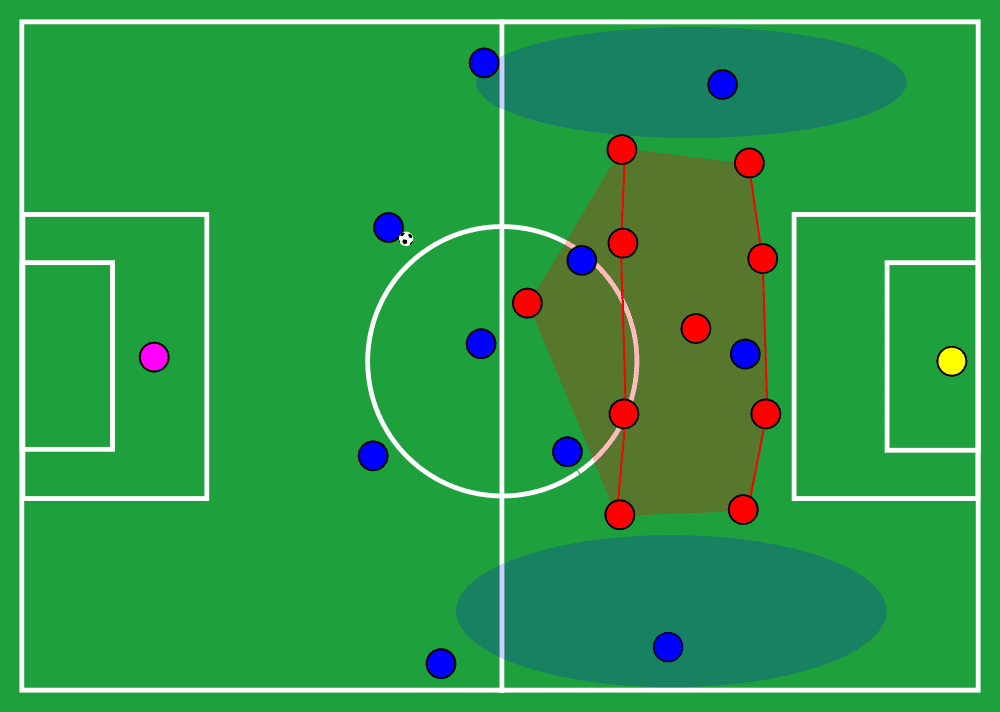
Due to that, the defending team occupies the centre of the pitch with a lot of bodies to give the opposition in possession of the ball no space to get through this area.
Atlético Madrid are probably the most well-known example of these tactics, with the focus on staying compact and giving away no space, neither between the two banks of four nor in the middle of the pitch.
As a consequence, the defending team gives away a lot of space on the wings, and the squad in possession see a chance to progress the ball to the final third and create something dangerous.
The image below shows an example of a team defending deep and staying compact (horizontally and vertically).
Due to that, it seems like the wide areas would be the perfect area to attack for the quad in possession.
Therefore, one of the simplest and most effective ways to progress the ball (at first glance) is to play it to the wide area and then play a long line pass.
Considering this, the one who plays the ball is mostly the full-back or wing-back, and the receiver is normally the winger, as we see in the graphic below, which illustrates the theoretical idea of the long-line pass.
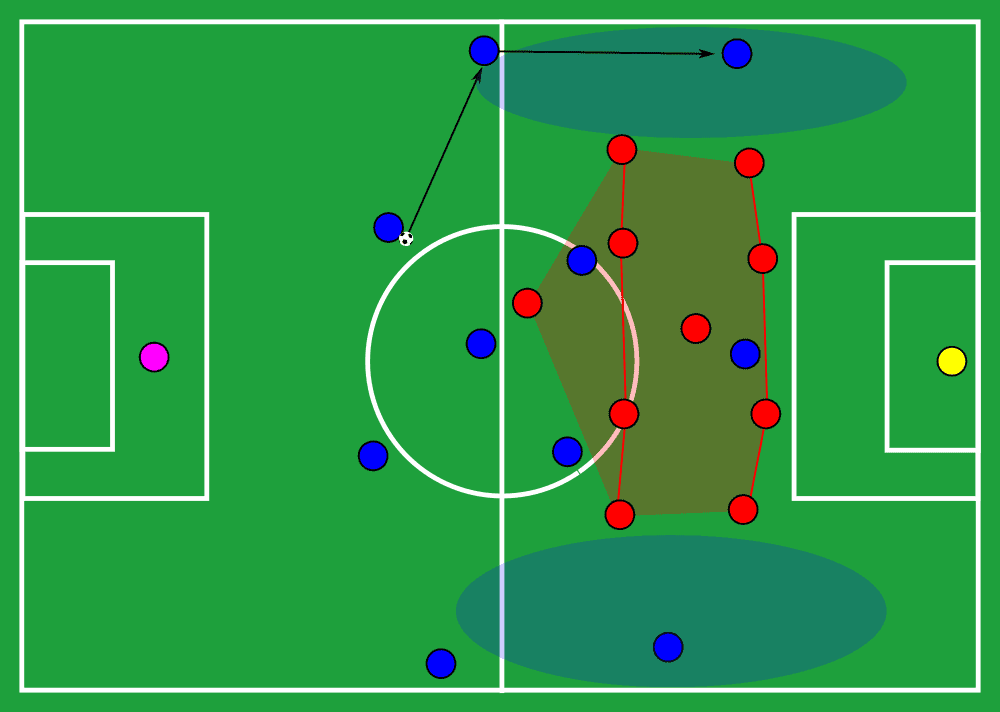
In a nutshell, the basic idea is to get the ball forward in the wide areas since there are too many opponents in the middle of the pitch.
Due to that, it is hard to get through there, and the men in possession of the ball see the solution on the wings.
In these areas near the touchline, the long line pass is the most obvious option and, therefore, a common way of advancing play.
Advantages And Disadvantages Of Long Line Passes
The first advantage that immediately comes to mind is the already mentioned aspect that it is a simple vertical pass, and therefore, the ball's passer should have no problems executing this action.
Furthermore, no complicated movements, runs, or changes of position are required as the players are already in their usual positions.
Even if you play, for example, with inverted full-backs who move into the space in front of the other defenders, the wider-positioned centre-back can play this simple ball towards the winger or striker/midfielder who drifted to the outside.
In light of this, a long line pass seems to always be an option.
However, there is one huge disadvantage on the other side, which is the main reason why coaches like the former PSG head coach, Tuchel, do not want their players to play this kind of pass.
The huge disadvantage is that this ball brings the receiver into an awful situation in which the opposition can easily put pressure on him to win the ball.
Before we dive into the problem of the long-line pass in a bit more detail, I want to note that situations like the one in the graphics above rarely occur.
We now discuss situations like these in the actual game when the defensive team shifts quickly enough over to the respective wing.
The first and probably greatest problem is that the receiver has the opponent (mostly full-back) behind him and makes the first contact with the ball, with his face towards his own goal and his back towards the actual game, as we can see below.
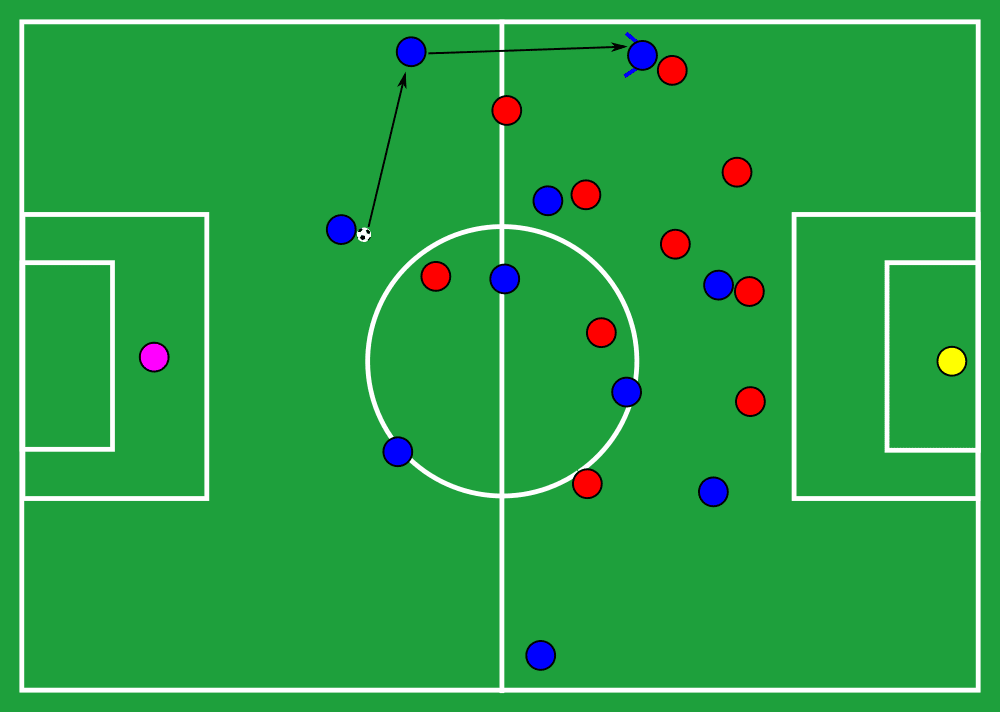
In this position, it is easy for the defender to win the ball as the receiver is in a bad position (with the face towards his own goal), and additionally, the options for the player are limited.
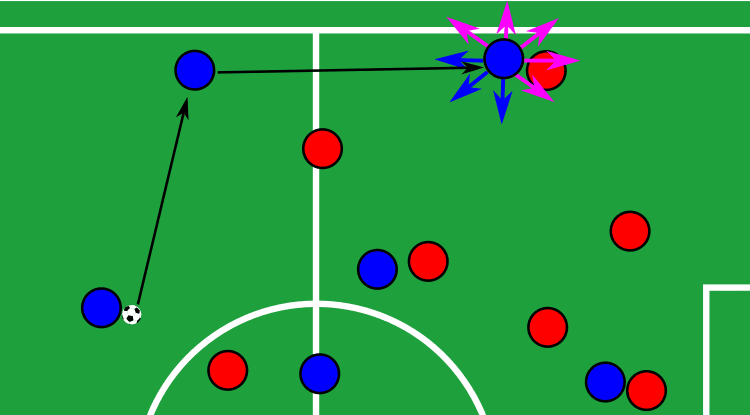
When we say that a player on the ball has basically eight directions to go to (simplified), then five of them are in this situation not possible (violet in the image below) due to the touch line or the defender behind him.
So, he just has three ways (blue) to dribble away, and none of them will put him in a much better and more beneficial position.
Besides, when the other opponents work well together and use effective movements to pressure the player on the ball, he will have even fewer options.
Due to that, we can often see that a team want to provoke the pass to the full-back and then also the long line pass during the press by eliminating all other options.
They want to put the opposition in a situation where the receiver of the long-line ball has limited options.
Tuchel’s View On Long Line Passes
I will briefly summarise Tuchel's speech from that famous video from 2012.
He said that when he took over the senior squad of Mainz 05 in 2009 (before that, he was the coach of the U19), the players in the training sessions mainly used the long line pass to get forward in the wide areas.
However, he knew the disadvantages already mentioned and wanted to use diagonal passes instead of a long line pass to get forward.
So, a diagonal pass from the centre to the outside and from there back into the middle (in the final third).