
![Inter Milan Vs Como [3–2] – Coppa Italia 2025/2026: How Cristhian Chivu Inspired A Comeback To Reach The Final – Tactical Analysis](https://cdn.mymidnight.blog/77f959f119f4fb2321e9ce801e2f5163/size/w1000/2026/04/Inter-Milan--Vs-Como-20252026.png)
Inter Milan Vs Como [3–2] – Coppa Italia 2025/2026: How Cristhian Chivu Inspired A Comeback To Reach The Final – Tactical Analysis

Inter Milan faced Como at the San Siro for the second leg of the Coppa Italia semi-final to decide who would face Lazio in the final.
The match ended with a dramatic 3-2 comeback by Inter Milan after Como were leading 0-2 for much of the match.
Inter Milan succeeded, once again, in making a comeback against Como, and this was even more complicated than their early-April comeback in Serie A, since Inter had to score three goals in a short time in order to qualify for the final.
Inter succeeded in doing so mainly thanks to the valuable second-half player changes, which added more dynamism to the team’s attacking performance.
Como’s collective and individual defending inexperience also played a critical role in paving the way for Inter Milan to complete their comeback and exploit Como’s psychological breakdown in the final minutes of the match.
In this tactical analysis, we focus on Como’s ability to disturb Inter Milan’s defence and the solutions used to do so, while also shedding some light on Inter Milan’s comeback and what made it possible for I Nerazzurri.
Inter Milan Vs Como Lineups & Formations
Inter Milan Lineup Vs Como
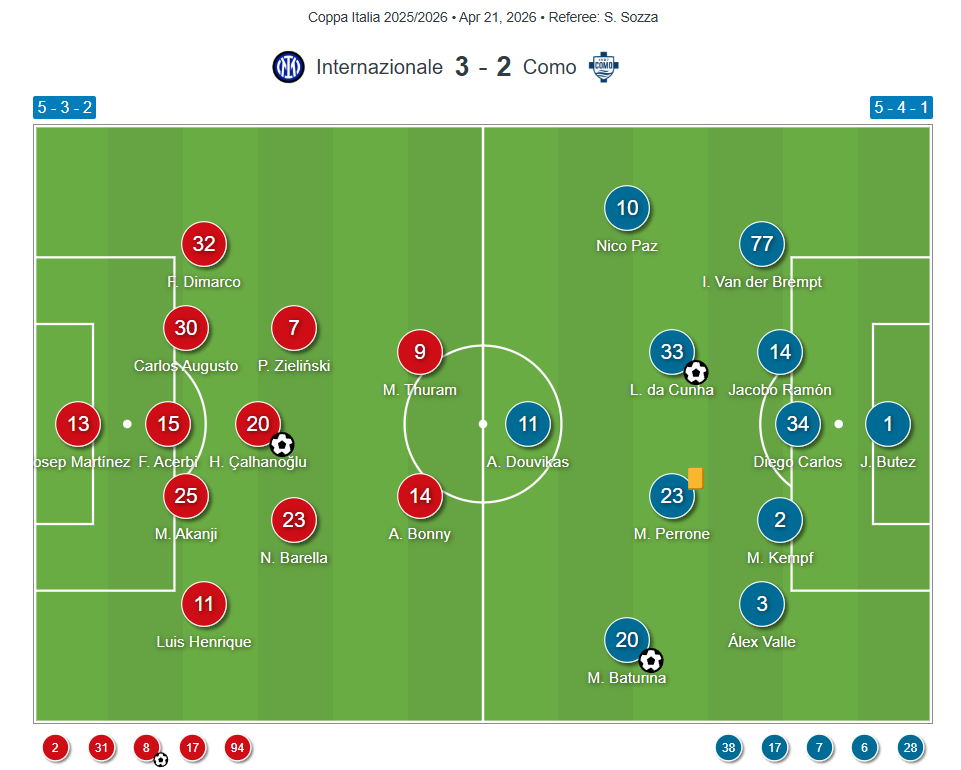
Cristian Chivu lined his team up in their usual 3-5-2 formation, with Josep Martínez being the goalkeeper behind the centre-backs Carlos Augusto, Manuel Akanji, and Francesco Acerbi.
Luís Henrique and Federico Dimarco started as the two wing-backs, while the midfield was made up of Nicolò Barella, Hakan Çalhanoğlu, and Piotr Zieliński.
And in attack, Ange-Yoan Bonny and Marcus Thuram started as the two strikers.
Como Lineup Vs Inter Milan
On the other side, Cesc Fàbregas started the match with a 3-4-2-1 formation, which turned into a 5-4-1 formation as the match progressed, with Jean Butez as the goalkeeper, with Jacobo Ramón, Diego Carlos, and Marc Kempf as centre-backs, Ignace Van der Brempt as a right wing-back, and Álex Valle as a left wing-back.
The midfield comprised Máximo Perrone and Lucas Da Cunha as central midfielders, with both Nico Paz and Martin Baturina as wide playmakers, and Anastasios Douvikas as the team’s main striker.
Como Intelligent Attacking Solutions Vs Inter Milan Mature Comeback
Como started the match with their usual high-pressing system, despite playing an away game, and relied on man-marking inside Inter Milan’s half to force them into mistakes and therefore make high recoveries.
The aim is also to at least prevent Inter Milan from building out from the back without being disturbed and to at least slow their advance towards Como’s half.
Should Inter Milan avoid Como’s high press, Cesc Fàbregas' team would drop back quickly and try to regroup inside their own half to defend against a possible Inter Milan attack.
This plan helped Como limit Inter Milan’s initial threats, progressively gain confidence, and start to gain more possession.
Como Initial Attacking Plans & Numerical Superiority Inside The Box
Como succeeded in threatening Inter Milan thanks to their quick passing, off-the-ball movement, and switching play in the final third.
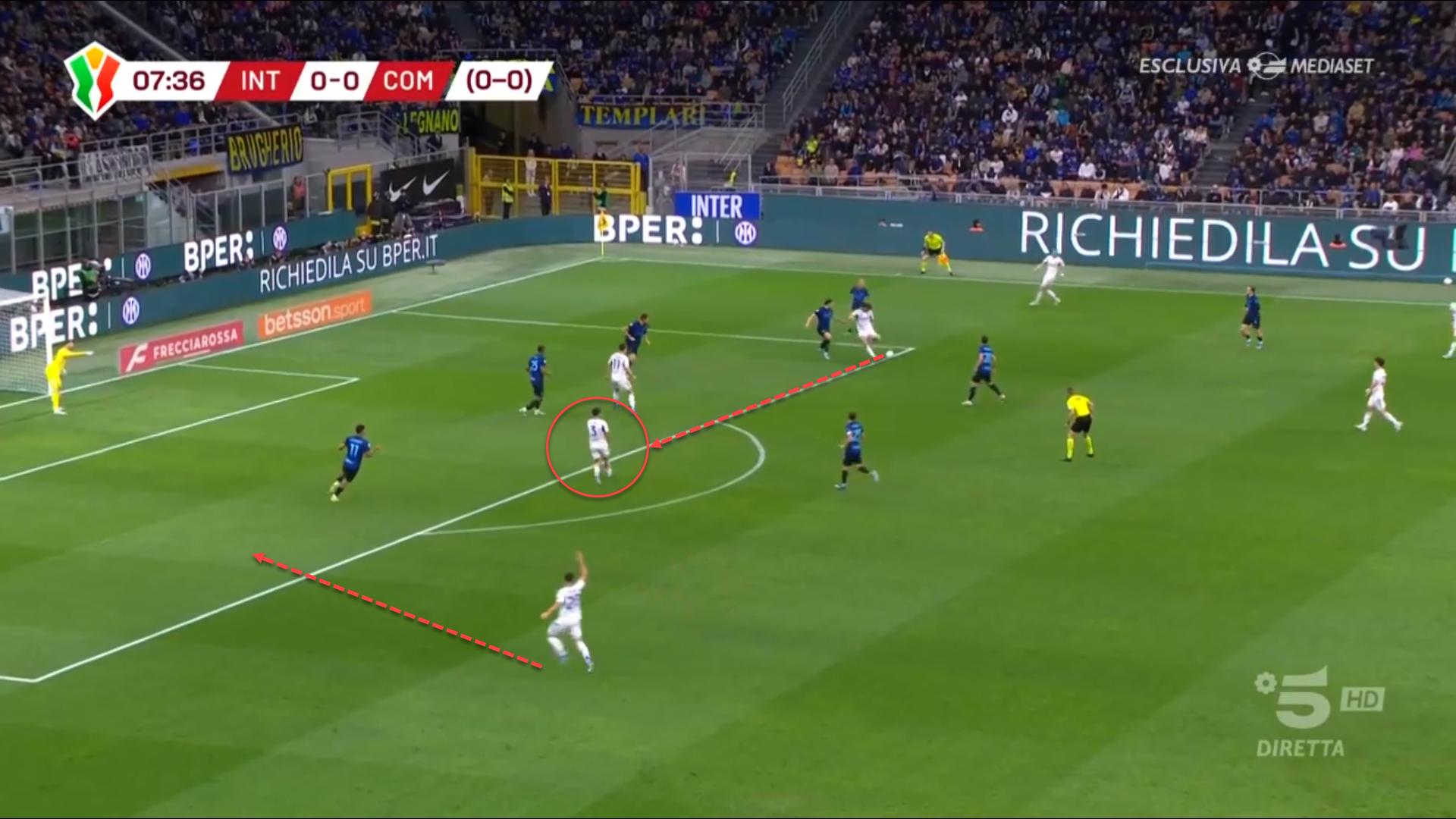
Baturina got very close to scoring in the early minutes of the first half, mainly thanks to the Como players' intelligent movement inside the final third and the ability to exchange positions and use that to confuse Inter Milan’s man-marking in that area.
The action saw Como advance from the right wing, with Paz moving suddenly and quickly away from Augusto to exploit the space near the box and provide a progressive passing option.
Paz’s creative movement was followed by a quick turn and pass towards Valle, who occupied the spot of a second striker alongside Douvikas in the centre of the box, while Baturina advanced from the left wing to propose another passing option.
This helped in disturbing Inter Milan’s marking plans and allowed Baturina to receive a golden opportunity after Valle’s quick pass.
Baturina’s first-time shot was also the right decision in that situation, knowing that he shot the ball with the necessary power and accuracy.
Unfortunately for him, Inter Milan’s goalkeeper was attentive and reactive enough to save it.
Valle’s advancement towards the box was the key element in making this opportunity as dangerous as it was, since it helped Paz find a passing option apart from Douvikas, who was tightly marked.
These continuous penetrations without the ball from Valle are valuable, as they help Como find concrete passing options inside the box when all the attacking players seem to be marked.
Como Use Of Space Inside The Box Through Numerical Superiority
One recurring attacking aspect that Como relied on extensively in this match was their tendency to advance with more than one player in the box.
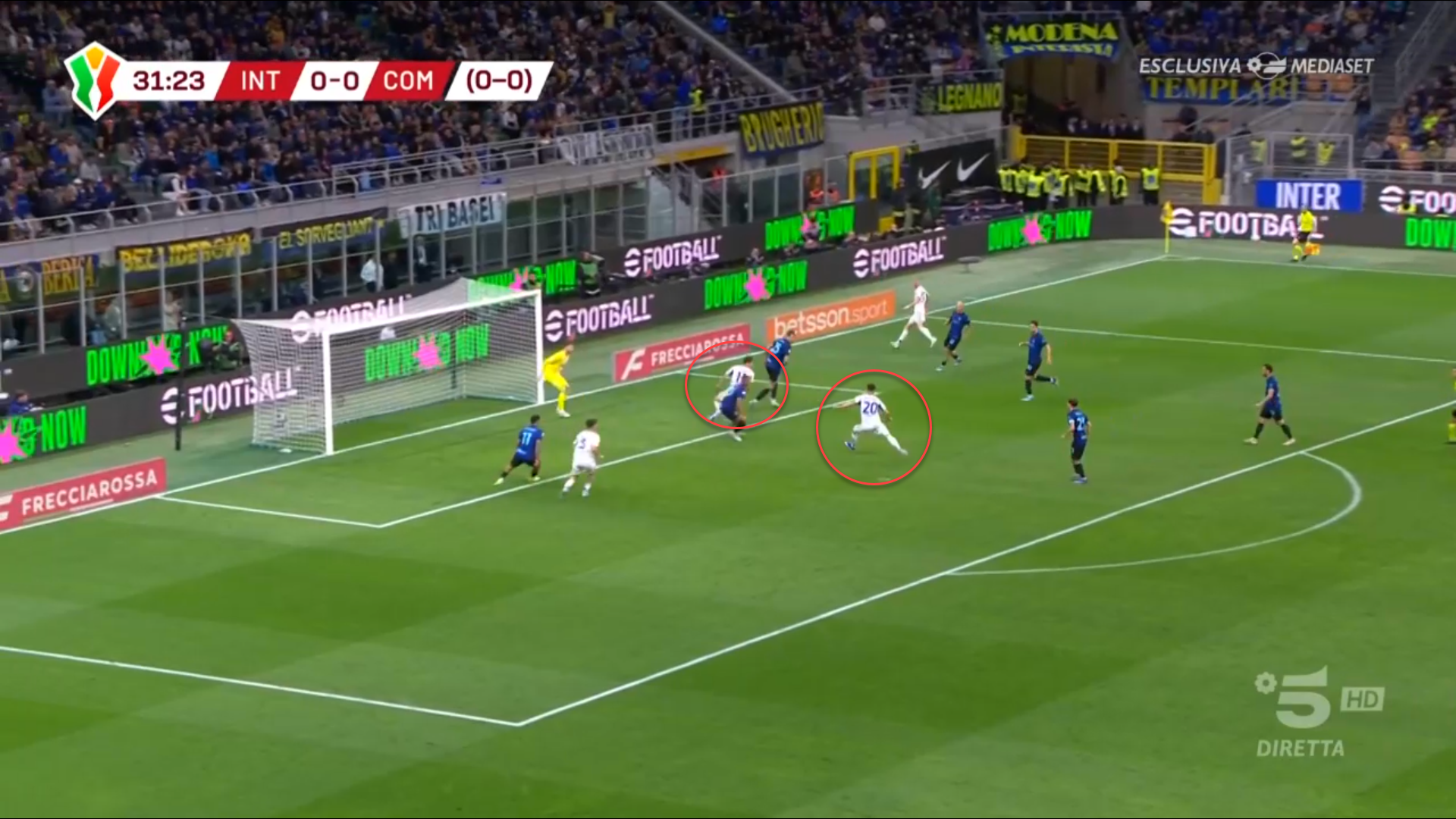
Como were able to score their first goal mainly by exploiting the fact that two defenders were usually marking Douvikas tightly inside the box, preventing him from receiving passes or crosses and limiting his goalscoring opportunities.
However, Inter Milan were unable to anticipate who was coming from the back or from the wings each time, and the anticipatory movements of Inter Milan’s midfielders and defenders were not well-timed in many of the actions during which Como used their numerical superiority in that area.
The first goal action, for instance, saw Baturina lean towards the box and occupy a second striker position.
As Douvikas received a pass and gave it back towards the right wing before returning to his position inside the box, Baturina exploited that and made a few steps backwards in order to receive a pass behind the zone occupied by Douvikas and his markers.
This well-timed movement helped his teammate give him the needed assist, and Baturina had the time and space needed to score with a first-time shot that was complicated for the goalkeeper to save.
Once again, playing behind and alongside Douvikas as a second striker helped Como break down Inter Milan’s defence.
Inter Milan Crucial Build-Up From The Back Tactical Adjustment
Inter Milan failed to control possession early on in the first half, and Como succeeded in their plan of limiting their build-up from the back, thanks to the disciplined high pressing.
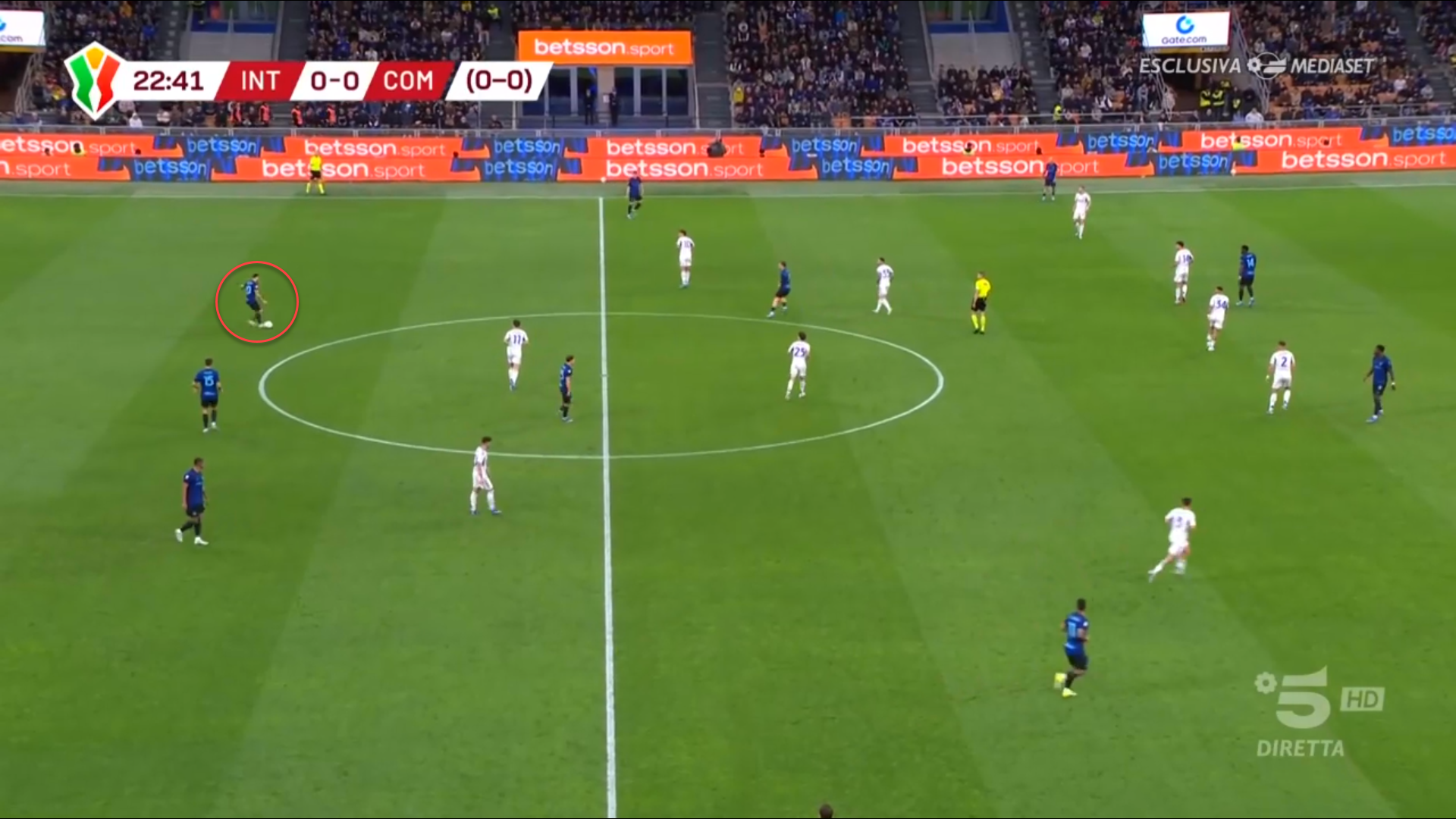
That’s why Chivu resorted to instructing Çalhanoğlu to drop back and form a back-four in the build-up phase, in order to avoid that Como high pressing and help in making Inter Milan build-up from the back successfully and overcome Como’s press without necessarily resorting to desperate long passes.
At the same time, he instructed the goalkeeper to alternate between short passing and long passing when needed.
Following this tactical change, Inter Milan started to become more balanced and were able to advance more frequently towards Como’s half.
Even when Çalhanoğlu was distant from the action, one of Barella or Zieliński replaced him in the build-up from the back by retreating within the defensive line and distributing the ball from there in order to make Como’s press ineffective.
![Real Sociedad Vs Bournemouth [1-2] Europa League 2026/2027: How Do Marco Rose Pressing Tactics Work? - Tactical Analysis](https://cdn.mymidnight.blog/77f959f119f4fb2321e9ce801e2f5163/size/w600/2026/09/Real-Sociedad-Vs-Bournemouth-20262027---Tactical-Analysis-1.png)
![AC Milan Vs Benfica [0-2] Europa League 2026/2027: How Marco Silva Tactics Exposed Rúben Amorim Defensive Problems - Tactical Analysis](https://cdn.mymidnight.blog/77f959f119f4fb2321e9ce801e2f5163/size/w600/2026/09/AC-Milan-Vs-Benfica-20262027---Tactical-Analysis.png)
![Sunderland Vs AZ Alkmaar [1-0] Europa League 2026/2027: Why The Black Cats Make Better Underdogs - Tactical Analysis](https://cdn.mymidnight.blog/77f959f119f4fb2321e9ce801e2f5163/size/w600/2026/09/Sunderland-Vs-AZ-Alkmaar-20262027---Tactical-Analysis.png)
![Leeds United Vs Newcastle United [4-1] Premier League 2026/2027: Why Did Daniel Farke Tactics Dominate The Magpies? - Tactical Analysis](https://cdn.mymidnight.blog/77f959f119f4fb2321e9ce801e2f5163/size/w600/2026/09/Leeds-United-Vs-Newcastle-2026_2027---Tactical-Analysis.png)
![Real Sociedad Vs Atlético Madrid [0-3] La Liga 2026/2027: How Diego Simeone Tactical Precision Rescued A Late Victory - Tactical Analysis](https://cdn.mymidnight.blog/77f959f119f4fb2321e9ce801e2f5163/size/w600/2026/09/Real-Sociedad-Vs-Atl--tico-Madrid-20262027---Tactical-Analysis-1.png)
![Manchester United Vs Manchester City [0-1] Premier League 2026/2027: How Enzo Maresca Tactics Secured Victory With 10 Men - Tactical Analysis](https://cdn.mymidnight.blog/77f959f119f4fb2321e9ce801e2f5163/size/w600/2026/09/Manchester-United-Vs-Manchester-City--20262027---Tactical-Analysis.png)
![Tottenham Hotspur Vs Everton [0-0] Premier League 2026/2027: Why Can't Spurs Score? - Tactical Analysis](https://cdn.mymidnight.blog/77f959f119f4fb2321e9ce801e2f5163/size/w600/2026/09/Tottenham---Vs-Everton-20262027---Tactical-Analysis.png)
![West Ham United Vs Wrexham [6-0] EFL Championship 2026/2027: The Cost Of Passive Defending Against Smart Movement - Tactical Analysis](https://cdn.mymidnight.blog/77f959f119f4fb2321e9ce801e2f5163/size/w600/2026/09/West-Ham-United-Vs-Wrexham-2026_2027---Tactical-Analysis.png)