

Why Top Teams Like Arsenal & Liverpool Need A False Nine: The Hidden Geometry Behind Dropping Strikers – Tactical Theory
As the tactical game evolves rapidly, more and more money is spent on teams of analysts, data scientists, and research departments to get ahead in a game of often-narrow margins.
Whilst murmurs of football becoming more 'boring' have grown over the last few years, I believe this can be boiled down to the fact that out-of-possession ideas and coaches' abilities to implement them have improved.
Take, for instance, the Premier League: it never feels as though any 'big' team takes any match in their league for granted.
If you are not at the races, the league will find you out, and teams will not hesitate to take points off you.
The reason slipping up happens so often is that teams can adopt a low block and use fast players on the counter to cause problems, whilst prioritising a compact block that cuts off space in the centre of the pitch.
Bar Arsenal in the Premier League, it's anyone's guess who the best team is after that.
Serie A has five teams fighting it out, and each week, each one of them finds it difficult in a league bereft of goals and goal scorers.
Real Madrid have Vinícius Júnior, Jude Bellingham, Arda Guler, Rodrygo, Kylian Mbappé, and more, yet have stuttered in attack lately.
Barcelona doesn't have a problem scoring goals, but struggles to find a balance between scoring lots and keeping the number of goals conceded down.
PSG play in a league where they have far superior resources, and the same goes for Bayern Munich, so it's hard to judge them based on current Champions League fixtures and their own league form.
The point is, even the biggest teams in Italy, Spain, and England don't win every week.
The Pep Guardiola-Jürgen Klopp era produced inevitable win after win, and the feeling is that we won't see that for some time.
Given the difficulty of dealing with out-of-possession tactics, one way teams use their strikers to create space up front is by dropping them into the build-up.
This tactical theory explores the role of a false nine and why they can be so crucial in certain moments.
The Effectiveness Of A False Nine
The reason the idea of having a traditional number nine up front slowly eroded was that managers wanted their forwards to do a lot more than stand in the opponents' box and score goals from headers.
Think of some of the best trios in front of goal of the last 15 years or so: Luis Enrique's Barcelona (Lionel Messi, Luis Suarez, Neymar), Klopp's Liverpool (Sadio Mané, Mohamed Salah, Roberto Firmino), Carlo Ancelotti's Real Madrid (Karim Benzema, Cristiano Ronaldo, Gareth Bale).
They all contained strikers who could do what a big, traditional centre-forward could, but the point was to have all of them in dangerous positions, elevating the others.
It's why you'll likely find the strikers that drop off not to be the most glamorous.
Take, for instance, Arsenal's game against Bayern Munich in the Champions League.
The striker was Mikel Merino, but there are huge rewards to having a player who has played the majority of his career as a central midfielder.
What Merino and Mikel Arteta did against Bayern Munich opened up the Bundesliga champions' defence.
Arsenal have gotten miles better at opening defences this season than last, and a big reason is Arteta playing a ‘false nine’ striker who drops deep.
Whilst Arsenal had five set-pieces from minute 45 to 60, piling on the pressure, Merino dropping kept dragging Jonathan Tah out of position inside Arsenal’s own half.
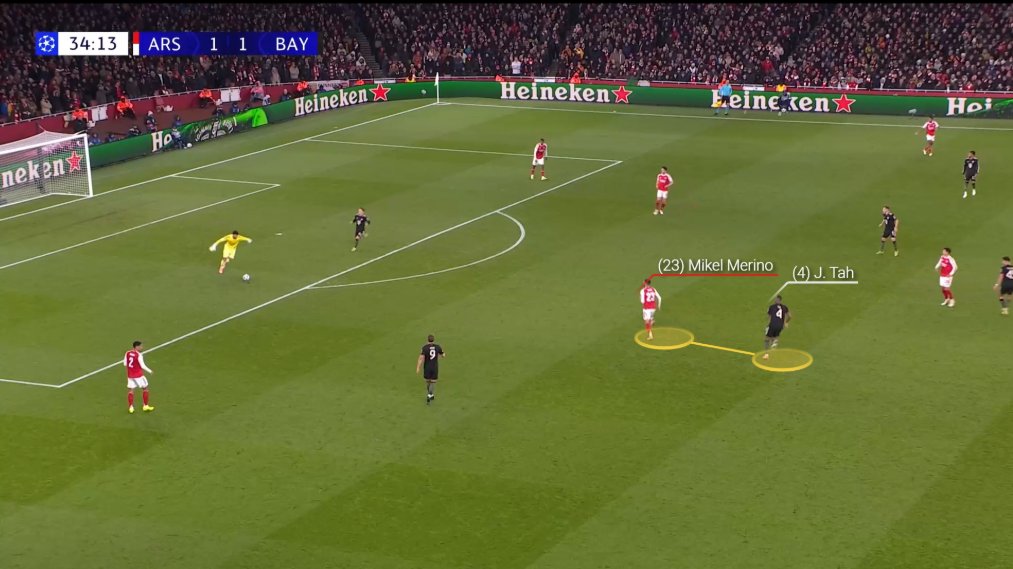
Arteta had subbed Noni Madueke on, too, which meant that even with Merino dropping deep as a striker, they didn’t lose width or a central presence.
With Merino dropping, other Arsenal players stepped in to take his position, keeping Bayern’s central defence occupied and pushing them back.

If you look at the graphic above, Tah is wary of Merino’s movements, but he’s in an awkward position to mark.
Tah can’t follow him out fully, because that would create a gap in Bayern’s back five.
Additionally, other Arsenal players are aware of this, with five attackers pushing Bayern’s defensive line back.
It means you don’t lose a central passing option or the thread, wide, or in the half-spaces.
When you take the position of a striker and tell him to drop off, you create multiple possibilities as opposed to a central striker who always has to occupy two centre-backs.
It encourages the rest of the players in your team to move and rotate positions, which is the only way you can infiltrate defences as good as Bayern’s.
For the chance of Declan Rice bearing down on goal and getting in behind Bayern's defence for a one-on-one, you could see precisely what Merino was doing.
The Spaniard took Tah's man-marking and dragged him into his own half, whilst Eberechi Eze and Myles Lewis-Skelly did the same.
What it meant was that Arsenal dragged eight players into their own half and then went long and over the top to Madueke.

It's the practice of having a striker but not needing him to be in the box or wide, since other players can do that; it confuses the opposition about who to mark.
The striker dropping transforms the team's attack into a multi-functional forward line; it's less about how many goals the striker scores and more about what you can do when they use their movements to drag opposition around.
Multiple False Nines & Variations
One major reason Liverpool are not as good as they were last year is the sale of Luis Diaz.
Though many hailed the deal at the time, just because a deal is good and mutually beneficial for all parties involved doesn't mean it should be taken or completed.
The Colombian was the link between defence and attack, with the way he used drop-off.
It's salient that when you watch Liverpool matches now and see the problems they have, there is ample space in the middle where Diaz used to play.
It feels like a team that misses the way they used to play and the chemistry they had in attack.
The multiple dropping-forwards Arne Slot used last season understood each other's roles and knew they had to work together to be dangerous.
As touched upon earlier, these are what the best strike forces in the world give you.
Once you start using variations with different strikers dropping deep, you can utilise moving around different defenders, thus creating different spaces in different areas of the pitch.
Using this tactic also means you don't have to create chaos in your attack.
Though it requires your team to commit men forward, it doesn't feel like an attacking tactic that needs much chaos.
It also offers a solution when one or both of your midfielders in a double pivot are tracked and marked off.

In the graphic above from last season, Ryan Gravenberch is marked by two players close to him, with Diaz dropping into midfield, and two West Ham United players following him.
With Diaz free, he becomes the 'third' midfielder, and the option to pass to that isn't Alexis Mac Allister and Gravenberch.
Once again, as I mentioned in the last section, it gives other players the chance to push up and pin the defence back.
This time, it is Curtis Jones making sure Diaz's movements are accounted for, so Liverpool have pinned the Hammers back 3-v-4.
Even when West Ham narrowed the centre of the pitch, the variation of attackers dropping meant they could bait them into the press and fire the ball long and in behind to quick strikers.

This time, it's Curtis Jones and Diaz dropping as midfielders, which frees up Gravenberch, who is making a run in behind.
The defenders have to follow the players; if they do not, they are free and in space in deep build-up.
The sequence above shows Diaz dropping into midfield without dragging a player or marker with him; it creates an extra passing option and puts the onus on other Liverpool players to make the runs off him, as Gravenberch does.
Take a look at how many players are attempting to close Liverpool down in deep build-up.
The problem worsened when Mohamed Salah started doing the same thing on the other side, except in wide positions.

This also became effective as West Ham began to be dragged over to one side.
Multiple false nines, in different positions, coupled with the fact that whoever is not dropping deep in build-up, recognises that a player is helping to create a chance, and he should get on the end of it.
Conclusion
Though these are two examples, throughout football, people are beginning to question whether a striker is good based on the number of goals he scores.
However, the truth is, managers and coaches don't just want a striker anymore; they need players who can do more.
The definition of a striker has changed because the deeper they are in build-up, the more dangerous they are in attacking moves.
![Manchester United Vs Liverpool [3–2] Premier League 2025/2026: How Michael Carrick Tactics Exploited Arne Slot's Defensive Weaknesses - Tactical Analysis](https://cdn.mymidnight.blog/77f959f119f4fb2321e9ce801e2f5163/size/w600/2026/05/Man-United--Vs-Liverpool-20252026.png)
![Liverpool Vs PSG [0–2] – Champions League 2025/2026: PSG Counter-Attacking Efficiency & Midfield Control – Tactical Analysis](https://cdn.mymidnight.blog/77f959f119f4fb2321e9ce801e2f5163/size/w600/2026/04/Liverpool--Vs-PSG-20252026.png)
![PSG Vs Liverpool [2–0] – Champions League 2025/2026: Luis Enrique Rotations Dismantle Liverpool – Tactical Analysis](https://cdn.mymidnight.blog/77f959f119f4fb2321e9ce801e2f5163/size/w600/2026/04/PSG-VS-Liverpool-FC-2025_2026.png)