How To Coach 4-2-4 Formation In & Out Of Possession Like Jürgen Klopp & Pep Guardiola - Tactical Theory

In recent times, certain football formations have become the convention for deployment, as they are conducive to meeting the tactical demands of modern football.
The 4-3-3 formation, for example, somewhat phased out the regular 4-4-2 formation due to its numerical superiority in midfield.
By extension, the 4-3-3 is an ideal formation for teams that favour a positional play (Juego de Posicion/JDP) approach.
And this appears to be the essence of why formations come into and out of fashion; they are simply a means for a team to access structures and shapes that are suitable when adhering to certain overarching principles.
A three-at-the-back formation is typically helpful for a very rigid, automatism-heavy tactical makeup.
The use of only one nominal wide player on each wing, along with three nominal centre-backs, makes lateral rotations very difficult to execute, and the team is less fluid as a result.
With great interest, a handful of elite teams have begun to adopt the 4-2-4 formation.
This formation induces a refreshingly exciting style of play – quite the move away from disciplined JDP systems and rigid three-at-the-back structures.
The 4-2-4 encourages fluidity, ambitious front-foot possession play, attacking overloads, and physically intensive pressing.
This tactical analysis article will primarily refer to Jürgen Klopp's time at Liverpool as a case study, while also aiming to discuss some key distinctions between various 4-2-4 formations.
This tactical theory piece will be a tactical football analysis examining the 4-2-4 formation and how top coaches like Manchester City's Pep Guardiola have implemented their tactics within this structure.
The Build-Up Phase In A 4-2-4 Formation
The build-up phase in a 4-2-4 is an interesting case study because the sequential manner of building with the ball, in conjunction with the notion that the 4-2-4 is generally a move away from a rigid possession style, seems somewhat counterintuitive.
In short, one can interpret that statement as follows: a 4-2-4 in build-up offers ideal positional and spatial advantages without the limitations of rigid positioning.
Build-Up Versus A Mid-Block
It is essential to distinguish the build-up shape of the 4-2-4 formation versus a mid-block and versus a press, as the two defensive set-ups are certainly distinct.
The two centre-backs, with support from a ball-playing goalkeeper, form the central and deep base of the build-up.
The midfield double-pivot are another component, strongly linked to each other for a number of reasons; not least to offer a compact rest defence and a strong central core.
The full-backs are another relevant component in this build-up scenario, as they generally move in a vertical plane to create progression angles and provide width that can disrupt the first line of the opposition's defensive structure.

While it is easy to break down the different build-up components into “centre-backs, double pivot, fullbacks”, another way to view the build-up is as a right side and a left side.
Lateral passes are generally discouraged in both positional play systems and overly fluid systems, such as the ‘classic’ Red Bull 4-2-4 / 4-4-2 system.
For example, the right side will have strong passing links from the right-sided centre-back to the fullback (diagonal pass) or the right central midfielder (vertical pass).

Similarly, if the ball is switched to the left side, typically through a centre-back-to-centre-back pass, the opposing structure would be created.
Ball progression can occur in a fairly sequential manner in the 4-2-4.
This means that each pass from player to player induces changes in the opposition's shape, which opens up a logical passing option for the next pass.
Each player is a checkpoint, in some regards, a checkpoint which is established in a position which forces the opposition to react.
Like placing an opposition’s King under check in chess.
One example of such a sequential build-up is initiated when the centre-back passes into a midfielder.

Being forced to make this pass is often induced by an opponent’s front two playing in a conventional manner; one striker curves their pressure to force play in one direction, and the other screens the double-pivot midfielder.
This opens a wall pass into the other double pivot midfielder, who can then play an ‘around the corner’ pass into the fullback.
The fullback can receive with an open body shape and attack space into an attacking area, particularly because the opponent’s left midfielder has been dragged inside by the attacking team’s right winger.
The 4-2-4 is conducive to many of these dilemmas being posed on the opponent’s defensive structure; do players jump to press or sit off and allow the player in ball possession to get their head up?
Perhaps this is a result of the 4-2-4 mirroring the 4-4-2 defensive block so closely or the fact that the defined components (double pivot, vertically fluid fullbacks, etc) can collaborate in any given area of the pitch, just in a similarly congruent manner, unlike in a positional play style where the team is confined to zones and are therefore somewhat predictable.
Additionally, the dangers the front four pose certainly play a role in disrupting the opponent’s defensive structure.
The threats a dynamic front four can pose are significant, particularly when considering that if the defensive side apply a press, a simple ‘out ball’ can lead to a 4v4.
The predictive threat of the attacking side accessing their front four in this manner means that the midfield line of the defensive team is often preoccupied with screening passes into the front four, which therefore opens pockets for the players in the earlier build-up to progress through.
Build-Up Versus A Press
The 4-2-4 in nature offers a great foundation when looking to play out of a press.
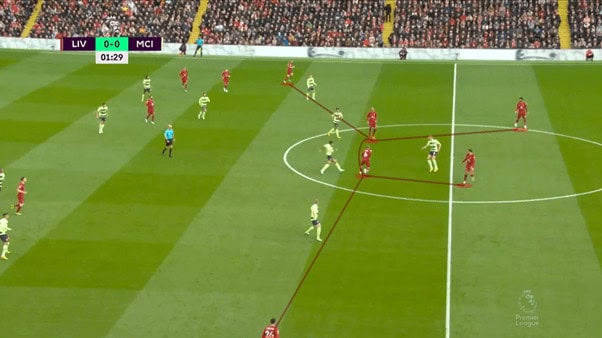
One instance where the 4-2-4 is utilised to play out of pressing scenarios is Pep Guardiola’s Manchester City side from 2021 onwards.
This example is highly pertinent, particularly because Guardiola typically opted for a completely distinct nominal formation in ball possession, with the shape morphing into a 4-2-4 to deal with a high press.
Guardiola appears to have a strong aversion to non-JDP formations, such as the 4-2-4.
Yet, he coached his team to revert to it in scenarios where the 4-2-3-1 can break through high-quality pressing opposition, and the 4-2-3-1 was most notably employed against Klopp's Liverpool.
In the structure, the fullbacks dropping deep and wide is the most evident change when switching from a 4-3-3, for example.
With the fullbacks dropping deep and wide, the team in ball possession can then have a strong ‘security ring’ in possession, with the keeper plus four defenders all occupying the first line of build-up.
If play is forced down one side by the press, the fullback can often receive in enough space to open their body with their first touch, and play out in a manner which is less conducive to being dispossessed by a presser.

Taking a step back to a more holistic viewpoint, it could be said that disciplined positional play systems may struggle against a good, high-intensity press.
A more fluid (almost freeform) system, like the 4-2-4, is therefore more adaptable, and the reason for its successes over a press isn’t limited to numerical or geometric advantages.
The 4-2-4 is conducive to most players having quite a wide scope of movement within the structures, just as the fullback can drop deep and wide to receive in an ideal posture.
Likewise, other players can take advantage of the situation to ensure they have the extra time and space required to execute actions with a higher chance of success when trying to break through the pressure.
The 4-2-4 relies on principles rather than all-encompassing coaching, which accentuates its adaptability.
Principles include, but are not limited to, repeated micro-actions such as body shape when receiving in certain circumstances, dis-marking to receive, out-to-in/in-to-out funnels of play, and triggers.
Attacking Phase & Induced Transition States
Maintaining a somewhat holistic view of the game, we can say that football is broadly broken down into four phases of play: ball possession (build-up, progression, and creation), opposition possession, attack-to-defence transition, and defence-to-attack transition.
The boundaries between these four sections blur when elite coaches began to tinker with some pretty complex ideas.
Inducing a transition-like state is something that can occur when you bait a press, for example.
Encouraging the opponent to press the team in ball possession drags their structure up the pitch, and they’ll likely take risks in ‘jumping’ on an individual level to press when the carrot of regaining possession in what would be their attacking third is dangled in front of them.
The result for the ball possession side when inducing this situation is a manufactured state of defensive disorganisation to exploit if they can break through the pressure.
The features of the 4-2-4 make this formation ideal for baiting a press and playing out of the press.
These features are touched upon in both of the build-up sections above, as build-up is where baiting an entire defensive structure up the pitch to press is most effective, and the defensive line is dragged the furthest up the pitch, creating either more space behind or leaving space between the lines.
The means of baiting and playing out of a press are one side of the coin; having a form of superiority in attack is the other side, when discussing how to exploit defensive structures in an induced transition.
Quite put, having a front four to capitalise on transition-like attacking scenarios is highly advantageous, as it goes above and beyond what you’d generally expect from a team going forwards (typically you’d have a front three, or a few players on the break, but rarely a highly organised front four).
The profiles in the front four differ from team to team and on an individual level.
It can be ideal to have a #10 and a striker, with two wingers.
Guardiola typically utilised this formation when his side reverted to a 4-2-4, with Kevin De Bruyne having been the #10 and catalyst to bring the ball into final third situations.
Liverpool utilised Darwin Núñez well as a disruptive striker, but they were still reliant on inverting wingers, such as Mohamed Salah, to provide the clinical goalscoring edge.
Many teams use a front five, in a 2-3-5 or 3-2-5 formation.
While a front five has advantages that stretch opponents laterally, they are often quite rigid and easy to defend against if vertical movement isn’t pronounced.
Spurs notoriously struggled to access their rigid front five against Brentford, as in the 4-2-4, dynamism and social relationships between players are generally more conducive to fluid, attacking play.