
![Fenerbahçe Vs AS Roma [1-1] Champions League 2026/2027: How İsmail Kartal's Compact Defence Limited Gian Piero Gasperini's Attack - Tactical Analysis](https://cdn.mymidnight.blog/77f959f119f4fb2321e9ce801e2f5163/size/w1000/2026/09/Fenerbah--e-Vs-Roma-20262027---Tactical-Analysis.png)
Fenerbahçe Vs AS Roma [1-1] Champions League 2026/2027: How İsmail Kartal's Compact Defence Limited Gian Piero Gasperini's Attack - Tactical Analysis

Fenerbahçe hosted AS Roma at the Şükrü Saracoğlu Stadium for their first match of the 2026/2027 UEFA Champions League, and the contest ended with a 1-1 draw.
This draw can mean a lot for Fenerbahçe as it would boost their confidence levels and make them build on it to try winning in the upcoming fixtures.
On the other side, Roma failed to win after a stellar start in Serie A, marked by some spectacular wins that put the team on the right track domestically from the get-go.
Despite that, they failed to impose their game on a Fenerbahçe side that studied Roma well enough to limit their strengths.
In this Fenerbahçe vs AS Roma tactical analysis, we look mainly at İsmail Kartal’s defensive tactics, how they countered Gian Piero Gasperini’s attacking style of play, and why they largely succeeded in their game plan.
Fenerbahçe Vs AS Roma Lineups & Formations
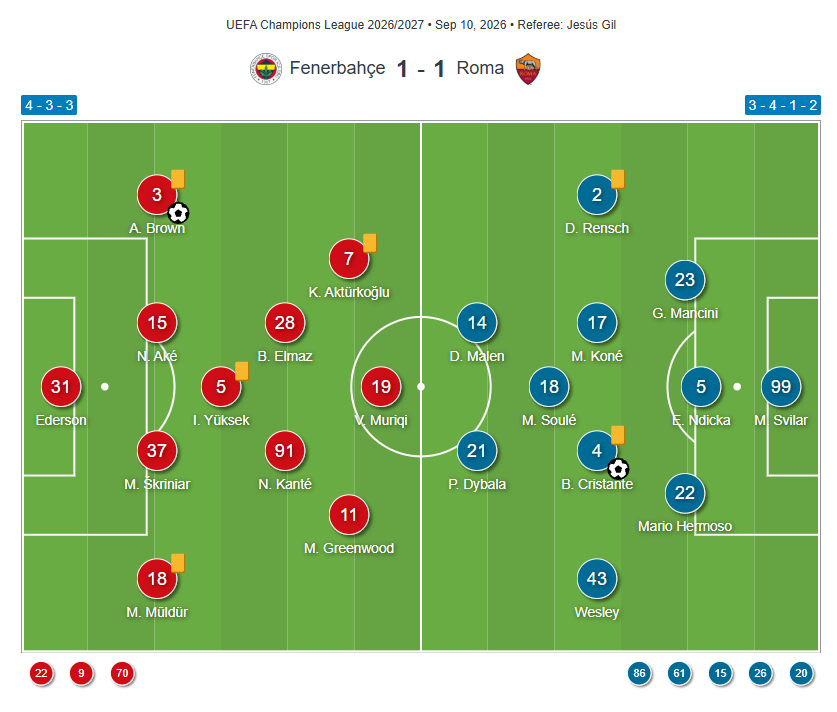
Fenerbahçe Lineup Vs AS Roma
Kartal relied on a 4-3-3 formation, using Ederson as a goalkeeper, and a defensive line made up of Mert Müldür as a right-back, Milan Škriniar and Nathan Aké as centre-backs, and Archie Brown as a left-back.
The midfielder was composed of İsmail Yüksek as a defensive midfielder, N'Golo Kanté and Bartuğ Elmaz as central midfielders, Kerem Aktürkoğlu and Mason Greenwood started as wingers, with Vedat Muriqi as the main striker.
AS Roma Lineup Vs Fenerbahçe
On the other side, Gasperini started the match in his preferred 3-4-2-1 formation, with Mile Svilar in goal and a defensive line of three centre-backs: Gianluca Mancini on the right, Evan Ndicka in the centre, and Mario Hermoso on the left.
The midfield line featured Wesley França and Devyne Rensch as left and right wing-backs, with Bryan Cristante and Manu Koné as central midfielders.
Gasperini used Matías Soulé as the advanced playmaker, with both Paulo Dybala and Donyell Malen as the attacking duo.
Fenerbahçe Defensive Organisation
Fenerbahçe started the match in a very dynamic way in possession and tried to be as aggressive as Gasperini’s team in order to match their opponent’s dynamism, whether in high press or in continuous man-marking.
In defence, Kartal tried to limit Roma’s midfield superiority by opting for a 4-1-4-1 formation in the defensive phase, with Yüksek playing as a defensive midfielder in front of the backline, and a line of four midfielders/wingers, behind the striker Muriqi.
This defensive organisation helped Fenerbahçe make Roma struggle to find solutions, isolate the midfielders and the wing-backs from Malen, Dybala, and Soulé, and force I Giallorossi to opt for more rushed solutions.
In other words, Fenerbahçe tried to intensify and condense their defensive presence into one tight area in midfield in order to complicate the playmaking process for Roma, knowing that allowing them the space to advance with ease would eventually hurt Fenerbahçe.
Fenerbahçe were aware of the threat that creative players like Dybala, Malen, and Soulé could have on the team’s defence, and that’s why they opted to try and limit the passing to them while also applying tight marking on them.
Choosing to defend using a high defensive block against a team like Roma is obviously a courageous tactical choice that could have had dangerous consequences if the defenders had failed to retreat on time during counterattacks.
But overall, it was the best choice that Kartal could have made in such a situation.
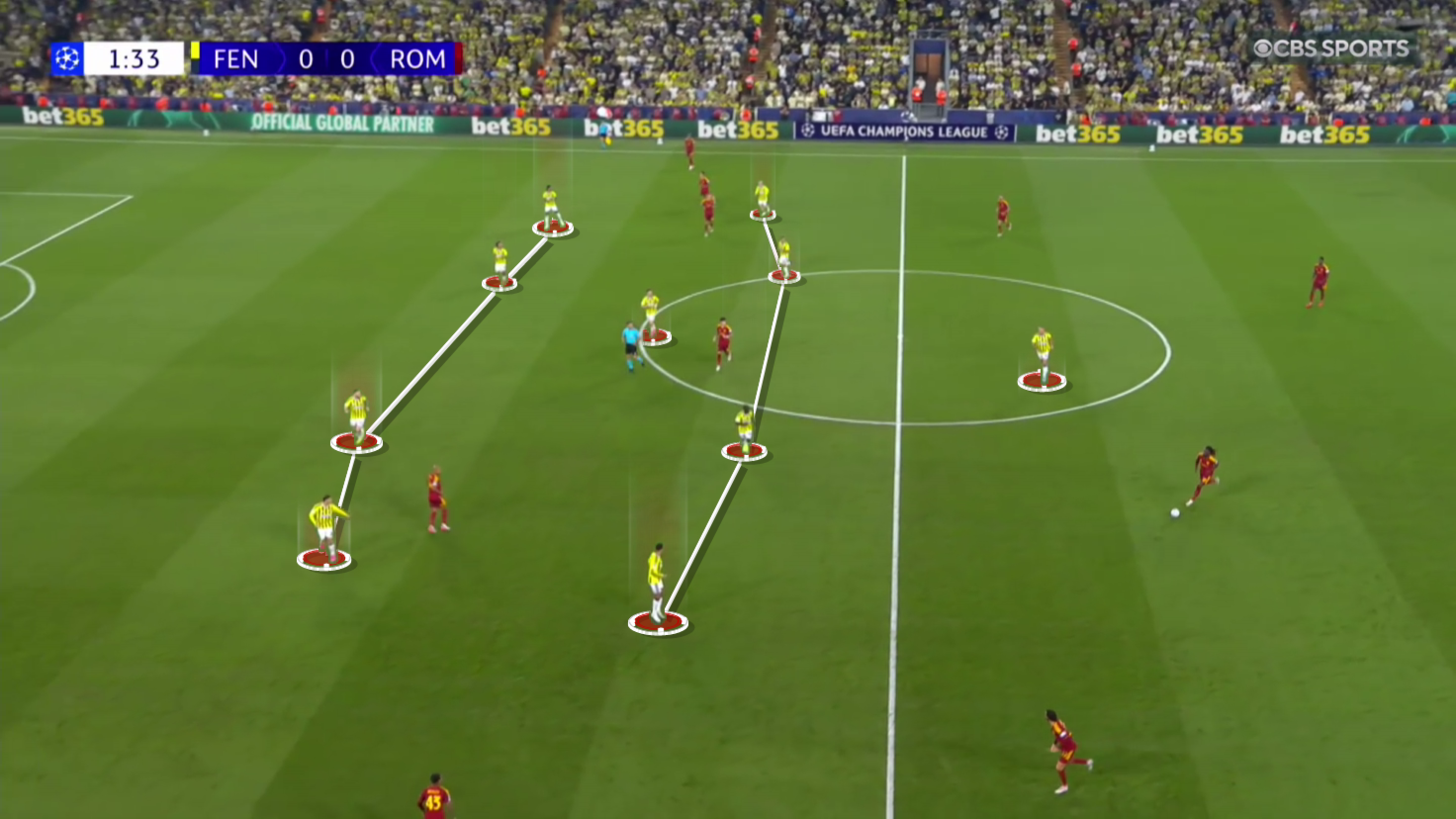
Fenerbahçe tried to minimise the distance between both lines of defence to leave no time for Roma’s creative players to think about dribbling.
Playing with two close lines of defence while using a high defensive line made Fenerbahçe defend with more conviction and created issues for Roma, who are not used to being put in such situations.
More importantly, Roma have been used to finding solutions with relatively more ease in attack, as their opponents since the start of the season were not as compact and intelligent defensively as Fenerbahçe.
The following situation highlights how Fenerbahçe succeeded in preventing Soulé from advancing and obliging him to opt for a pass that they also succeeded in intercepting.
This double and sometimes triple marking on the ball holder inside Fenerbahçe’s half was very important to prevent both Soulé and Dybala from penetrating centrally to eventually serve Malen.
![Tottenham Hotspur Vs Everton [0-0] Premier League 2026/2027: Why Can't Spurs Score? - Tactical Analysis](https://cdn.mymidnight.blog/77f959f119f4fb2321e9ce801e2f5163/size/w600/2026/09/Tottenham---Vs-Everton-20262027---Tactical-Analysis.png)
![West Ham United Vs Wrexham [6-0] EFL Championship 2026/2027: The Cost Of Passive Defending Against Smart Movement - Tactical Analysis](https://cdn.mymidnight.blog/77f959f119f4fb2321e9ce801e2f5163/size/w600/2026/09/West-Ham-United-Vs-Wrexham-2026_2027---Tactical-Analysis.png)
![Liverpool Vs Atlético Madrid [2-1] Champions League 2026/2027: How The End-To-End Battle Fell In Andoni Iraola's Favour - Tactical Analysis](https://cdn.mymidnight.blog/77f959f119f4fb2321e9ce801e2f5163/size/w600/2026/09/Liverpool-Vs-Atl--tico-Madrid-2026_2027---Tactical-Analysis.png)
![Real Madrid Vs Inter Milan [2-1] Champions League 2026/2027: Why Cristian Chivu Tactics Struggled Against José Mourinho Defensive Strategy - Tactical Analysis](https://cdn.mymidnight.blog/77f959f119f4fb2321e9ce801e2f5163/size/w600/2026/09/Real-Madrid-Vs-Inter-Milan-2026_2027---Tactical-Analysis.png)
![Everton Vs Manchester United [2-2] Premier League 2026/2027: Why The Red Devils Left Two Points Behind - Tactical Analysis](https://cdn.mymidnight.blog/77f959f119f4fb2321e9ce801e2f5163/size/w600/2026/09/Everton-Vs-Man-United-2026_2027---Tactical-Analysis.png)
![Arsenal Vs Chelsea [2-1] Premier League 2026/2027: How Mikel Arteta Attacking Dynamism Opened Chelsea - Tactical Analysis](https://cdn.mymidnight.blog/77f959f119f4fb2321e9ce801e2f5163/size/w600/2026/09/Arsenal-Vs-Chelsea-2026_2027---Tactical-Analysis.png)
![Newcastle United Vs Bournemouth [2-2] Premier League 2026/2027: Marco Rose Vs Matthias Jaissle In A Red Bull Pressing Battle - Tactical Analysis](https://cdn.mymidnight.blog/77f959f119f4fb2321e9ce801e2f5163/size/w600/2026/09/Newcastle-Vs-Bournemouth-2026_2027----Tactical-Analysis.png)
![Real Betis Vs Real Madrid [1-0] La Liga 2026/2027: Can José Mourinho Fix Attacking Inefficiency? - Tactical Analysis](https://cdn.mymidnight.blog/77f959f119f4fb2321e9ce801e2f5163/size/w600/2026/09/Real-Betis-Vs-Real-Madrid--1---0------La-Liga.png)