
Barcelona Vs Real Madrid [1-2] La Liga 2026/2027: How José Mourinho Tactics Outmanoeuvred Hansi Flick At Camp Nou - Tactical Analysis
Real Madrid beat Barcelona 2-1 at Camp Nou in a crucial El Clásico. This tactical analysis examines how Madrid escaped Barcelona’s press, imposed man-oriented pressure and exploited Barcelona’s static build-up and individual errors.

Real Madrid returned to the Spanish capital with three valuable points after Sunday's testing trip to the Spotify Camp Nou.
For Barcelona, although this was their first La Liga defeat in nine games, it marked their second consecutive loss following a 4-2 defeat against Paris Saint-Germain in Paris in their most recent UEFA Champions League fixture.
In big games, the details are very important, and today it didn't go our way.
For Madrid, any negative result could have dealt a significant blow to their title hopes, potentially leaving them nine points behind league leaders Barcelona.
However, the 2-1 victory kept them in the title race alongside Barcelona and Atlético Madrid, leaving them three points behind the former and just one point behind the latter.
The boys played an extraordinary game, very organized, very focused, and with a lot of courage to play out from the back against an opponent that presses a lot... It was a great match, high-level, which surely the world of football lovers stopped to watch and were not disappointed, with two teams playing to win.
Barcelona Vs Real Madrid Lineups & Formations
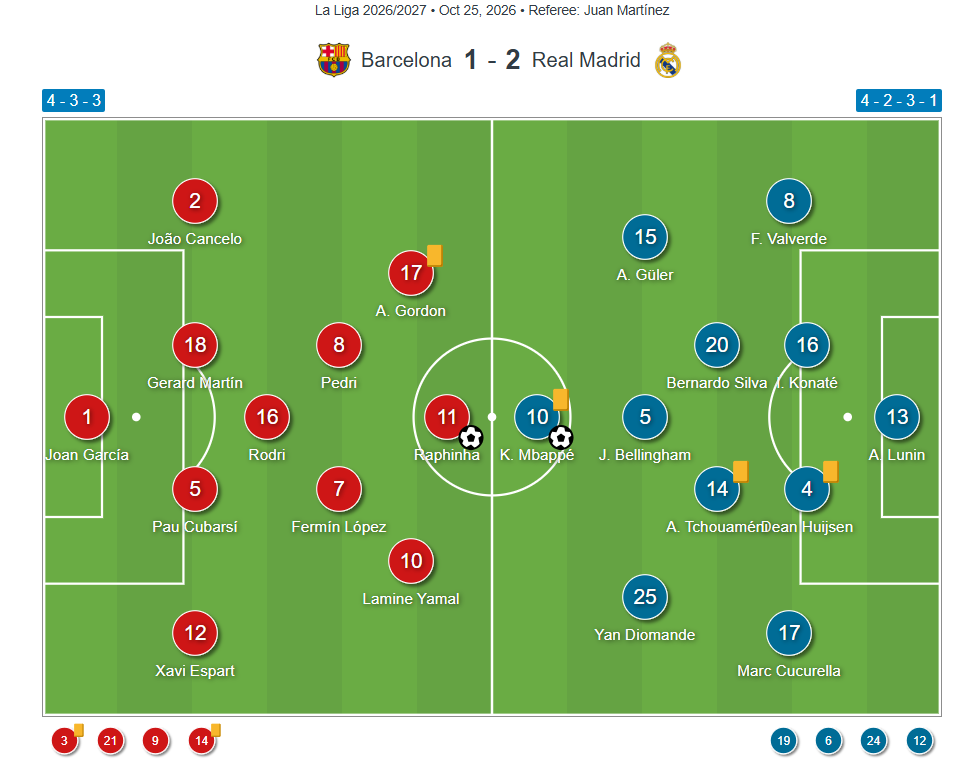
Barcelona Lineup Vs Real Madrid
Hansi Flick lined up with a 4-2-3-1 formation that could sometimes become a 4-3-3 formation.
Joan García started in goal.
Their back four had Pau Cubarsí as a right centre-back, while Gerard Martín operated as the left centre-back, flanked by Xavi Espart on the right and João Cancelo on the left as full-backs.
Rodri and Pedri started as the two central midfielders, with Fermín López playing as a No. 10.
Lamine Yamal was Barcelona's right winger, with Anthony Gordon on the left wing, and Raphinha as the striker.
The German coach made four substitutions in the match.
Alejandro Balde (30′) came on for Xavi Espart, while Frenkie de Jong (74′) came on for Fermín López.
Gabriel Jesus and Karim Adeyemi (86′) were introduced for Raphinha and Anthony Gordon.
Real Madrid Lineup Vs Barcelona
José Mourinho lined up with a 4-2-3-1 formation too.
Andriy Lunin started in goal.
Madrid's back four were Dean Huijsen and Ibrahima Konaté as right and left centre-backs, with Federico Valverde and Marc Cucurella as the right and left full-backs, respectively.
Bernardo Silva and Aurélien Tchouaméni started in central midfield, with Jude Bellingham as the advanced playmaker.
Arda Güler and Yan Diomande started on the right and left wings, with Kylian Mbappé as the striker.
The Portuguese coach made four substitutions in the match, too.
Denzel Dumfries (62′) came on for Federico Valverde, and Eduardo Camavinga (80′) came on for Bernardo Silva.
Trent Alexander-Arnold and Carlos Espí (90′) were introduced for Arda Güler and Yan Diomande.
How Did Real Madrid Find Their Way To The Barcelona Goal?
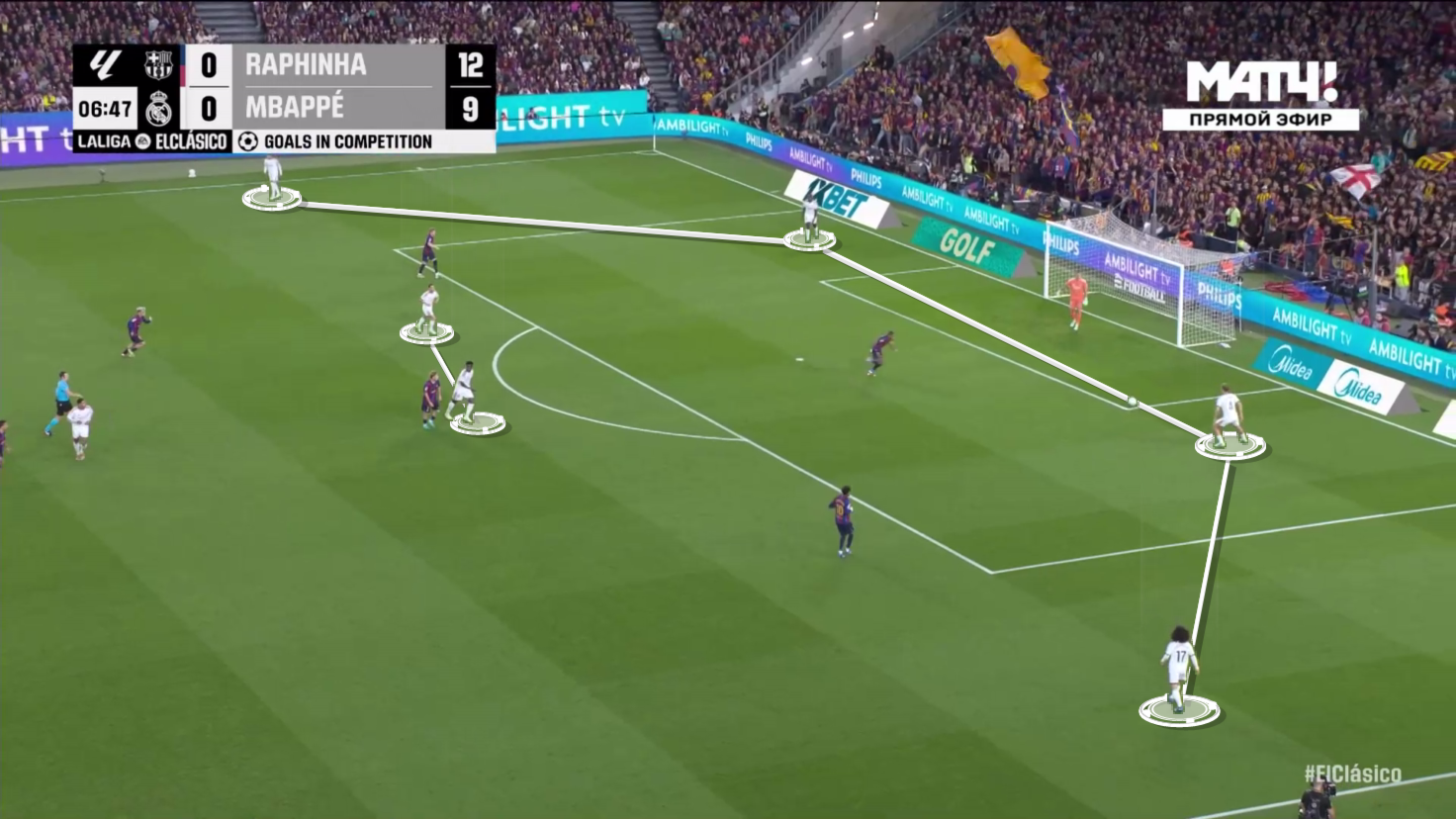
In their build-up, Real Madrid adopt a 4-2 shape, with the two centre-backs forming the first line and the two sixes positioned alongside the full-backs in the second line.
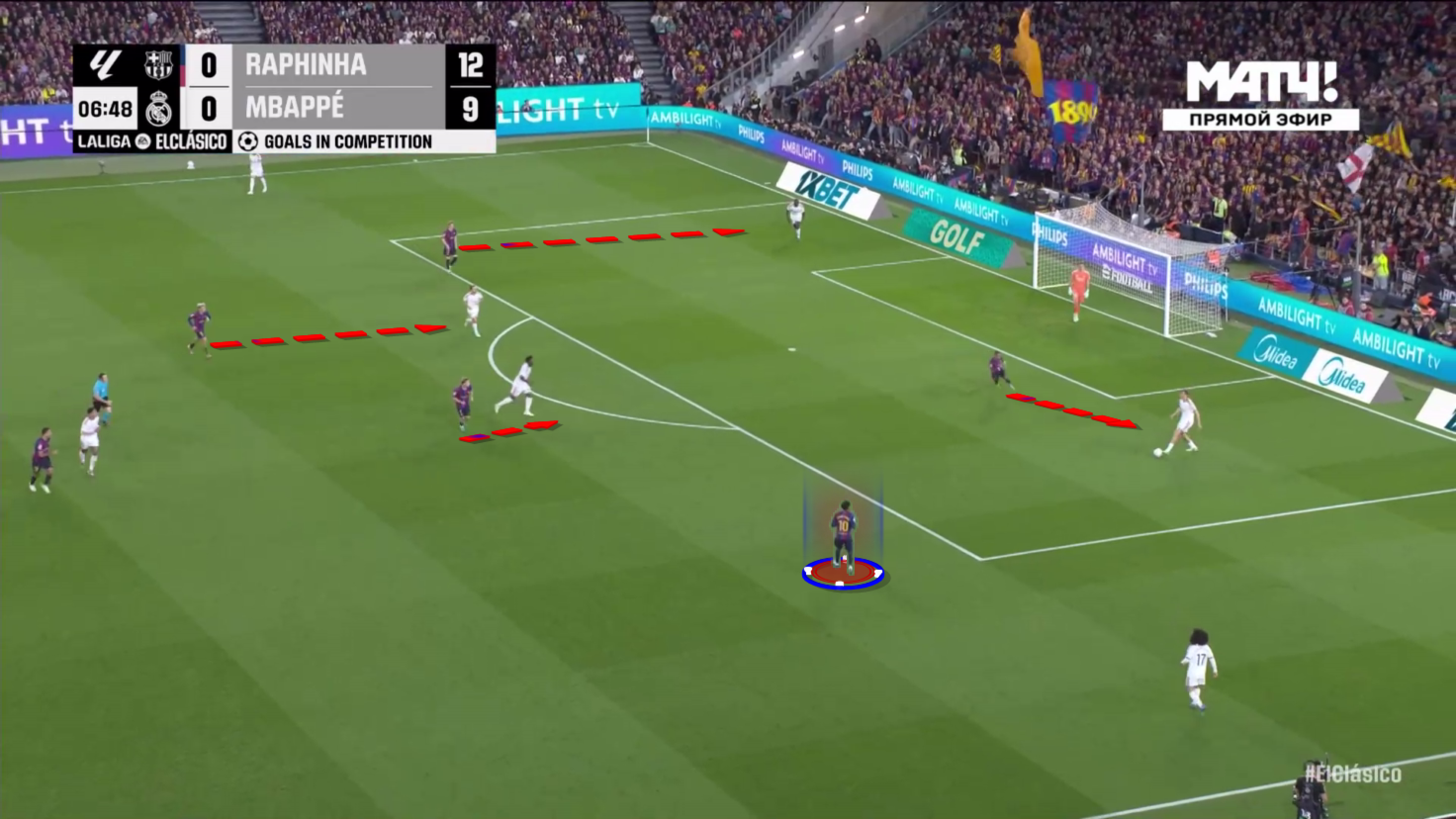
Against this shape, Barcelona used a man-marking approach during goal kicks, which they could use to influence how Real Madrid started their build-up.
Raphinha pressed the ball carrier, while Lamine Yamal marked Huijsen when he received the ball, with the passing lane back to goalkeeper Lunin also closed.
The three midfielders marked Madrid’s three midfielders, while Anthony Gordon tracked Ibrahima Konaté.
This left Yamal positioned near the box and Real Madrid’s left-back, while also closing the vertical passing lane into the channel.