
![Bologna Vs AS Roma [0–2] – Serie A 2025/2026: Gian Piero Gasperini Counterattacks Keep Champions League Chase Alive – Tactical Analysis](https://cdn.mymidnight.blog/77f959f119f4fb2321e9ce801e2f5163/size/w1000/2026/04/Bologna-Vs-AS-Roma-20252026.png)
Bologna Vs AS Roma [0–2] – Serie A 2025/2026: Gian Piero Gasperini Counterattacks Keep Champions League Chase Alive – Tactical Analysis

Bologna hosted AS Roma at the Renato Dall'Ara Stadium in Gameweek 34 of Serie A 2025/2026.
The match ended in a decisive win for I Giallorossi, putting them only three points behind Juventus, who are holding fourth spot.
This win comes at a delicate time, following Roma's struggles in recent fixtures, especially their draw with Atalanta and a disappointing loss to Inter Milan.
Roma will need to give their best in what’s left of the season to snatch that UEFA Champions League spot, especially since their four remaining matches include an encounter against Fiorentina, an away match at Parma, a derby against Lazio at home, and a final match against Hellas Verona.
Even though this final calendar can be tricky, especially with the derby game and the complicated trip to Verona, Roma can still hope to win all four games to put pressure on Juventus and Como.
On the other hand, Vincenzo Italiano Bologna will fail to finish the season in a European spot, despite not having a negative season overall.
The European participation definitely had an impact on the team, since they are not used to playing midweek games and, more importantly, do not have the squad depth needed to compete in both tournaments without compromising quality.
Bologna should learn from this experience and try to reinforce their squad in the summer in order to be more competitive in Serie A.
In this tactical analysis, we focus mainly on Roma’s attacking performance, their reliance on counterattacks, and how they created issues for Bologna’s defence through this plan.
Bologna Vs Roma Lineups & Formations
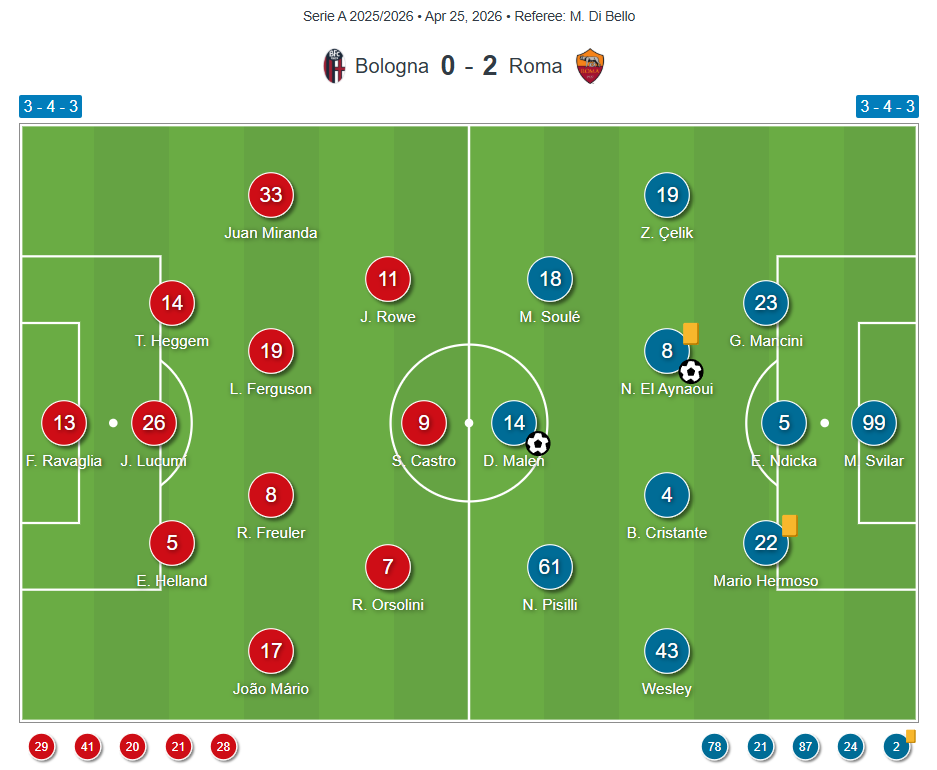
AS Roma Lineup Vs Bologna
Gian Piero Gasperini started the match in his preferred 3-4-2-1 formation, with Mile Svilar in goal and a defensive line of three centre-backs: Gianluca Mancini on the right, Evan Ndicka in the centre, and Mario Hermoso on the left.
The midfield line featured Wesley França and Zeki Çelik as left and right wing-backs, with Bryan Cristante and Neil El Aynaoui as central midfielders.
In attack, Gasperini used both Matías Soulé and Niccolò Pisilli as right and left-sided wide playmakers, with Donyell Malen as the team’s striker.
Bologna Lineup Vs AS Roma
Vincenzo Italiano started the match in a 3-4-3 formation, with Federico Ravaglia as goalkeeper, a defensive line of Torbjørn Heggem, Jhon Lucumí, and Eivind Helland as centre-backs, with João Mário and Juan Miranda as wing-backs.
The midfield consisted of Remo Freuler and Lewis Ferguson as central midfielders, Riccardo Orsolini and Jonathan Rowe as wide playmakers/wingers, with Santiago Castro being the main striker.
Roma Efficient Direct Counterattacking Performance
Roma started the match more direct on the ball, knowing that surprising Bologna with quick, direct attacks or counterattacks would make their mission easier against a side that can be tough to score against, especially as time goes by.
In other words, Roma tried to, and succeeded in, scoring a goal very early to oblige Bologna to advance and leave space in behind.
Roma Exploitation Of Bologna High Defensive Line
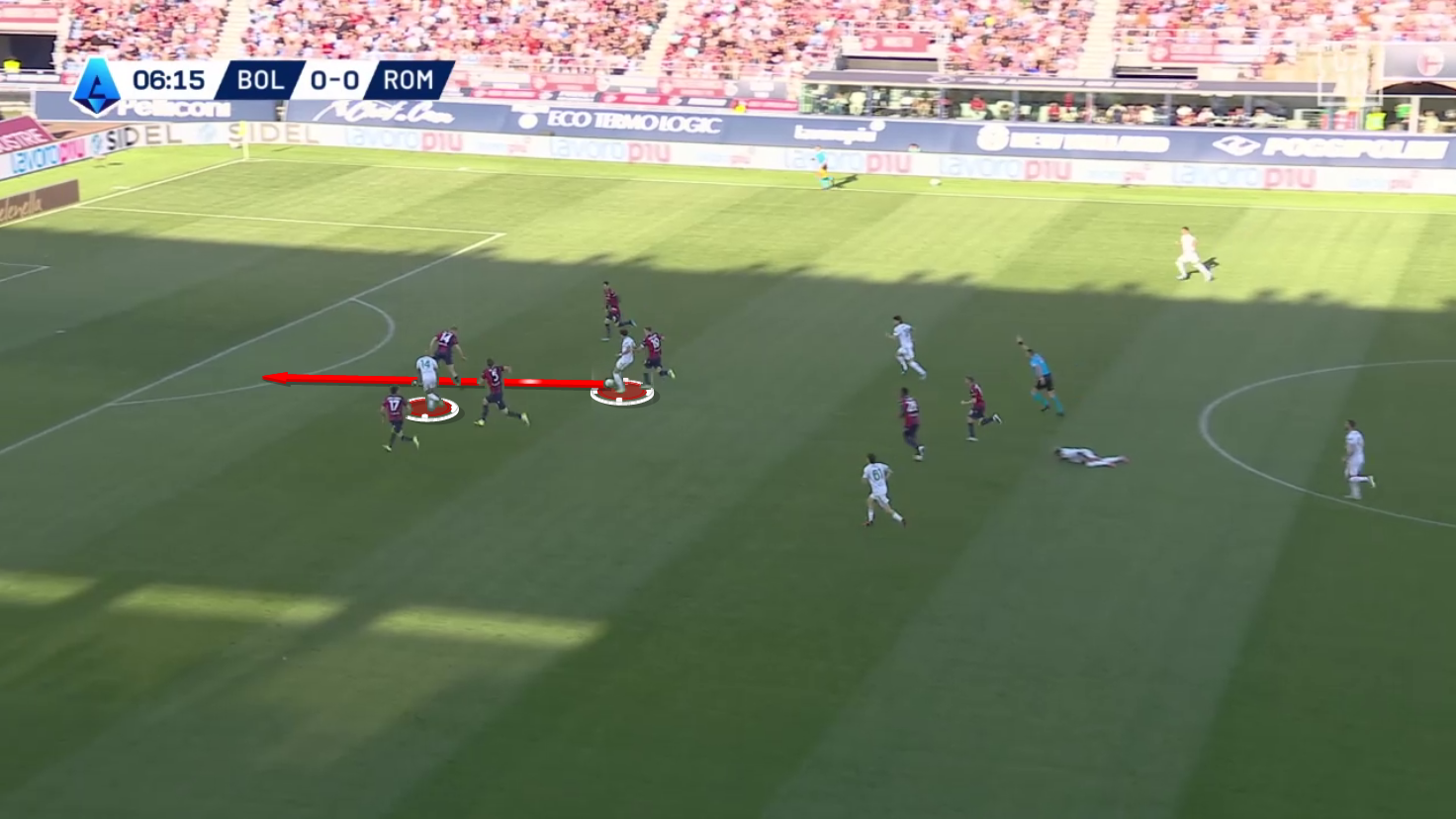
Roma succeeded in executing their plan in the sixth minute, when they intercepted a free-kick pass and exploited the fact that Bologna’s defensive line was very high at the moment of the free-kick by launching a quick counterattack that led to the first goal of the match.
Roma’s goal saw some quick short passes between Cristante, Malen, and El Aynaoui before trying to serve França on the left wing.
Despite Mário’s interception of that pass, França succeeded in intercepting the ball and exploiting the spaces left behind Bologna’s defensive line, with El Aynaoui coming from behind to accelerate the attack and provide a perfect key pass assist to the direction of Malen’s run.
The latter was very skilful and decisive in his run without the ball, before advancing the ball using the outside of the foot, paving the way for himself to finish with mastery before the goalkeeper reaches him, while doing all this before the defenders get closer to him as well.
The goal highlights the importance of such a clinical striker to Roma’s attacking performances, as his finishing and way of dealing with similar complicated attacking situations made the difference for the team on many occasions this season.
Roma Rewarding Reliance On Donyell Malen
The early goal gave Roma the needed boost and confidence to play with greater ease, circulate the ball more efficiently, and continue pressing high on Bologna’s players when out of possession.
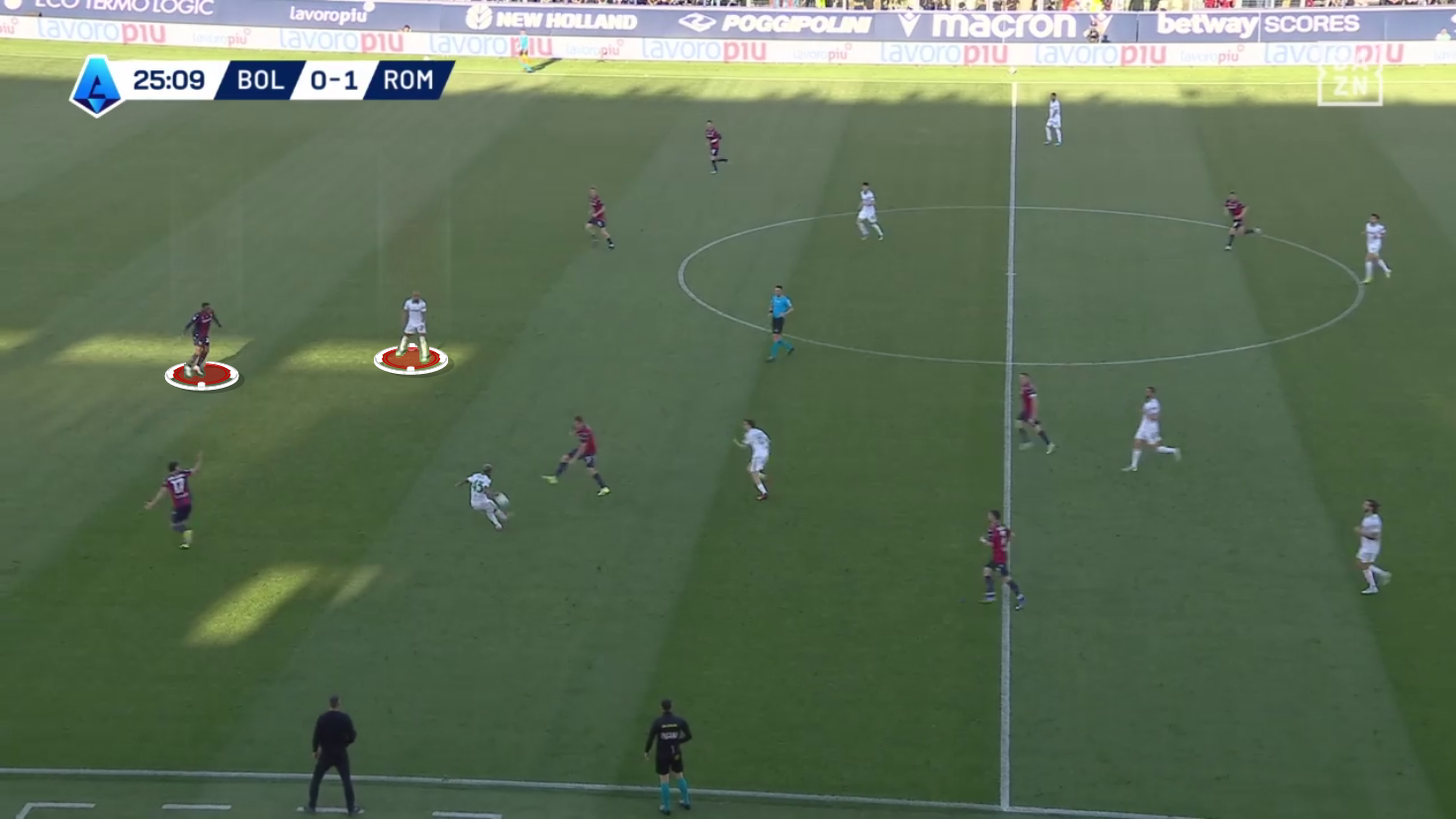
Roma’s main sources of attacking threat were centred around Malen and serving him with key passes in space or when he retreats.
In both cases, Malen was able to keep his distance from his direct markers, block them, turn, and accelerate to pave the way for himself to finish on goal.
The problem for Bologna’s man-marking of Malen was keeping way more distance than needed from Malen, something that helped the latter in executing his plans with ease and against an inefficient disturbance.
During this second dangerous action, which closely resembled the first goal action, Lucumí left too much space for Malen to receive the ball, as he did not apply tight marking on him when the pass was launched.
This helped Malen a lot in making a dribbling decision before Lucumí gets close to him.
Malen’s decision to accelerate and touch the ball to get past Lucumí was taken before Bologna’s defender started to run towards Malen, and that made a huge difference in Malen's advantage.
He succeeded in getting past Lucumí but failed to execute a spectacular lobbed shot accurately, missing a huge chance to add a second goal early in the game.
The action stresses Bologna’s passive man-marking of Malen and the consequences for Bologna’s defence, while highlighting the importance of relying on Malen to receive short passes, whether at the back of the defensive line or when he retreats to the edge of the final third.
![Real Sociedad Vs Bournemouth [1-2] Europa League 2026/2027: How Do Marco Rose Pressing Tactics Work? - Tactical Analysis](https://cdn.mymidnight.blog/77f959f119f4fb2321e9ce801e2f5163/size/w600/2026/09/Real-Sociedad-Vs-Bournemouth-20262027---Tactical-Analysis-1.png)
![AC Milan Vs Benfica [0-2] Europa League 2026/2027: How Marco Silva Tactics Exposed Rúben Amorim Defensive Problems - Tactical Analysis](https://cdn.mymidnight.blog/77f959f119f4fb2321e9ce801e2f5163/size/w600/2026/09/AC-Milan-Vs-Benfica-20262027---Tactical-Analysis.png)
![Sunderland Vs AZ Alkmaar [1-0] Europa League 2026/2027: Why The Black Cats Make Better Underdogs - Tactical Analysis](https://cdn.mymidnight.blog/77f959f119f4fb2321e9ce801e2f5163/size/w600/2026/09/Sunderland-Vs-AZ-Alkmaar-20262027---Tactical-Analysis.png)
![Leeds United Vs Newcastle United [4-1] Premier League 2026/2027: Why Did Daniel Farke Tactics Dominate The Magpies? - Tactical Analysis](https://cdn.mymidnight.blog/77f959f119f4fb2321e9ce801e2f5163/size/w600/2026/09/Leeds-United-Vs-Newcastle-2026_2027---Tactical-Analysis.png)
![Real Sociedad Vs Atlético Madrid [0-3] La Liga 2026/2027: How Diego Simeone Tactical Precision Rescued A Late Victory - Tactical Analysis](https://cdn.mymidnight.blog/77f959f119f4fb2321e9ce801e2f5163/size/w600/2026/09/Real-Sociedad-Vs-Atl--tico-Madrid-20262027---Tactical-Analysis-1.png)
![Manchester United Vs Manchester City [0-1] Premier League 2026/2027: How Enzo Maresca Tactics Secured Victory With 10 Men - Tactical Analysis](https://cdn.mymidnight.blog/77f959f119f4fb2321e9ce801e2f5163/size/w600/2026/09/Manchester-United-Vs-Manchester-City--20262027---Tactical-Analysis.png)
![Tottenham Hotspur Vs Everton [0-0] Premier League 2026/2027: Why Can't Spurs Score? - Tactical Analysis](https://cdn.mymidnight.blog/77f959f119f4fb2321e9ce801e2f5163/size/w600/2026/09/Tottenham---Vs-Everton-20262027---Tactical-Analysis.png)
![West Ham United Vs Wrexham [6-0] EFL Championship 2026/2027: The Cost Of Passive Defending Against Smart Movement - Tactical Analysis](https://cdn.mymidnight.blog/77f959f119f4fb2321e9ce801e2f5163/size/w600/2026/09/West-Ham-United-Vs-Wrexham-2026_2027---Tactical-Analysis.png)