Dissecting Sevilla's Structural Decline: La Liga 2025/2026 – Data Analysis

Sevilla FC’s 2025/2026 La Liga campaign has evolved into a turbulent battle for survival rather than a pursuit of European qualification.
Once regarded as one of Spain’s most structurally stable clubs, Sevilla have endured a season defined by inconsistency, managerial instability, and underperformance relative to expectations.
The dismissal of Matías Almeyda in March, following a poor run of results, highlighted the severity of their decline, with the team sitting just above the relegation zone at the time.
Luis García Plaza has since been appointed in an attempt to stabilise performances and secure safety, but the margins remain extremely tight in a congested lower table.
This Sevilla FC data analysis will explore Sevilla’s underlying performance levels, tactical issues, and structural inefficiencies, while also contextualising their position within a highly competitive relegation battle in La Liga this season.
Sevilla’s Tactical Instability & Ongoing Relegation Struggles
Sevilla’s 2025/2026 La Liga campaign remains precariously balanced in the lower mid-table, with their survival still not mathematically secure after 31 matches.
They sit on 34 points from nine wins, seven draws and 15 defeats, placing them just above the relegation cluster.
This return is marginally below their expected points total of 35.8, underlining a slight but persistent underperformance across the season.
La Liga Relegation Battle - Performance Vs Expectation
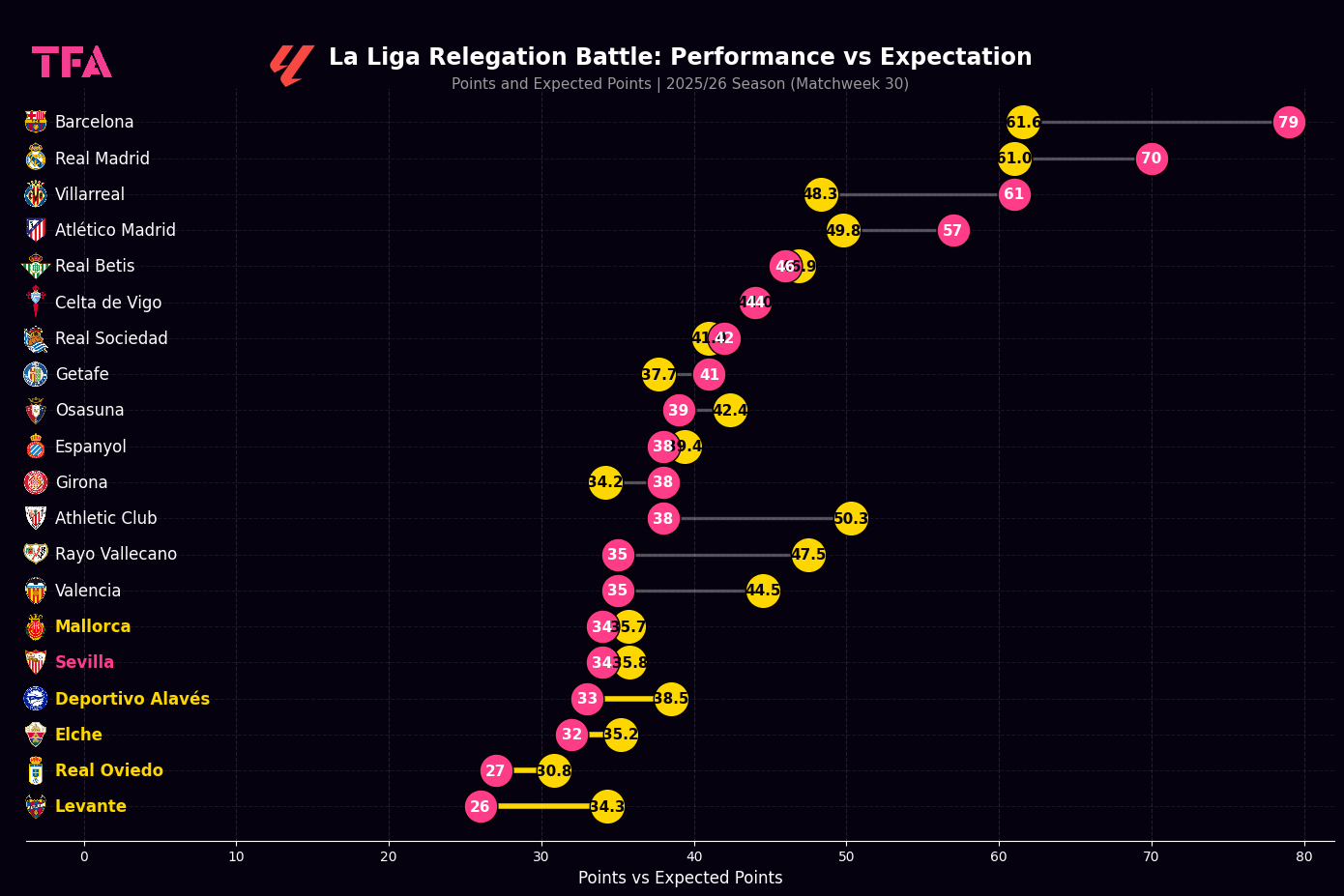
The standings remain extremely congested, with Sevilla effectively part of a six-team battle alongside RCD Mallorca, Deportivo Alavés, Elche, Real Oviedo and Levante.
Even after recent results elsewhere, including Atlético Madrid’s rotated victory narrative, the broader picture remains unchanged for Sevilla.
They occupy a tense mid-lower position, where fine margins determine whether they drift upwards or remain entangled in survival pressures.
With only a handful of fixtures remaining, Sevilla’s trajectory will depend heavily on consistency in both defensive structure and chance conversion.
These are areas that have repeatedly fluctuated throughout the campaign under successive managerial changes and ongoing tactical adjustments across multiple formations, ultimately undermining sustained upward momentum.
Sevilla’s Tactical Instability Through Constant Structural Shifts
One of the most defining features of Sevilla’s 2025/2026 campaign has been the extreme tactical inconsistency reflected in their formation usage.
Over the course of the season, Sevilla have deployed 11 different formations, each with varying structural demands and positional responsibilities, highlighting a clear lack of tactical continuity.
Sevilla FC Tactical Setups Across 31 La Liga Matchweeks 2025/2026
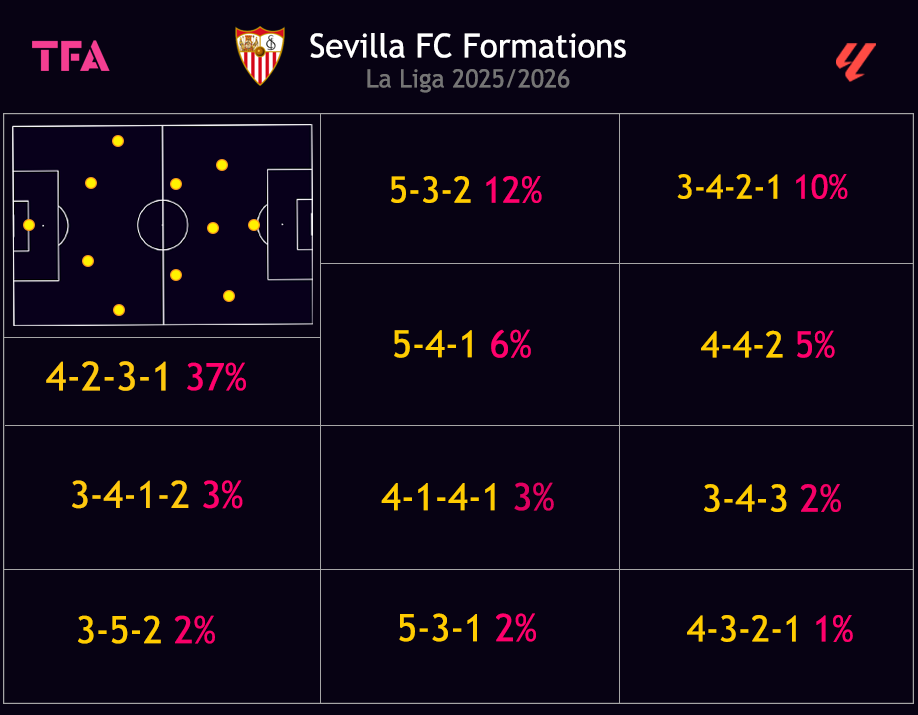
The most frequently used system, the 4-2-3-1 (37%), suggests an initial preference for a balanced structure with double-pivot stability and advanced central occupation; this foundation has been repeatedly abandoned.
The use of back-five systems, such as the 5-3-2 and 5-4-1, indicates reactive adjustments aimed at defensive solidity, often associated with teams under pressure in the lower half.
These structures typically reduce central vulnerability but at the cost of attacking presence and progression quality.
Simultaneously, Sevilla have experimented with hybrid and transitional shapes like the 3-4-2-1 and 3-4-3, which require well-drilled wing-back dynamics and coordinated pressing structures, elements difficult to establish without consistency.
Even more sporadic systems, including the 4-4-2, 4-1-4-1, and 3-4-1-2, further underline the absence of a stable tactical identity.
This constant structural fluctuation disrupts player role clarity, automatisms, and collective cohesion.
The lack of a fixed framework has likely contributed to Sevilla’s inconsistent performances, leaving players tactically disoriented and unable to build sustainable on-pitch relationships.
Sevilla’s Chance Creation Efficiency & Finishing Output Within La Liga’s Relegation Battle
Sevilla’s attacking profile in the 2025/2026 La Liga season reflects a team operating on the margins of offensive efficiency, with an expected goals (xG) total of 35.85 and an actual return of 39 goals, indicating a slight overperformance in finishing despite relatively modest chance creation volume.
La Liga 2025/2026 Goals Vs Expected Goals - Finishing Efficiency Across La Liga Teams
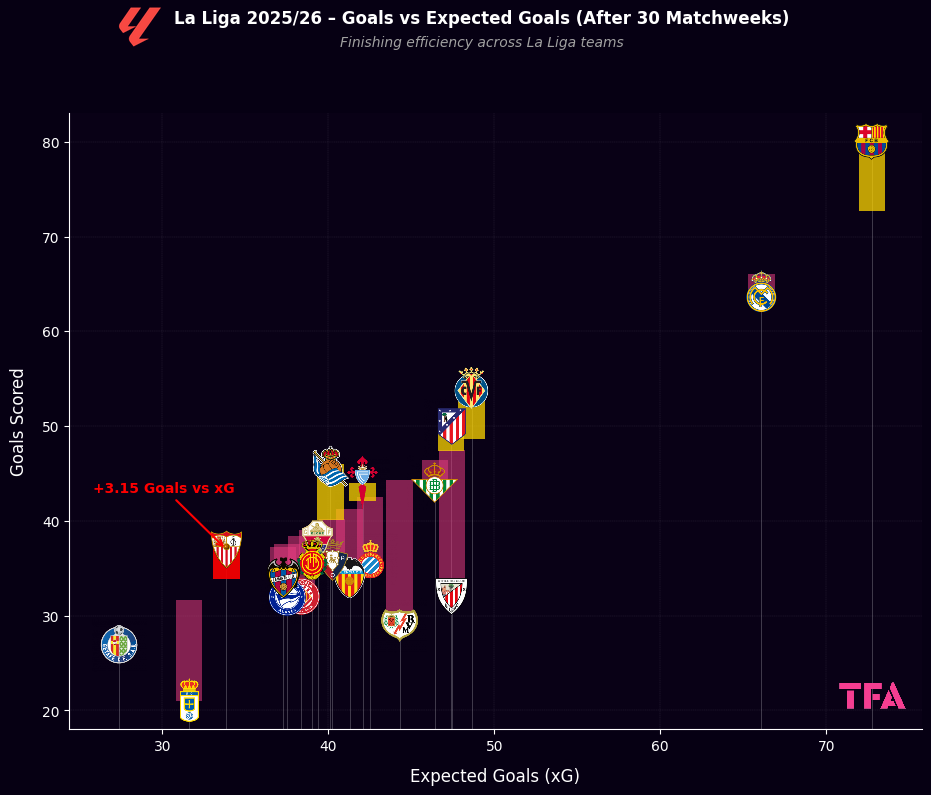
Compared to direct relegation rivals such as Mallorca, Deportivo Alavés, Levante, Elche, and Real Oviedo, Sevilla’s underlying numbers suggest a lack of sustained attacking pressure rather than inefficiency in conversion.
Structurally, their fluctuating systems have limited their ability to consistently generate high-quality chances, particularly in settled possession, where automatisms and positional relationships are critical.
While their marginal overperformance in goals scored provides short-term compensation, it is not a reliable indicator of long-term attacking stability.
In contrast, teams like Elche and Mallorca demonstrate more stable chance creation frameworks, even if their finishing remains inconsistent.
This imbalance leaves Sevilla vulnerable, without a significant increase in chance volume or structural attacking coherence; their reliance on overperformance may regress, reinforcing their precarious position within the relegation battle.
Sevilla’s Pressing Intensity & Territorial Control: Interpreting PPDA Dynamics In La Liga 2025/2026
Sevilla’s underlying defensive and territorial profile can be effectively interpreted through their PPDA (9.13) and PPDA against (11.78), both of which offer insight into the quality of their pressing and their ability to sustain possession in advanced zones.
Ranking third-lowest in PPDA in the league behind Barcelona and Rayo Vallecano, Sevilla demonstrate a relatively aggressive pressing approach, allowing fewer passes per defensive action.
La Liga 2025/2026 PPDA Vs PPDA Against - Pressing Structure & Defensive Intensity Across Teams
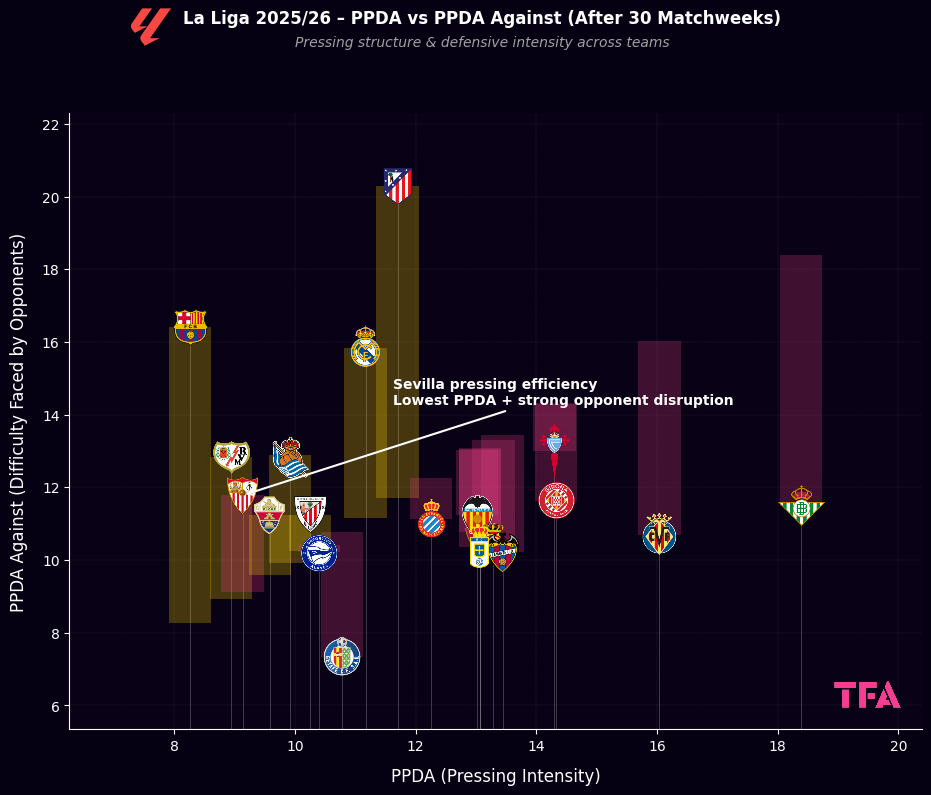
This suggests a proactive out-of-possession structure, often engaging higher up the pitch rather than retreating into passive mid-blocks.
Players such as Djibril Sow operate as the primary reference point within Sevilla’s midfield structure, supported by rotational profiles like Lucien Agoumé.
This midfield configuration provides a functional balance between intensity and control, with Sow’s mobility and defensive coverage underpinning Sevilla’s pressing phases.
Meanwhile, Agoumé offers physical presence and ball-winning support when selected.
This blend of a consistent core and adaptable supporting roles allows Sevilla to maintain vertical compactness and initiate pressing triggers through central zones, albeit without the full stability of a fixed, consistently deployed midfield unit.
However, their PPDA Against figure of 11.78 reveals a more nuanced picture; while not among the league’s elite in territorial dominance, it still indicates a moderate capacity to circulate possession under pressure, particularly within the final 60% of the pitch.
This reflects a team capable of sustaining controlled spells but lacking the consistency of high-possession sides.
The balance between an assertive press and only average resistance to opposition pressure highlights Sevilla’s broader structural issue: intensity without sustained control.
This combination continues to define their fragile position in the relegation battle.
Sevilla’s On-Ball Rhythm, Possession Cadence, & Build-Up Efficiency
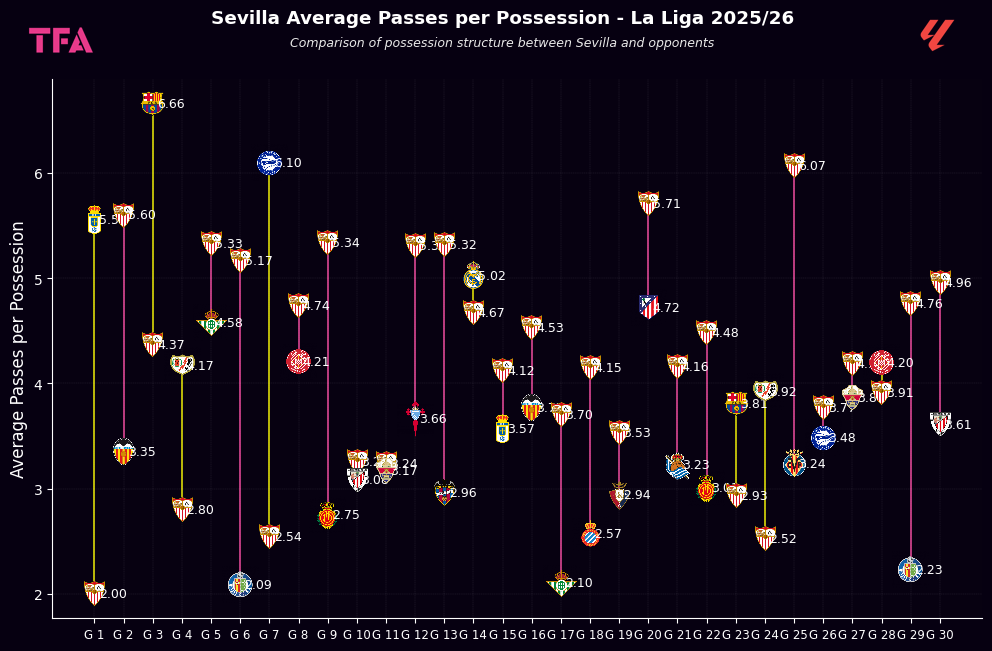
Sevilla’s in-possession profile across the 2025/2026 campaign reflects a side oscillating between controlled circulation and fragmented build-up, with passes per possession and match tempo serving as key indicators of their structural coherence.
The highlighted matches in pink, where Sevilla outperformed opponents in passes per possession, tend to correlate with their more stable performances, suggesting improved control, longer sequences, and a clearer positional framework.
In contrast, the fixtures marked in yellow expose the opposite dynamic, where opponents dictated possession flow, forcing Sevilla into shorter, more direct sequences and reducing their ability to establish rhythm.
Sevilla Average Passes Per Possession Vs Opponents - La Liga 2025/2026