
Serie A 2025/2026: The Tactical Trends Behind Italy’s Decline – Data Analysis

Over the past decade, Serie A has experienced a tactical renaissance that helped restore the league’s reputation as one of Europe’s most intellectually sophisticated football environments.
Innovative structures built by coaches such as Luciano Spalletti and Gian Piero Gasperini transformed the league into a space where positional rotations, aggressive pressing systems and complex build-up mechanisms flourished.
Teams became increasingly creative in how they manipulated man-oriented defensive schemes, particularly through adventurous centre-back movements and fluid occupation of central spaces.
However, the recent return to more rigid, conservative structures has gradually reduced the league’s tactical dynamism.
This regression has not only impacted the entertainment value and attacking productivity of the league, but has also coincided with declining European competitiveness and an alarming rise in low-event football, reflected in Serie A producing more goalless draws than any other major league.
In this data analysis, we will analyse the tactical trends behind Serie A’s current decline, examine how traditionalism has reshaped the league’s strategic identity, and explore how these structural problems have ultimately contributed to the Italian National Football Team's failure to qualify for the FIFA World Cup for the third consecutive time in 2026.
Sterile Circulation & The Decline Of Vertical Progression
One of the clearest tactical symptoms behind Serie A’s regression is the increasing reliance on sterile possession and wide circulation rather than direct vertical progression through central zones.
The passing distribution data highlights this issue clearly, with the overwhelming majority of passes concentrated in the middle third before being redirected towards the flanks instead of penetrating through the centre.
Serie A 2025/2026 Successful Pass Distribution By Pitch Third
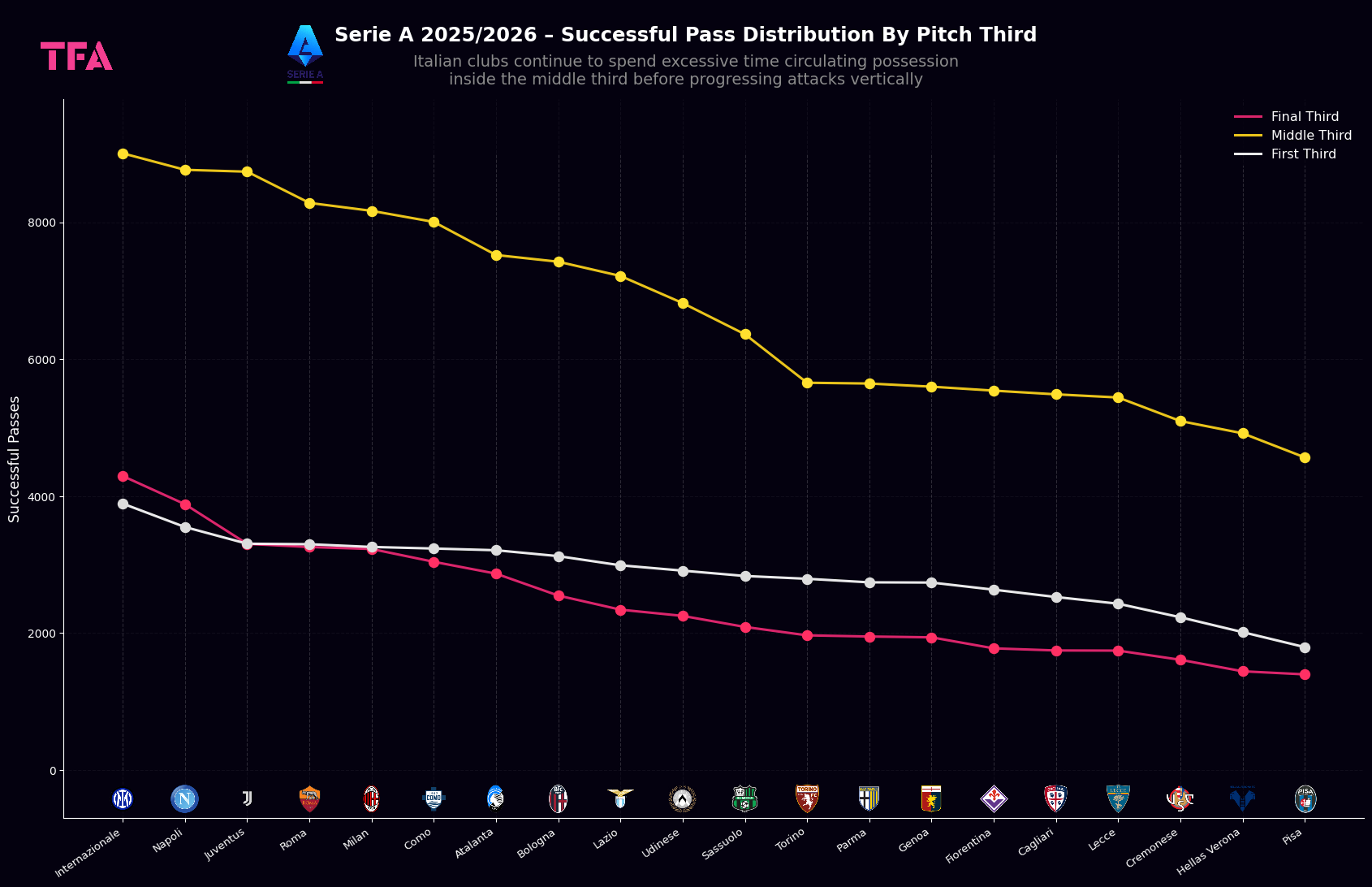
Once teams enter the final third, the tendency becomes even more extreme, as attacks increasingly develop in a U-shaped structure around the defensive block rather than through it.
Around three-quarters of progression occurs through wide areas, while over 80% of entries into the final third arrive from lateral channels rather than central combinations.
Modern defensive structures across Italian football have become extremely compact and man-oriented, reducing distances between players and congesting central spaces.
However, while Serie A sides maintain considerable pressing intensity, many lack coordinated pressing traps or efficient counterpressing mechanisms capable of generating dangerous central recoveries.
As a result, possession often becomes slow, repetitive and horizontally focused, with circulation prioritised over penetration.
The consequence is a league increasingly dominated by low-event football, limited central access and reduced attacking unpredictability.
Italy's performance against Northern Ireland perfectly reflected the structural limitations increasingly visible throughout Serie A.
Despite dominating possession for long periods, Italy struggled to generate consistent vertical access through the central zones, instead circulating possession along the flanks and deeper in the midfield in a highly predictable U-shaped structure.
Italy’s Pass Map Shows A Clear U-Shaped Structure with Most Circulation Focused Across The Flanks & Middle Third
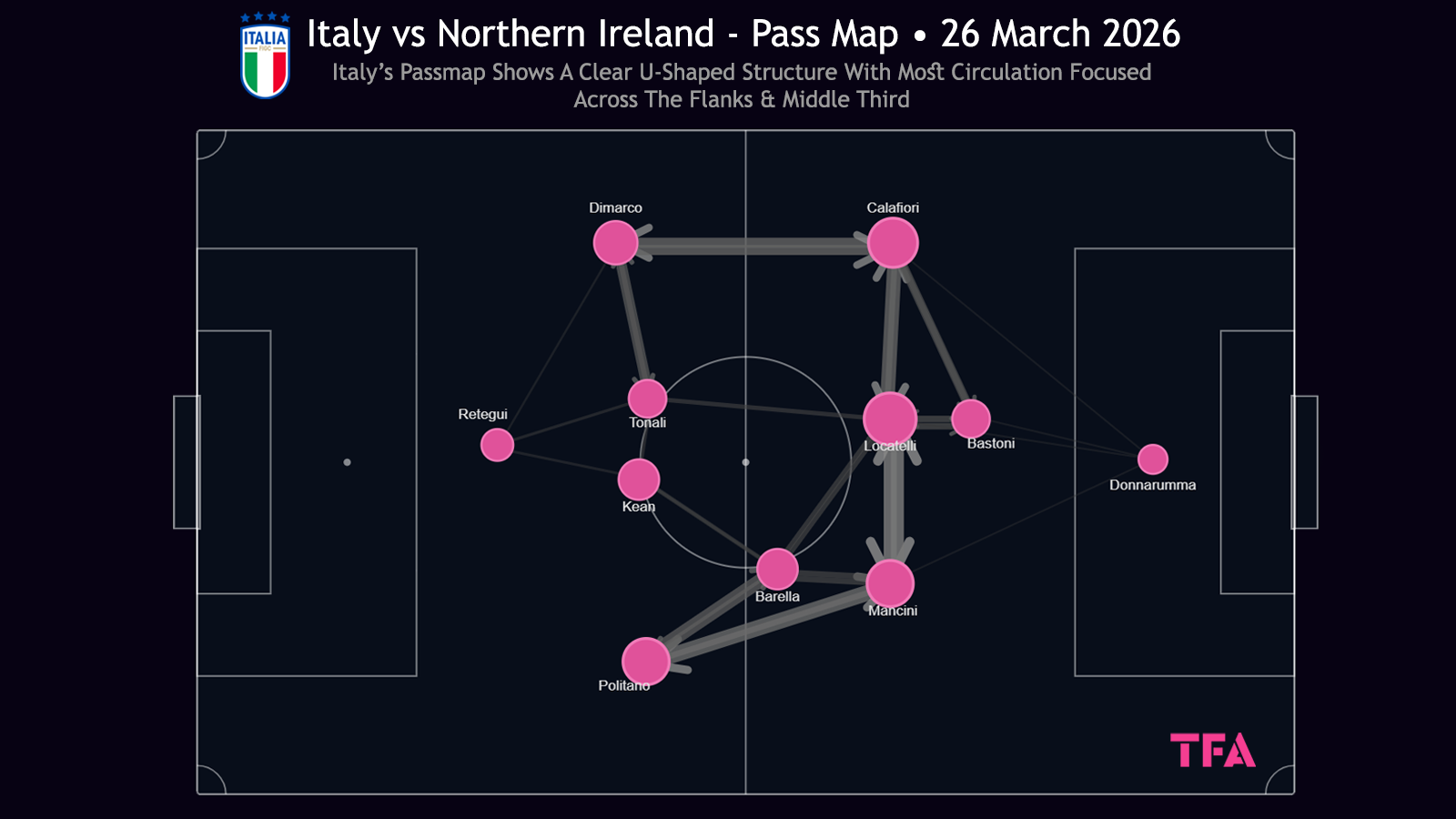
The midfield became disconnected during build-up phases, with Manuel Locatelli frequently dropping alongside the centre-backs, Nicolò Barella drifting into deeper right-sided positions, and Sandro Tonali remaining isolated from the rest of the structure.
This hollowed-out midfield removed central passing angles and left Italy with minimal occupation between the lines, despite operating within a system theoretically designed to encourage vertical progression.
The result was sterile dominance; Italy controlled 71% possession during the first half, and Northern Ireland produced a comparable number of zone 14 passes and only seven fewer half-space connections.
Rather than destabilising the opposition block through dynamic central combinations, Italy continuously recycled possession wide without sufficient penetration, mirroring many of the tactical issues currently limiting the evolution of Italian club football.
Serie A’s Creative Passing Decline Compared To Europe’s Elite
Another major indicator of Serie A’s tactical regression is the volume of smart passes produced by Italian clubs compared with the rest of Europe’s top-five leagues.
Smart passes, progressive and creative deliveries designed to break defensive lines or generate attacking advantages, have become increasingly associated with the most dynamic positional teams in Europe.
Serie A’s Clubs Creative Passing Crisis Compared To Europe’s Elite 2025/2026 Season
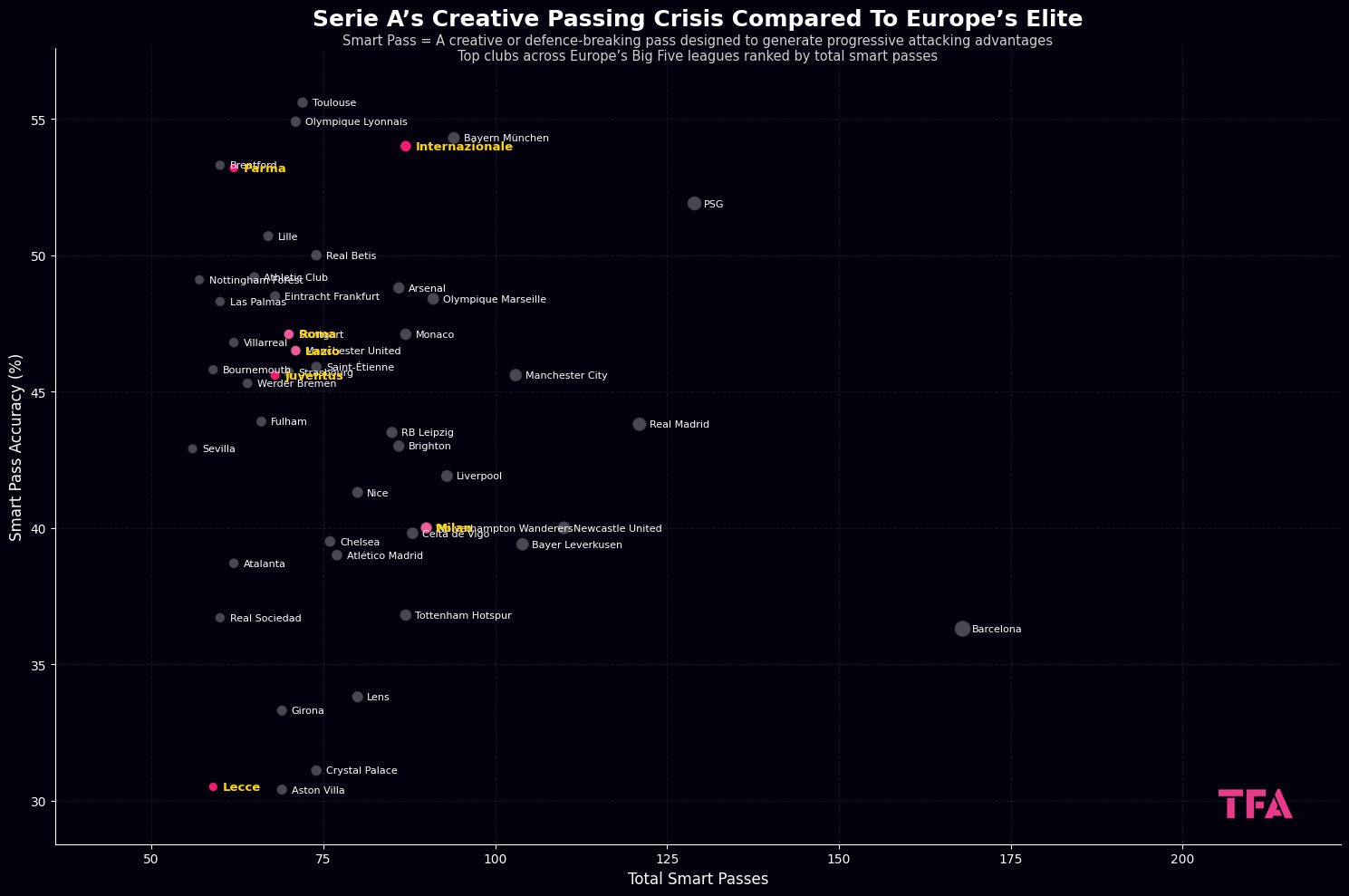
FC Barcelona lead the rankings with 168 smart passes, followed by Paris Saint-Germain (129), Real Madrid (121) and Newcastle United (110), all sides built around fluid positional occupation, aggressive rotations and vertical access through central zones.
The highest-ranked Italian side is AC Milan in ninth place with 90 smart passes under Massimiliano Allegri, whilst Inter Milan sit 13th with 87 under Cristian Chivu.
Beyond them, the drop becomes dramatic, Lazio rank 27th (71), AS Roma 30th (70), Juventus 34th (68), while Atalanta, once considered one of Europe’s most vertically aggressive sides under Gian Piero Gasperini, have fallen to 41st with only 62.
Even more concerning is Napoli's position in 50th place with just 56 smart passes.
The broader trend highlights a league that is increasingly dependent on safe circulation and territorial control rather than on disruptive creativity.
While Europe’s elite continue prioritising dynamic central progression and risk-taking combinations, many Italian sides now favour structural stability and controlled possession, reducing both attacking unpredictability and the frequency of decisive line-breaking actions.
The Growing Pressing Divide Between Serie A’s Elite & Lower Blocks
Another structural issue accelerating Serie A’s tactical regression is the enormous disparity in pressing behaviour between the league’s elite sides and its smaller clubs.
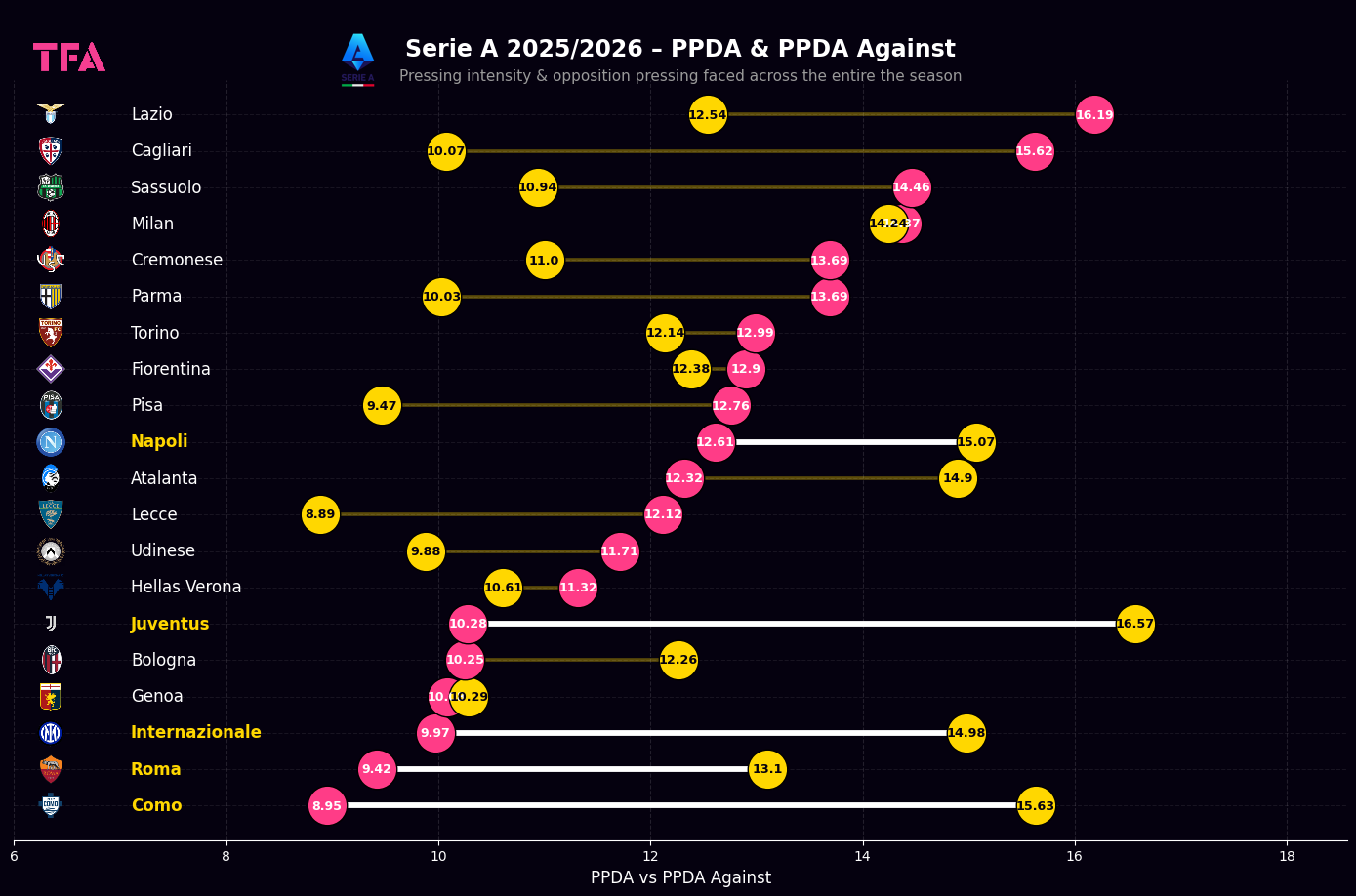
The 2025/2026 PPDA data highlights a division in which stronger teams generally maintain lower PPDA Against figures, aggressively limiting opposition circulation, whilst also sustaining relatively controlled pressing structures themselves.
Serie A 2025/2026 Pressing Intensity & Opposition Pressing Faced Across The Entire Season