Thomas Tuchel Tactics At England 2026: Explaining The Three Lions' Controversial World Cup Lineup – Data Analysis

When Thomas Tuchel accepted the England job in October 2024, the expectation surrounding the national team was clear: anything short of winning the 2026 FIFA World Cup would be viewed as failure.
Before a ball has even been kicked in North America, Tuchel’s first major controversy has already emerged through his squad selection.
The omissions of Phil Foden, Cole Palmer and Trent Alexander-Arnold immediately sparked debate across England, with many questioning how some of the country’s most gifted and creative footballers could be excluded from such a decisive tournament squad.
However, this appears to be far more than a simple form or fitness decision; Tuchel’s selections suggest a deliberate tactical reconstruction of England’s identity.
The inclusion of players such as Morgan Rogers, Noni Madueke, Djed Spence, Elliot Anderson and Jordan Henderson points towards a squad designed around athleticism, structural discipline, defensive reliability and transitional intensity rather than individual improvisation.
This data analysis examines the tactical and statistical reasoning behind Tuchel’s controversial decisions, exploring whether England are moving away from luxury creators towards a more functional, controllable and tournament-oriented football model.
Creative Risk Vs Structural Stability
The statistical profile of England’s omitted creators strongly supports the idea that Thomas Tuchel is prioritising structural security over individual expression.
Phil Foden, Cole Palmer and Trent Alexander-Arnold remain among the country’s most technically gifted footballers; the data consistently highlights the tactical instability that accompanies their creativity.
Cole Palmer & Trent Alexander-Arnold Stand Out Among England Players Across Europe’s Top-Five leagues 2025/2026
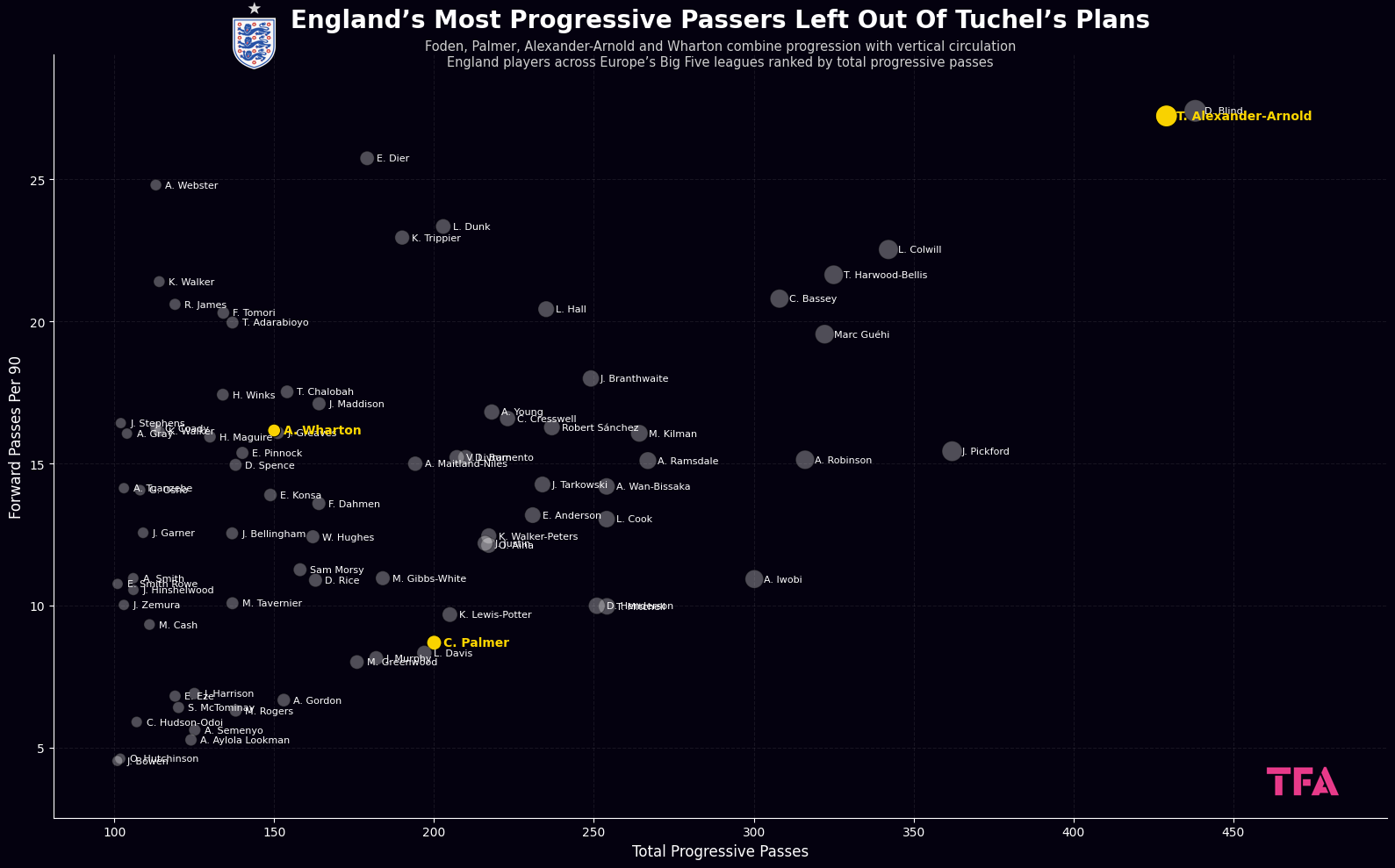
Palmer attempts 8.69 progressive forward passes per 90, but completes only 67.7% of them, while Alexander-Arnold records 27.23 forward passes per 90 with just 67.5% accuracy and only 43.7% success on long distributions.
These numbers reflect a highly aggressive vertical approach designed to accelerate attacks immediately, but they also increase the likelihood of possession losses in structurally vulnerable areas of the pitch.
Foden similarly operates with constant risk-taking between the lines, regularly attempting ambitious combinations and progressive carries in congested central zones.
Although these actions generate attacking unpredictability and moments of individual brilliance, they simultaneously expose the team to transitional instability whenever possession is lost.
In tournament football, where defensive spacing and structural compactness often determine success, Tuchel appears increasingly reluctant to build his system around players whose creativity naturally introduces tactical disorder and uncontrolled possession sequences.
Why Was Trent Alexander-Arnold Excluded From The England Squad?
Among all of Tuchel’s controversial omissions, Trent Alexander-Arnold’s exclusion may be the clearest reflection of England’s growing tactical shift towards defensive reliability and structural control.
Although Alexander-Arnold remains one of the most progressive passers in world football, the defensive data exposes a significant contrast between his profile and the more functionally stable full-backs selected by Tuchel.
England Full-Back Defensive Comparison 2025/2026
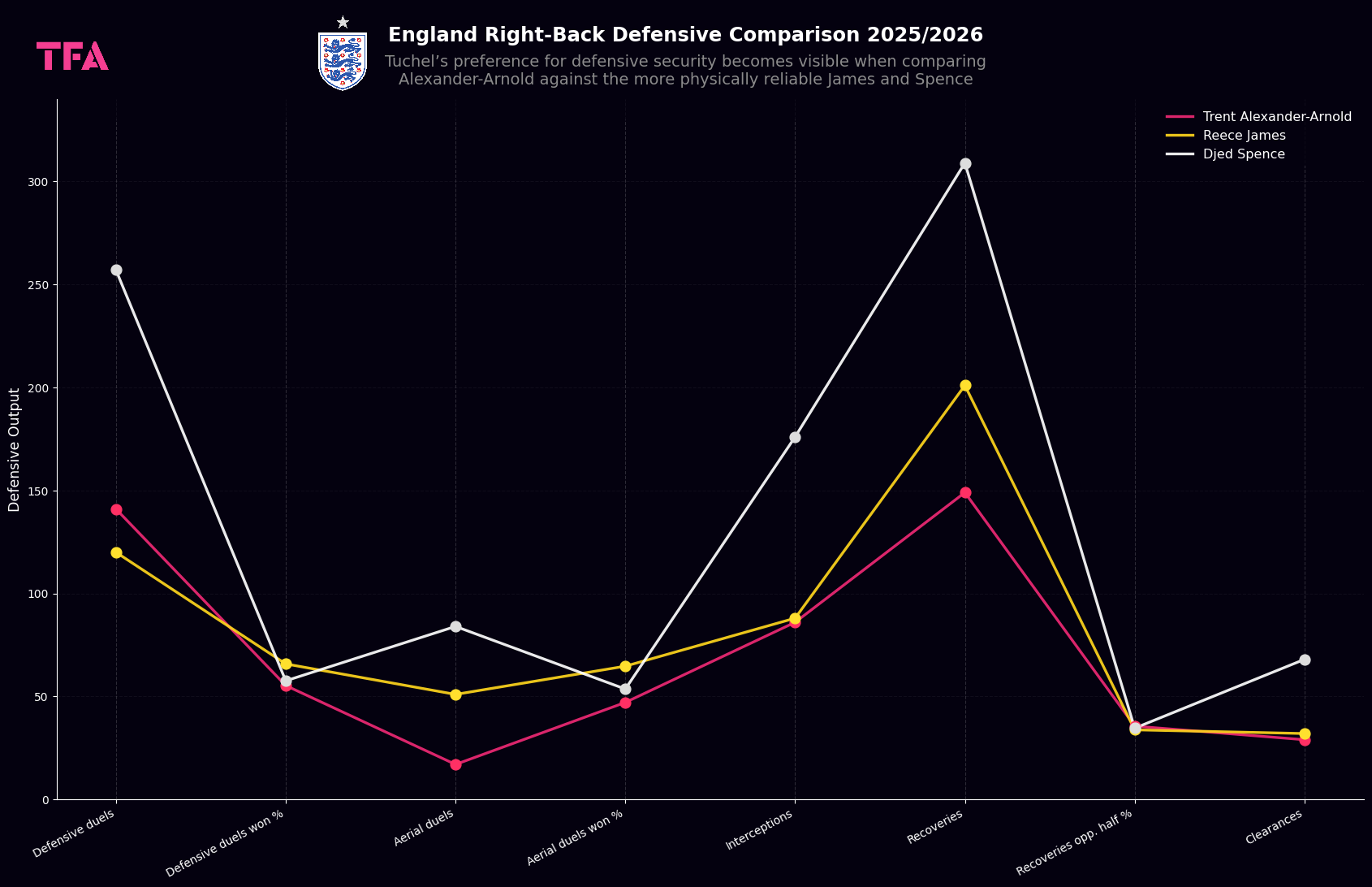
Trent records 141 defensive duels with a success rate of 55.3%, alongside only 17 aerial duels throughout the season with a modest 47.1% win rate.
In comparison, Reece James wins 65.8% of his defensive duels and dominates aerially, with a 64.7% success rate across 51 aerial contests.
The contrast becomes even more extreme when compared to Djed Spence, whose defensive volume completely surpasses Alexander-Arnold’s profile, recording 257 defensive duels, 176 interceptions, 309 recoveries and 68 clearances during the campaign.
These numbers highlight the core tactical issue surrounding Trent within a tournament structure.
Tuchel appears to prioritise full-backs capable of defending large spaces, consistently recovering possession, and maintaining defensive compactness during transitions.
While Alexander-Arnold offers unmatched creativity and vertical distribution, his overall defensive profile lacks the physical intensity, duel dominance and recovery security displayed by James and Spence.
In knockout football, where transitional moments often decide entire tournaments, Tuchel seemingly values defensive control and structural reliability above creative risk from deep areas.
Defensive Commitment & Functional Discipline
The contrast with several of Tuchel’s selected profiles is particularly revealing from a defensive and structural perspective.
Players such as Morgan Rogers, Elliot Anderson, Jordan Henderson and Noni Madueke demonstrate far stronger off-the-ball reliability and tactical discipline throughout the underlying data.
Rather than constantly forcing ambitious vertical actions, these players maintain more controlled circulation, safer decision-making and greater defensive engagement during transitional phases.
Madueke, for example, completes 77% of his forward passes while also contributing significantly more consistently within pressing sequences and defensive recoveries.
Elliot Anderson similarly offers lower-risk circulation alongside aggressive counter-pressing behaviour and strong duel intensity, attributes that align directly with Tuchel’s preference for compactness and collective organisation.
Thomas Tuchel’s England Prioritises Defensive Commitment Over Creative Freedom
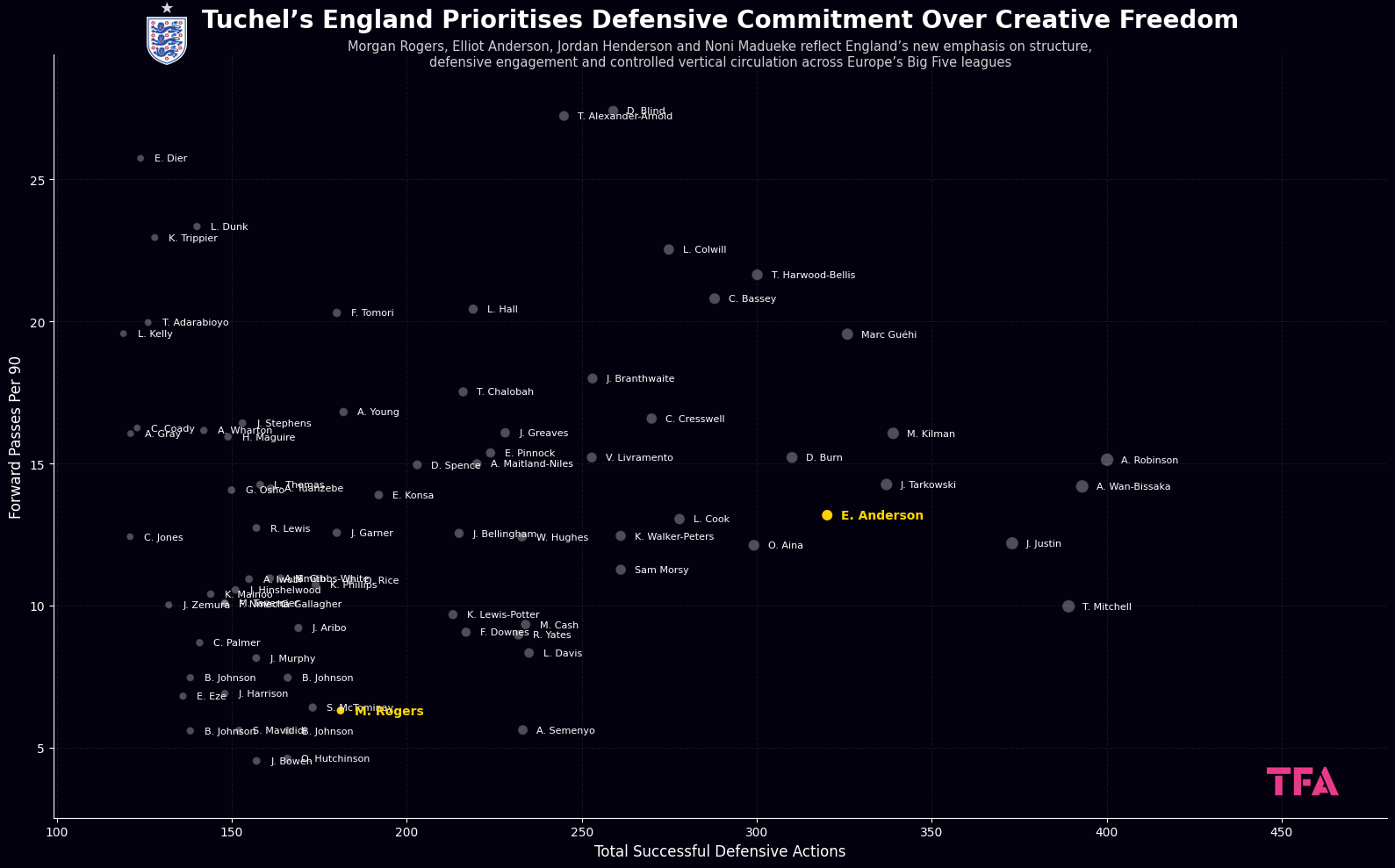
Morgan Rogers combines physical carrying power with substantial defensive duel involvement, allowing England to preserve athletic intensity without sacrificing structural balance.
Even Jordan Henderson’s inclusion reflects this broader tactical philosophy, with his positional discipline and communication valued more highly than unpredictable attacking invention.
Tuchel is not simply selecting the most talented footballers available, but rather constructing a squad capable of maintaining collective control, defensive spacing and transitional security across every phase of tournament football.
England's Adam Wharton Dilemma
Unlike the exclusions of Phil Foden, Cole Palmer or Trent Alexander-Arnold, Adam Wharton’s omission presents a far more complex tactical dilemma within Tuchel’s reconstruction of England.