
Manchester City Vs Napoli [2-2] Champions League 2026/2027: How Max Allegri Attacking Tactics Troubled Enzo Maresca - Tactical Analysis
Manchester City and Napoli drew 2-2 in the Champions League. This tactical analysis examines how Massimiliano Allegri’s side exploited City’s slow build-up through patient possession, high recoveries, quick counterattacks and the De Bruyne-Politano partnership.

Manchester City hosted Napoli at the Etihad Stadium for their fifth fixture of the 2026/2027 UEFA Champions League’s League phase, and the match ended in a 2-2 draw, with both teams in the midst of a relatively negative period.
Napoli had the lead twice, but Manchester City were able to equalise on both occasions.
This match showed that Massimiliano Allegri and his team have the tools to disrupt any team, but only if they want to and play with a progressive approach rather than a very defensive one.
The problem with this team is that they have been overly defensive in the first part of this season, and that prevented them from earning as many points as their opponents.
This match should serve as a reference for them to start changing their tactics and being more attack-minded for the rest of the season, as their patient build-up, attacking transitions, and high-pressing efforts helped them punish a powerful team in Manchester City.
On the other hand, Enzo Maresca’s team failed to impose their game despite having more possession, as the lack of chemistry and inability to cope well with the three-centre-back possession phase were impactful.
It was a real test for Manchester City’s progress, especially ahead of a big Premier League clash with Arsenal.
The players showed a lot of personality and desire to complete a comeback.
Yet, this game also highlighted the team’s defensive weaknesses under pressure and their slow build-up from the back.
In this tactical analysis, we focus on Napoli’s solutions to counter Manchester City’s slow build-up and exploit the space left at the back.
Manchester City Vs Napoli Lineups & Formations
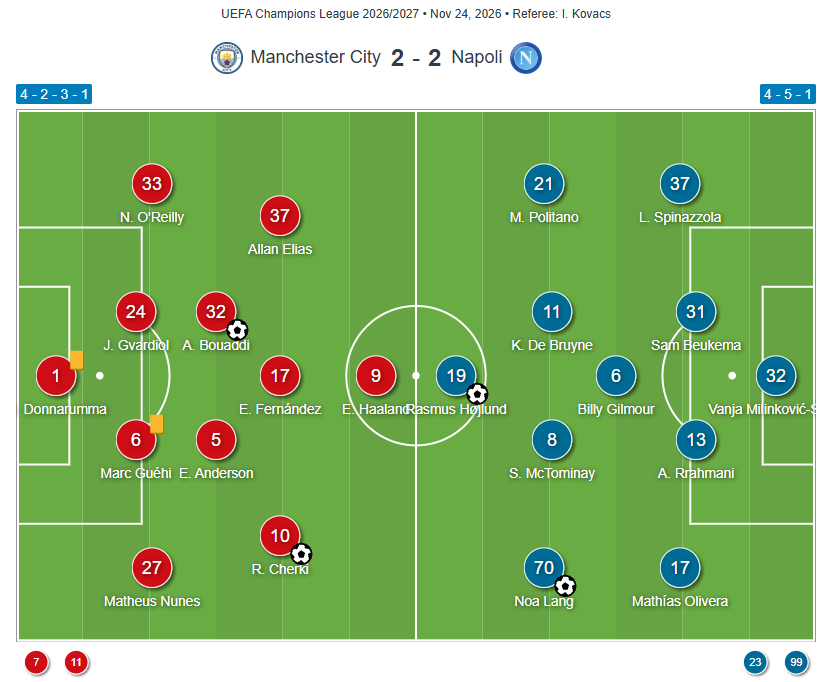
Manchester City Lineup Vs Napoli
Maresca opted for a 4-2-3-1 formation, using Gianluigi Donnarumma as goalkeeper, Marc Guéhi and Joško Gvardiol as centre-backs, Matheus Nunes as right-back, and Nico O'Reilly as left-back.
In midfield, he relied on Ayyoub Bouaddi, Enzo Fernández, and Elliot Anderson as central midfielders, with Bouaddi often playing the defensive role, and both Anderson and Fernández advancing more often to support the attacks.
In attack, Rayan Cherki and Allan played on the wings, while Erling Haaland was used as the main striker.
Napoli Lineup Vs Manchester City
For Napoli, Allegri relied on a 4-5-1 formation, with Vanja Milinković-Savić in goal and a back four of Sam Beukema and Amir Rrahmani at centre-back, Leonardo Spinazzola at right-back, and Mathías Olivera at left-back.
In midfield, he used Billy Gilmour as the defensive midfielder, with Scott McTominay and Kevin De Bruyne as central midfielders, and Noa Lang and Matteo Politano as wide playmakers supporting the striker, Rasmus Højlund.
Napoli Counterattacking
Manchester City immediately started the match with an ambitious attacking plan based on progressive possession and a high press on Napoli’s build-up from the back as soon as Manchester City lost the ball.
Napoli had to resist this intense high press to get out of that danger zone and start their playmaking process more easily, but they failed to do so in the opening minutes of the match due to errors in passing and decision-making in tight areas.
With that said, Manchester City did not exploit Napoli’s errors immediately, as they also committed passing errors that prevented them from attacking in dangerous areas initially.
City's formation and lineup were designed to provide maximum support to Haaland and disrupt Napoli, thanks to the four technical players inside the opposing half.
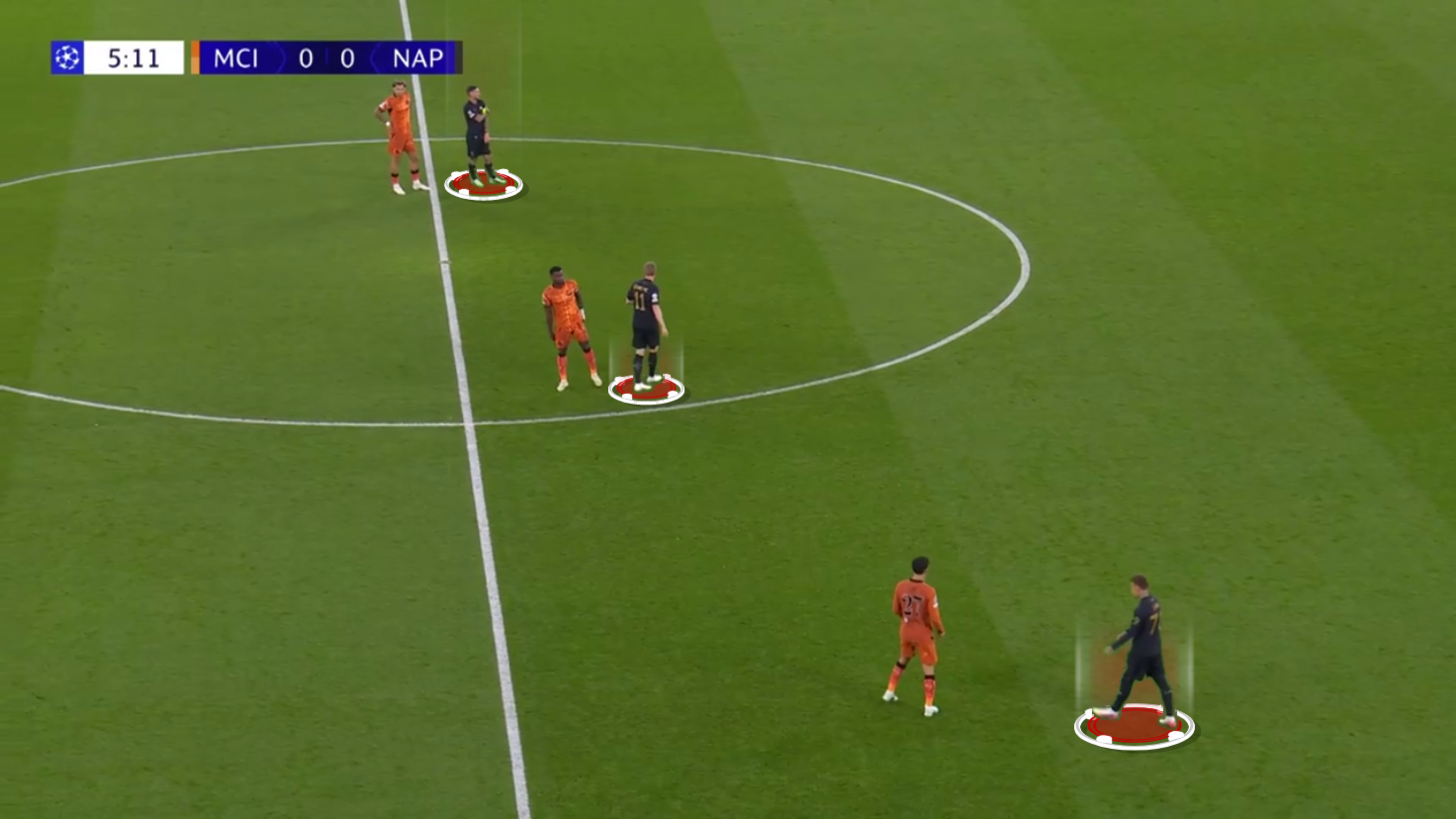
At the same time, it was a risky approach that allowed Napoli to launch dangerous counterattacks, with De Bruyne, Politano, and Lang standing high when Manchester City attacked, especially during corner kicks.
This positioning keeps Manchester City’s three centre-backs busy and keeps Napoli ready to be dangerous whenever they win the ball back inside their own half.
It also prevents those tall centre-backs from advancing and gives City an advantage in aerial duels.
The following picture highlights this advanced positioning from those three Napoli players, whose mission was to defend against the three Manchester City centre-backs, block them from advancing, and be ready to receive any clearance from Napoli’s defenders and turn it into a counterattack.
Napoli Build-Up Under Pressure & Attacking Transitions
Despite Manchester City’s recurrent ambition to have more possession, Napoli gradually became more positive when winning the ball back and progressively started to keep more possession.
Due to Manchester City’s intense high-pressing plan, Napoli knew they needed to be perfect in their build-up from the back and in their attacking transitions to reach Manchester City’s half.
Any errors or lack of accuracy would not only make the team lose possession quickly but also concede dangerous counterattacks and fail to prevent the Citizens from having possession so often.
About 10 minutes into the match, Napoli showed very positive signs of their ability to bypass Manchester City’s press and start attacking.
To do so, they relied on quick, accurate short passing in defence, followed by through passes towards the wings and, if possible, quick switches of play to exploit space on both sides.
The following action highlights Napoli’s ability to avoid Manchester City’s high press and the dangerous impact of the used first-time vertical passes.
In fact, Napoli were patient in their build-up and resisted Manchester City’s interception attempts before finding the best possible vertical passing trajectory.
In particular, it was De Bruyne's first-time through pass to Politano that made the difference in this action and made the attacking transition fluid, as that pass allowed Politano to accelerate and use the space he had while facing Gvardiol in the end.
Gvardiol saved Manchester City from conceding a very dangerous opportunity as he deflected Politano’s cross.
The latter could have done better in this situation, as it was a golden chance to threaten Donnarumma’s goal, given Politano's agility and dribbling skills to beat Gvardiol.
When he noticed Gvardiol planning to block a potential pass or cross, Politano could have cut inside and dribbled past his direct marker to find himself in a perfect shooting position.
But Politano preferred the quicker solution, especially since he noticed his teammates well-positioned inside the box.