

Scott McTominay Scout Report At Scotland & Napoli 2025/2026: Can Tartan Army Advance Past The World Cup Group Stage? – Player Analysis

This weekend, Scotland will kick off their FIFA World Cup campaign against Haiti in what will be their first match in a World Cup finals since France ‘98.
That tournament, 28 years ago, began with a gallant 2-1 loss to Mário Zagallo’s eventual finalists Brazil in the opening game.
The Scotland side at the time had qualified for four out of five major tournaments and had appeared in six of the previous seven World Cups.
Having gone toe to toe against the likes of Ronaldo, Rivaldo, Cafu and Roberto Carlos, it was unthinkable they would go on to miss out on football’s biggest stage for a generation.
Steve Clarke's reign has turned the tide, and Scotland are now approaching their third major tournament out of four.
A key and ever-present member of Clarke’s side has been midfielder Scott McTominay.
Scorer of one of Scotland's most iconic goals ever, and the one that propelled the Scots to the United States, McTominay has been vital in Scotland’s resurgence.
This Scott McTominay scout report and player analysis examines the importance of McTominay, in particular his goalscoring threat, and how the talisman can help his country reach the knockout phase of a major finals for the first time.
Scott McTominay Stats
McTominay has 70 caps for Scotland, winning more than twice the number of games he has lost for his country, and qualifying for three major tournaments.
A quick look at the stats of the players who followed the likes of John Collins, Paul Lambert, and Craig Burley after France ‘98, and never tasted international tournament football, shows how impressive McTominay’s era has been.
The Lancaster-born 29-year-old has scored 15 goals for his country, including two in the most recent qualifying campaign in which no other Scotland player scored more.
Both goals, coming against Denmark and Greece at Hampden Park, were vital in securing Scotland’s progression to the finals.
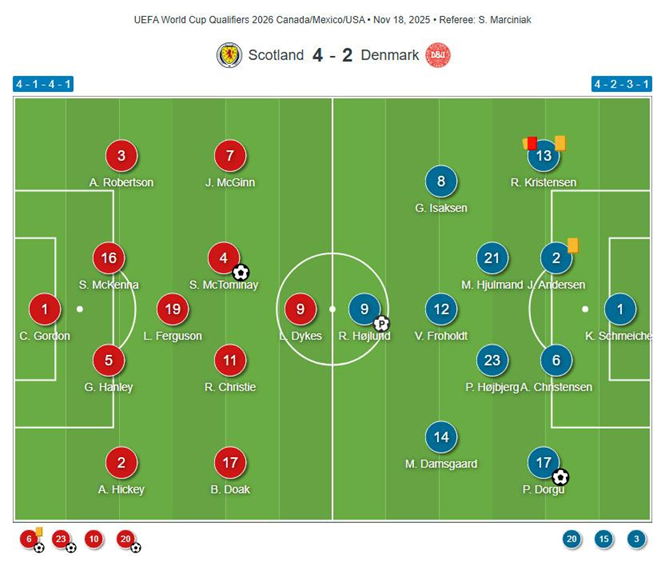
In addition to his goalscoring exploits, McTominay has also played in almost every area of the pitch for Scotland.
Especially in the early days of the Clarke era, it was McTominay who sacrificed his own positional preferences to do a job the team required.
For his club, Napoli, and since the arrival of attacking midfielder Kevin De Bruyne at the start of the 2025/2026 season, McTominay has played mostly in a deeper midfield role.
In the former Manchester United star's first season in Italy, he played close to the striker, even at times becoming a second forward.
This more advanced, attacking position is closer to the role he has performed for Scotland, as shown in the lineup image above from Scotland's final group game.
In the 2025/2026 league campaign, McTominay played 34 matches with Napoli, ending the season as champions.
Individually, McTominay won the Serie A Player of the Year and became the first Scot since Ally McCoist in 1987 to be nominated for a Ballon d'Or.
Scott McTominay Style Of Play
Arriving In The Box
There is no better way of starting an analysis of what McTominay brings to the Scotland side and his place in the hearts of the Tartan Army than with his overhead kick against Denmark.
McTominay’s extravagant strike was the goal that took Scotland to their first World Cup in 28 years.
A moment that has since been immortalised with a mural outside Hampden Park and an image of McTominay on a limited-edition £20 note.
In some minds, it eclipsed the great Archie Gemmill goal against the Netherlands in Argentina ‘78.
It should be remembered that, as glorious as Gemmill's goal was, Scotland ultimately exited the tournament after that match.