
Germany Vs Netherlands [5-0] UEFA Nations League 2026/2027: How Jürgen Klopp Gegenpressing Dismantled Xavi Hernández's Oranje - Tactical Analysis
Germany thrashed the Netherlands 5-0 to win their Nations League group. This tactical analysis examines Klopp’s 3-2-2-3 build-up, aggressive counterpress and second-half wing adjustments that transformed the game.

The UEFA Nations League is not the most popular competition for most fans, but the last matchday of Group A2 had a lot of eyes on it, especially in Germany.
Germany and Netherlands faced off at the Olympiastadion in Berlin on Monday night, with the stage set for a big game between two old rivals.
The first game between the two teams in Amsterdam ended in a 1-1 draw, Jürgen Klopp's first game as the new head coach of the German national team, with Cody Gakpo scoring the equaliser in stoppage time.
Since then, Klopp's team has beaten Serbia twice but also lost against Greece, so coming into the last matchday, Germany were in a tough spot.
The Netherlands had already qualified for the quarter-finals; Germany had not, and after Greece beat Serbia, Klopp and his men needed to win by five goals to finish first in the group.
In the end, Germany won 5-0, the biggest loss for the Netherlands against Germany since 1959, and they are going into the quarter-finals as group winners.
The 5-0 might sound like it was an easy game, but it actually wasn’t, especially in the first half.
At half-time, Germany had only generated 0.22 expected goals; the Dutch had about one more, and in the end Germany had 1.39 xG, way fewer than the five goals they actually scored.
In this tactical analysis, we'll look at how Germany built up, how they won the game with their counterpress, and how they used the wings to good effect in the second half.
Germany Vs Netherlands Lineups & Formations
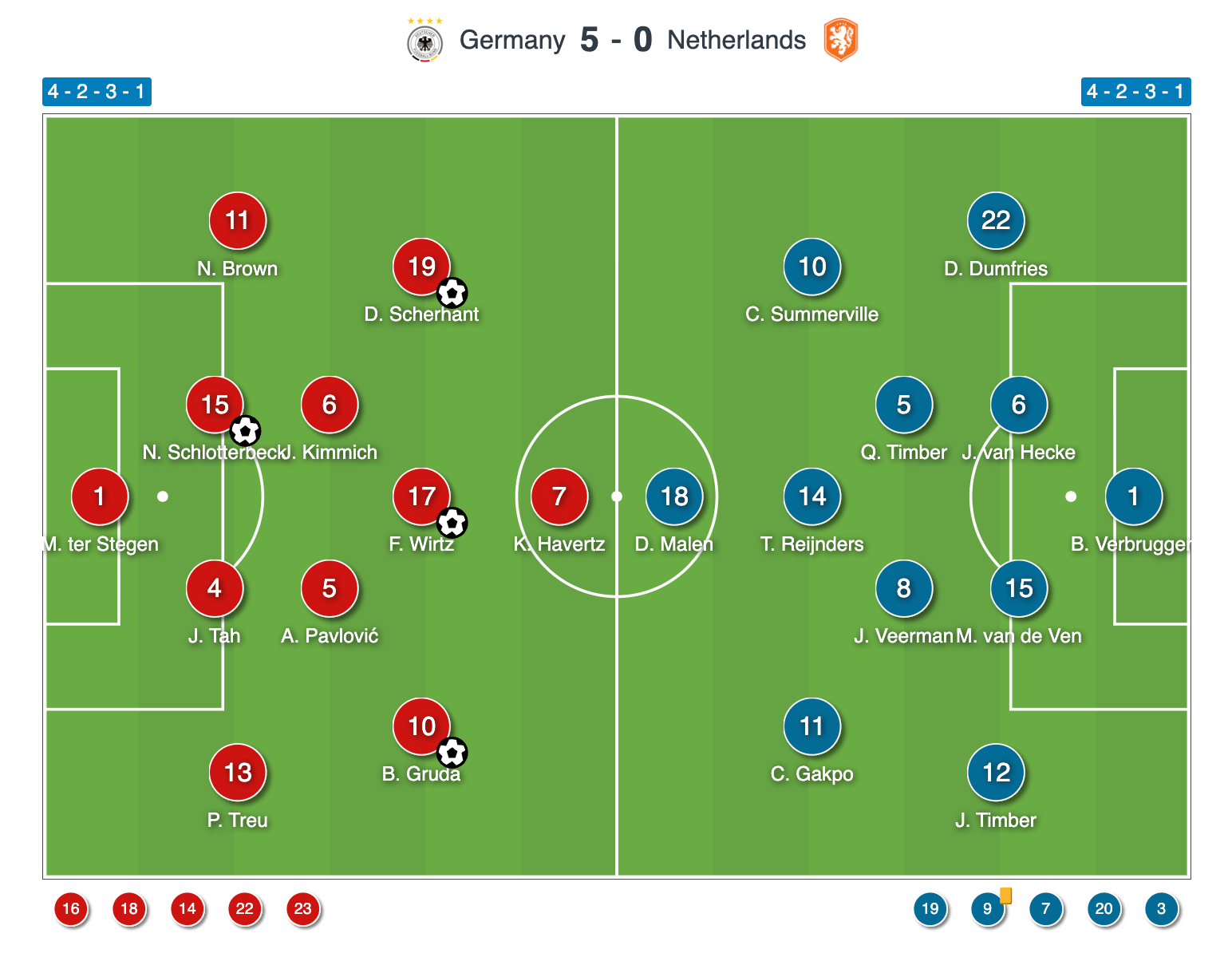
Germany Lineup Vs Netherlands
Klopp didn’t change much after the 3-1 win against Serbia three days prior, and there was no real reason to.
In goal, Marc-André ter Stegen got the start with a back four in front of him consisting of Philipp Treu on the right, Nico Schlotterbeck and Jonathan Tah in the centre, and Nathaniel Brown on the left, ahead of Maximilian Mittelstädt.
Captain Joshua Kimmich and Aleksandar Pavlović played as the double pivot in midfield, with Florian Wirtz as the attacking midfielder ahead of them.
Brajan Gruda played on the right wing for the second game in a row, Derry Scherhant started on the left wing, and Kai Havertz played as the lone striker in the usual 4-2-3-1 formation for Klopp.
After 65 minutes, Mittelstädt and Younes Ebnoutalib came in for Brown and Havertz, before Finn Jeltsch and Tom Bischof replaced Treu and Wirtz 10 minutes later.
Netherlands Lineup Vs Germany
For the away team, Xavi Hernández also opted for a 4-2-3-1 formation.
Bart Verbruggen started in goal, with a back four of Denzel Dumfries, Jan Paul van Hecke, Micky van de Ven and Jurriën Timber defending the space right in front of him.
Joey Veerman and Tijjani Reijnders played as the double pivot, with Cody Gakpo, Donyell Malen, Crysencio Summerville and Quinten Timber in attack.
Germany 3-2-2-3 Build-Up
Looking at what Germany do with the ball, we have to talk about their build-up structure, first and foremost.
The 4-2-3-1 formation only stays a 4-2-3-1 against the ball; as soon as Germany have it, they move into a 3-2-2-3 shape, the same shape they used against Serbia.
Nathaniel Brown is the player who stays back in the first line of play; he moves inside next to Tah and Schlotterbeck and basically plays as a third centre-back on the left side, which is not a spectacular job, but a really important one.
On the right side, Treu did the opposite: he didn't overlap on the wing; he moved diagonally into the right half-space and positioned himself right in front of Kimmich and Pavlović.