
Pep Chavarría Scout Report At Chelsea 2026/2027: Why Did Xabi Alonso Want The 28-Year-Old Left-Back? – Player Analysis
Pep Chavarría is an experienced and attack-minded Spanish left-back. This scout report analyses his expected role at Chelsea, crossing, playmaking, internal penetrations, shooting from distance and how he could replace Marc Cucurella.

Who Is Pep Chavarría?
Weeks after having sold Marc Cucurella to Real Madrid, Chelsea have reached an agreement to acquire the services of Pep Chavarría for a fee of €19m.
Chelsea had been negotiating with Rayo Vallecano for a relatively lengthy period to reach a suitable agreement for both sides and eventually sign the player.
In fact, Chavarría had been Chelsea's primary target because expected to fit Xabi Alonso tactics.
Moreover, signing a player who is currently in his peak years can always be complicated in negotiations, yet rewarding in the long-run.
With the huge gap left by Cucurella’s departure, it was important for Chelsea to find a reliable and experienced replacement for the left-back or left wing-back positions.
Alonso is already aware of the player's talent and has ideas about how to exploit his traits on the pitch in favour of the team.
That said, it is also safe to say that this transfer has its risks since Chavarría has not proven himself at the top level yet despite having reached his peak years, and that’s something to take into consideration when looking at his potential and quality.
In this Pep Chavarría scout report and player analysis, we analyse the expected positions and roles of Chavarría under the management of Alonso while exploring the Spanish left-back's traits and comparing him to Cucurella, his predecessor.
Pep Chavarría Expected Roles At Chelsea
Chavarría is a very talented and experienced left-back who can be useful both from a defensive and an attacking perspective.
His tendency to be very active in the attacking phase makes him stand out as a dangerous left-back for opposing defences.
He likes to penetrate with the ball on the left wing whenever possible and sometimes advance near the box too.
His leaning towards the middle inside the final third usually allows him to be very dangerous and decisive, whether with key vertical passes or shots from distance.
Moreover, he has shown throughout his career that he is very disciplined and knows exactly when he needs to retreat and defend, as well as when to avoid advancing.
This is very important for top-tier football, as the experience in making such decisions that may not be so impactful can make a massive difference.
In other words, having a left-back who is used to the tiring defensive duties of left-back while choosing the timing of advancing wisely and retreating on time whenever required makes Alonso’s job easier and Chelsea’s defensive organisation more compact and secure.
Alonso likes this type of player with talented passing qualities, acceleration abilities, and disciplined defensive input.
The profile of Chavarría looks very balanced and, therefore, suitable to Alonso’s preferred style of play.
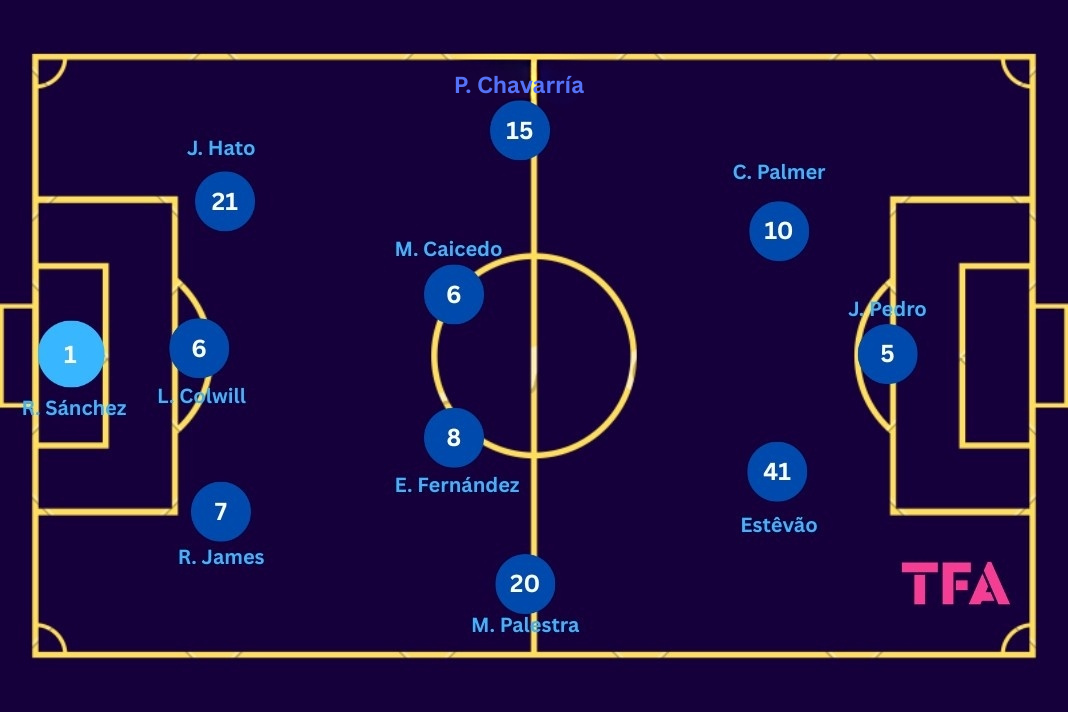
And what would make it even more useful is the fact that Chavarría will more likely be used in a 3-4-2-1 formation.
This formation allows Chavarría to showcase his attacking skills more often and have defensive security behind him in case of errors or inability to retreat on time.
Having a left centre-back behind Chavarría helps in creating the balance that Chelsea need.
At the same time, this does not mean that Chavarría will not have defensive duties.
On the contrary, Chavarría’s positioning will be crucial to helping the left centre-back in marking on the left flank and applying double marking whenever necessary to alleviate the opposing wingers’ threats.
This means that Chelsea can be much more solid at the back this coming season if everything goes as planned for Alonso, with both Chavarría and Marco Palestra retreating regularly to support actively in the defensive phase on both flanks.
Chelsea Predicted Starting XI 2026/2027
In addition to defensive roles, Chavarría will also be encouraged to provide crosses and key passes regularly from the left wing, as his quality in terms of passing can make the difference for the Blues.
Although he might not seem like a very dangerous player when looking at his penetrations, he actually is a player who knows how to avoid marking and reach his objective in a discreet but efficient way.
This can be more confusing for opposing defenders as they do not expect Chavarría to be the main source of danger within the team.
That makes Chavarría capable of creating surprises, especially through his intelligent and well-timed penetrations, one-two passes, and accelerations towards the byline, and more importantly, through his accurate crosses towards the box.
Alonso will certainly be exploiting Chavarría’s crossing traits and try to make them even more useful to the team by encouraging his early crosses and surprising cutbacks, as well as his crosses towards the centre of the box.
Furthermore, being able to guarantee accuracy even when crossing while accelerating is an asset that makes Chavarría more useful for crossing duties than any of the other players within the team for that specific left wing-back position.
Chavarría can also be encouraged to try shooting more often, given that he has a tendency to fire from distance and exploit second balls when possible.
He proved at Rayo Vallecano on numerous occasions that he can be extremely dangerous in this regard and has already scored many goals with powerful shots from range.
That’s an aspect that Alonso is surely aware of and will be pushing Chavarría to reproduce quite often.
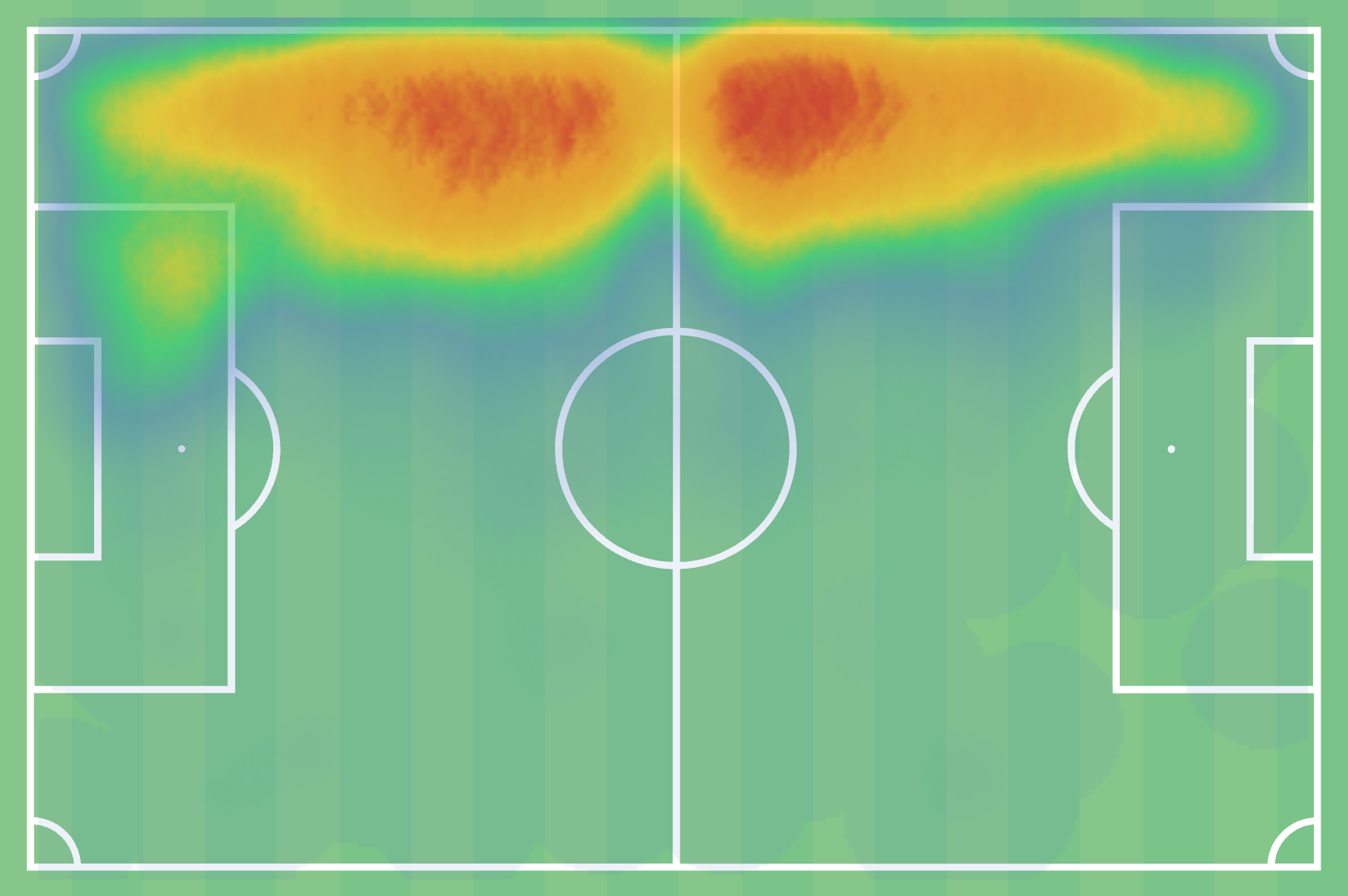
The following heat map highlights how balanced Chavarría’s movement and positioning are, with a presence inside his team’s own half and inside the opponent’s half at almost the same frequency.
Pep Chavarría Heat Map 2025/2026
Pep Chavarría Playmaking
Chavarría proposes a remarkable addition in terms of playmaking, as he has what it takes to replace Cucurella with a similar attacking input and with even more acceleration possibilities and threat.
Chavarría has the athletic assets needed to battle against most Premier League right-backs in duels, even against those who can run faster.
Chavarría’s experience enables him to perform well in offensive duels against complicated opponents and rely on his dribbling or one-two combinations to escape from marking when feeling that the opponent is quicker than him.
That said, Chavarría’s challenge will be to know how to cope with the physical intensity of the Premier League, its athletic requirements and quick transitions.
This means that Chavarría will have to carry on extra athletic work ahead of next season in order to be ready to endure the rhythm of Premier League games throughout the season.
Although this might create issues for Chavarría, especially at the start, being experienced enough in this position would help him to quickly adapt to this new style of play.
Furthermore, the 3-4-2-1 formation would help him have more freedom inside the opponent’s half and fewer obligations to retreat to his team’s third, with a defender covering for him in case he fails to get back on time.
Pep Chavarría Crossing
Chavarría’s crosses can be extremely dangerous and unexpected, as he usually alternates between early crosses and deliveries from near the byline to add diversity and an element of unpredictability.
This diversity of solutions includes cutbacks, key passes from the wing, crosses to the near post, crosses to the far post, or balls played into the middle of the box, which makes Chavarría’s wing actions complicated to predict or defend against.
The following assist example highlights Chavarría’s mastery of crosses and how he usually raises his head to spot potentially well-positioned teammates before crossing.
This is very important as many full-backs tend to cross without a real target/destination in mind, but just opt for crossing towards the box and let luck do its magic.
Being meticulous about crossing and knowing when to cross according to the situation he is in makes Chavarría’s crosses very dangerous to opponents, like in this goal action.
That’s why Alonso should encourage Chavarría to intensify his crosses at Chelsea, knowing that his number of crosses per match reached 3.67 last season.